
























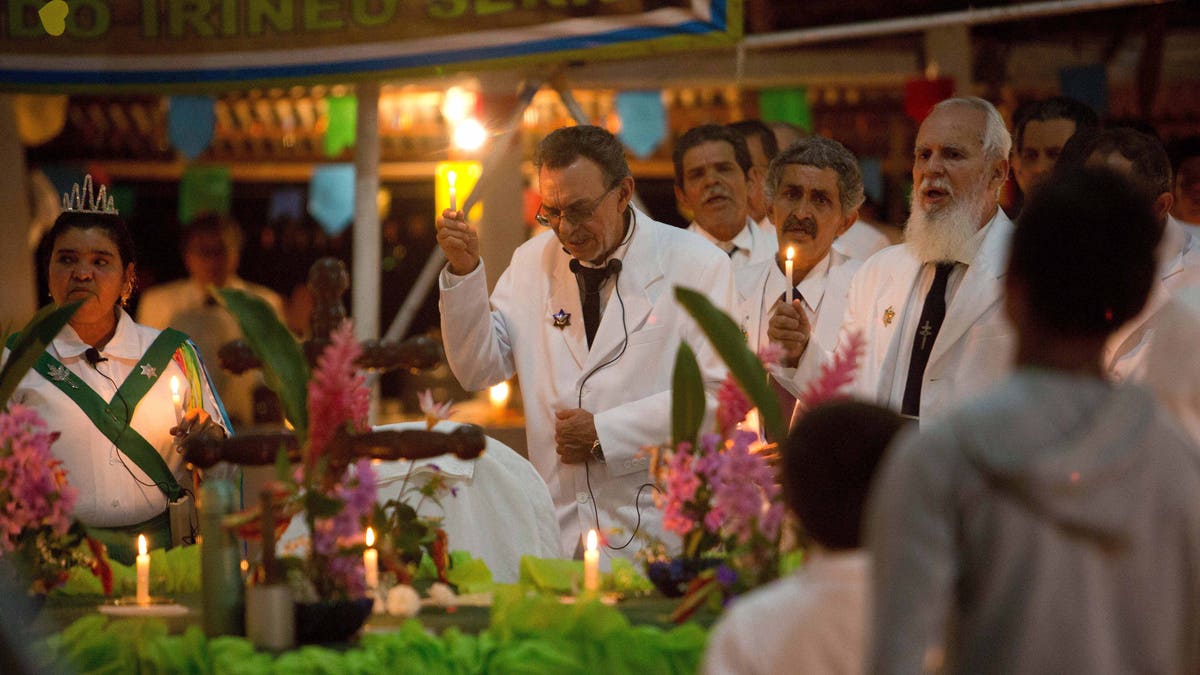
In this June 22, 2016 photo, Godfather Alfredo Gregorio, center, leads a religious service in the church of doctrine of the Holy Daime, in Ceu do Mapia, Amazonas state, Brazil. Alfredo Gregorio de Melo is son of the village founder, rubber tapper Sebastiao Mota de Melo, nicknamed Godfather Sebastiao. (AP Photo/Eraldo Peres) (Copyright 2016 The Associated Press. All rights reserved. This material may not be published, broadcast, rewritten or redistribu)
CEU DO MAPIA, Brazil (AP) – Canoes slide through a narrow river, dodging branches and trees for more than four hours to reach a tiny village deep in the Amazon jungle of western Brazil.
The community's culture revolves around an ancient psychedelic tea locals know as the Holy Daime. The Ayahuasca brew is sacred to Ceu do Mapia villagers, who use it in rituals that blend Indian beliefs with Roman Catholicism.
The Cult of the Holy Daime was started in 1930 by a descendant of slaves. It wasn't until the early 1980s that rubber tapper Sebastiao Mota de Melo, nicknamed Godfather Sebastiao, took hundreds of followers deeper into the forest to create a new village that would live by the doctrine of the Ayahuasca tea. People here believe the drink heals the body and expands the mind.
"There was nothing here. We had this cleansing ceremony with a candle and we built a house for everyone, for all the people who arrived first. We were all family," said Rita Gregorio de Melo, wife of Sebastiao and the village's matriarch.
Melo died in 1990, but his wife, who is now 91, still heads the sect with her two sons.
- Best pix of the week
- Despite risks, Americans flock to Amazon for Ayahuasca ritual and spiritual awakening
- Rio repeating World Cup mistakes, rushing at last-minute to finish Olympic projects
- At Hispanic Caucus gathering, new DNC chair apologizes for email leak
- Rio 2016: Once the pride of Brazil, men’s soccer team now inspires disillusionment
- Fears of terrorism and violence grow like lightning in Rio ahead of Olympics
- Terrorism experts cast doubt on Brazilian group’s pledge to ISIS on social media
- Drug gangs control illegal dumps near Rio’s Olympic sites, complicating clean-up efforts
Brewing the sacramental tea is a ritual in itself. Men chant to a steady rhythm, banging mallets on jungle vines called Jagube. In a giant pot, a man cooks the juice that comes out of the hammered vines and mixes it with a plant with hallucinogenic properties named Psychotria viridis.
The tea is used several times during religious ceremonies, but otherwise not usually more than weekly. While the hallucinogenic effects are usually moderate, drinkers say it helps facilitate spiritual connections.
On a recent evening, villagers gathered for a celebration. Women wore shiny white crowns on their heads, green sashes over their shoulders and green belts around their waists.
At the church, Alfredo Gregorio de Melo, son of the village founder and spiritual leader of Holy Daime, lit candles on a table shaped like the Star of David. Men and women lined up in two separate rows to drink the tea after making the sign of the cross. They then sang together prayers and psalms in a large circle.
"The Daime is everything to me. It saved me from death," said Luiz Lopes de Freitas, a village man. "I found a world that heals and teaches faith."
