




















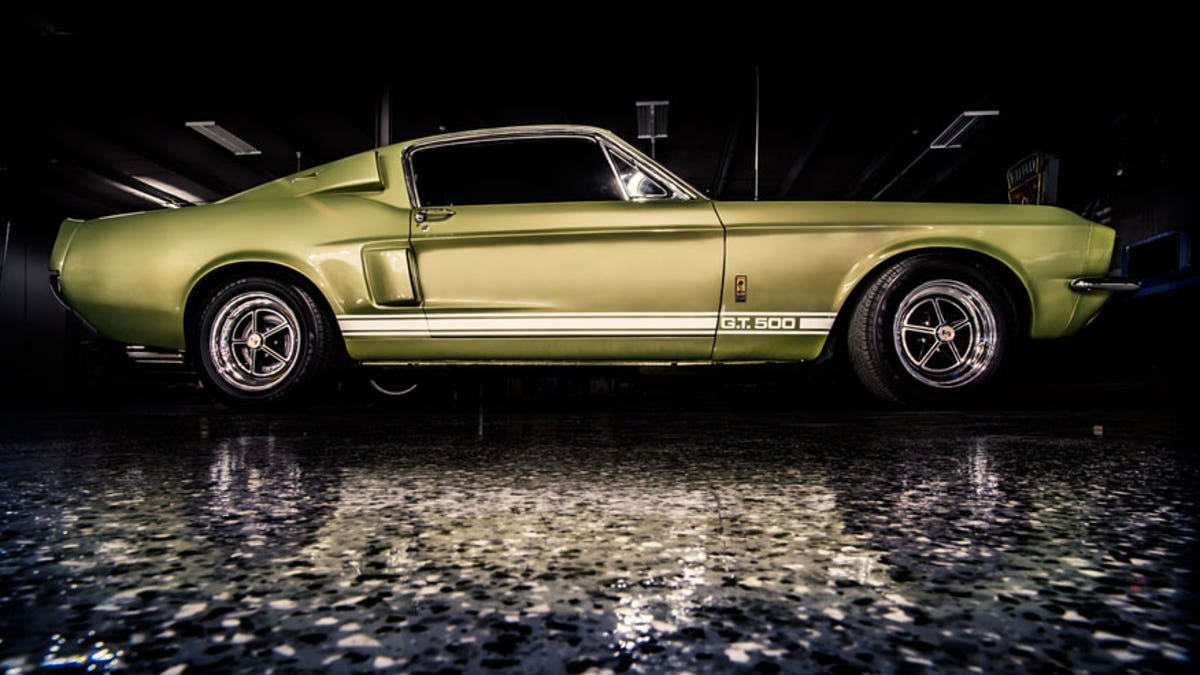
1967 Ford Mustang Shelby GT500 (Hagerty)
Like other groups that share a passion, Mustang enthusiasts have their own vocabulary. Here’s a small sample of the lexicon you may hear from other owners.
- Boss: The Boss 302 was introduced in 1969 to homologate the 302 cid Hi-Po engine for SCCA Trans-Am racing. The nameplate was revived in 2012.
- Boss 9: The Boss 429, or as enthusiasts say, “the Boss 9” was introduced in 1969 to homologate the 429-cid canted-valve engine for NASCAR racing.
- Cleveland V-8: In production in 1970-74, this 351-ci powerhouse was a high-performance engine in Ford’s stable. Its canted-valve cylinder heads were favored by performance enthusiasts.
- Cobra Jet: The Cobra Jet was a high-performance 428-cid Mustang engine introduced for 1968. Championed by car dealer Bob Tasca, it helped make Mustang competitive with other pony cars of the era.
- Detroit Locker: An automatic locking differential that delivers torque equally to both rear wheels in straight-line driving. It unlocks in turns. Note: Not to be confused with the foul-smelling cabinets in the area where the Detroit Lions dress for games.
- GT: Historically, it meant Gran Turismo in Italian or Grand Touring in English, although in Mustang-speak it’s a high-performance model designation that simply means good times. Retired in 1969, it reappeared in 1982.
- K-Code: Ordering a 1965-67 Mustang with a K-code 289-cid engine got you a 271-horsepower pony. To make sure everyone knew, you also got a “High Performance 289” badge on the fender.
- Mach 1: Another Mustang high-performance designation that signaled high velocities, it was a step above the GT and available from 1969 to 1978.
- Pony: 1. Yet another synonym for Mustang. 2. Pony cars are a class of sporty mid-sized cars inspired by the original Mustang. Camaro is a pony car, but it’s not a pony. A Shetland is a pony, but it’s not a car
- Shelby: 1. Shelby Mustangs are ultra high performance variants of the model, built by Carroll Shelby in 1965-68 and by Ford in later years. The first version produced 306 horsepower with a hopped up version of the K-Code 289-cid V-8. The 1966 version wasn’t branded Mustang; it was simply the Shelby GT 350. The 2016 Shelby GT generates 627 horsepower. Warning: Don’t get confused by the brand of chili marketed under the same name.
- SVO: The Mustang SVO was produced in limited numbers in 1984-86. Its turbocharged 2.3-liter four-cylinder developed 205 horsepower in its most potent form. Suspension mods made it an entertaining drive. Trivia alert: It’s also the code for Moscow’s Sheremetyevo International airport.
- T-5: The code name for the original Mustang development project. It was also the badge for the horse with no name — the German version of the Ford Mustang. (And it’s one version of a five-speed manual transmission.)
- T-56: Six-speed manual transmission originally manufactured by BorgWarner, now by Tremec.
- Toploader: The toploader was a Ford manual transmission that was introduced in 1964 and in use until 1973.
- Windsor V-8: Introduced in 1961, this moderate-performance V-8 engine was used in midsize and compact Ford cars until 1996. It had conventional inline-valve cylinder heads.
Click here for more classic car stories, or here to sign up for Hagerty's classic car newsletter
----------
Return of the Ford Mustang Shelby GT350
