






















Taste test puts invasive reptile on the menu in over-the-top pizza build
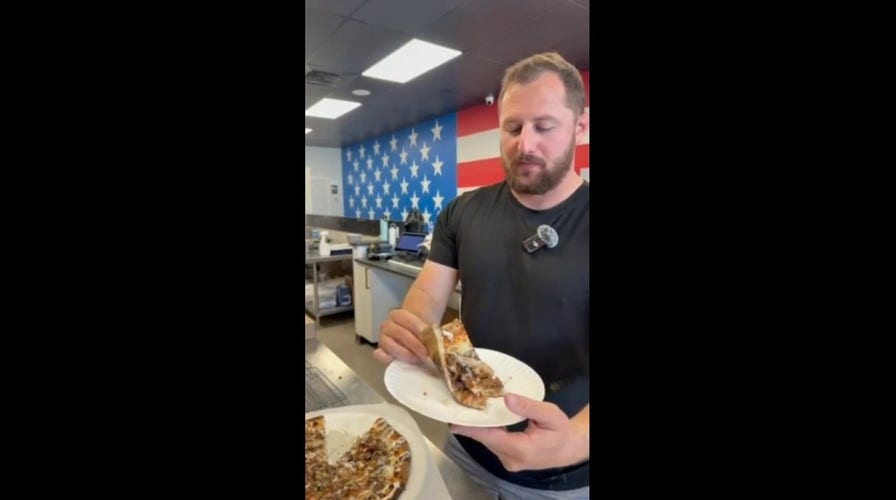
After a recent cold snap left iguanas stunned, a content creator headed to Bucks Coal Fired Pizza in Florida with a wild request as his friend and pizzeria owner made a pie topped with the invasive reptile meat.
Cavemen hunted turtles — but not for food, new research suggests.
Scientists say that shells of reptiles caught by children may have been used as ladles or digging devices by early humans over 100,000 years ago.
Careful cleaning of fragments found at the Neumark-Nord archaeological site in Germany indicates that pond turtle shells were used as small containers or scoop-like implements, news agency SWNS reported.
SCIENTISTS SHATTER TIMELINE OF HUMAN FIRE-MAKING WITH 400,000-YEAR-OLD DISCOVERY IN ENGLAND
An international research team examined pieces of turtle shell — dating back some 125,000 years — discovered at the dig in what is now the Saxony-Anhalt region of Germany.
Using methods including high-resolution 3D scanning, researchers found that many of the 92 fragments bear cut marks on their inner surfaces, indicating that the turtles were carefully butchered by Neanderthals — with limbs detached, internal organs removed and shells thoroughly cleaned.

Researchers believe the pond turtles were not used for food — as abundant high-yield prey meant there was likely a caloric surplus in the area. (iStock)
Study leader professor Sabine Gaudzinski-Windheuser said, "Our data provide the first evidence that Neanderthals hunted and processed turtles north of the Alps, beyond the Mediterranean region."
However, the team believe the turtles were not used as a food source.
CLICK HERE TO SIGN UP FOR OUR LIFESTYLE NEWSLETTER
Gaudzinski-Windheuser, of the Institute for Ancient Studies at Johannes Gutenberg University (JGU) in Mainz, said, "We can virtually rule this out, given the abundance of remains [of] large, high-yield prey animals at this site. There was in all likelihood a complete caloric surplus," as SWNS noted.
A total of more than 100,000 animal bones or bone fragments have already been recovered at Neumark-Nord, including numerous bones from deer, cattle and horses, as well as from the largest land mammals of the time — the European straight-tusked elephant, which could weigh more than 10 tons.
CLICK HERE FOR MORE LIFESTYLE STORIES
The research team reported last year that Neanderthals operated a kind of "factory" at the site, systematically extracting fat from the bones of large mammals.

"Pond turtles have a comparatively low nutritional value," weighing roughly 2.2 pounds, said the study's lead author. (iStock)
Gaudzinski-Windheuser said that "pond turtles have a comparatively low nutritional value," weighing roughly 2.2 pounds.
"However, they are relatively easy to catch and may therefore have been hunted by children. Their shells may then have been processed into tools."
TEST YOURSELF WITH OUR LATEST LIFESTYLE QUIZ
She said it was also possible they were hunted for their taste or for an assumed medicinal value — a suggestion supported by findings from studies of later Indigenous peoples.

"Our data provide the first evidence that Neanderthals hunted and processed turtles north of the Alps, beyond the Mediterranean region," said the study's lead author (not pictured). (iStock)
Gaudzinski-Windheuser added, "Our current results shed new light on the ecological flexibility and complex survival strategies of Neanderthals, which went far beyond simple caloric maximization."
CLICK HERE TO DOWNLOAD THE FOX NEWS APP
The new study was published in the journal Scientific Reports. It's the latest in a series of ongoing scientific analyses of material from the former open-cast lignite mine at Neumark-Nord.
