






















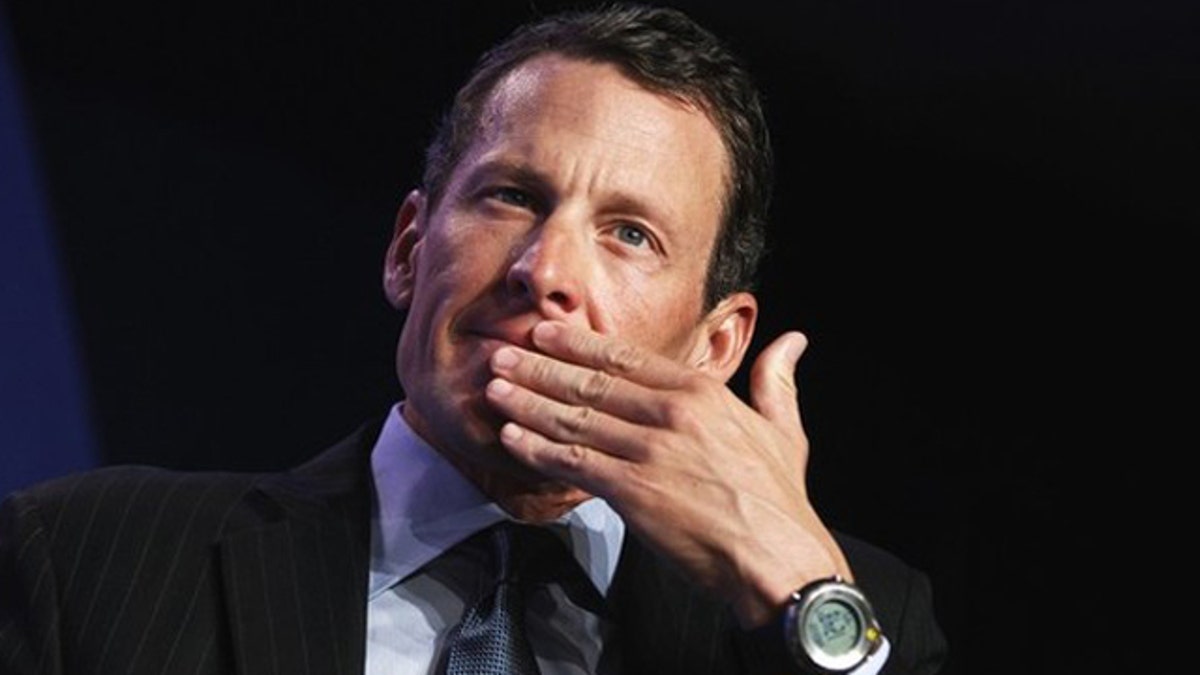
Sept. 22: Lance Armstrong, founder of the LIVESTRONG foundation, takes part in a special session regarding cancer in the developing world during the Clinton Global Initiative in New York. (Reuters)
PARIS -- U.S. investigators interviewed French anti-doping officials at Interpol headquarters Tuesday as part of a probe into allegations of drug use by cyclists including Lance Armstrong, a French official told The Associated Press.
The investigation shifted its focus to France, with an American delegation seeking information from police officials and the national anti-doping agency that has stored some of Armstrong's samples from the Tour de France.
Francoise Lasne, director of the AFLD agency's lab, and testing director Jean-Pierre Verdy were heard as witnesses Tuesday at Interpol, an official with knowledge of the meeting told the AP. The official spoke on condition of anonymity because he was not authorized to speak publicly on the case.
Interpol, the international police agency, is acting an intermediary between the U.S. and French officials.
The AFLD plans to share everything it knows with the Americans, another French official said. The official also spoke on condition of anonymity because he was not authorized to publicly discuss the meeting.
The official said he believes the American delegation is comprised of U.S. Food and Drug Administration Agent Jeff Novitzky, as well as U.S. federal prosecutor Doug Miller and U.S. Anti-Doping Agency CEO Travis Tygart.
French police officials whose job it is to investigate doping in sports in France are also meeting later this week with the Americans, a senior police official said Tuesday. That official spoke on condition that he not be named because he was not authorized to discuss the meeting publicly.
The meeting will also be in Lyon, the south-central city where Interpol is located, and was organized through the police agency, said the official. He said he expects the meeting would cover, among other matters, disgraced cyclist Floyd Landis' allegations that seven-time Tour champion Armstrong and members of his former U.S. Postal team systematically doped.
The police officials work for a French agency that, separately, has also been investigating syringes and transfusion equipment found after the 2009 Tour de France in a trash container that French officials say belonged to the Astana cycling team that included Armstrong and Tour winner Alberto Contador.
Novitzky was booked Tuesday into a hotel in Lyon. Miller had also been booked in at the same hotel but then canceled the reservation.
Miller couldn't immediately be reached for comment. His office voicemail and e-mail have messages saying he'll be out of the country from Monday to Thursday. Thom Mrozek, a spokesman for the U.S. attorney's office, declined comment.
Reached via e-mail, Tygart declined to comment. In a recorded phone message at USADA headquarters, Tygart said he was out of the office on business.
The World Anti-Doping Agency has "no particular information about this particular matter," spokesman Frederic Donze said.
One of the French officials said the AFLD would share "everything we know, everything we have, in the fridges, in the freezers, everything, everywhere" and is prepared to answer "everything that they ask."
The former head of the French agency, Pierre Bordry, previously promised to hand over Armstrong's samples from the 1999 Tour de France to Novitzky if the agent makes an official request. Bordry announced his resignation this September after battling with French authorities over the budget for the doping agency.
"The samples were clean when originally provided and tested. So we have nothing to be concerned about. Period," Mark Fabiani, an attorney for Armstrong, said in a statement sent to the AP on Tuesday.
One of the French officials, meanwhile, said he does not know whether U.S. investigators have formally requested the samples.
"They can't just take them with them. There's all the preparation that needs to be done before that happens," he said.
The French sports daily L'Equipe reported in 2005 that Armstrong's samples from 1999 contained traces of the banned performance-enhancer EPO after being retested in 2004.
An investigator mandated by cycling's international governing body later cleared Armstrong. The American, who retired in '05 before coming back for the '09 and '10 Tours, has repeatedly denied allegations that he took performance-enhancing drugs.
U.S. federal prosecutors have been taking a look at cheating in cycling for months, aided by Novitzky, who played a key role in the BALCO scandal that implicated athletes such as Barry Bonds and Marion Jones and opened a window into the methods used to dope.
Armstrong became a more important figure in the probe this spring after Landis, who was stripped of the 2006 Tour de France title after failing a doping test, dropped long-standing denials and acknowledged he used performance-enhancing drugs. In doing so, he accused Armstrong and others of systematic drug use.
