





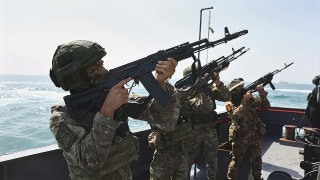









NEW YORK – NEW YORK (AP) — A U.S.-South Korean naval exercise in the Yellow Sea will soon be held as planned despite protests from China and North Korea, a top South Korean defense official said Thursday.
The naval exercise will go ahead "in the near future" though a U.S. aircraft carrier will only participate in the East Sea and not in the Yellow Sea near China's territorial waters, said South Korean Vice Defense Minister Chang Soo-man.
"I don't think that China will have a severe reaction, because China's major point was that there should be no U.S. ship" nearby, said Chang, the No. 2 official in the Ministry of National Defense.
China's Foreign Ministry repeated Thursday its objections to U.S.-South Korean naval exercises, saying they would threaten Chinese interests and unsettle an already tense region.
Chang said during a brief presentation and follow-up question-and-answer session that the "major purpose is to give threat to North Korea" as a response to the March deadly sinking of a South Korean warship. And he said North Korea has 30 to 40 kilograms (66 to 88 pounds) of weaponized plutonium. That would be enough for up to half a dozen or more bombs.
"North Korea may protest, but I don't think that will be a problem," he said. "Despite the provocation, the two Koreas are maintaining a minimum level of cooperation."
Chang said South Korea also "will soon have another anti-submarine naval exercise."
His talk, which he called an overview of South Korea's efforts at "stable management" of the latest crisis on the Korean Peninsula, said this was an "inappropriate time for sensitive changes in defense posture."
The reasons, his talk cited, were "senior leadership changes in 2012" — presidential elections in South Korea, the United States and Russia — along with expected major changes in Chinese leadership at its 18th National Congress of the Chinese Communist Party.
An international investigation in May concluded a North Korean submarine fired a torpedo that sank the 1,200-ton Cheonan near the tense Korean sea border, killing 46 South Korean sailors.
South Korea and the U.S. have called the sinking a violation of the armistice agreement that ended the Korean War in 1953, while Pyongyang denied responsibility and warned any punishment would trigger war.
"We are thinking (that it was) a North Korean submarine, not a big one, but a small one, 300 or 400 tons size," that fired upon the Cheonan, Chang said.
The U.N. Security Council approved a statement that condemned the sinking, but it stopped short of directly blaming North Korea. The U.N. Command, which oversees the armistice, separately investigated whether the sinking violated the truce, though the findings have not been disclosed.
