


















Recent developments in the transfer portal have college football drifting toward a potential doomsday scenario — and FOX Sports lead college football analyst Joel Klatt believes the sport’s leaders aren’t doing enough to avoid the icebergs.
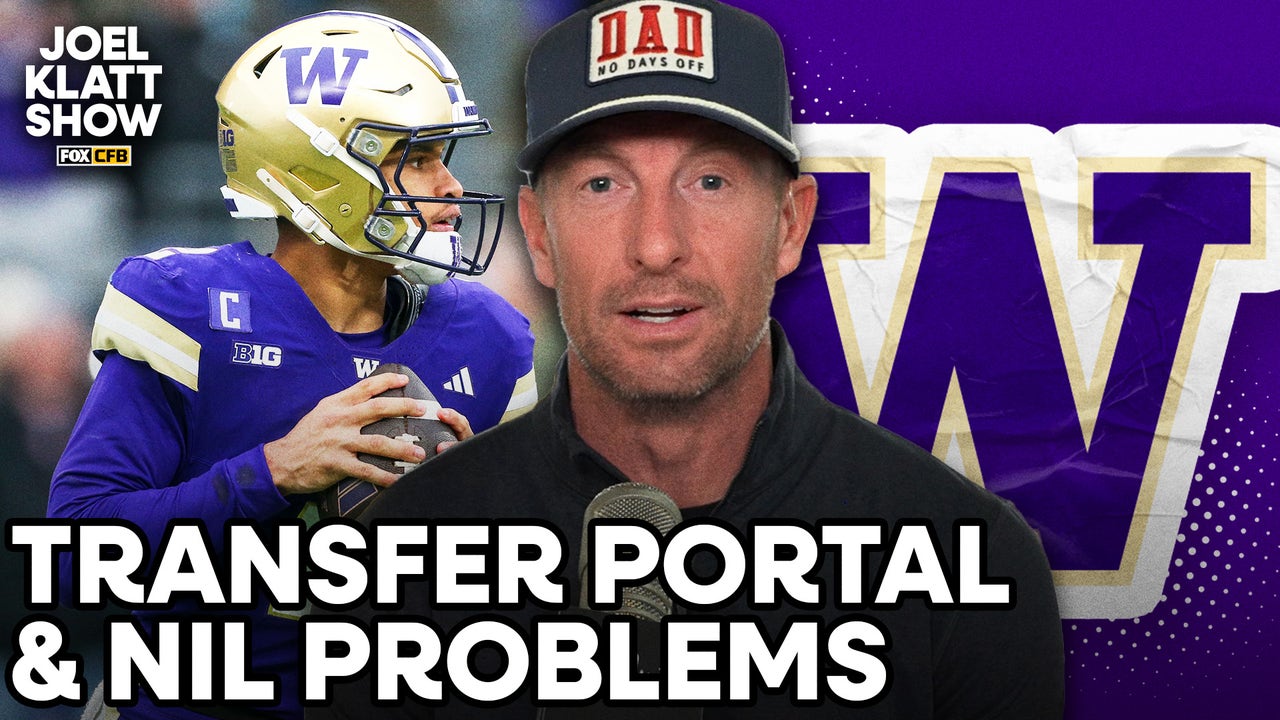
The situation with Washington quarterback Demond Williams Jr. headlined a chaotic first week of the transfer portal. He announced that he was entering the portal just days after signing a contract to remain at Washington before announcing that he was reversing his transfer decision and remaining with the Huskies.
But there was some other transfer news that alarmed Klatt. Wide receiver Quincy Porter, who was a five-star high school recruit, opted to transfer from Ohio State to Notre Dame after spending one year in Columbus. Jaime Ffrench fell into a similar boat, as the former highly-touted recruit transferred from Texas to Michigan.
Klatt wants someone "to have enough courage" to stand up and fight for change in the sport, proposing three changes he'd like to see made to the portal before it's too late.
"If we don't do this, I think it spells doom for college football, to be honest with you," Klatt said of his three-step proposal on the most recent episode of 'The Joel Klatt Show.' "There's going to be more player-program lawsuits, like I'm sure was threatened with Washington in the Demond Williams situation. High school recruiting is going to be hurt, because who's going to be investing in high school recruiting if that player's going to leave after a year?
"I think the biggest impact is we're going to just flat out lose coaches. Some of our best coaches in our sport, which the NFL always sniffs around, what keeps them from going to the National Football League if you're going to continue to put them into this structure that is totally wrong? And they can't succeed in. And there's no loyalty in. They've got to recruit every single player, every single year. Nobody wants that."


So, let's take a look at Klatt's three-step plan to revamp the transfer portal.
1. Make players employees and enforce a CBA
Before anything else is done to revamp college football, Klatt adamantly wants to see college football players become employees at their respective universities, which would pave the way to make more changes to the sport.
"I understand some people are vehemently against that, but that's actively what's happening. They are, and all we need to do is label them as such," Klatt said, referring to the shared revenue agreement student athletes have with their schools. "Once you do that, it opens up a world of possibilities, frameworks and structures in order to negotiate with the players as employees to get a framework that helps limit their movement and protect them as people.
"That's obvious. We need to do that. We need to get to a CBA — a collective bargaining agreement — but only once somebody has the brass to step in and have the fight and say, ‘These are employees, we’re paying them straight from our revenue stream. They're employees of the school and that's what they are.'"
If a CBA is agreed to between student-athletes and the schools, Klatt believes that would allow the sport to have multi-year contracts.
"A binding multi-year contract would be much better for the players and coaches in college football, and it's not even close," Klatt said. "If you had one-, two- and three-year contracts, then let's just say, for the sake of argument, a guy like Quincy Porter, who was one of the better wide receivers in the class last year, goes to Ohio State and he says, ‘I’ll sign with you, but I'm only willing to sign a one-year contract.' Then, maybe, Ohio State could look at him and say, ‘You know what? We’re only going to recruit you if you sign a two- or three-year contract. Then, they can part ways in the recruiting process."
The implementation of multi-year contracts would also allow for easier team-building and for fans to follow some of the top players around.
"Once you get to the next transfer portal window, you'd know who's available and who's not, just like free agency in the National Football League," Klatt said. "So, the players would know what seats are available with different programs and it's not just a total free-for-all."
On top of all of that, Klatt also believes a CBA would allow schools to require agents of student-athletes to become registered. That would have another positive side effect to the transfer portal, according to Klatt.
"Once you have registered third-party officials or agents, you could better enforce tampering rules," Klatt said.
2. End the CFP by Jan. 1 or Jan. 5
Klatt has long vouched for the college football season to end by either Jan. 1 or Jan. 5 at the absolute latest. Part of that is due to the fact that he'd like to see college football's biggest games not go head-to-head with the NFL.
"There are so many advantages in trying to complete this playoff and get this competition done before the first in January," Klatt said. "One of them is that you'd avoid the National Football League, so then you wouldn't have to have some of your marquee products on Thursday and Friday night. You don't have to avoid the National Football League and have your national championship game, which should be your tentpole event, and we play it on a Monday night randomly in January. Obviously, that's bad for the sport."
But Klatt's other reason for ending the college football season sooner is so there isn't as much time for teams to have to juggle two timelines. As it stands, the two teams that'll play in the national championship will have to spend at least a month splitting time between preparing for playoff games and building their team for the upcoming season.
In Klatt's proposed structure, teams would only have to juggle both duties for a few weeks, at most.
"We can compete, end and roster-build," Klatt said of his proposal. "That's probably the most important piece of the schedule."
3. Move transfer portal to March
Finally, Klatt would like to see the sport's lone transfer portal window move from early January to March as he believes "spring football is archaic."
"We can do spring workouts much better," Klatt said. "If you had the transfer portal in March, then in April you could finish the academic year, and in May you could start workouts with what I would call ‘OTAs’ — some of them padded, some of them not. By the way, you could have more than 15 [practices] because you wouldn't have to be in pads the whole time."
As it stands, spring football for most schools ends in April and players typically don't regroup with their teams until at least July. In this proposal, though, student-athletes would be able to complete their spring semester at their current school before having to make a decision about their football future while practicing closer to the start of the season.
Want great stories delivered right to your inbox? Create or log in to your FOX Sports account, and follow leagues, teams and players to receive a personalized newsletter daily!
