



















China’s AI growth is about ‘economic and political leverage,’ Rep Hinson says
Rep. Ashley Hinson, R-Iowa, discusses why the U.S. must lead in artificial intelligence development to counter China amid growing national security concerns on ‘Sunday Morning Futures.’
If you drive a hybrid or an electric vehicle (EV), fly on a modern jet, or expect American weapons to hit their targets, you owe thanks to a small group of elements known as heavy rare earths. For more than a decade, China has been the world’s near-sole supplier. Last year, Beijing shut that door to Western defense companies.
Here is my prediction: it is not going to reopen for any industry in the West.
Some Western leaders keep treating each new Chinese export restriction as a bargaining chip — leverage to be traded for the right concession at the right summit. That is the wrong way to read what is happening. China is methodically executing a long-term economic and military plan to stop shipping these materials abroad altogether. It intends to send us Chinese-made EVs, wind turbines and robots built with dysprosium and terbium — not the oxides themselves.
Who would blame them? Keeping the entire mine-to-magnet-to-manufacturer chain inside China preserves jobs and stability at every link. For the Chinese Communist Party, maximizing employment and minimizing internal dissent is Job No. 1. Denying Western militaries the inputs they would need in a fight over Taiwan, for example, is an added bonus to Beijing.
THE CCP CONTROLS THE MOST INTIMATE ELEMENTS OF OUR LIFE. MOST AMERICANS HAVE NO IDEA
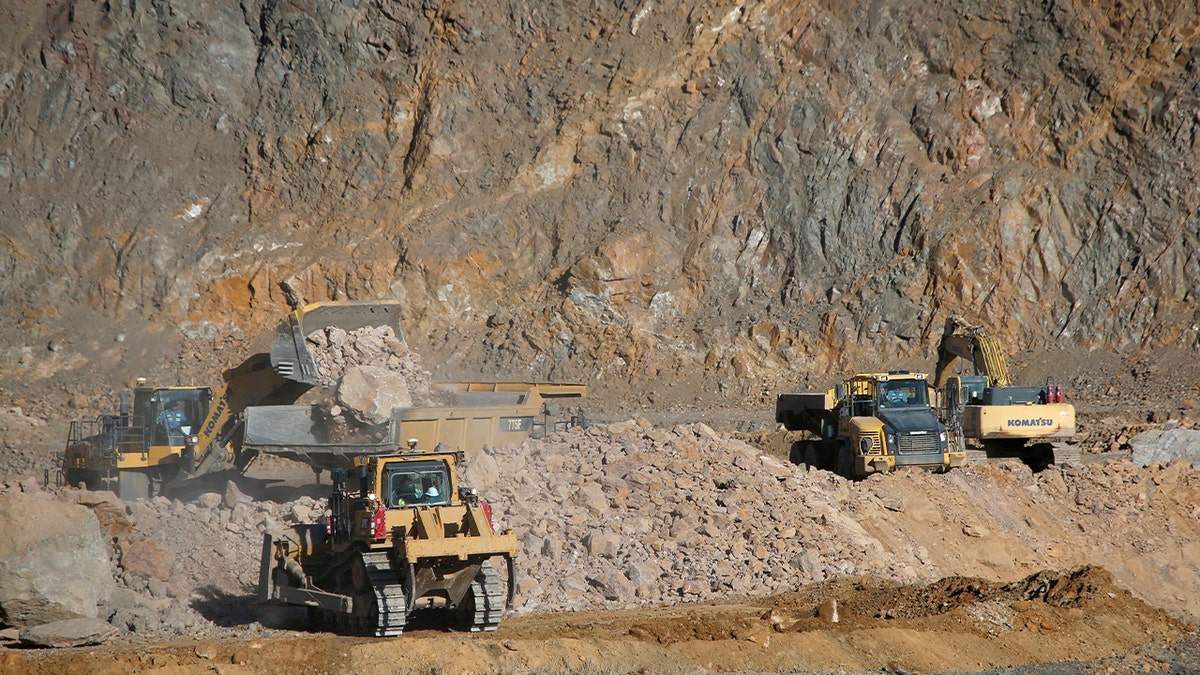
Wheel loaders fill trucks with ore at the MP Materials rare earth mine in Mountain Pass, Calif. Jan. 30, 2020. (Steve Marcus/Reuters)
The economic logic is the part Western policymakers need to internalize most. A kilogram of dysprosium shipped abroad as a powder earns China a few hundred dollars and employs a handful of miners. The same kilogram, tucked inside the motor of an electric car, helps roll a $40,000 vehicle off a Chinese assembly line.
It also employs millions of Chinese workers, from the mine to the smelter to the magnet plant to the auto factory. Multiply that across the seven million vehicles China will export this year, plus its wind turbines, drones, MRI machines and industrial robots, and the choice writes itself. Beijing said as much, out loud, in its Made in China 2025 blueprint: capture the full chain, from rock to robot.
Markets are responding rationally to that strategy. Earlier this month, dysprosium oxide sold in China for about $270 a kilogram. In Europe, the same material fetched $1,100 — more than four times as much. Terbium showed the same pattern: $1,145 per kilogram in China versus $4,250 in Europe. Last fall, Beijing quietly cut off terbium sales to private investors, so its own factories could get first call. That is not how an exporter behaves. That is how a country hoarding a scarce resource for itself behaves.
TEXAS RARE-EARTH PROJECT AIMS TO CURB US RELIANCE ON CHINA, STRENGTHEN NATIONAL SECURITY
The quiet truth is that China is running short of the heavy rare earths it once had in abundance. Despite holding roughly a third of the world’s total rare earth reserves, its deposits of the heavy varieties — the ones that make high-performance magnets work — have been thinning for more than a decade.

To cover the gap, China has been relying on imports from war-torn Myanmar, and even those mines are starting to fade. Every kilogram of dysprosium Beijing ships overseas comes from a shrinking pile.
The strategic stakes follow directly from the chemistry. A pinch of dysprosium or terbium, often less than 1% by weight, when alloyed into the permanent magnets that spin inside an EV motor, allows the magnets to withstand engine heat without losing strength. The same magnets steer cruise missiles, point fighter-jet radars and drive the silent propulsion in America’s submarines. Without these two elements, modern weapons and nearly every EV on the road either degrade or simply stop working.
CLICK HERE FOR MORE FOX NEWS OPINION
China is not weaponizing rare earths to punish the West. It is doing something colder and more durable: deciding that selling raw materials is bad business. The licensing rules, the extraterritorial reach and the on-again, off-again suspensions — these are not random skirmishes. They are the dial Beijing is slowly turning down on raw exports while it turns the other dial up on finished goods made from the same atoms.
Keeping the entire mine-to-magnet-to-manufacturer chain inside China preserves jobs and stability at every link.
President Donald Trump clearly sees where this is headed. His administration is working furiously to develop mine-to-manufacturer supply chains in the U.S., including the Pentagon's early investments in the domestic scandium supply chain. Europe must accelerate its efforts along the same lines.
CLICK HERE TO DOWNLOAD THE FOX NEWS APP
Any plan that assumes we will continue to receive Chinese heavy rare earths — even with a permit stamp — is built on a supply that basic economics says will shrink until it disappears. The Pentagon’s 2027 ban on Chinese magnets in American weapons systems and the surge of new mine-and-magnet projects on both sides of the Atlantic are not protectionism. They are a late but necessary admission that the world’s most important supply chain is being deliberately pulled out from under us.
The only question left is whether the West will build its own supply chains in time — or keep waiting for an opening that Beijing has every reason to keep shut.
