



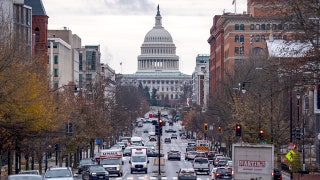



The U.S. Supreme Court may be inching toward striking down part of the Voting Rights Act after attorneys for a Texas community argued Wednesday that the law wrongly assumes some regions of the country persist in discriminatory tactics at the ballot box.
Civil rights leaders said any move to diminish the law would decimate the concept of equality at the polls.
Since its inception in 1965, the Voting Rights Act has been hailed as one of the most successful pieces of civil rights legislation in United States history.
But the latest battle is linked to a portion of the law that requires jurisdictions across 16 states to get "pre-clearance" from the Justice Department before they are allowed to alter their voting procedures in any way.
Congress extended Section 5 of the act for 25 years in 2006, but just eight days after the vote became law, a small utility district outside Austin, Texas, filed suit, saying that without any evidence of recent discrimination, forcing it to comply with Section 5 is unreasonable.
Attorneys for the Northwest Austin Municipal Utility District No. 1 said localities that can show they are free of discrimination should be able to bail out of Section 5 requirements. Since 1982, fewer than 20 jurisdictions have been permitted to do so.
Attorney Gregory Coleman, who represented the Texas district, told the court that the extension is an unconstitutional intrusion into the domain of state and local governments that have made substantial progress since the era of Jim Crow and government-sponsored discrimination.
Coleman said the country is vastly different than it was in 1965.
"I think there's a fundamental change in the fabric of America," he said, adding, "By and large, Americans want to do what's right."
But opposing counsel, Debo Adegbile, said the wrongs that Section 5 has remedied are not yet completely extinguished. "We've seen that discrimination takes root, grows back. The weeds are still there."
Justice David Souter expressed surprise that anyone who examined the record would argue that extension of Section 5 is unnecessary.
"I don't understand, with a record like that, how you can maintain as a basis for this suit that things have radically changed," Souter said. "They may be better, but to say that they have radically changed to the point that this becomes an unconstitutional Section 5 exercise within Congress' judgment just seems to me to deny the empirical reality."
Justice Ruth Bader Ginsburg referred to the "second-generation discrimination" that Congress was aiming to stop. "You start with the blatant overt discrimination, and then in time people recognize...that won't go any more, so the discrimination becomes more subtle, less easy to smoke out," Ginsburg said. "But it doesn't go from blatant overt discrimination to everything is equal."
However, several justices expressed dismay that the vast majority of the evidence Congress considered in renewing the section looked only at the states already covered under Section 5, and failed to investigate similar claims from the other 34 states.
Chief Justice John Roberts and Justice Samuel Alito noted that by some measures of racial disparity, states not required to submit election changes fare worse than those with a history of discrimination.
Justice Anthony Kennedy, likely to be the deciding vote in the case, expressed great skepticism.
"This is -- this is a great disparity in treatment, and the government of the United States is saying that our states must be treated differently. And you have a very substantial burden if you're going to make that case," Kennedy said.
"Democracy was a shambles" at the time the law was enacted, Kennedy said. "That's not true anymore."
The Supreme Court has upheld Section 5 four times, but if Wednesday's oral arguments are any indication, it appears the justices may be willing to narrow it for the very first time.
When Justice Department lawyer Neal Katyal pointed out that the high court has upheld previous extensions of the law, Justice Antonin Scalia dismissively replied, "A long time ago."
At another point, Roberts asked, "At what point does that history ... stop justifying action with respect to some jurisdictions?"
President Obama's election did not come up in court Wednesday, although both sides used it in their briefs.
Outside the court, more than 100 NAACP members wearing yellow rain slickers, jackets and hats sang and chanted while the justices were hearing the case inside.
Betty Johnson, 62, of Elkton, Md., said, "Just because we have an African-American president doesn't mean that people's voting rights can't be taken away."
Republicans controlled Congress and the White House in 2006. If the court strikes down a portion of the voting rights law, Democrats now in the majority are likely to write a new measure, although they could be restricted by what the court says, according to election law expert Richard Hasen, a professor at Loyola Law School in Los Angeles.
The justices also could find a way out of the case without ruling one way or the other on the constitutional issue. They could determine that the Northwest Austin Municipal Utility District No. 1 can opt out of the advance approval requirement, although a lower federal court found it could not.
For the only time this term, the justices made available audio recordings immediately after the arguments.
A decision should come by the end of June.
FOX News' Shannon Bream and The Associated Press contributed to this report.
