

















Barrett scolds Democrat for questioning her on specific cases
'I cannot answer that question,' Supreme Court nominee tells Sen. Richard Blumenthal during confirmation hearings.
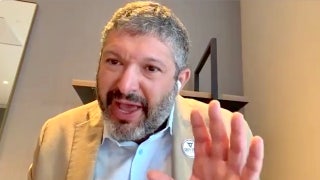
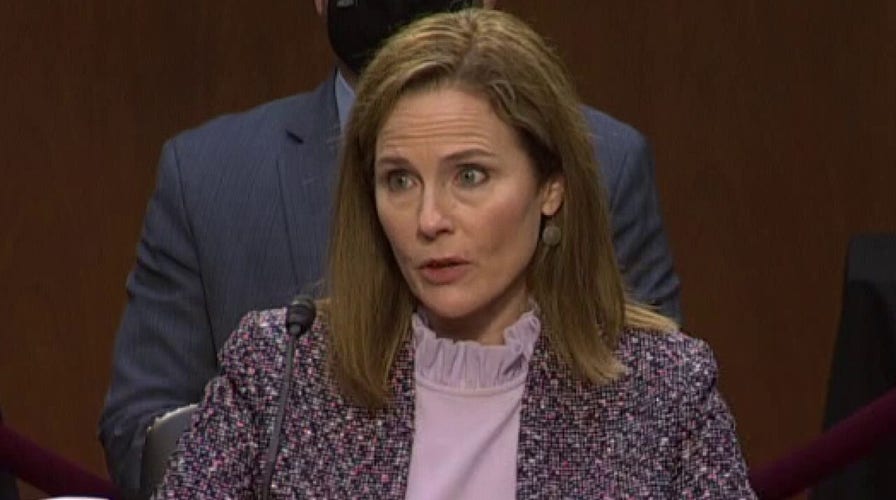
The conversation between Sen. Richard Blumenthal, D-Conn., and Judge Amy Coney Barrett seemed to be going smoothly on Wednesday, with the two sharing a laugh during her Supreme Court confirmation hearing, but that changed as they engaged in a tense back and forth where he pushed her to weigh in on landmark cases, despite her having said she would not do so.
It started when Blumenthal asked Barrett for her view of the decision in Griswold v. Connecticut, which protected the right of marital privacy by striking down a law that prohibited the use of contraceptives. While Barrett had repeatedly explained how, like others before her, she would not provide her stance on other decisions, Blumenthal persisted, claiming that Barrett’s answer could impact people’s lives.
GRAHAM REBUTS KAMALA HARRIS' ATTACK ON BARRETT'S CANDOR, AS DEMS CLASH WITH NOMINEE OVER OBAMACARE
“I want you to keep in mind how many people are listening and watching because they may take a message from what you say, they may see what you say and be deterred from using contraception or feel a fear that it could be banned."
“Well, Senator Blumenthal, the position that I’ve taken is whether a question is easy or hard, that I can’t offer an answer to it, and I would be surprised if people were afraid that birth control was about to be criminalized,” Barrett responded.
Blumenthal noted that other conservative jurists such as Chief Justice John Roberts and Justice Clarence Thomas had weighed in on Griswold during their hearings, agreeing with their outcomes.
“I’m stunned that you’re not willing to say an unequivocal yes that Griswold was correctly decided, I would have been in the majority,” Blumenthal said.
The senator then moved on to the landmark case of Lawrence v. Texas, which said that the state could not criminalize sexual activity involving gay and lesbian Americans.
“Was it correctly decided?” Blumenthal asked.
“Senator Blumenthal, I again, you know I’ve said throughout the hearing that I can’t grade precedent, in the words of Justice Kagan, give it a thumbs up or a thumbs down,” Barrett said.
“So you can’t give me a yes or no answer?” Blumenthal asked.
“Well, Senator Blumenthal, I can’t give a yes or a no, and my declining to give an answer doesn’t suggest disagreement or agreement,” Barrett said.
“I’m asking your legal position, judge,” Blumenthal pressed. “Not your moral position, not a policy position, not a religious faith position, a legal position. Correctly decided, Obergefell v. Hodges?” he asked about the case that recognized legal protection for same-sex marriage.
READ THE LIST OF WITNESSES WHO WILL TESTIFY AT THE AMY CONEY BARRETT HEARING
“Senator Blumenthal, every time you ask me a question about whether a case was correctly decided or not, I cannot answer that question because I cannot suggest agreement or disagreement with precedents of the Supreme Court,” Barrett explained. “All those precedents bind me now as a Seventh Circuit judge, and were I to be confirmed I would be responsible for applying the law of stare decisis to all of them.”
Blumenthal did not let the issue go, and asked Barrett how she would feel if she was a lesbian and heard a judge like her say she could not say whether the government could criminalize her relationship. Barrett rejected that approach, claiming that Blumenthal was implying that she was inclined to vote to overturn the Obergefell ruling, even though she does not “have any agenda” and has not expressed any position on the matter.
“You’re pushing me to try to violate the judicial canons of ethics to authorize advisory opinions and I won’t do that,” she said.
BARRETT, PRESSED BY DEMOCRATS ON FUTURE OF OBAMACARE IN HEARING, MAKES 'JENGA GAME' COMPARISON
Barrett had said during the hearing that the case of Brown v. Board of Education, which ended school segregation, was correctly decided, as was Loving v. Virginia, which protected interracial marriage. She explained that the reason why she was willing to give an answer regarding those cases is because she has already publicly spoken about her stance on Brown, and that the Loving decision stemmed from that one.
Earlier in their conversation, Blumenthal revisited a point of contention during Tuesday’s questioning, when he claimed, discussing Barrett’s stance on gun rights, that she herself “characterized it as kind of radical” in a dissenting opinion that she had written. When Barrett asked if she had called it radical in her opinion, Blumenthal responded, “I think you said, quote, ‘it sounds kind of radical to say felons can have firearms.’ That’s a direct quote.”
AMY CONEY BARRETT CONFIRMATION HEARING: CASES TO KNOW
The language in question was not from Barrett’s opinion, but from a discussion she had at Hillsdale College in 2019, in which Barrett said that her stance might seem radical, only to then explain her reasoning. When Fox News pointed this out to Blumenthal’s office, a spokesperson claimed that “Judge Barrett misunderstood him to be quoting from her dissent.”
On Wednesday, Blumenthal went on the record to clear the air.
“I want to ask you also, or clarify, the quote that I read to you was from a speech that you gave to the Hillsdale College, May 21, 2019, and it was, quote--about your opinion, dissenting opinion in Kanter--quote, ‘it sounds kind of radical to say that felons can have firearms,’ end quote,” Blumenthal said. “So I just want to clarify, that was the source of the quote that I read to you.”
CLICK HERE TO GET THE FOX NEWS APP
Barrett accepted Blumenthal’s statement, while pointing out that she had not characterized her own position as radical.
“Yes, it was in the course of explaining to the audience, saying it sounds kind of radical but then going on to explain why it wasn’t,” she said.
