








President Xi tried to act like the ‘boss,’ but instead showed China as ‘unstable’: Gordon Chang
Gordon Chang discusses President Donald Trump’s tariff threat against Canada over China trade ties.
As U.S. allies reopen trade and diplomatic channels with Beijing, critics warn that short-term economic relief is coming at the cost of deeper Chinese leverage — and weakening Washington’s ability to keep a united front against a strategic rival.
From Canada to Europe and Asia, U.S. allies are recalibrating economic ties with China as trade friction with Washington intensifies. Supporters frame the outreach as pragmatic and limited, but critics say it risks giving Beijing deeper access to Western industries.
Canada’s move has become the clearest illustration of the dilemma facing U.S. allies. After years of strained relations with Beijing, Prime Minister Mark Carney last week announced steps to reopen trade channels with China, including easing restrictions on Chinese electric vehicles in exchange for relief on Canadian agricultural exports.
"We don't know whether (Prime Minister) Mark Carney signed up that trade agreement because he genuinely believes Canada should align with China, or he's trying to create some leverage in discussions with President Trump," said Gordon Chang, a China analyst and author. "But in either case, it's not good for us."
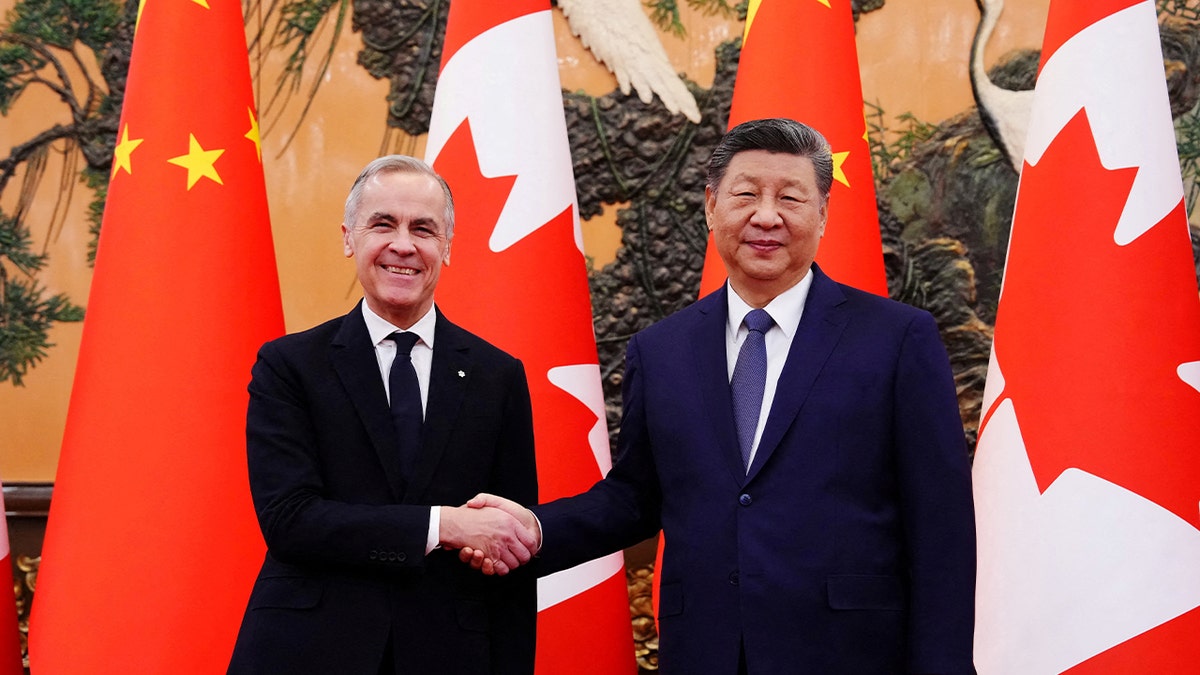
Canadian Prime Minister Mark Carney pictured meeting with Chinese President Xi Jinping in January 2026. (Sean Kilpatrick/Pool via Reuters)
EUROPEAN LEADERS WARN TRUMP TARIFFS OVER GREENLAND 'RISK A DANGEROUS DOWNWARD SPIRAL'
On Saturday, Trump threatened 100% tariffs on Canadian goods if the country "makes a deal" with China, escalating a war of words that has included Trump suggesting Canada should become the U.S.’s 51st state.
Canada is not alone. Similar recalculations are underway across Europe and Asia as other U.S. allies weigh economic pressure against long-term strategic risk.
In Britain, Prime Minister Keir Starmer is traveling to Beijing this week — the first visit by a U.K. leader in eight years — as London seeks to stabilize trade ties with China after years of tension over Hong Kong, espionage concerns and Chinese investment in critical infrastructure. British officials have framed the trip as narrowly economic, but critics warn it signals a broader willingness to compartmentalize security concerns in pursuit of market access.
"Like it or not, China matters for the U.K.," Starmer said on the visit, adding it had been "far too long" since a British prime minister visited Beijing.
Across continental Europe, leaders have taken a more cautious but still notable approach. Germany’s new chancellor, Friedrich Merz, is expected to visit China in February, while Finland’s prime minister already has met with Chinese officials in Beijing.
President Donald Trump is also expected to travel to China in April.
In Asia, South Korea has gone further rhetorically.
President Lee Jae-myung recently called for a "full-scale restoration" of ties with China, underscoring Seoul’s dependence on Chinese trade even as it deepens security cooperation with the United States and Japan.
Trade analysts say these moves reflect economic reality more than geopolitical realignment.
Chad Bown, senior fellow at the Peterson Institute for International Economics, said smaller and mid-sized economies facing trade barriers with the United States are under pressure to find alternative markets.
"If they’re no longer allowed to sell to the U.S. market, they have to sell somewhere else," Bown said. "And the other major large economy out there is China."
"Allies are clearly deepening commercial ties with Beijing — but this isn’t choosing China over America," Hart said. "It’s hedging, keeping options open while Washington proves unpredictable," said Adam Irwin, managing partner of strategic insights at the financial investment firm Heligan Group.
"But when allies diversify trade toward Beijing, their willingness to absorb economic pain in a future crisis diminishes — and that weakens America’s ability to coordinate on issues like export controls, sanctions, and Taiwan."
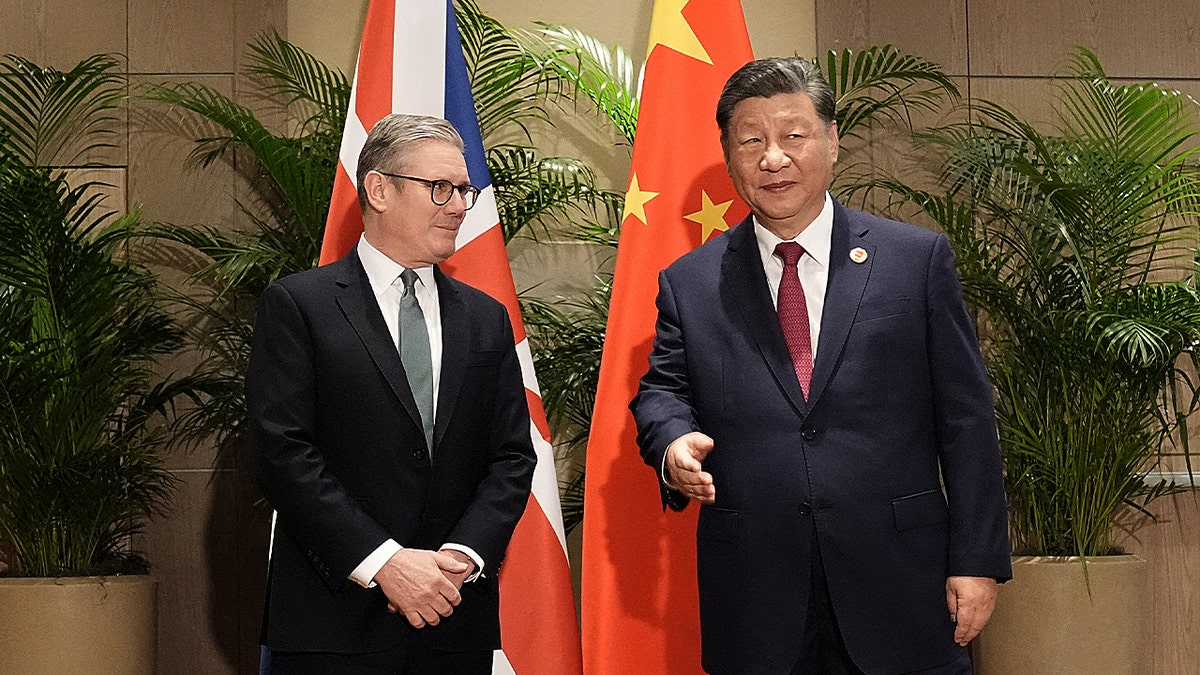
U.K. Prime Minister is in China meeting with Xi Jinping. (Stefan Rousseau/Pool via Reuters)
TREY GOWDY: CHINA IS MISJUDGING TRUMP ON TRADE. IT MAY SOON BE VERY SURPRISED
Critics argue that the renewed outreach to Beijing overlooks how closely Chinese companies are tied to the Chinese Communist Party — and how difficult it can be to unwind economic exposure once it takes hold.
Nazak Nikakhtar, a former Trump administration official and China policy expert, said Western governments have repeatedly underestimated the degree of control Beijing exercises over ostensibly private firms.
"What business leaders and government leaders fail to fully acknowledge is that they assume Chinese companies are acting autonomously — and that’s just not the case," Nikakhtar said.
She warned that Chinese investment and trade often follow a familiar pattern: targeting commodity sectors and lower-value industries first, generating revenue that is then used to move up the value chain and undercut foreign competitors.
"If you get control of the commodity factor, that’s where the revenue is to invest in next-generation technologies," she said.
Nikakhtar said the risk is not just overseas dumping, but what happens when Chinese firms establish a presence inside Western economies. Once that happens, she said, governments lose key policy tools.
She pointed to past cases where Chinese firms acquired Western companies not to grow them, but to extract technology and eliminate competitors. In one instance, she said, a Chinese company acquired the U.S.-based Segway manufacturer, later acknowledging it was interested in the self-balancing technology rather than the product itself.
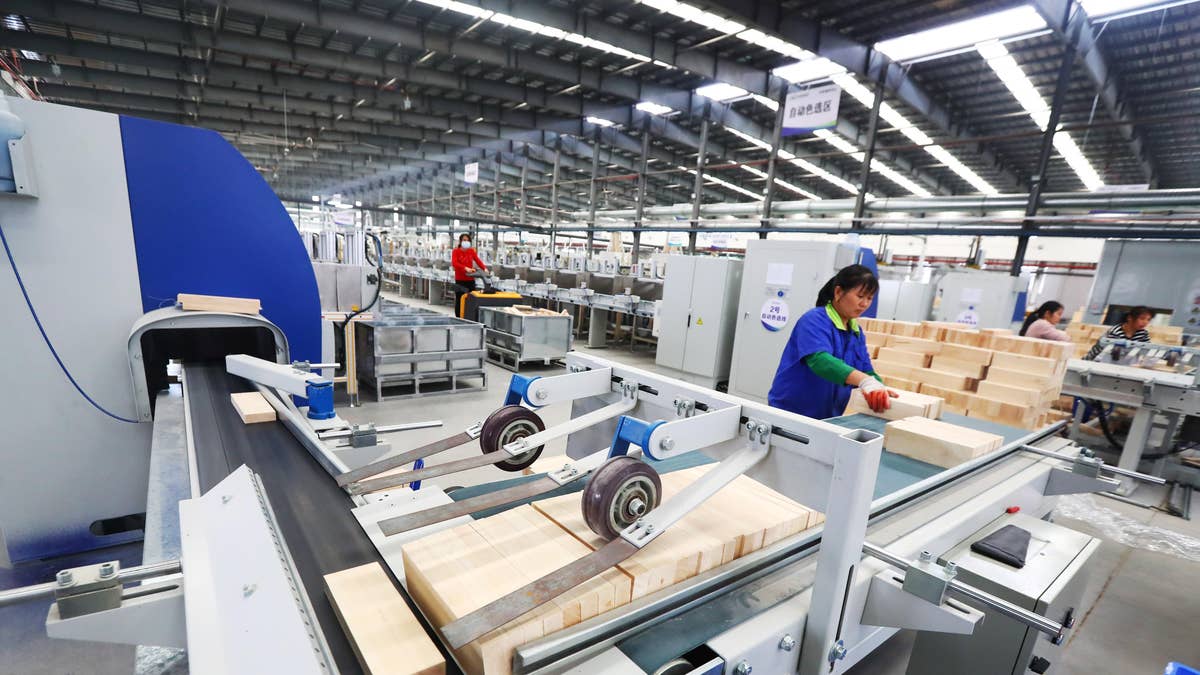
Nikakhtar said the risk is not just overseas dumping, but what happens when Chinese firms establish a presence inside Western economies. (Liu Zhankun/China News Service via Getty Images)
"It’s almost like leaving the doors unlocked and wondering how the burglars got in," Nikakhtar said, arguing that both the United States and its allies have failed to put sufficient safeguards in place to prevent predatory foreign investment.
Others warn the consequences of allies’ outreach to China extend beyond trade, shaping global perceptions of U.S. leadership at a moment when Beijing is actively pushing a narrative of Western decline.
CLICK HERE TO DOWNLOAD THE FOX NEWS APP
Chang said the steady stream of Western leaders traveling to Beijing risks reinforcing that message.
"The images and the pictures of all of these Western leaders bowing down to Xi Jinping doesn’t help us," Chang said, arguing that China increasingly uses trade and diplomacy as tools of information warfare.
Chang warned that uncertainty around U.S. trade policy has made it easier for Beijing to present itself as a predictable alternative, even as China restricts imports and relies on one-way trade.
"We need to become predictable," he said, adding that allies’ outreach to Beijing complicates Washington’s ability to maintain a united front.
