Supreme Court justices make rare Capitol Hill appearance to push $230M security budget
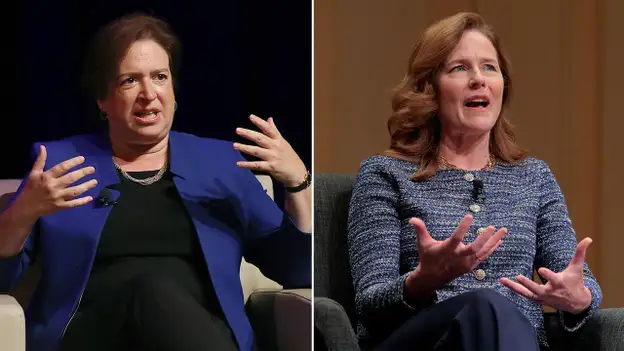
Supreme Court Justices Amy Coney Barrett and Elena Kagan are set to testify before House and Senate appropriators – a first since 2019 – as the high court seeks a 10% increase for its $230 million budget, including $14 million for "protective activities for justices' residences and families."
Coverage for this event has ended.
Kagan warns Supreme Court threats have come ‘very close indeed’ amid 38% surge
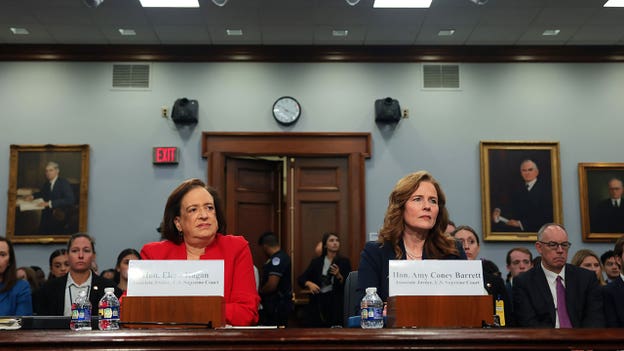
Supreme Court Justice Elena Kagan warned Tuesday that threats against members of the high court have come “very close indeed,” as she and Justice Amy Coney Barrett pressed senators for additional security funding.
“The Supreme Court police expect a smaller but still substantial 38% annual increase in threats this year, which follows a 25% increase last year,” Kagan told the Senate Appropriations Subcommittee on Financial Services and General Government.
“For some of us, those threats have come very close indeed,” she continued. “And all of us live with the knowledge that they may again materialize.”
Kagan said the court’s recent budget growth has been driven almost entirely by security needs, including larger personal details, residential protection, threat assessments and cybersecurity.
Despite the heightened danger, Kagan said the justices continue deciding cases “without fear or favor.”
FLASHBACK: Video surfaces of protesters targeting Kavanaugh's home hours after assassination plot
As Supreme Court Justices Amy Coney Barrett and Elena Kagan warned Congress on Tuesday about escalating threats against the judiciary, Fox News Digital’s exclusive video from June 8, 2022, shows protesters marching outside Justice Brett Kavanaugh’s home just hours after authorities foiled an alleged assassination plot targeting the justice.
The video captured demonstrators and a drumline outside Kavanaugh’s Maryland residence later that day, despite the overnight arrest of an armed California man accused of traveling to the justice’s home with the intent to kill him.
During Tuesday’s hearing, Kagan said threats against the justices have “come very close indeed,” while Barrett recounted recent threats against her own family as the court requested additional funding to expand security protections.
Kagan says Supreme Court cybersecurity once centered on supporting BlackBerry devices
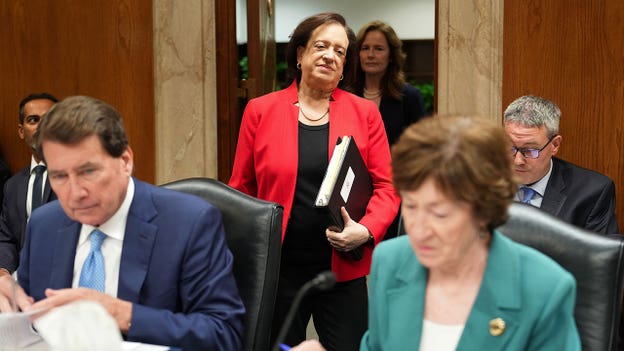
Supreme Court Justice Elena Kagan said Tuesday that when she joined the high court in 2010, the court’s cybersecurity operation was far different than it is today.
“I first joined the court in 2010. Our security was very different at that time,” Kagan told senators while defending the court’s fiscal 2027 budget request.
“The Supreme Court police focused almost exclusively on protecting the building. And as for cybersecurity, well, our IT department focused on supporting the latest BlackBerry devices,” she said.
Kagan said the court began expanding its security program in 2017 at Congress’ urging, adding personal security details for associate justices, increasing residential protection, strengthening physical security systems and requesting additional cybersecurity resources as “online attacks grew in number and sophistication.”
“Our strategy has been consistent: expand incrementally but effectively to meet evolving security challenges,” Kagan said.
Kagan says Supreme Court justices receive less protection than some Cabinet officials
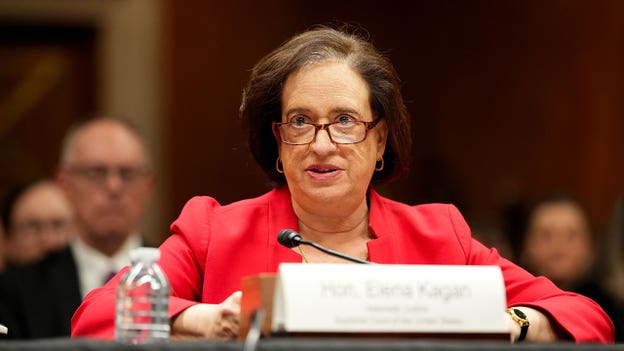
Supreme Court Justice Elena Kagan said Tuesday that members of the high court currently receive less security than some Cabinet officials as the court seeks additional funding to expand protection for the justices.
Kagan testified before the Senate Appropriations Committee along with Justice Amy Coney Barrett, who said justices’ security details currently range from four to eight personnel, including residential security, and are stretched by around-the-clock coverage.
“I do think it’s not feasible to manage this round-the-clock kind of protection with a detail of four to eight people,” Barrett said.
Kagan said the court’s goal is to increase personal details to about 12 officers per justice to reduce overtime and burnout while providing what security experts consider an appropriate level of protection.
“Sometimes you go someplace to an event … that there will be Cabinet members at, and I drive up in my one car and there are five cars outside for a single Cabinet member,” Kagan said. “So even now, I think that we have less protection than some.”
Kagan said the court is not seeking Secret Service-level protection, but “the level of protection that we think will make us secure.”
Barrett says some threats against justices appear intended to influence court decisions
Supreme Court Justice Amy Coney Barrett said Tuesday that some threats against justices appear designed to intimidate the court and influence its rulings.
Asked by Sen. Jon Husted, R-Ohio, whether the threats are intended to change justices’ decisions, Barrett said, “It’s hard to say how some of them are not designed to do precisely that.”
“I think they’re designed to intimidate or designed maybe to punish after decisions that the person sending the threat didn’t like as a warning not to do it in the future,” Barrett said.
She pointed specifically to anonymous threatening packages sent in the name of the late son of U.S. District Judge Esther Salas.
“It’s hard to interpret, particularly those anonymous deliveries that are sent in the name of Judge Salas’ murdered son, as anything other than an attempt to intimidate and influence decisions,” Barrett said.
Earlier in the exchange, Justice Elena Kagan said the court’s understanding is that most threats come from “more lone actors,” while Barrett said some information about the sources of threats would be more appropriate for a classified briefing.
Kagan says Supreme Court police force may take years to fully staff
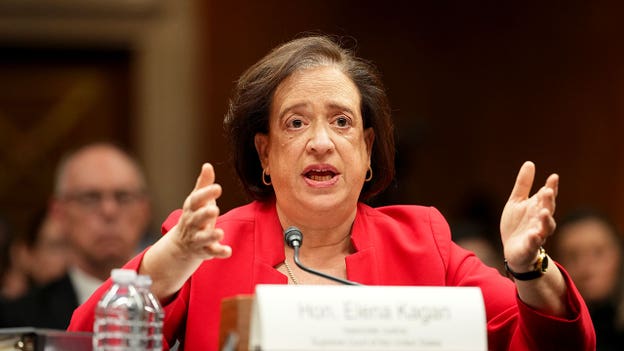
Supreme Court Justice Elena Kagan said Tuesday it could take years for the court’s police force to reach full staffing as it expands security amid rising threats against justices.
Testifying before the Senate Appropriations Committee, Kagan said the court’s goal is to staff 477 Supreme Court police officers.
“If we include people we get through contracting, we can probably do it within a couple of years,” Kagan said. “But in order to have our own employees get up to that mark, then we’re probably talking more like six years — into the 2030s.”
Asked by Sen. Patty Murray, D-Wash., about training for the expanded force, Kagan said she was confident the court had “good” training programs in place but said officials would provide lawmakers with additional details later.
Kagan says Supreme Court leaks endanger justices, undermine trust inside court
Supreme Court Justice Elena Kagan said Tuesday that leaks of confidential court deliberations pose security risks for justices and threaten the trust needed for the court to function.
Asked by Sen. Bill Hagerty, R-Tenn., about leaks including the 2022 draft Dobbs opinion and more recent disclosures, Kagan said they are unacceptable.
“They’re not,” Kagan said. “It dramatically increases security risks. It also dramatically changes the way we do our business internally, or at least has the potential to do so.”
Kagan said the court depends on candid discussions among the nine justices and their staffs.“The way we relate to each other depends so much on honest communication among the nine of us,” she said. “If the nine of us don’t have trust in one another and don’t have trust in … all the people who work for us, then those kinds of honest conversations that we need to do our business are not going to take place, or they’re at least going to be frustrated.”
Kagan added that the leaks have frustrated “every single one of the justices” because of both the security implications and the effect on the court’s internal deliberations.
Barrett, Kagan arrive for Senate hearing, ignore shouted questions
Justices Amy Coney Barrett and Elena Kagan arrived at the Senate hearing room Tuesday afternoon ahead of their scheduled 2 p.m. testimony on the Supreme Court’s budget request.
The justices did not answer shouted questions from reporters as they entered the room.
The Senate appearance marks the justices’ second round of Capitol Hill testimony Tuesday as the court presses lawmakers for funding, including security resources, amid rising threats against members of the federal judiciary.
Kagan delivered a heart-felt salute to late Sen. Lindsey Graham before the House committee, but another salute should be expected before the Senate committee.
Fox News' James Levinson contributed to this report.
Kagan: Ethics code lacks 'enforcement mechanism'; Barrett warns of 'complexity'
The Supreme Court would be “better off” with an enforcement mechanism for its ethics code, according to Justice Elena Kagan.
"I think that we would be better off with an enforcement mechanism," Kagan told Tuesday's House appropriators hearing, noting "it's not to say I think that my colleagues are taking this code incredibly seriously" or "making every effort – and I think successful efforts – to live by it."
But an enforcement mechanism for the Supreme Court can help bolster "public confidence," according to Kagan.
"Not every accusation, not every charge has anything to it," but it could "make clear: this is off base; this is wrong; there's nothing here."
But "are real complexities about how that would be done" and "it's really important that it come from the judiciary itself," Kagan added.
Justice Amy Coney Barrett said she is “fully committed” to the code, as she said all the justices are, but was less certain about creating a formal enforcement body.
“I’m less certain,” she said of the need for "an enforcement mechanism" – which would “without question” have to come from within the judiciary.
“There’s just a lot of complexity,” Barrett concluded.
Justice home security shifted from US Marshals to its own Supreme Court Police force
Supreme Court justice Cabinet-level personal security detail needs have grown in the past decade and has stressed the U.S. Marshalls Service.
"The Supreme Court's funding needs have grown on average, 15% per year," Justice Elena Kagan noted in a House appropriators hearing Tuesday. "Aside from annual inflationary increases, recent growth in the court's budget has been almost entire, entirely for security expenses.
"The majority of last year's funding increase went to shifting the responsibility for residential security of the justices from the Marshall Service to the Supreme Court police."
Private security is a new thing, and due to radicals' violent threats on the justices.
"When I first joined the court in 2010, our security was very different at the time: The Supreme Court Police focused almost exclusively on protecting the building, and our IT department focused on supporting the latest BlackBerry devices," she said.
"I didn't have a security team of my own, and I was accompanied by security personnel only when I participated in work related public events.
"We began expanding our security program in earnest in 2017, initially at the behest of members of Congress. We engaged government and private industry experts to evaluate our needs on an ongoing basis.
"We started by expanding personal security beyond the Chief Justice, so that associate justices also received small security details – much too small, as it turned out, as threat assessments called for larger details and as overtime costs correspondingly rose.
"We requested funding for more officers, vehicles and support staff. As events at the Capitol and other federal courthouses revealed our buildings vulnerabilities, we also added new physical security systems. When personal threats increased following the Dobbs leak, we expanded our residential security and threat assessment activities."
Justice Barrett says she now needs personal security detail: 'I wish it weren't so'
The radicalization of violent activists against the Supreme Court justices is now necessitating private security details, according to Justice Amy Coney Barrett on Tuesday.
"I wish it weren't so, but it's necessary for protection and daily activities to have a security detail," she told the House appropriators during a hearing to call for nearly a $230 million Supreme Court budget, a 10% increase that bolsters private home security by $14 million.
She said "the threats are constant and they're always there."
She pointed top "burnout and exhaustion" for Cabinet-level detail.
"It's just a lot of hours" to cover, she said.
Supreme Court justices now receive Cabinet-level security details handled by the Supreme Court Police, while the U.S. Marshals Service helps protect the justices outside the capital and during travel.
The expanded posture reflects a sharp rise in threats against the judiciary, including the 2022 attempted assassination of Justice Brett Kavanaugh. Security has also been extended to justices’ homes and immediate family members under the 2022 Supreme Court Police Parity Act, marking a significant blostering in how the court protects its members.
Justice Elena Kagan added "it's easier living life without security than living life with security."
"We started, slowly, incrementally, carefully making sure that we balanced all the necessary factors," she said. "Then, of course, the Dobbs leak happened, and that really increased the urgency of the entire thing.
"But we've been working on this now for about a decade. And actually, I think, are grateful to Congress for coming to us and saying, you have to up your game in this area."
Justice Kagan remembers exchange with Graham where 'confirmation was sealed'
Justice Elena Kagan paid tribute to the late Sen. Lindsey Graham with a pointed reminder of what his support meant: He "sealed" my confirmation.
Speaking on behalf of the Supreme Court, Kagan offered condolences to Graham’s family, friends and colleagues, then turned personal.
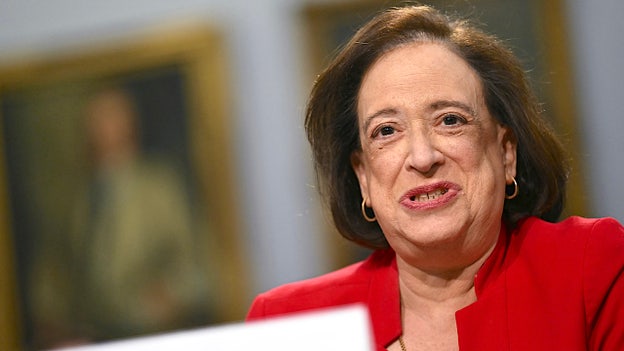
Graham, a South Carolina Republican, was one of five GOP senators who voted to confirm Kagan to the Supreme Court in 2010, when the Senate approved her nomination 63-37.
“I didn’t get many Republican votes when I was confirmed to the Supreme Court,” she remembered.
But Graham did more than cast a vote, she said.
“Somehow Sen. Graham made me look funny,” Kagan said, adding many people later told her that moment “was the moment my confirmation was sealed.”
“I want to express my gratitude toward him, not only for his support, but for approaching the confirmation process with the kind of seriousness that he did,” she said.
GOP Rep. David Joyce: '1,000 serious threats against federal justices' in past 5 years
Threats against the federal judiciary have surged since a Supreme Court justice last appeared before the House Appropriations Committee in 2019, Rep. David Joyce, R-Ohio, warned Tuesday.
“A great deal has changed over the last seven years,” Joyce, who chairs the appropriations subcommittee overseeing the judiciary, told the House appropriators hearing Tuesday, citing Chief Justice John Roberts’ 2024 year-end report.
"Chief Justice Roberts himself wrote in his 2024 year-end report that he was troubled by the U.S. Marshals Service data showing that hostile threats and communications toward judges had more than tripled over the preceding decade, and the marshals had investigated more than 1000 serious threats against federal justices in just the last five years."
Joyce warned about "bad actors" fomenting violence against the judiciary.
“New technologies have become accessible for bad actors," Joyce warned. "The threat environment facing our federal judiciary, including the Supreme Court, has evolved substantially."
House Speaker Mike Johnson warns DSA court-packing push is ‘not a game’
The open Democratic Socialists of America push for a radical governing agenda, and openly seeking to “pack the Supreme Court” is a warning for voters, House Speaker Mike Johnson warned Tuesday.
“They want to pack the Supreme Court and they want a unicameral legislature,” Johnson said at Tuesday's House GOP leadership news conference.
The DSA platform shows the left is saying “the quiet things out loud,” Johnson added, pointing to proposals aimed at weakening the Supreme Court, expanding the House and moving toward a single federal legislature.
The DSA program calls for limiting the Supreme Court’s power of judicial review and says its goal includes a new constitution based on proportional representation in “a single federal legislature.”
Johnson said the stakes go beyond institutional reform, arguing that a new crop of socialist candidates — whom he called “Mini Mamdanis” — would push policies on borders, policing and prisons that he said would endanger American families.
“This is not a game,” Johnson warned House GOP leaders. “There is far more beneath those promises.”
“Everybody needs to understand these crazy little Mini Mamdani who are popping up all around the country. They were a danger to you and your family.”
Justice Kagan: Supreme Court’s 'shadow docket' surge may be feeding itself
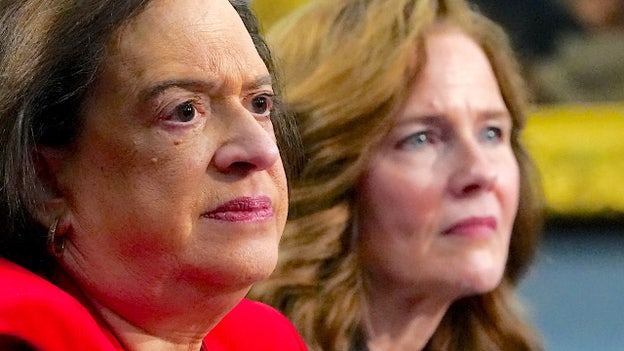
Justice Elena Kagan said the Supreme Court is wrestling with a rise in emergency appeals on its so-called “shadow docket,” warning that the court’s willingness to grant some requests may be encouraging more litigants to seek fast-track relief.
“There are downsides of using emergency relief,” Kagan said.
“Why are all these people coming to us for this relief when they didn’t in the past? And partly it has to do with the fact that the court did grant some of these petitions, and then you encourage everybody else to bring them to you,” she added.
The emergency docket typically involves time-sensitive requests to stay, block or delay lower-court orders or government actions while litigation continues. Those cases are often handled quickly, without the full briefing, oral arguments or written explanations that accompany traditional merits cases
Justices do not get “the kind of briefing” or “the argument” they ordinarily receive, Kagan warned, adding that the court should weigh those limits when deciding how often to grant emergency relief.
Justice Kagan: Supreme Court expecting 38% increase in threats
Supreme Court threats are getting more and more common and dangers, Justice Elena Kagan warned.
The court’s police force is preparing for a sharp increase this year, she told House appropriators Tuesday, "still very substantial 38% annual increase in threats this year, which follows a 25% increase last year.”
"Our respective department's growing needs are obvious given current conditions, the Capitol Police chief recently testified that threats against Congress are up 50% this year," she said.
Barrett says threats forced her to explain a bulletproof vest to her 12-year-old son
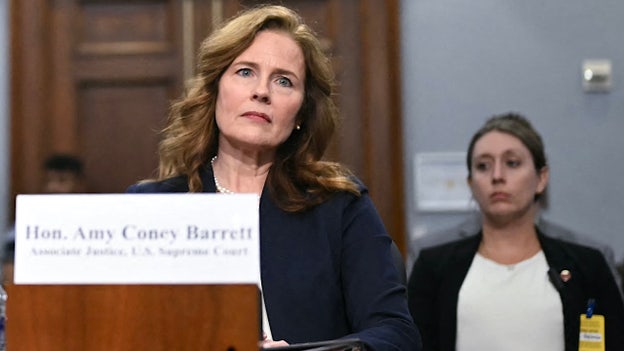
Security statistics “sound abstract,” Justice Amy Coney Barrett told the House appropriators Tuesday, but they are very real when you have to explain a bulletproof vest to your 12-year-old son.
“I didn’t expect that performing this service was going to put me in the position of explaining to my children what a bulletproof vest was,” Barrett said, detailing threats against her around the time of the Dobbs leak, prompting her security detail to send her home with a bulletproof vest.
She carried it inside, set it down in her bedroom and turned to find her 12-year-old son standing in the doorway.
Threats have forced her children “to think about and see things that children should not have to see or think about,” she lamented.
She also described a recent swatting incident at her home, in which police responded to a false report of gunshots and raised voices. Barrett said one of her teenage sons opened the door to leave with friends and saw the street “full of police cars.”
The incident was reported in May.
“I was very, very grateful that I had Supreme Court police outside my home,” she added.
Notably, Barrett said, judges have received anonymous threatening deliveries sent in the name of Judge Esther Salas’ slain son — an apparent attempt to invoke the 2020 attack in which a gunman targeting Salas killed her 20-year-old son at their home.
“Many of us, me included, have received threatening anonymous deliveries designed to intimidate and harass us," Barrett said. "They are often sent in the name of Judge Salas’ son, who, as you mentioned in the beginning, Mr. Chairman, is deceased because he was killed by a disgruntled lawyer who showed up at Judge Salas’ home intending to kill her.
"But her son, 20 years old at the time, opened the door and took the bullet instead. Her husband, standing behind, was seriously injured. So I think the message on these deliveries being sent in his name is clear.”
Barrett reminded House appropriators: “The threat level is really high.”
Justice Kagan opening statement: Threats have come ‘very close’ to us
Threats against Supreme Court justices have come “very close” to members of the court, Justice Elena Kagan told House appropriators to defend the high court’s fiscal 2027 budget request.
“The Supreme Court Police expect a smaller but still substantial 38% annual increase in threats this year, which follows a 25% increase last year,” Kagan said in her opening statement Tuesday.
“For some of us, those threats have come very close, and all of us live with the knowledge that they may again materialize,” she added.
Kagan said the court is requesting an additional $14 million for salaries and expenses, a 7% increase, with recent budget growth driven largely by security.
“Aside from annual inflationary increases, recent growth in the Court’s budget has been almost entirely for security expenses,” Kagan said.
She said the court’s security posture has changed dramatically since she joined the bench in 2010, when the Supreme Court Police focused mostly on protecting the building and justices did not have the kind of personal security details they do now.
“We began expanding our security program in earnest in 2017, initially at the behest of members of Congress,” Kagan said.
She pointed to the Dobbs leak, online attacks and physical security vulnerabilities as reasons the court has expanded residential security, threat assessments, cybersecurity and officer staffing.
Kagan said the court’s approach has been to “expand incrementally but effectively to meet evolving security challenges.”
Still, she said the justices remain committed to their work.
“All members of the Court continue to do their jobs as they believe legally right, adjudicating cases without fear or favor,” Kagan said.
Notaby, Kagan stressed to keep the House lawmakers questions focused on the budget request and not recent or pending Supreme Court decisions.
“While we cannot comment on decisions or pending cases, Justice Barrett and I are happy to answer any budget-related questions you have,” she said.
Justices Kagan, Barrett arrive on Capitol Hill ahead of rare Supreme Court budget hearing
Supreme Court Justices Elena Kagan and Amy Coney Barrett arrived on Capitol Hill at approximately 9:41 a.m. ET on Tuesday ahead of their rare appearance before Congress.
The justices walked into the witness room and did not speak to reporters or cameras.
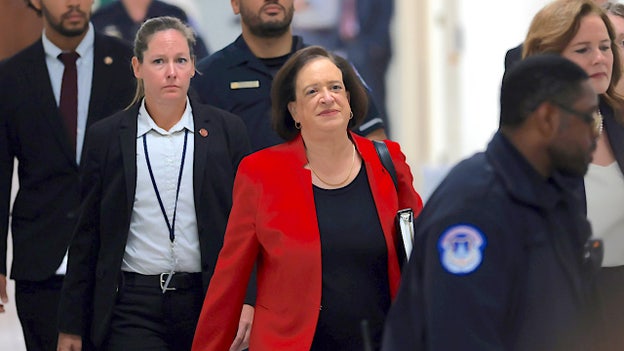
Kagan and Barrett are expected to enter the hearing room shortly for a House Appropriations subcommittee hearing on the Supreme Court’s fiscal 2027 budget request, which includes additional funding for security as threats against judges continue to rise.
The appearance marks the first time sitting Supreme Court justices have testified before Congress since 2019, outside of confirmation hearings.
Fox News' James Levinson contributed to this report.
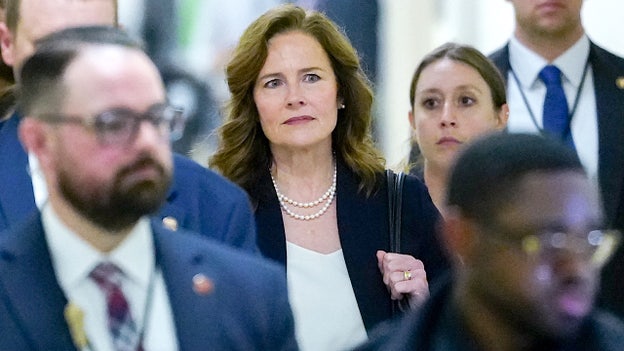
Justice Amy Coney Barrett arrives for a House Appropriations Subcommittee on Financial Services and General Government hearing Tuesday. (Aaron Schwartz/Bloomberg via Getty Images)
Senate Judiciary Supreme Court hearing unfolds in shadow of Lindsey Graham’s absence
The Senate’s afternoon Supreme Court budget hearing will unfold under the shadow of Sen. Lindsey Graham’s absence, just days after the death of one of the Judiciary Committee’s most memorable voices in modern confirmation fights.
After appearing before the House, Justices Elena Kagan and Amy Coney Barrett are scheduled to appear before the Senate Appropriations Subcommittee on Financial Services and General Government as the high court seeks funding for fiscal 2027, including additional money for security.
But the Senate’s return to Supreme Court business comes as lawmakers are also preparing to memorialize Graham, whose desk was draped in black cloth and white flowers after his death.
Though Tuesday’s hearing is an appropriations matter, Graham’s legacy is closely tied to the court. He was not on the committee presiding Tuesday, but he was the sitting chair of the Senate Budget Committee.
During Brett Kavanaugh’s explosive 2018 confirmation hearing, Graham delivered one of the defining moments of the fight, blasting Democrats’ handling of the allegations against the nominee and defending Kavanaugh in remarks that became instantly famous among conservatives.
President Donald Trump called Graham's impassioned Kavanaugh defense one of the greatest moments in political history.
Two years later, as Judiciary Committee chairman, Graham presided over Barrett’s confirmation hearing and praised her as a worthy successor to Justice Ruth Bader Ginsburg. He also cast Barrett as a jurist of exceptional ability, saying she belonged in a “category of excellence.”
Barrett now returns to the Senate not as a nominee, but as a sitting justice for the first time, appearing alongside Kagan to make the court’s case for a nearly $230 million budget request.
The hearing comes as the court seeks more than $14 million for expanded protective activities for justices’ residences and families amid rising threats against federal judges.
Sitting members of the Subcommittee on Financial Services and General Government:
Republicans
Chair Sen. Bill Hagerty, R-Tenn.
Sen. Susan Collins, R-Maine, chair of Overall Senate Appropriations Committee
Sen. John Boozeman, R-Ark.
Sen. Deb Fischer, R-Neb.
Sen. Jon Husted, R-Ohio
Democrats
Ranking Member Sen. Jack Reed, D-R.I.,
Sen. Dick Durbin, D-Ill.
Sen. Chris Coons, D-Del.
Sen. Chris Van Hollen, D-Md.
Fox News' Tyler Olson contributed to this report.
Justice Elena Kagan back before Congress for first time since 2019
Justice Elena Kagan returned to Capitol Hill on Tuesday for a rare appearance before Congress, this time helping make the Supreme Court’s case for more security funding amid rising threats against judges.
Kagan will appears alongside Justice Amy Coney Barrett before House appropriators as the court seeks a nearly $230 million budget for the next fiscal year, a roughly 10% increase over the current year.
The appearance carries added significance for Kagan, who was one of the last sitting justices to testify before Congress. She appeared in 2019 with Justice Samuel Alito before the same House appropriations subcommittee to discuss the court’s budget request.
Tuesday’s hearing marks the first time sitting justices have appeared before Congress since then.
The security request comes as threats against judges have become a central concern for the judiciary. According to U.S. Marshals Service data cited by Reuters, nearly 400 judges faced threats last year, and 276 had been targeted this year as of July 1.
More than $14 million of the court’s request would go toward expanding Supreme Court Police Department “protective activities for justices’ residences and families,” according to the judiciary’s administrative arm.
Kagan, one of the court’s three liberal justices, appeared with Barrett, one of President Donald Trump’s three conservative appointees, after a term marked by major rulings on presidential power, abortion-related precedent and other divisive legal fights.
Reuters and The Associated Press contributed to this report.
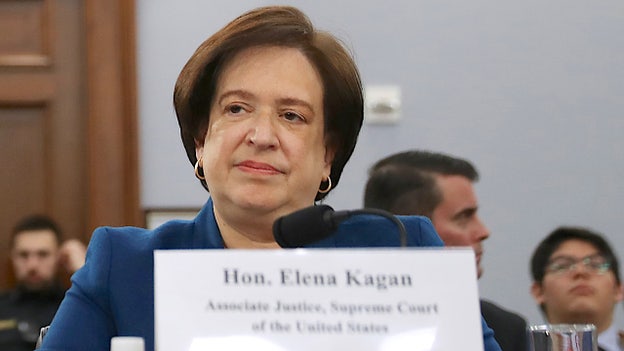
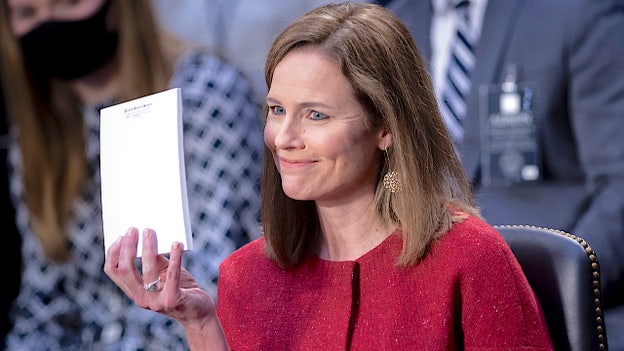
Justice Amy Coney Barrett brings her blank notebook, brain back to Congress for first time
Justice Amy Coney Barrett's returns to Capitol Hill on Tuesday for her first congressional appearance since the 2020 confirmation hearing where Sen. Lindsey Graham said she would be a worthy successor to the late Justice Ruth Bader Ginsburg.
The appearance marks a rare public turn before Congress for Barrett, who became a breakout figure during her confirmation hearing after holding up a blank notepad when asked what notes she had been using — a moment conservatives still point to as a display of her command of the law.
Barrett, one of President Donald Trump’s three Supreme Court appointees, and Justice Elena Kagan, one of the court’s three liberal justices, are expected to defend the court’s request amid rising threats against the judiciary.
Recapping recent Supreme Court security threats in era of court-packing rhetoric
Rising security threats on the Supreme Court have come amid rhetoric campaigns on court-packing, according to constitutional legal scholar Jonathan Turley.
Fox News' "Fox & Friends" Lawrence Jones recapped several recent incidents Tuesday morning
It comes as Supreme Court Justices Elena Kagan and Amy Coney Barrett make their rare appearance before Congress as the high court seeks more security funding.
May 2022: The draft opinion overturning Roe v. Wade was illegally leaked, sparking protests and threats against Justice Samuel Alito, who was targeted outside his home.
June 2022: A man was arrested near Justice Brett Kavanaugh’s Maryland home after allegedly attempting to assassinate him.
June 2022: Protesters demonstrated outside the homes of justices in an effort to pressure the court ahead of major rulings.
July 2023: Chief Justice John Roberts was targeted with reported death threats.
September 2024: Authorities uncovered an alleged plot involving threats to kill justices and their family members.
May 2026: Justice Amy Coney Barrett’s home was targeted in a swatting incident.
Kagan and Barrett are expected to make the case for additional $14 million in security funding to protect justices, their families and their residences.
"All of this campaign against the justices and the court have nothing to do with how they're ruling: It is an effort to pack the court because there's a long agenda of items that the far left wants to get through everything from wealth taxes to even getting rid of the Senate, which is part of the DSA platform," Turley told "Fox & Friends."
"All of that's going to require control of the Supreme Court; to do that, you've got to get citizens to hate them, hate the justices and hate the court."
Jonathan Turley: Campaigns to ‘demonize’ Supreme Court fueling hostility toward justices
Escalating rhetoric against the Supreme Court is fueling hostility toward justices and undermining public trust, legal scholar Jonathan Turley warned Tuesday.
“This is coming from a real movement to demonize the justices, demonize the court,” Turley told Tuesday's "Fox & Friends" before justices appear before two congressional hearings.
“It’s part of an effort to convince American citizens on our 250th anniversary to essentially gut the court by packing it.”
Recent threats and protests have targeted members of the high court, including the 2022 attempted assassination of Justice Brett Kavanaugh and a protest outside Justice Amy Coney Barrett’s home where demonstrators left bloody dolls on her lawn.
“These are people who are being triggered by this rhetoric,” Turley said, arguing that the attacks are “unconnected to the institution itself.”
The comments come as Justices Amy Coney Barrett and Elena Kagan appear before Congress to discuss the Supreme Court’s budget request, including $14 million additional funding for security.
“The Supreme Court has continued to show great independence and integrity,” Turley said, despite the threats, arguing that criticism of the court is about the leftist designs on court-packing.
“You’ve got to get citizens to hate them, hate the justices and hate the court,” Turley said.
Rising threats on Justices loom over $14 million Supreme Court security push
The Supreme Court’s renewed push for security funding – $14 million for "protective activities for justices' residences and families" – comes amid rising threats on justices.
Most notably, Justice Brett Kavanaugh faced a death threat at his home in 2022.
A California resident appeared near Kavanaugh’s Maryland home armed with a handgun in one of the most high-profile security scares involving a sitting justice.
Sophie Roske later pleaded guilty to attempted assassination and was sentenced in 2025 to eight years in federal prison.
The episode became a stark example of the risks facing justices outside the courtroom, particularly at their homes.
It also helps explain why the court is now asking for more than $14 million to expand protective activities for justices’ residences and families as part of a nearly $230 million fiscal 2027 budget request.
The concern is not limited to the Supreme Court. The U.S. Marshals Service reported that nearly 400 judges faced threats last year, with 276 more targeted this year as of July 1.
Chief Justice John Roberts has warned that personal hostility toward judges is dangerous.
“It’s got to stop,” Roberts said earlier this year, after highlighting a significant rise in threats across the judiciary in his year-end report.
Justices Elena Kagan and Amy Coney Barrett testify before House and Senate appropriators Tuesday.
Supreme Court seeks nearly $230 million budget, 10% increase of $21M, including $14M for security
The Supreme Court is asking Congress for nearly $230 million for fiscal 2027, a roughly 10% increase over the current year, with security costs driving a major part of the request.
Justices Elena Kagan and Amy Coney Barrett will testify before the House (10 a.m. ET) and Senate (2 p.m. ET), a first justice appearance before Congress since 2019.
Using the court’s approximate 10% increase, the current budget baseline would be about $209 million, meaning the request represents an increase of roughly $21 million overall.
More than $14 million of the new request would go toward expanding the Supreme Court Police Department’s “protective activities for justices’ residences and families.”
That security figure equals a little more than 6% of the court’s total requested budget.
The push comes amid growing concern about threats against judges. Data cited from the U.S. Marshals Service shows nearly 400 judges faced threats last year, and 276 had been targeted this year as of July 1.
Supreme Court justices testify to Congress for first time since 2019
Supreme Court Justices Elena Kagan and Amy Coney Barrett are set for an unusually public day on Capitol Hill, appearing before House appropriators at 10 a.m. Tuesday before heading to the Senate side for a 2 p.m. hearing on the court’s fiscal 2027 budget request.
The back-to-back appearances mark the first time sitting justices have testified before Congress since 2019. Kagan was one of the last justices to do so, appearing that year with Justice Samuel Alito before the same House appropriations subcommittee.
Tuesday’s hearing will be Kagan’s second congressional appearance as a justice and Barrett’s first.
The appearances are rare, but not unprecedented.
Supreme Court justices have testified at congressional hearings 175 times since 1960, according to the Congressional Research Service.
Justices had appeared at least once every year from 1960 through 2011, but the practice has slowed in recent years.
The House hearing will focus on the Supreme Court’s budget request, with security expected to be a central topic.
The Senate hearing later in the day gives lawmakers another chance to press the justices on the court’s needs after years of rising threats, contentious rulings and sustained public scrutiny.
Fox News' Tyler Olson, Elaine Mallon and Robert Schmad contributed to this report.
Live Coverage begins here