









What does "everything" mean when President Obama's debt commission tackles the nation's $14 trillion debt?
It could mean Obama's prized health care law.
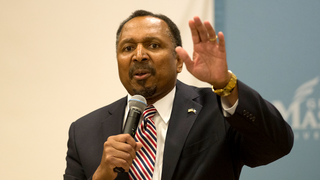
The commission's co-chairs, Democrat Erskine Bowles and Republican Alan Simpson, told Fox after at a meeting today at the White House that Obama's newly minted health care law is not a sacred cow and must be scrutinized for future cost savings.
"When you talk about the health care problem in this country and you talk about trying to solve that over a six-month period," Bowles said, referring to the commission's Dec. 1 deadline. "You watched these guys (the White House) struggle for two years. We've gotta bend that cost curve if we're really gonna be able to ever get the fiscal situation fixed in this country."
Asked if he agreed, Simpson said: "America's new health care plan will be on the table."
Bowles said cost-cutting measures in the new health care law -- touted frequently by Obama and others as significant contributions to deficit and debt reduction -- were insufficient to deal with America's debt crisis.
"Even under the administration's numbers, they only reduce spending the next ten years by $138 billion and by $1.3 trillion in the next ten years. We're gonna build up $10 trillion worth of debt just in the next 10 years."
Talk of examining the new health care law has already sparked division within the commission.
"There are a couple of Democrats in there, unidentified except to us, who don't agree at all on health care," Simpson said. "And we'll have to, you know, we'll bring everybody together."
That won't be easy. To forward a recommendation to Obama and Congress, 14 of 18 commission members must endorse it. That means serious bipartisan buy-in for the commission's 10 Democrats and 8 Republicans.
"Getting 60 votes in the Senate people think is impossible," Bowles said. "We've gotta get 78% of the vote. It's gonna be really hard. We've got to make some painful, tough decisions. Choice is all about sacrifice. I think there will be sacrifice for sure. I'm not a bit afraid of it."
The commission conducted its first meeting across the from the White House, in a brick walk-up that looks out over Lafayette Square. As it took testimony from Federal Reserve Chairman Ben Bernanke and OMB Director Peter Orszag, news broke that Standard & Poor's down-graded Greece's bond rating to junk bond status and lowered Portugal's dangerously close to junk status. Markets fell in Europe, London and New York.
Bowles and Simpson said the Greece and Portugal's woes could offer a glimpse into America's future.
"We live in a global economy," Bowles said. "We've got a deficit this year of $1.6 trillion. Half of what we're borrowing every year we borrow from foreign countries. Forget if China starts to sell our (Treasury) bonds. Think if they just quit buyin' and what that will do to our interest rates, what that will do to the dollar, and what that will do to the economy in America. We've got to fix this debt problem or there's not going to be a great future for this country."
Added Simpson:
"These things are known to guys in Dubuque, Iowa, and Cody, Wyoming. You just don't realize how alert the American people are to what's happening. And they'll come up to you on the street and say I'm willing to pay more taxes or I'm ready to cut back on this. Unsustainable is not a good word. It's called going broke."
But for all the dire warnings of economic doom, Bowles and Simpson said they may only leave a legacy of a public that's better educated about the problem and the range of solutions available.
"What we wanna do is to first educate the American people that this really is a crisis," Bowles said. "This is the most predictable economic crisis in history. It's going to happen if we don't change. We've got to make sure people know this is real. And it's big."
Educating the public? That's all? No big solution? No action plan? It sounds like Bowles and Simpson are minimizing expectations in the face of a toxically partisan atmosphere and Washington's legendary aversion to what both called the necessary "sacrifice" ahead.
"We don't care if move the ball one yard down the field," Simpson said. "We're gonna move the ball from where it is now. I don't know where we're goin' if it doesn't work. But they're gonna know a lot more about their world than they do now. We're not here to change the world."
