
















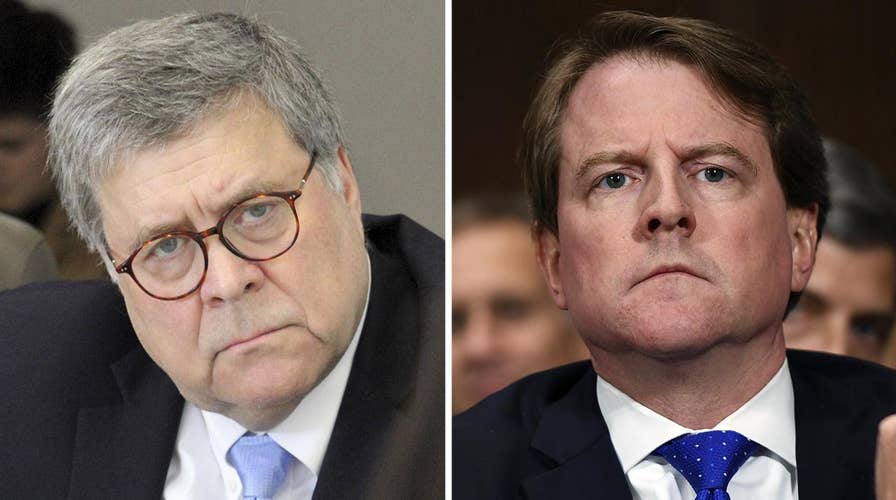
House Democrats set sights on Attorney General William Barr and former White House counsel Don McGahn
A contempt vote is now formally scheduled for June 11 as Democrats move to enforce subpoena for full Mueller report; chief intelligence correspondent Catherine Herridge reports from Washington.
Attorney General Bill Barr got a surprise this week when he hosted a listening session for civil rights groups supposedly concerned about the Justice Department's commitment to police reform.
Hardly anybody showed up.
The meeting itself stemmed from a commitment he made to Sen. Kamala Harris, D-Calif., during his confirmation hearing. The 2020 presidential candidate had challenged Barr to host the session to discuss a memo from his predecessor Jeff Sessions limiting the use of so-called "consent decrees" to reform local police departments accused of rights violations.
But after Barr invited numerous groups to such a meeting on Tuesday, the only person to attend was Frederick Misilo, president of the Arc, an organization that provides advocacy for those with intellectual disabilities.
A statement from the Justice Department said the meeting between Barr and Misilo was “productive” and touted the “critical role” of partnerships between the federal government and state agencies in protecting people’s rights.
“As Attorney General Barr publicly stated in his Senate hearings, he is committed to vigorous enforcement of federal civil rights laws and has directed the Department to continue its diligent work on these matters,” the statement said.
However, a Justice Department official accused the other invited organizations of letting politics get in the way of advancing that conversation.
“The attorney general clearly spent the time to listen to this one president, and if there were more folks, we would have had more perspectives, but they kind of just wanted to play the political games,” the official told The Washington Post.
Misilo told the Post that the 40-minute discussion with Barr was “helpful,” and that Barr expressed “an openness to take our interests under advisement,” though Barr did not commit to any specific action.
The other organizations on Barr’s invite list were the American Civil Liberties Union, the NAACP, the Human Rights Campaign, the National Fair Housing Alliance, UnidosUS, and the Mexican American Legal Defense and Educational Fund.
The Leadership Conference on Civil & Human Rights, a coalition of civil rights groups, sent a letter to Barr on Tuesday explaining why the above groups were not going to meet with him. They said a larger number of them had initially requested a meeting with Barr, but the attorney general only selected a portion of them. The letter was signed by the six groups who declined Barr’s invitation, as well as others who were not invited -- including The Drug Policy Alliance, Human Rights Watch, The Lawyers’ Committee for Civil Rights Under Law, the NAACP Legal Defense and Educational Fund, and the National Urban League.
"In our view, the decision not to include certain organizations severely limits the Department's ability to learn about and consider the critical civil rights and public safety issues at stake," the letter said.
The handling of consent decrees has long been a contentious issue.
The Obama administration had used such decrees in cities where there were concerns of unfair treatment of minorities by the police. A consent decree with the Baltimore Police Department, for example, came about after a DOJ investigation found patterns of discriminatory conduct.
Sessions’ memo said that while consent decrees are “sometimes necessary and appropriate to secure compliance with federal law,” there are federalism-based concerns with federal court decrees that govern state and local government entities. It outlined requirements for future consent decrees, including defined limits on the terms of decrees, as well as “specific and measurable actions that trigger the decree's termination,” so that a consent decree can come to an end if an agency shows that they have “come into durable compliance” with the relevant federal laws.
COMEY DENOUNCES BARR AFTER CBS INTERVIEW: 'AN AG SHOULD NOT BE ECHOING CONSPIRACY THEORIES'
The Justice Department stated that Barr is also planning a listening session with state and local law enforcement, and that "the Department's door remains open to groups who wish to discuss these important civil and constitutional issues."
Sessions' memo was sent out in November 2018. Since then, the DOJ has still used consent decrees, entering into one to reform the Chicago Police Department in January 2019.
