Trump tells Iran to 'get smart soon' as Hegseth testifies to House Armed Services on $1.5T budget
President Donald Trump issued a sharp warning to Iran as War Secretary Pete Hegseth prepared to face lawmakers on Capitol Hill, setting up a politically charged moment centered on national security, administration messaging, and U.S. policy toward Tehran.
Coverage for this event has ended.
US considers deploying 'dark eagle' hypersonic missile to Middle East: report
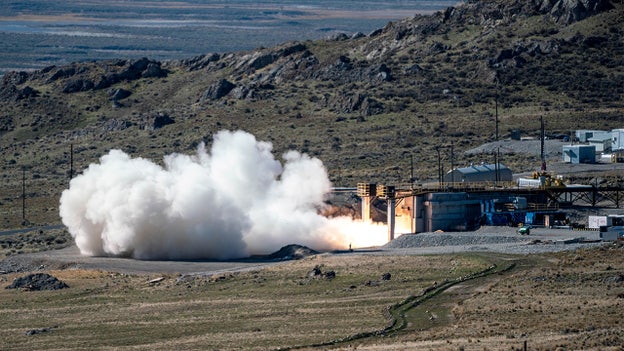
The U.S. Army’s Dark Eagle hypersonic missile could be deployed to the Middle East for potential use against Iran, according to reports.
Citing a source Wednesday, Bloomberg reported that U.S. Central Command (CENTCOM) has requested the long-delayed system to target ballistic missile launchers deep inside the country.
The hypersonic missile is behind schedule and has not been declared fully operational, even as Russia and China have fielded similar systems, the report said.
The request for forces submission argues the move is necessary because Iran has shifted its launchers beyond the reach of the Precision Strike Missile, which can strike targets more than 300 miles away, the source said.
No decision has been made on the request, the source added.
USS Gerald R. Ford conducting routine flight operations in the Red Sea: CENTCOM
U.S. Central Command (CENTCOM) said Wednesday that the USS Gerald R. Ford is conducting routine flight operations in the Red Sea.
This comes amid the U.S. Navy’s ongoing presence in the Middle East.
“USS Gerald R. Ford (CVN 78) continues to conduct routine flight operations as it sails in the Red Sea,” the command said in a post shared on X.
US races to boost missile production as Vance dismisses report of stockpile concerns
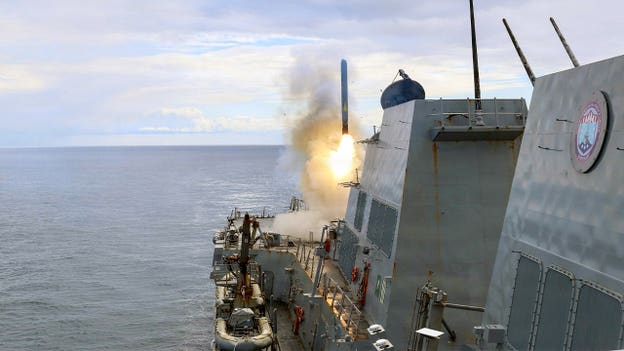
The U.S. military is racing to boost missile production after years of output that lagged behind current demand left key weapons in short supply, according to an analysis of Pentagon procurement data.
At current production rates, some of the Pentagon’s most critical munitions would take years — and in some cases decades — to replenish, exposing a gap between battlefield use and industrial capacity that cannot be quickly closed.
Major defense contractors have struck new agreements with the Pentagon and pledged to significantly increase production across several high-end munitions programs.
But senior military officials warn the buildup will take time.
"I think it will take one to two years for them to scale. It won't be soon enough," Indo-Pacific Command Commander Adm. Samuel Paparo told lawmakers in April.
The push comes as recent combat has drawn down U.S. stockpiles of high-end munitions, exposing a growing gap between how quickly the military can use advanced weapons and the years it takes to replace them, raising concerns about longer-term readiness.
The gap between usage and replenishment is also reportedly drawing scrutiny inside the administration.
This is an excerpt from a report by Morgan Phillips.
White House highlights Skydio's $3.5B US drone manufacturing expansion plan
The White House on Wednesday highlighted a $3.5 billion investment by Skydio to expand its U.S. manufacturing footprint and accelerate development of autonomous drone systems.
“HUGE: @SkydioHQ announces a $3.5 billion investment to expand its U.S. manufacturing footprint and accelerate its R&D capabilities,” it said in a post shared on X.
“AMERICAN DRONE DOMINANCE!” it added.
The company said the investment would be used to scale production and advance the development of its autonomous drone systems.
US urges allies to join new maritime coalition to protect shipping through the Strait of Hormuz
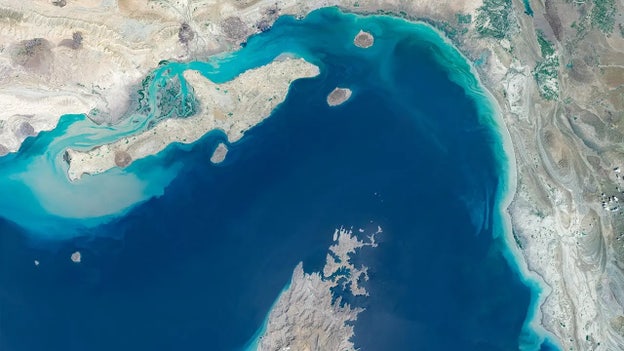
The U.S. is urging allies to join a new maritime security coalition to protect global shipping around the strait, emphasizing “collective action,” according to a State Department cable reported by The Wall Street Journal on Wednesday.
The cable, sent April 28 to U.S. embassies, directs diplomats to press foreign governments to sign onto the initiative — called the “Maritime Freedom Construct.”
The coalition would share information, coordinate diplomatically, and enforce sanctions, the report said.
“Your participation will strengthen our collective ability to restore freedom of navigation and protect the global economy,” the cable reads, according to The Wall Street Journal.
“Collective action is essential to demonstrate unified resolve and impose meaningful costs on Iranian obstruction of transit through the strait.”
The framework would be a joint effort between the State Department and U.S. Central Command (CENTCOM).
The State Department “will serve as the diplomatic operations hub,” while U.S. Central Command “will provide real-time maritime domain awareness” for commercial shipping and coordinate information sharing among partner militaries.
An official confirmed the proposal is one of several diplomatic and policy tools available to the president, the outlet said.
Operation Economic Fury strangling Iran's shadow banking, oil networks, says Treasury
The Treasury Department on Wednesday said the U.S. sanctions campaign against Iran is choking off billions in revenue, straining the country’s economy while threatening its oil exports.
In a release shared on X, the Treasury said that under the framework of "Operation Economic Wrath," it has targeted Iran's “international shadow banking infrastructure, its access to cryptocurrencies, the shadow fleet, weapons supply networks, financial resources of regional terrorist proxy groups and also Chinese independent refineries known as "teapots" that support Iran's oil trade.”
“These actions have disrupted tens of billions of dollars in revenue that could have been used to finance terrorism,” the department said.
Under the framework of the U.S. president's "maximum pressure" campaign, the inflation rate in Tehran has doubled, and the value of its currency has rapidly declined, the statement read.
“Kharg Island, Iran's main oil export terminal, will soon approach its storage capacity; a situation that will force the regime to reduce oil production, thereby creating an additional daily revenue reduction of approximately $170 million and inflicting permanent damage on Iran's oil infrastructure,” the department said.
The Treasury Department said it would “continue to apply maximum pressure, and any individual, ship, or entity that has played a role in facilitating illicit flows to Tehran will be exposed to U.S. sanctions.”
Iran's 55-day internet blackout is longest nationwide shutdown ever recorded: report
For 55 days and counting, Iran has kept 92 million people effectively offline, in what has become the longest nationwide internet shutdown ever recorded, according to reports.
The blackout began on February 28, coinciding with the onset of Operation Epic Fury, and has now stretched beyond 1,296 hours of near-total digital silence.
What started as a government-imposed restriction has evolved into a sweeping disruption affecting nearly every aspect of daily life in Iran.
Tehran’s own communications minister acknowledged the severity of the situation, estimating losses at roughly $35 million per day.
Independent monitoring group NetBlocks places the total damage closer to $2 billion.
For ordinary Iranians, around 80 percent of online sales have disappeared, cutting off a vital lifeline for businesses that depend on digital platforms, the California Post reported.
Small businesses are collapsing at an alarming pace, with many unable to operate or reach customers, the outlet said.
Trump tells Netanyahu only take 'surgical' action in Lebanon, Israeli PM shares strike video
President Donald Trump has told Prime Minister Benjamin Netanyahu to only take “surgical” military action in Lebanon and avoid a full resumption of the war, according to reports.
Trump’s remarks came as Netanyahu shared a post on X on Wednesday with a video showing an Israeli strike.
“Lebanon — continuing,” Netanyahu captioned the post.
Speaking to Axios and Trump said he “told Netanyahu he has got to do it more surgically, not knock down buildings. He can't do it. It is too terrible and makes Israel look bad.”
So far, Secretary of State Marco Rubio has hosted two meetings with the respective ambassadors.
A 10-day ceasefire between Lebanon and Israel set on April 16 has been extended for three weeks.
Hezbollah has continued to strike Israeli forces in Lebanon and villages across the border. Israel has alsi struck in Lebanon.
This comes as Trump spoke to Netanyahu Axios said, with Trump also saying that he likes Lebanon and its leadership and thinks the country can “make a comeback.”
“Iran ruined Lebanon. Their proxy [Hezbollah] ruined Lebanon. When Iran gets taken out, Hezbollah automatically gets taken out,” Trump told the outlet.
Israeli navy intercepts flotilla headed for Gaza, mocks 'aid' cargo as drugs found
The Israeli navy intercepted a flotilla sailing to the Gaza Strip on Wednesday near the Greek island of Crete.
The flotilla was made up of 58 vessels and with the navy also saying it found drugs and condoms on board.
“This is the ‘medical aid’ found aboard the PR stunt flotilla: condoms and drugs,” the navy said in a post shared on X.
Meanwhile, flotilla organizers shared footage of an Israeli navy officer calling on the activists to change course.
“If you wish to deliver humanitarian aid to Gaza, you may do so through established and recognized channels. Please change course and return to the port of origin. If you are carrying humanitarian aid, you are invited to proceed to the port of Ashdod,” the officer can be heard saying.
USS Gerald R. Ford to leave Middle East within days, return to Virginia: report
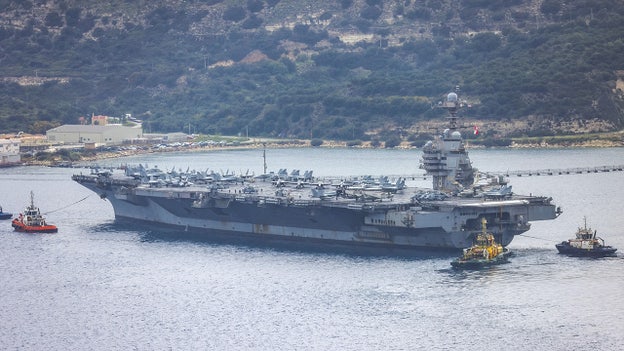
The USS Gerald R. Ford is set to return to the United States within days after 10 months at sea, according to reports.
Citing officials, The Washington Post reported the departure of the aircraft carrier, one of three in the Middle East region, will mark a decrease in U.S. firepower in the region.
This comes amid a fragile ceasefire with Iran, and as the U.S. maintains its blockade of Iranian ports.
The aircraft carrier is likely to arrive in Virginia around mid-May, an official told the outlet.
Ghalibaf calls Bessent's advice 'junk,' blames US blockade for surging oil prices
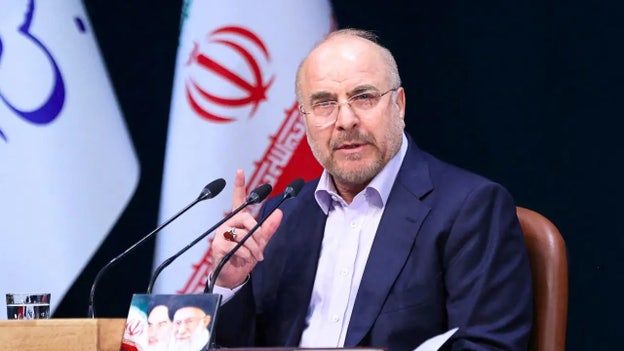
Iran’s Mohammad Ghalibaf slammed U.S. policymakers, including Treasury Secretary Scott Bessent, on Wednesday over the impact of the U.S. blockade of Iranian ports.
The parliamentary speaker cited “junk advice” and blamed the Treasury for pushing up oil prices.
“Three days in, no well exploded,” Ghalibaf said in a post shared on X.
“We could extend to 30 days and livestream the well here. That was the kind of junk advice the U.S. administration gets from people like Bessent who also push the blockade theory and crank oil up to $120-plus,” he added.
“Next stop: 140. The issue isn’t the theory, it’s the mindset,” Ghalibaf said.
Hamadeh suggests US military drop leaflets of Trump's Truth Social posts over Iran
Rep. Abe Hamadeh, R-Ariz., argued Wednesday that Americans need to know the U.S. has air superiority over Iran, as War Secretary Pete Hegseth and Chairman of the Joint Chiefs of Staff Gen. Dan Caine appeared before the House Armed Services Committee.
“America has air superiority over Iran,” Hamadeh said in a post shared on X.
“The people on the ground need to know they have our full support to stand up to the regime, and they need to hear it directly from our commander in chief,” he said.
“That’s why I told @SecWar we should drop leaflets with @POTUS @realDonaldTrump Truth Social posts from the skies,” Hamadeh added.
Iran slams US enrichment claims, says not 'one gram' of nuclear material diverted
Iran’s envoy to the International Atomic Energy Agency (IAEA) accused the United States of misrepresenting the country’s enriched uranium as a threat.
The remarks came as President Donald Trump issued a warning for Iran to “get smart soon” and “sign a nonnuclear deal,” amid ongoing concerns over Iran’s enrichment program.
“While all of Iran’s enriched uranium has always been under the full supervision of the International Atomic Energy Agency, and there is no report of even one gram of Iran’s nuclear material being diverted, the U.S. exploited the NPT Review Conference and portrayed Iran’s enriched uranium as a danger in order to divert attention from its own violations and those of its allies in the field of nuclear disarmament,” the Iran Mission to the U.N., New York, said in a post shared on X.
“The UN Security Council, the IAEA Director-General and the Board of Governors not only failed to condemn these illegal attacks, but most regrettably, took actions that reversed the roles of the victim and the aggressor," it said.
Iranian institutions back Security Council on war, US negotiations: report
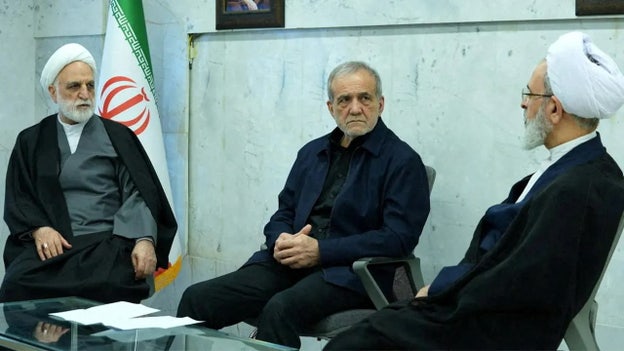
Iranian state institutions are united behind the Supreme National Security Council on decisions made over the war and any US negotiations, Iran’s Justice Minister Amin Rahimi said Wednesday, according to reports.
“In matters such as war or negotiation, it is the Supreme National Security Council that makes decisions based on the interests of the country,” Rahimi said in comments carried by Tasnim News Agency and reported by Iran International.
He also said that decisions are implemented after the approval of the Supreme Leader and said all branches of the state share the same goal of protecting the rights of the Iranian people.
Vance pushes back on report claiming he's worried about weapons shortages
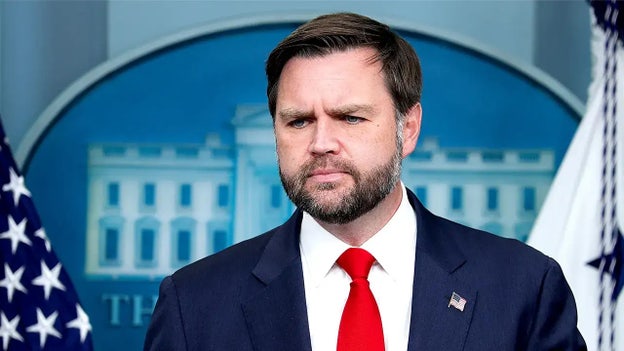
Vice President JD Vance pushed back on a report from The Atlantic April 27 suggesting he is concerned about U.S. weapons shortages and a potentially depleted missile stockpile.
The outlet cited two senior administration officials who said Vance has questioned the accuracy of Pentagon information about the war with Iran.
In an interview on "The Will Cain Show", Vance downplayed the report and urged skepticism.
“Of course, I'm concerned about, you know, our readiness, because that's my job to be concerned,” he said.
“But I think that Pete Hegseth, our Department of War secretary, I think General Kane, our chairman of the Joint Chiefs of Staff, they’re doing an amazing job.
“But it's, of course, my job to ask these questions. It's, of course, my job to make sure that we're on top of every issue," he added.
“And of course, it's the president's job, too, and I think that both of us are very focused on that.
“But we've got a great military, a military that can do a lot well, so don't believe everything you read, especially in papers like The Atlantic,” Vance warned.
Rubio, UK foreign secretary discuss freedom of navigation in the Strait
Secretary of State Marco Rubio said Wednesday he discussed the need for freedom of navigation in the Strait of Hormuz with U.K. Foreign Secretary Yvette Cooper.
“Met with U.K. Foreign Secretary @YvetteCooperMP on the occasion of the @RoyalFamily’s visit to the United States,” Rubio said in a post shared on X.
“We discussed the need for freedom of navigation in the Strait of Hormuz,” he added.
US prepared for further military action against Iran if nuclear deal isn't reached: Hesgeth
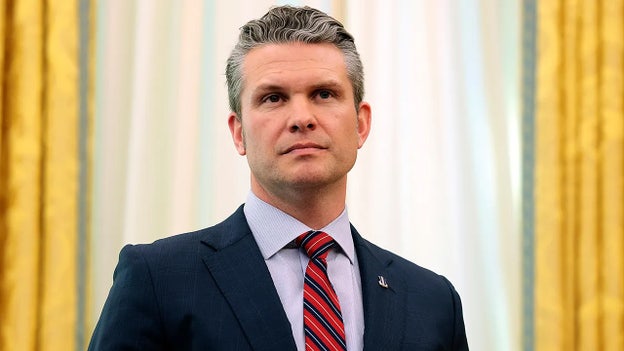
Responding to questions from Rep. Jeff Crank on Wednesday, War Secretary Pete Hegseth highlighted the professionalism of the joint U.S.-Israeli operation that began Feb. 28 with Operation Epic Fury.
He also referenced the rescue in which U.S. special operations forces recovered two crew members of a downed F-15E Strike Eagle and said the U.S. was prepared to take further military action.
“We've never seen an air campaign like what we did alongside the Israeli Air Force, not to mention the rescue of those two pilots and the professionalism of that joint force that went downtown twice, once in the day and once in the night to leave no man behind,” Hegseth said at the House Armed Services Committee hearing.
“That is a call the commander in chief makes, and he had the guts to make it,” Hegseth added, saying the ceasefire is in a “strong place” alongside the blockade.
Hegseth said the blockade “will ensure that when this is done, when a deal is said, it's a deal on the president's terms to ensure Iran never gets a nuclear weapon.”
“If they had a nuclear weapon, they would use it. This president has unleashed his military to do something about it.”
“We've had historic successes, and if we need to go at it again to ensure that success, we are prepared to. But we're hopeful over time that a deal will be compelled and compelled quickly,” Hegseth added.
Navy guided-missile destroyer USS Mason operating in Middle East: CENTCOM
U.S. Navy guided-missile destroyer USS Mason is in the Middle East, U.S. Central Command (CENTCOM) said Wednesday.
This came as President Donald Trump issued a warning to Iran after discussing measures that could be taken to continue the blockade of Iranian ports on Tuesday.
“Guided-missile destroyer USS Mason (DDG 87) sails regional waters within the U.S. Central Command area of responsibility,” the command said in a post shared on X.
“Mason, alongside other destroyers, is part of the George H.W. Bush Carrier Strike Group, one of three carrier strike groups currently operating in the Middle East,” CENTCOM said.
Trump 'had the courage' to take on Iranian nuclear threat despite anticipated risks: Hesgeth
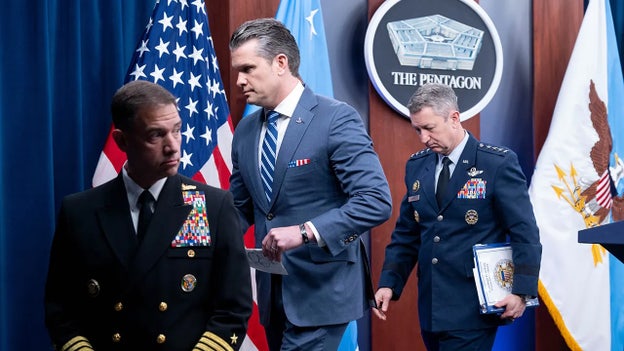
War Secretary Pete Hegseth was asked about the anticipated risks of going to war with Iran on Wednesday before the House Armed Services Committee.
“The president did understand the risks and had the courage to undertake the endeavor nonetheless, which the American people voted for, that kind of courage and taking on that Iranian nuclear threat,” he stated.
Rep. Sarah Elfreth (D-MD) also pushed on what it will require of U.S. service members to eradicate any Iranian nuclear threat.
Chairman of the Joint Chiefs of Staff Dan Caine responded that there is a wide range of options under consideration, many of which are "classified."
“There's such a wide range, ma'am, of options in there, all of which are classified. It would be out of my swim lane, but we always deliver the full range of options, the associated risks, and the advice to go do the things that we would be asked to do. There's many,” Caine said.
Trump says call with Putin touched on Iran, nuclear enrichment involvement
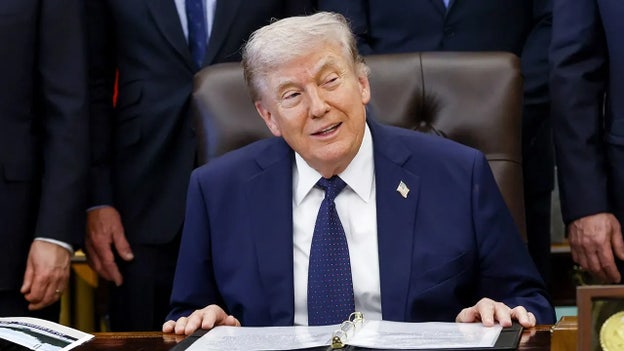
President Donald Trump said Wednesday he held a call with President Vladimir Putin which touched on Iran.
Shedding some light on the conversation, Trump told reporters in the Oval Office the two leaders covered multiple topics but centered primarily on the ongoing conflict in Ukraine.
“I talked about Ukraine, and I talked a little bit about Iran,” Trump said.
“I talked about a few different subjects, mostly about Ukraine. And we had a very good conversation. I think we’re going to come up with a solution relatively quickly, I hope.
“I think you’d like to see a solution, I can tell you. And that’s good,” he said.
Trump also addressed Putin’s interest in Iran.
Asked what involvement Putin wants to have in the Iran war, Trump confirmed it would include the nuclear enrichment topic.
“He told me he’d like to be involved with the enrichment,” Trump said.
“If he can help us get it. I said I’d much rather have you be involved with ending the war in Ukraine. To me, that would be more important,” Trump added.
Putin, Trump discuss Iran nuclear program in call, Kremlin aide says
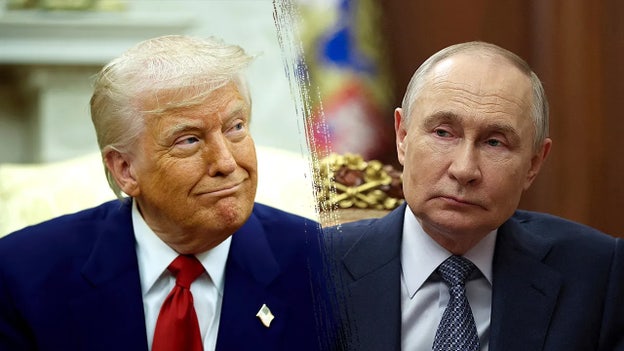
President Vladimir Putin and President Donald Trump discussed Iran in a phone call that lasted more than 90 minutes, Kremlin aide Yuri Ushakov said on Wednesday.
According to Reuters, Ushakov said Putin shared ideas on Iran’s nuclear program and voiced support for Trump’s decision to extend the Iran ceasefire.
He also described the call as friendly and businesslike.
Hegseth says protecting freedom requires 'sacrifice and risk'
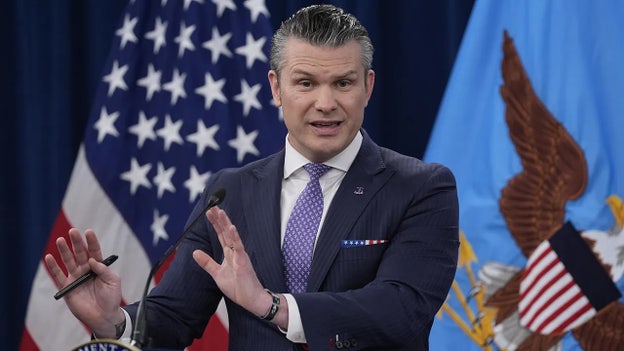
War Secretary Pete Hegseth was asked Wednesday by Rep. Chris Deluzio whether more could have done more to protect troops who were wounded, six of whom are dead, to which Hesgeth said “every conceivable thing” was done at his level.
“As a department, we did every conceivable thing at my level and every echelon down to ensure the maximum force protection for our troops,” Hesgeth said.
“We live in a dangerous world and a dangerous place against a determined enemy that cannot have a nuclear weapon, and that requires sacrifice and risk,” he added.
“And it tragically, in this case, meant six Americans lost their lives and others were wounded. And we all know that. And that’s part of the cost. But it does not mean we didn’t care,” Hesgeth said.
Deluzio went on to raise the issue of overhead protection in drone strikes.
“There was no overhead protection, given the known threat in that environment,” he responded.
“And I think we all here understand it is an overhead drone strike. There was no protection for overhead drone strikes. So I’m struggling to understand how your answer and your spokesman’s answer is that every possible measure was taken,” he said
Hegseth fires back at House Dems: 'What would you pay to ensure Iran doesn't get a nuclear bomb?'
War Secretary Pete Hegseth, defending the estimated $25 billion cost to date on the Operation Epic Fury on Iran and the $1.5 trillion Pentagon budget request for 2027, fired back at House Armed Services Committee Democrats for questioning the costs.
"I would simply ask you what the cost is of an Iranian nuclear bomb,” Hegseth said during a fiery exchange with Rep. Rep. Ro Khanna, D-Calif.
Hegseth clashed sharply with House Democrats, turning a line of questioning about the financial cost of the Iran war into a broader argument about the price of stopping Tehran from getting a nuclear weapon.
Khanna demanded answers on what the war would cost American households, which Hegseth rebuked as "gotcha questions about domestic things."
“What would you pay to ensure Iran doesn’t get a nuclear bomb?" Hegseth repeated a number of times. "What would you pay?”
The exchange came as Khanna accused the Pentagon of failing to fully account for the war’s cost, arguing Hegseth’s $25 billion estimate did not reflect replacement weapons, damaged equipment or the broader hit to consumers.
"Your $25 billion number is totally off," Khanna claimed. "It's incompetence."
Hegseth said any Iran-specific supplemental request would come in at “less than $25 billion.”
Khanna argued the White House had “betrayed” voters by dragging the country into a costly war with Iran, while Hegseth leaned on a simpler defense: whatever the price now, he suggested, it is worth paying to keep Iran from crossing the nuclear threshold.
Trump: Hormuz Strait blockade has Iran 'choking like a stuffed pig'
President Donald Trump is echoing Secretary of State Marco Rubio's comments earlier this week that the U.S. military blockade on Iran oil shipping through the Strait of Hormuz has the force and effect of an "economic nuclear weapon."
"The blockade is somewhat more effective than the bombing: They are choking like a stuffed pig," Trump told Axios in an interview Wednesday. "And it is going to be worse for them.
"They can't have a nuclear weapon."
Iran ultimately wants "to settle" but Trump said that only happens with Iran giving up its nuclear weapons aspirations permanently.
"They don't want me to keep the blockade; I don't want to [lift the blockade], because I don't want them to have a nuclear weapon," Trump told Axios.
Iran's oil storage and pipelines "are getting close to exploding," he added.
Hegseth asks House Armed Service Democrats: 'Who are you cheering for?'
War Secretary Pete Hegseth rebuked House Armed Services Committee Democrats during Wednesday's 2027 budget hearing, asking "who are you cheering for?"
"The president has got himself and America stuck in the quagmire of another war in the Middle East," Rep. John Garamendi, D-Calif., said, prompting a sharp response from Hegseth. "He's desperately trying to extricate himself from his own mistakes."
Hegseth rebuked Democrats for their "hatred for President Trump," which "blinds you to the truth of the success of this mission and the historic stakes that the president is addressing, which the American people support."
"You call it a quagmire, handing propaganda to our enemies: Shame on you for that statement," Hegseth shot back directly to Garamendi. "And statements like that are reckless to our troops.
"Don't say I support the troops on one hand, and then a two-month mission is a quagmire. That's a false equivocation.
"Who are you cheering for here? Who are you pulling for? Our troops are doing incredible work."
War comptroller: Epic Fury has cost $25B 'so far'
Operation Epic Fury has cost the Pentagon about $25 billion so far, with most of that spending tied to munitions, acting War Department Comptroller Jules Hurst told lawmakers Wednesday.
Speaking during the House Armed Services Committee’s hearing on the fiscal 2027 defense budget, Hurst said that “as of this day,” the operation’s price tag stood at roughly $25 billion. The comment offered one of the clearest public cost estimates yet for the campaign.
“Approximately at this day, we’re spending about $25 billion on Operation Epic Fury,” Hurst said. “Most of that is in munitions.”
This comes as the Trump administration pushes Congress to approve a $1.5 trillion national defense budget centered on rebuilding stockpiles, expanding production capacity and increasing readiness.
War Secretary Pete Hegseth testified the Biden administration "was focused on a lot of the wrong things going in the wrong direction."
"With reconciliation, we're able to put $22 billion in shipbuilding, $22 billion into golden dome, $25 billion into munitions, established drone dominance, which we're continuing to do this day," Hegseth said.
Hegseth opening statement: Trump $1.5T plan will ditch ‘woke’ spending and rebuild the arsenal
War Secretary Pete Hegseth's opening statement to the House Armed Services Committee on Wednesday will cast President Donald Trump’s fiscal 2027 defense budget as a sweeping reset for the military, arguing the administration is redirecting money away from “woke” and other nonlethal priorities and back into warfighting, munitions and industrial capacity.
"The War Department will not be distracted by democracybuilding, interventionism, undefined wars, regime change, climate change, woke moralizing, and feckless nation-building," Hegseth's opening statement released before the 10 a.m. hearing read.
"We will instead put our nation’s practical, concrete interests first. We will deter war. We will advance American interests. We will defend our people. Peace is our goal – and in service of that objective, we will always be ready to fight and win decisively if called upon.
"As part of this mission, we are asking American taxpayers to fund the world’s greatest military."
Hegseth said the proposed $1.5 trillion defense budget would build on last year’s $1 trillion topline and fund what he called three core goals: restoring the “warrior ethos,” rebuilding the military and reestablishing deterrence.
UN nuclear chief: Iran’s highly enriched uranium likely buried at Isfahan site
The head of the U.N. nuclear watchdog says much of Iran’s highly enriched uranium is likely still at the Isfahan nuclear complex, buried in tunnels.
International Atomic Energy Agency's best estimate is that a large share of the material stored there before the 2025 war remains there, IAEA Director-General Rafael Grossi told The Associated Press on Wednesday.
The IAEA has satellite imagery showing the effects of recent strikes but has not been able to return to the site to confirm the uranium’s status or verify whether agency seals are still intact, according to Grossi.
Inspections at Isfahan ended when last year’s war broke out, leaving the watchdog to rely on imagery, prior records and outside information as it tries to track one of the most sensitive elements of Iran’s nuclear program.
The IAEA says Iran has 440.9 kilograms of uranium enriched to 60% purity, which is close to weapons-grade, and Grossi has said roughly 200 kilograms is believed to be stored in tunnels at Isfahan. That unresolved stockpile keeps Iran’s nuclear material at the center of any effort to turn a fragile ceasefire into a broader agreement.
Grossi told the AP that any durable deal will require full inspections and likely some arrangement to remove or dilute the material. For now, though, the basic problem remains unchanged: the uranium is believed to still be there, and no outside authority has been able to check it on the ground.
The Associated Press contributed to this report.
Oil executives express support for Trump actions after White House meeting
President Donald Trump met oil executives at the White House on Monday, talking Iran and oil amid the Strait of Hormuz blockade.
With Trump leveraging the shutdown of Iran's oil industry, he has been urging the world to come to the U.S. for its oil in lieu of Iran's.
Secretary of State Marco Rubio said earlier this week that the blockade on the Strait of Hormuz is equivalent to an "economic nuclear weapon" to leverage Iran toward giving up its nuclear weapons aspirations.
Trump meets with energy executives frequently to get their feedback on domestic and international energy markets. The executives discussed many topics Monday, including domestic production, progress in Venezuela, oil futures, natural gas, and shipping.
The executives all spoke highly of the actions Trump has taken to unleash American energy dominance, and expressed support for what the president is doing for global oil supply under the circumstances, sources told Fox Business.
FOX Business' Edward Lawrence contributed to this report.
Trump eyes longer Iran blockade in Hormuz Strait as it clings to nuclear aspirations
President Donald Trump has reportedly told aides to prepare for a longer blockade of Iran, betting sustained economic pressure in and around the Strait of Hormuz will force Tehran to back down on its nuclear weapons aspirations.
Trump, pursuing peace through strength, is willing to keep the Strait of Hormuz closed off to Iran's global oil industry as a pressure point to get the shaken leadership to give up designs to ultimately have a nuclear weapon.
Trump publicly argued earlier this week that the pressure campaign is working, saying Iran is nearing a “state of collapse,” while officials maintain the blockade has given Washington leverage in any future negotiations.
Trump has temporarily ceased his major bombing campaign as of April 7, but Iran has long sought to delay talks on giving up its nuclear weapons program.
Trump has temporarily ceased his major bombing campaign as of April 7, but Iran has long sought to delay talks on giving up its nuclear weapons program.
Trump ended the JCPOA and has vowed "Iran will never have a nuclear weapon."
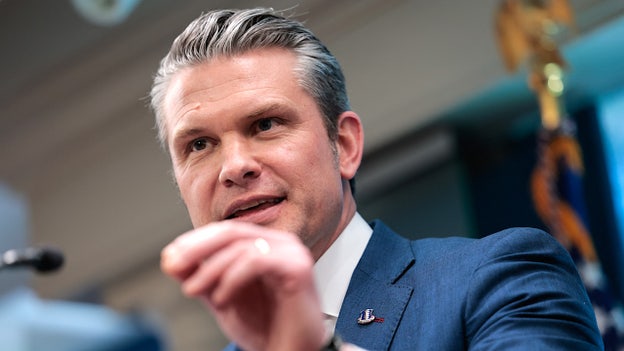
War Secretary Pete Hegseth and Chairman of the Joint Chiefs of Staff Gen. Dan Caine are set to testify before the House Armed Services Committee on Wednesday as the war with Iran reaches its 60-day mark and pressure builds on the administration to defend both its strategy and its costs.
The hearing is scheduled to begin at 10 a.m. ET on Capitol Hill and is officially focused on the Pentagon’s fiscal 2027 budget request.
But the backdrop is the latest with Iran, which has become a central political and military test for President Donald Trump’s national security team.
Lawmakers are expected to press Hegseth on the administration’s war aims, the legal basis for the operation, military readiness, and the broader economic fallout from conflict.
The hearing will also mark Hegseth’s first appearance before Congress since the war began, giving both parties a high-profile chance to question the Pentagon’s handling of the fight and the administration’s case for a proposed $1.5 trillion defense budget.
Caine’s testimony is expected to offer lawmakers a battlefield and readiness assessment as scrutiny intensifies over how long the conflict could continue.
Trump: Iran 'better get smart soon,' learn how to 'sign a nonnuclear deal'
President Donald Trump might be willing to remain under a ceasefire in pursuit of peace, but he is not willing to allow Iran to delay talks on ending its nuclear weapon aspirations.
"Iran can’t get their act together," Trump wrote early Wednesday morning on Truth Social. "They don’t know how to sign a nonnuclear deal. They better get smart soon!"
The message underscored Trump’s frustration with stalled diplomacy, notoriously an Iranian strategy as it works toward attaining a nuclear weapon, something Trump has long declared would "never" be allowed to happen.
Recent reporting has pointed to tension around possible U.S.-Iran talks, with Trump and his advisers signaling skepticism about Tehran’s willingness or ability to finalize terms.
Live Coverage begins here