























Nvidia CEO: ‘We need to stay ahead’ of the AI race
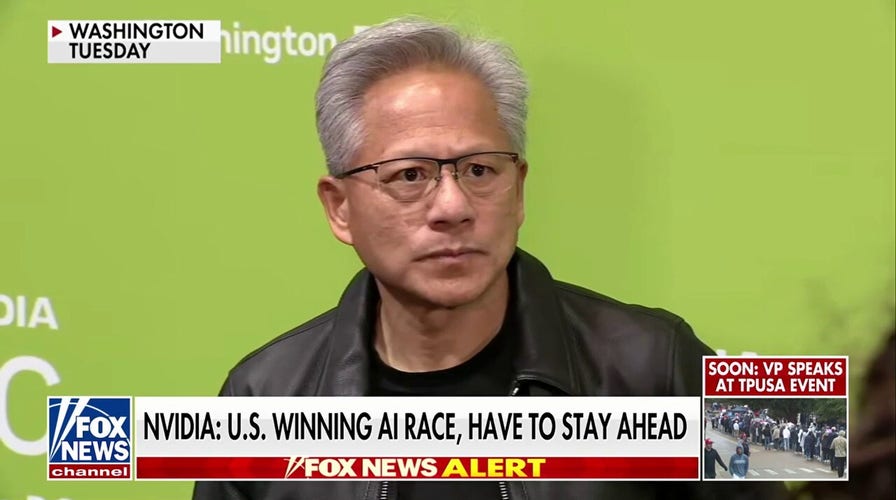
FOX Business' Madison Alworth joins ‘The Story with Martha MacCallum’ to discuss her interview with Nvidia CEO Jensen Huang on the U.S.–China AI race, workforce impact and the massive energy demand driving future innovation.
Lawmakers on Capitol Hill are split over the Trump administration’s decision to allow Nvidia to sell chips to China, a move that some see as a dangerous concession and others view as strategic.
Some lawmakers are worried about putting one of America’s most valuable products into the hands of its greatest adversary, while others familiar with the president’s thinking believe it’s a move that sets up the U.S. for long-term success.
Asked to describe the White House’s reasoning, Rep. Brian Mast, R-Fla., chairman of the House Foreign Affairs Committee, kept it simple.
NAVY SECRETARY WARNS SHIPYARDS MUST ‘ACT LIKE WE’RE AT WAR’ AS CHINA’S AI-POWERED FLEET RACES AHEAD
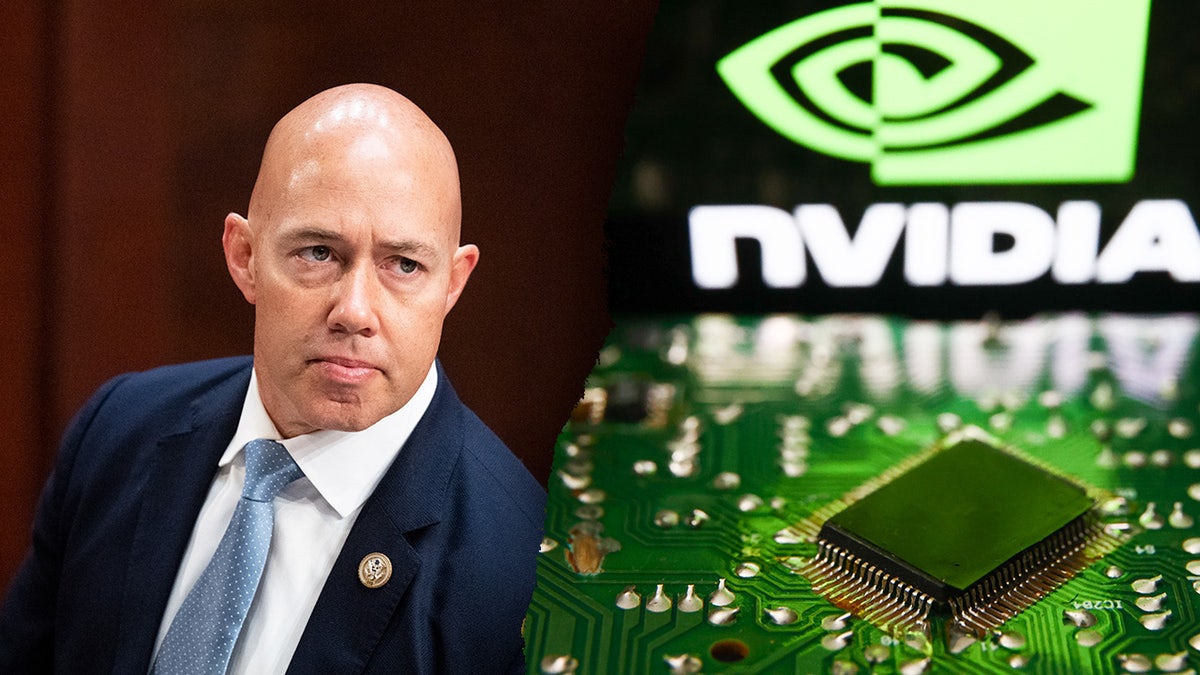
Rep. Brian Mast, R-Fla., chairman of the House Foreign Affairs Committee, pictured next to a Nvidia chip (Bill Clark/CQ-Roll Call, Inc via Getty Images; Jakub Porzycki/NurPhoto via Getty Images)
"Dominate," Mast said.
He described the decision as part of a larger plan to maintain U.S. leadership in the artificial intelligence (AI) and computing space and said the strategy had been personally communicated to him. He said he was made aware of that strategy in a one-on-one conversation with Jeffrey Kessler, the administration’s under secretary of commerce for industry and security.
While he couldn’t disclose the details of that conversation, Mast expressed renewed confidence in the White House’s leadership.
"I'll tell you there's a very specific strategy being executed to make sure that we maintain our dominance, also increase market share and widen our gap on all things AI related. Whether it's chips, coding, cloud, all the things related to it — these play into that [strategy]," Mast said.
Nvidia, the world’s foremost developer of processing chips, creates the computational power enabling some of the most cutting-edge AI breakthroughs and other developing technologies that play an increasingly important role in defense.
The company was first ordered to halt sales to China in 2022 under the Biden administration.
"The [government] indicated that the new license requirement will address the risk that the covered products may be used in, or diverted to, a ‘military end use’ or ‘military end user’ in China," the company said in a filing.
The Biden administration also prohibited Nvidia’s sales to Russia.
Lawmakers on Capitol Hill are split over the Trump administration’s decision to allow Nvidia to sell chips to China. (Kent Nishimura/Bloomberg via Getty Images)
Now that Nvidia is free to sell its high-power chips to China, some lawmakers worry that the decision could come back to bite the United States — a concern voiced by Rep. Andrew Garbarino, R-N.Y., chairman of the House Homeland Security Committee.
"We are facing a serious threat from China. So, there's always a concern. You don't want the technology that we spend so much time and money on falling into the wrong hands that could then be used against us," Garbarino said.
Among many concerns, Garbarino highlighted quantum computing, a breakthrough in computation that could upset existing information security protections like encryption. Garbarino said he hopes that the Trump administration has found some way to ensure that the technology can’t be weaponized against the United States as it has done previously.
"They do this with everything," Garbarino said.
Sen. John Fetterman, D-Pa., also shared bewilderment at the decision.
"Yeah, I don’t get this one. I mean, it's clear that China is even more than just an adversary at this point. I don't understand the logic [even] if there's a deal," Fetterman said.
"Honestly, I don't know Nvidia even needs that. They're the world's most valuable company. Do they really need more sales?" he asked.
TRUMP SAYS EVERY AI PLANT BEING BUILT IN US WILL BE SELF-SUSTAINING WITH THEIR OWN ELECTRICITY

Sen. John Fetterman, D-Pa., speaks to reporters in the Senate Subway at the U.S. Capitol Building in Washington, Feb. 12, 2025. (Anna Moneymaker/Getty Images)
Nvidia, a publicly traded entity, has a market capitalization of $4.36 trillion and earlier this year became the first company to break $5 trillion, according to The New York Times.
Mast said part of the administration’s strategy focuses on maintaining an ability to sell American technology easily, something he believes has hindered American sales of defense equipment in other areas.
"I, specifically, as foreign affairs chairman, deal with sales of things in a very encumbered process. The No. 1 complaint that comes to me from allies is that somebody paid for something, and they've been waiting 2, 3, 4, 5, 6, 10 years for whatever it is," Mast said.
"What we want to make sure of as a country is that we not create a system where our industry is bogged down in something so encumbered because we're dealing with one adversary that we can't be competitive," Mast said.
Although he understands his colleague’s hesitations, Mast hopes the administration can help resolve those concerns. He has requested the White House explain its plans to other leaders on the Hill.
CLICK HERE TO DOWNLOAD THE FOX NEWS APP
"I made the request that we broaden the aperture, starting with subcommittee leads to which [Kessler] said we would. People naturally have questions," Mast said.
Mast didn’t give a timeline for when a briefing along those lines might take place.
While the White House also didn't describe the outlines of the plans laid out by Mast, it said it would remain committed to advancing American interests across the board.
"The Trump administration is committed to ensuring the dominance of the American tech stack – without compromising on national security," White House Spokesman Kush Desai told Fox News Digital.
