

























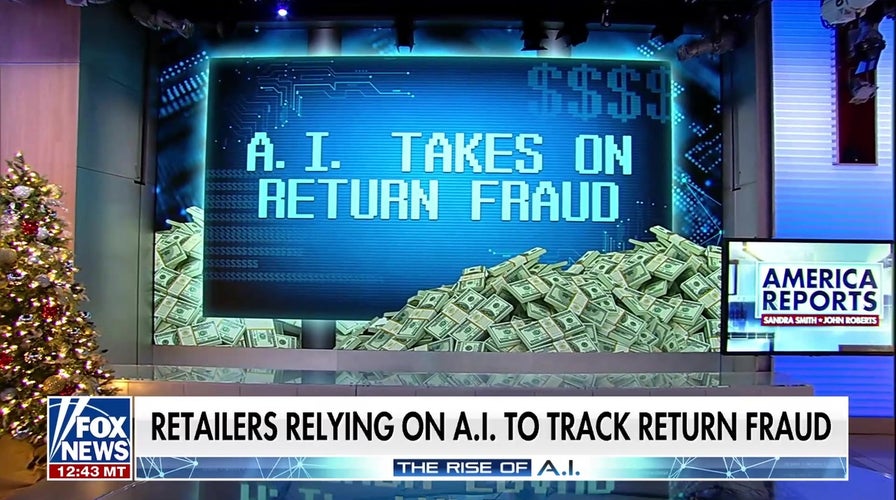
Retailers using artificial intelligence to track return fraud
FOX Business correspondent Max Gorden explains how Happy Returns is using artificial intelligence to audit legitimacy of customer returns on ‘America Reports.’
For the better part of two centuries, Americans have lived by a simple economic truth: progress disrupts. The steam engine displaced artisans. Electricity remade factories. The assembly line reduced the need for skilled craftsmen even as it made goods affordable to the masses. The computer automated clerical work. The internet hollowed out entire industries, including travel agencies, record stores and video rental outlets.
And each time, the sky was said to be falling.
Now comes generative artificial intelligence: tools that can draft contracts, write code, analyze medical scans, generate marketing campaigns and tutor students. The anxiety feels different this time. Louder. More personal.
PALANTIR'S SHYAM SANKAR: AMERICANS ARE 'BEING LIED TO' ABOUT AI JOB DISPLACEMENT FEARS
That’s because it is.
For decades, the brunt of technological change and globalization fell disproportionately on blue-collar workers. The Industrial Revolution transformed agricultural and manual labor. Late-20th-century outsourcing and automation eroded manufacturing towns across the Midwest. Global supply chains lowered costs for consumers, often at the expense of factory workers and entire communities.
The professional class — lawyers, consultants, academics, journalists, doctors, bankers, architects, designers, accountants — largely watched from a safe distance. They were the "knowledge workers," beneficiaries of the information economy. Their jobs required education, credentials and cognitive skills. Those traits were supposed to provide insulation from disruption.
Generative AI has shattered that assumption.
DEMOCRATS ARE LOSING AI BECAUSE OF A BIG MESSAGING PROBLEM
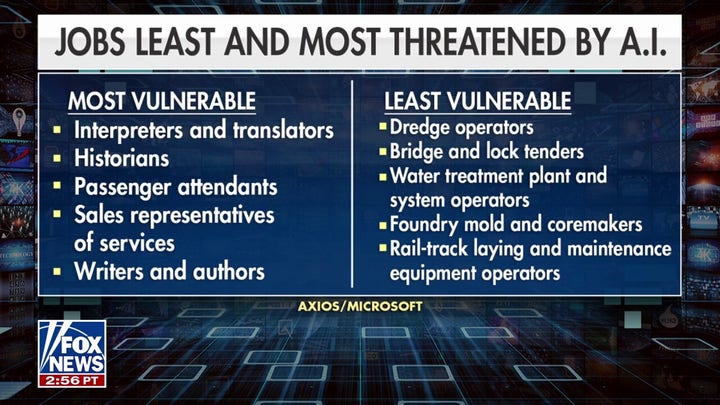
For the first time in modern economic history, the most highly educated workers find themselves squarely in the blast radius of automation. Software drafts legal briefs. AI copilots write and debug code. Language models generate polished essays and emails in seconds. Image generators design logos and marketing collateral without a design degree.
This isn’t just another productivity tool. It’s a general-purpose technology, like electricity or the internet, touching nearly every sector at once. And it’s moving at a speed that makes previous revolutions look slow by comparison.
That pace is unsettling. But it is not a reason to retreat.
TRUMP'S SCIENCE AND TECH MAN LAYS OUT WHITE HOUSE'S GLOBAL AI STRATEGY
Economist Joseph Schumpeter called this process "creative destruction" — innovation dismantling old industries to make room for new ones. It is not painless. But it is the engine of prosperity in a dynamic economy. America’s global leadership has always depended on our willingness to lean into change rather than legislate it away.
What makes this moment feel volatile is not merely the scope of change, but who it affects. Disruption has reached the offices, not just the factory floor. It is threatening the comfortable as well as the vulnerable.
That discomfort is understandable. It is also clarifying.
ELON MUSK SAYS YOU CAN SKIP RETIREMENT SAVINGS IN THE AGE OF AI. NOT SO FAST
When automation came for blue-collar America, many in the professional class invoked "market forces." When globalization decimated manufacturing jobs, workers were told to retrain for the knowledge economy.
Now the knowledge economy itself is being redefined.
The answer remains the same: adaptation.
The workers who will thrive in the AI era will not be those who reject or defer to these tools, but those who master them. Generative AI is not a replacement for human intelligence. It is an amplifier.
It drafts the first version; judgment refines it.
It generates code; humans decide what to build.
It analyzes mountains of data; people determine what matters.
In medicine, AI flags anomalies, but doctors interpret them and treat patients. In law, AI summarizes case law, but attorneys craft the argument. In education, AI accelerates knowledge, but teachers shape character and curiosity.
The winners will treat AI as augmentation, not competition.
AI RAISES THE STAKES FOR NATIONAL SECURITY. HERE’S HOW TO GET IT RIGHT
There is a reason for optimism here. Generative AI democratizes capabilities once scarce. A small business owner can generate marketing copy without hiring an agency. A startup founder can prototype software without a massive engineering team. A student in a rural district can access high-quality tutoring on demand.
Yes, some jobs will disappear. Some roles will evolve. Entire workflows will be redesigned. That has always been true during periods of rapid technological advancement.
New categories of work will emerge: AI trainers, model auditors, human-AI workflow designers, data curators, governance specialists and roles we cannot yet imagine.
PALANTIR'S SHYAM SANKAR: HERE'S WHAT EXECUTIVE AND LEADERS USING AI SHOULD DO
The question is not whether change is coming. It is whether America will shape it, or allow others to.
Other nations are racing to lead in artificial intelligence. China, in particular, views AI not only as an economic engine but as a strategic asset. Authoritarian systems will deploy these tools at scale.
The United States became the world’s most dynamic economy not by freezing innovation, but by channeling it. We do not win by retreating from technology. We win by leveraging technology more effectively than anyone else.
THE NEW ARMS RACE IS FOR COMPUTE — AND AMERICA CAN’T AFFORD TO FALL BEHIND
There is a profound opportunity embedded in this shift. With AI tools, individuals can accomplish far more than they could on their own. Productivity will rise not because humans matter less, but because they can do more. The advantage will belong to those who are flexible, adaptable and highly skilled at using tools to amplify their own effectiveness.
The transition will require serious investment in education and workforce development. It will demand humility from institutions that assumed credentials guaranteed security. And it will require policymakers to balance innovation with sensible safeguards.
But the proper response to disruption is not nostalgia. It is preparation.
The Industrial Revolution raised living standards. The computer age created industries employing millions. The internet unlocked global commerce and communication. None of those transitions were smooth. All expanded opportunity.
Generative AI is the next chapter in that American story.
The most resilient individuals and companies will not ask how to preserve yesterday’s job descriptions. They will ask how to combine human intelligence with machine capability to produce better outcomes, faster and at lower cost.
CLICK HERE FOR MORE FOX NEWS OPINION
That is not artificial intelligence.
That is augmented human intelligence.
That is not decline.
CLICK HERE TO DOWNLOAD THE FOX NEWS APP
That is renewal.
The age of augmentation has arrived. Let’s meet it the way Americans always have: with confidence, hard work and faith in our ability to build what comes next.
