6 days until midterms, Trump returns to Ohio as Republicans fight to hold once-safe state
President Donald Trump is returning to Ohio to rally Republican candidates as the party leans on his campaign power and cultural issues in the final days before Election Day.
President Donald Trump is scheduled to campaign in Chillicothe, Ohio, on Wednesday as Republicans work to protect the state’s Senate and gubernatorial races.
Trump’s visit will be his third to Ohio this month and the fifth visit by the president or Vice President JD Vance, reflecting Republican concern about turnout and the competitiveness of races in a state Trump won by 11 points in 2024.
The Senate race between Republican Sen. Jon Husted and Democrat Sherrod Brown is among the contests that could help determine control of the chamber. The governor’s race has also drawn national attention amid controversy over Republican candidate Vivek Ramaswamy’s ad targeting Democratic rival Amy Acton’s childhood.
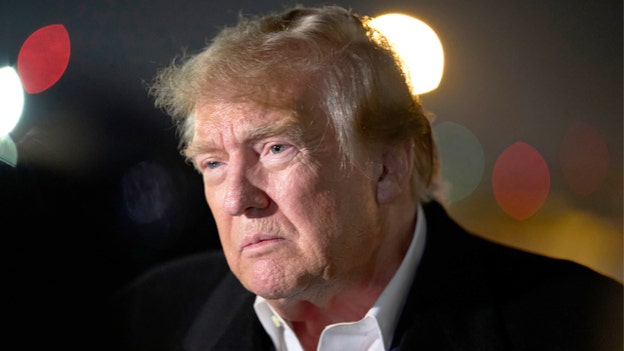
President Donald Trump arrives on Air Force One, Wednesday, Oct. 28, 2026, at Joint Base Andrews, Md. (AP Photo/Alex Brandon)
The Federal Reserve is widely anticipated to freeze benchmark interest rates Wednesday afternoon, opting for a brief policy pause just six days before nationwide midterm elections where consumer inflation and living costs remain the central fight between parties.
Investors have priced in a 90% probability that the Fed will leave the federal funds rate in the 3.75% to 4.00% range when it releases its 2 p.m. ET policy statement.
The expected decision sidesteps an immediate election-eve rate shock, shifting the political spotlight directly to the Nov. 3 balloting that will decide control of both chambers of Congress.
Yet the reprieve offers little comfort on the cost of living.
Rather than signaling an end to borrowing pain, market analysts and central bank watchers see Wednesday’s move as a tactical "skip" before borrowing costs climb again.
With inflation stuck at or above 3% annualized amid rampant growth – above the central bank’s 2% target but well below the average during the Biden administration post-COVID – economists project as many as three additional rate increases stretching into mid-2027.
Reuters contributed to this report.
Coordinated disinformation videos believed to be generated with artificial intelligence and traced to Russia are reportedly hijacking real people’s identities to smear Democratic Senate candidates in the critical final stretch of midterm voting.
The operations have deployed fabricated allegations against candidates in two high-stakes races, weaponizing the names and photos of unsuspecting private citizens to deceive voters before ballots are tallied.
In Ohio, a deceptive video stylized as a legitimate television newscast targeted Sherrod Brown in his race against incumbent Sen. Jon Husted, R-Ohio. The clip featured photos of former staff members, including former intern Haya Akbik, falsely attributing explosive accusations to her.
“It’s my name, it’s my reputation, making this allegation, and it’s just completely false,” Akbik told The Associated Press, calling the smear appalling.
“And it harms the senator, someone else, in the process. So, it’s just messed up.”
Akbik added that the exploitation of her likeness demonstrates why lawmakers must rein in what she called “AI slop on the internet,” warning that “this is so damaging.”
A similar attack surfaced in Texas aimed at James Talarico, who is challenging Sen. Ken Paxton, R-Texas. That video adopted the format of an intimate, direct-to-camera confessional purportedly from one of Talarico’s former students, but researchers found the testimonial was manipulated using artificial intelligence tools.
“The most powerful people in the world know they can’t beat James Talarico with the truth, so they’re slandering him with AI deepfakes, foreign bots, and conspiracy theories to protect their broken, corrupt political system,” Talarico campaign spokesperson JT Ennis said.
Digital forensics experts told AP the campaign bears unmistakable ties to Storm-1516, a well-known Russian disinformation network that ran sophisticated online influence campaigns during the 2024 presidential election.
Dartmouth College professor Hany Farid, an expert in synthetic media, found the Brown clip was a “fairly low-tech fake,” he told AP, while the Talarico confessional was likely produced through generative AI, noting that “it is consistent with previous disinformation campaigns released close to Election Day.”
AP contributed to this report.
Sen. Lisa Murkowski, R-Alaska, has thrown her support behind Democratic Alaska gubernatorial candidate Jonathan Kreiss-Tomkins as well as his nonpartisan running mate Zac Johnson, who is seeking the lieutenant governorship.
"Our future is too important to be hamstrung by partisan divisions,” Murkowski said, according to a press release from the candidates' campaign. “Jonathan understands that governing requires listening to people with different perspectives and finding common ground to solve the problems all of us face. Alaska needs a serious conversation about our fiscal future, as well as a focus on the cost of energy and growing our economy. I believe Jonathan is committed to working toward solutions that serve all Alaskans, regardless of party.
"I encourage Alaskans of every political stripe, whether Republicans, independents, or Democrats, to take a close look at Jonathan and Zac. Alaska needs leaders who will put our state first, and I’m proud to support them.”
While there are multiple Republicans running in the ranked-choice voting contest, President Donald Trump has endorsed Bernadette Wilson.
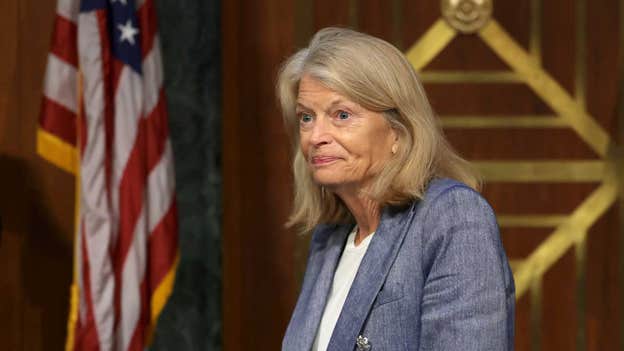
U.S. Sen. Lisa Murkowski (R-AK) arrives to a Senate Appropriations Committee hearing in the Dirksen Senate Office Building on Capitol Hill on July 21, 2026 in Washington, D.C. (Anna Moneymaker/Getty Images)
The Department of Justice (DOJ) announced Monday that investigators have identified more than 400 noncitizens illegally registered to vote in Washington state, some of whom have cast ballots in multiple elections dating back decades.
Many on the list are green card holders with legal immigration status and permanent residency, according to the U.S. attorney’s offices for the Eastern and Western districts of Washington.
"We have identified over 400 noncitizens who are registered to vote and have voted in multiple elections. This is only the tip of the iceberg," Neil Floyd, acting U.S. attorney for the Western District of Washington, said in a statement.
It seems like there are two electorates in these midterms.
The first is frustrated with President Donald Trump and ready to reject Republicans. It includes growing numbers of independent, rural and Hispanic voters who say they’ll vote for a Democrat.
That’s what the latest round of House polling shows, including a survey last week that had Democrats up 11 points on the generic ballot, and Fox’s most recent national poll.
The second electorate is wavering on Republicans but won’t necessarily hand Democrats the Senate. These are the voters in the Midwest and a few other places. They say they prefer the Democrat or Republican in their states by a point or two at most.
That’s the right conclusion from most of the battleground Senate polling.
How could both things be true? In other words, if Democrats have such a wide lead in the House, won’t the Senate fall too?
Both are true, and a big lead in the House doesn’t necessarily translate to the Senate. These voters are all in the same electorate, and they only seem divorced from each other because the House and Senate maps are so far apart this year.
A growing intraparty fracture is roiling the South Carolina Senate race as a Republican congressman is accusing President Donald Trump of trying to force his hand-picked candidate on Palmetto State voters.
Rep. Ralph Norman, R-S.C., who lost to Sen. Darline Graham, R-S.C., in a runoff for the Senate GOP nomination earlier this year, told Fox News Digital on Tuesday that he has no plans to help Graham in the final week before Election Day.
"The voters in S.C. are not buying the argument that everyone has to ‘settle’ for a candidate that has been propped up by special interest groups and a Republican president spending millions of dollars spreading false narratives about why Darlene [sic] Graham is qualified to be elected to the U.S. Senate for the next six years," Norman told Fox News Digital via text message in all capital letters.
He said the general election "is about attempts to ‘force’ a candidate on the voters of S.C. and regardless of the outcome, it didn’t have to be this way as the great people living in South Carolina deserve ‘better!!’"
"Elections have consequences," Norman ended the message.
This is an excerpt from an article by Fox News Digital's Elizabeth Elkind and Alex Miller, click here to read more
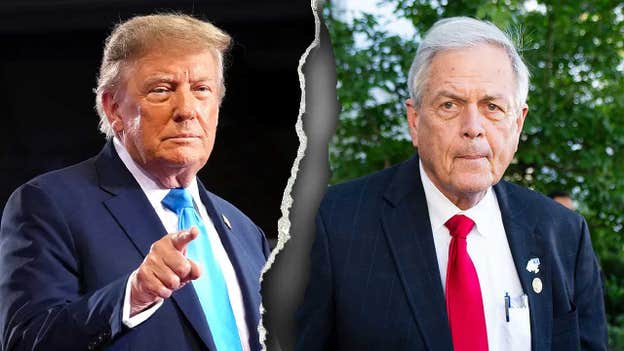
Rep. Ralph Norman, R-S.C., is accusing President Donald Trump of trying to "force" a Senate candidate on South Carolinians. Norman lost the GOP primary for the open Senate seat to Sen. Darline Graham, R-S.C. (Eric Lee/Getty Images; Bill Clark/CQ-Roll Call, Inc via Getty Images)
Vice President JD Vance said Tuesday that Michigan represents the nation’s most important election next week as Republicans fight to hold the Senate seat targeted by Democrat Abdul El-Sayed.
Speaking at a rally in Howell, Vance framed the race between Republican Mike Rogers and El-Sayed as a “clash of competing visions” and urged voters to send Rogers to the Senate.
“Michigan is the most important election in the United States of America in a week,” Vance said, arguing that the state’s Senate race reflects a broader choice between Republican policies and what he called the “far left.”
Vance’s appearance came as President Donald Trump prepared to campaign in Ohio, another state Republicans won comfortably in 2024 but are now treating as a critical battleground.
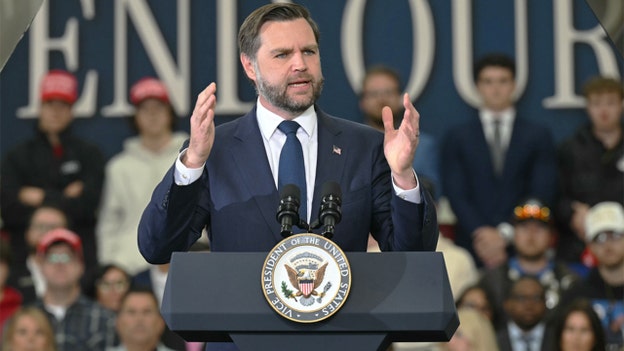
Vice President JD Vance speaks at a midterm campaign rally at CHI Aviation in Howell, Mich., Tuesday, Oct. 27, 2026. (Saul Loeb/Pool Photo via AP)
Republicans are leaning heavily on President Donald Trump and transgender-related attacks as they make their closing arguments before Election Day.
GOP campaigns and allied groups have spent an estimated $183 million on transgender-focused television ads this election cycle, according to AdImpact data provided to The Associated Press.
The strategy comes as Republicans face voter frustration over high prices, rising fuel costs and the war with Iran. About 8 in 10 voters in an October AP-NORC poll cited the economy or cost of living as one of the most important issues in the election, compared with roughly 1 in 10 who cited transgender issues.
The final days will test whether cultural issues can motivate voters enough to overcome economic anxiety and concerns about Trump’s leadership.
The Associated Press contributed to this report.
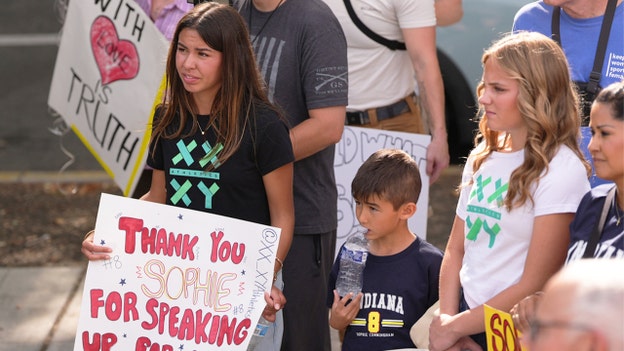
Ahnaleigh Wilson, 17, a track athlete who says she has competed against and placed behind transgender athletes at meets, holds a sign for Indiana Fever guard Sophie Cunningham during a rally before a WNBA basketball game between the Fever and the Seattle Storm, Tuesday, July 28, 2026, in Seattle. (AP Photo/Lindsey Wasson)
Live Coverage begins here