





















Stone Age dog buried with 5,000-year-old dagger found in Sweden
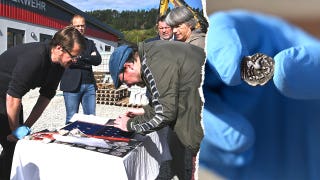
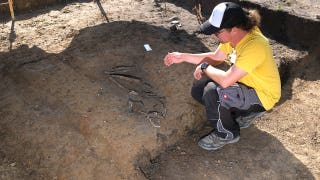
Archaeologists have discovered an exceptionally well-preserved Stone Age dog skeleton buried with a 5,000-year-old bone dagger in a Swedish bog.
Archaeologists recently uncovered two gold rings at an ancient burial site in Thailand — one of them engraved with an intriguing message that dates back 2,000 years.
The rings were found at the Don Yai Thong archaeological site in the Phetchaburi Province in late June, The Associated Press reported.
Thailand's Fine Arts Department said the rings were buried alongside human bones.
CAVE DISCOVERY PUSHES BACK EVIDENCE OF HUMAN ANCESTORS USING FIRE TO 1.79M YEARS AGO
Located in western Thailand, Don Yai Thong is about 80 miles southwest of Bangkok and was only recently identified as an archaeological site.
Residents found fragments of ancient bronze drums in a rice field earlier this year, prompting archaeologists to excavate the site.

Archaeologists uncovered two ancient gold rings at Thailand's Don Yai Thong archaeological site during excavations of a 2,000-year-old burial. (The Fine Arts Department via AP)
A picture of one ring shows a short inscription etched into its oval face, which experts believe is written in the ancient Indian Brahmi script.
Experts believe the script reads "pusarakhitasa," meaning "the one protected by Pushya."
CLICK HERE TO SIGN UP FOR OUR LIFESTYLE NEWSLETTER
Pushya is a lunar constellation in ancient Indian astronomy long associated with good fortune and protection, suggesting the inscription may have been intended as a blessing.
The other gold ring is similarly well-preserved, but does not have any pattern.

One of the newly discovered gold rings bears an inscription in the ancient Indian Brahmi script that experts believe conveys a protective blessing. (The Fine Arts Department via AP)
Experts believe the rings' owner may have belonged to the Vaishya class, which was traditionally associated with merchants and traders in ancient India's caste system.
The rings are among a host of discoveries at the site, including eight human skeletons, bronze and gold jewelry, pottery and other artifacts.
CLICK HERE FOR MORE LIFESTYLE NEWS
The grave goods suggest the deceased were members of society's upper class.
Research at the archaeological site will continue, officials said, and the excavation is expected to wrap up some time in July.

The second ring was found without a visible inscription or decorative pattern. (The Fine Arts Department via AP)
Eventually, the artifacts will be put on public display, the AP reported.
The discovery follows other archaeological excavations that have uncovered ancient gold treasures across the world.
TEST YOURSELF WITH OUR LATEST LIFESTYLE QUIZ
In February, Panamanian officials announced archaeologists had unearthed a more than 1,000-year-old tomb filled with gold artifacts, finely crafted ceramics and other funerary offerings at the El Caño archaeological site.

Experts continue to examine the burial site as excavations shed new light on life in the region roughly 2,000 years ago. (The Fine Arts Department via AP)
In May, Egyptian archaeologists uncovered a cache of ancient artifacts at the biblical city of Heliopolis, also known as On.
CLICK HERE TO DOWNLOAD THE FOX NEWS APP
The Associated Press contributed reporting.
