

























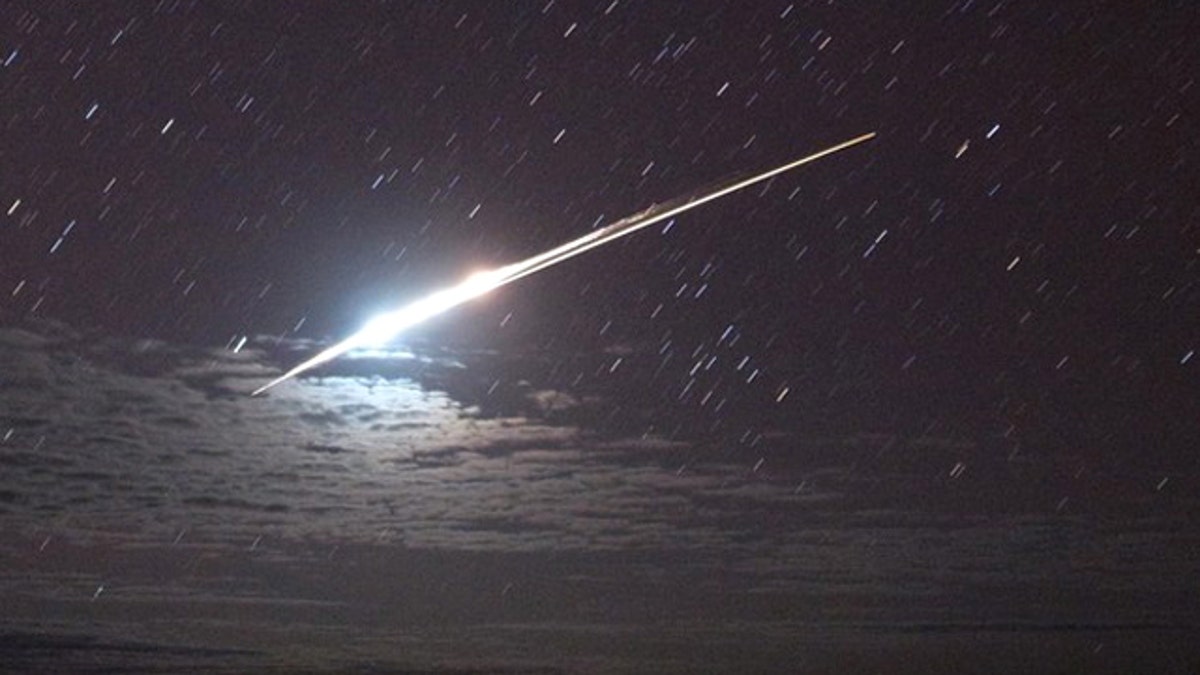
The successful re-entry of the Japanese space probe Hayabusa caused a bright streak in the night sky, seen from Glendambo in the Australian outback June 13, 2010. Hayabusa landed in the Australian outback on Monday after a 7-year voyage to an asteroid. (REUTERS/Wakayama University Institute for Education on Space)
A Japanese space probe that ended a seven-year voyage earlier this year brought back dust from the surface of an asteroid for the first time, Japan's space agency said on Tuesday.
Scientists hope the particles will help unlock secrets of the solar system's formation.
The unmanned craft Hayabusa, meaning "falcon" in Japanese, was destroyed on re-entry in June, but managed to drop a container bearing the sample after landing on the near-Earth asteroid Itokawa in 2005.
The Japan Aerospace Exploration Agency (JAXA) says the particles may offer clues about how the solar system was formed 4.6 billion years ago.
Asteroids are believed to have retained their original state over time, unlike the Earth's surface, which has been affected by atmospheric changes, water and volcanic activity.
"There is so much that humans don't know, such as how the moon was formed," a JAXA spokesman said. "But research, not just into these particles but into other findings, could provide us with hints on how the solar system and the planets were formed."
Part of the sample would be distributed next year to researchers around the world for further tests, JAXA said.
Most of the particles were smaller than one-100th of a millimeter and components included minerals such as olivine, pyroxene and plagioclases.
Scientists also hope the findings will shed light on the risk to Earth from asteroid impacts.
