





















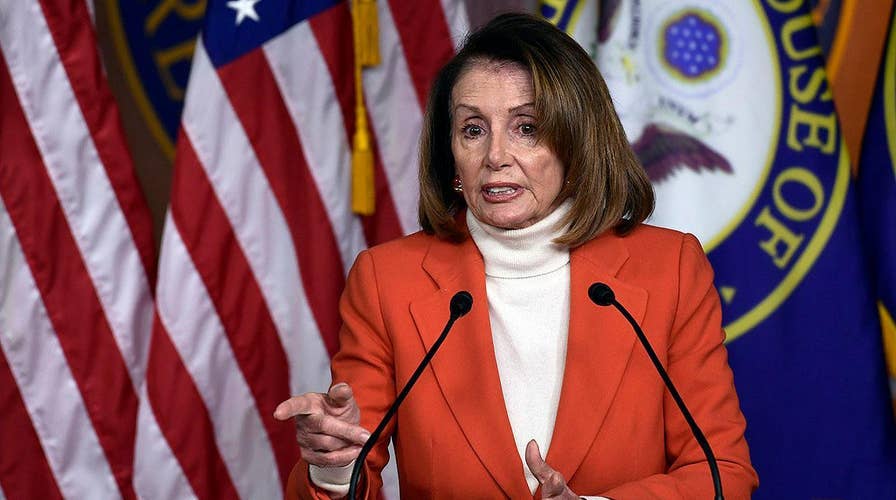
Could Republicans help Pelosi become House speaker?
House Democrats pen an open letter opposing Nancy Pelosi for speaker, but President Trump wants her to win.
As a Democrat, I have been open about my view that the party needs fresh leadership, especially at the federal level. In 2016 I publicly supported Rep. Tim Ryan, D-Ohio, in his bid to challenge Rep. Nancy Pelosi, D-Calif., for the position of House minority leader.
Ryan was unsuccessful two years ago. Today Pelosi is still the minority leader. But this cycle she’s not licking wounds of defeat. Instead, she led Democrats to victory, taking back the House by a pretty resounding margin in the Nov. 6 midterm elections.
Despite the good news, there are House Democrats who still want to prevent Pelosi from taking back the speaker’s gavel in January, when the Democrats become the majority party in the chamber.
Some of those opposed to Pelosi – like Rep. Kathleen Rice, D-N.Y. – argue that the Democrats won back the House majority due at least in part to the fact that candidates campaigned on supporting new leadership if elected to Congress.
And on Monday, Rice – along with 15 other current, newly elected and potentially elected Democratic House members – signed a letter publicly committing to vote against Pelosi both within their caucus meeting Nov. 28 and on the floor Jan. 3.
On Pelosi’s watch, House Democrats have both won and lost seats. Pelosi has been challenged in years where Democrats performed poorly, yet she still held on to the leadership spot even under the grimmest of electoral climates. So what would make Democrats think Pelosi is vulnerable now?
Since 16 members could be enough to stand between Pelosi and the speaker’s chair, the anti-Pelosi crew may think they have her painted into a corner. But, as a former whip and Democratic leader in the Ohio state Senate, I can attest that no vote is guaranteed until it is actually cast.
Without knowing how many seats Democrats really have to work with, this letter opposing Pelosi may not be as damning as it seems.
As of Tuesday morning, Democrats have won 232 House seats in the Nov. 6 midterm elections, Republicans have won 199 and four races remain too close to call.
This matters because two individuals who are part of the anti-Pelosi group of 16 are not actually elected yet. One or both of them may never get a chance to vote for speaker at all. So 16 members could easily dwindle to 14, should the two candidates ultimately lose their races.
Furthermore, the anti-Pelosi group is opposing her without presenting a clear alternative. One would think that if this group was so adamant about ousting Pelosi, someone would either step up and run for speaker himself or herself or recruit a candidate who could mount a credible campaign.
Rep. Marsha Fudge of Ohio, is the only House Democrat who has emerged as a possible challenger to Pelosi. Fudge has expressed her opposition to Pelosi but did not sign the letter committing to vote against her, raising questions about Fudge’s seriousness.
If there is no one willing to run against Nancy Pelosi for speaker, what is the point of undermining her? Yes, Pelosi is 78, from San Francisco and has seemingly been in the House forever (1987, actually).
Her detractors say Pelosi’s day has come and gone, and a new generation of leadership is needed to reinvigorate the caucus. However, the Never Nancy group’s inability to provide a true choice proves Pelosi’s argument that she is the only one with the experience to shoulder the responsibility of being speaker of the House.
Say what you will about Pelosi, but she is dogged and has a successful track record delivering legislative victories when it counts. While she was speaker she held together enough House votes to pass the Affordable Care Act, a major stimulus package, a minimum wage increase, Wall Street reform and a fair pay act.
These bills were pretty heavy lifts, but Pelosi made them happen. Because those who oppose Pelosi cannot even deliver enough votes for an alternative speaker candidate, they prove that they do not possess the same level of skill Pelosi has shown time and again.
I hope they prove me wrong. As someone who craves a new direction within the Democratic Party, it is disappointing – but not surprising – that we can’t get our act together long enough to change course.
In the absence of a credible challenger like Tim Ryan was in 2016, Pelosi seems like the only choice Democrats have to ensure someone with experience is at the helm.
Democrats are good at undermining our own best interests. To make matters even more intriguing, House Republicans may actually be the ones to help Pelosi over the finish line.
GOP members of the bipartisan Problem Solvers Caucus have expressed their willingness to support Pelosi for speaker if she commits to advance House rule changes that would allow more votes on bills that have a high number of co-sponsors from both parties.
Think of it this way: a Democratic speaker could be beholden to Republican members, creating a tenuous environment to advance a Democratic policy agenda.
The 24 GOP members of the Problem Solvers Caucus could prove to be just the insurance policy Pelosi needs to win even if 15 of her Democratic members defect. This would be a pretty unprecedented move, but remember, Nancy Pelosi plays to win.
