























US-China AI race intensifies as tech models, classroom robots fuel urgency
Former Deputy National Security Advisor Steve Yates and Kurt ‘CyberGuy’ Knutsson discuss a New York school’s plans to introduce the first humanoid robot in a classroom and the state of the U.S.-China AI race on ‘Fox & Friends.’
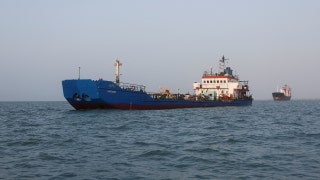
An enormous vessel taking shape near Guangzhou, China, appears designed to refuel, rearm and resupply Chinese carrier groups far from home. At roughly 885 feet long, it could become the world’s largest dedicated naval replenishment ship.
Every Army officer learns the same lesson: weapons attract attention, but logistics decides who can stay in the fight.
The ship does not prove that war is imminent. It does, however, fit a larger pattern. China is building the physical, industrial and technological capacity to absorb economic punishment, replace battlefield losses and project power long after a crisis begins. Taiwan remains the most dangerous flashpoint, but Beijing is preparing for a contest that could continue well beyond the opening shots.
CHINA’S IRAN TIES COMPLICATE TRUMP-XI SUMMIT AS TENSIONS TEST US LEVERAGE
Beijing is stockpiling staying power
Energy is the first requirement of endurance. By late February, China held an estimated 1.2 billion barrels of onshore crude, enough to cover roughly 109 days of seaborne imports. Those stocks gave Beijing more room to absorb the oil-market shock created by the Iran war.
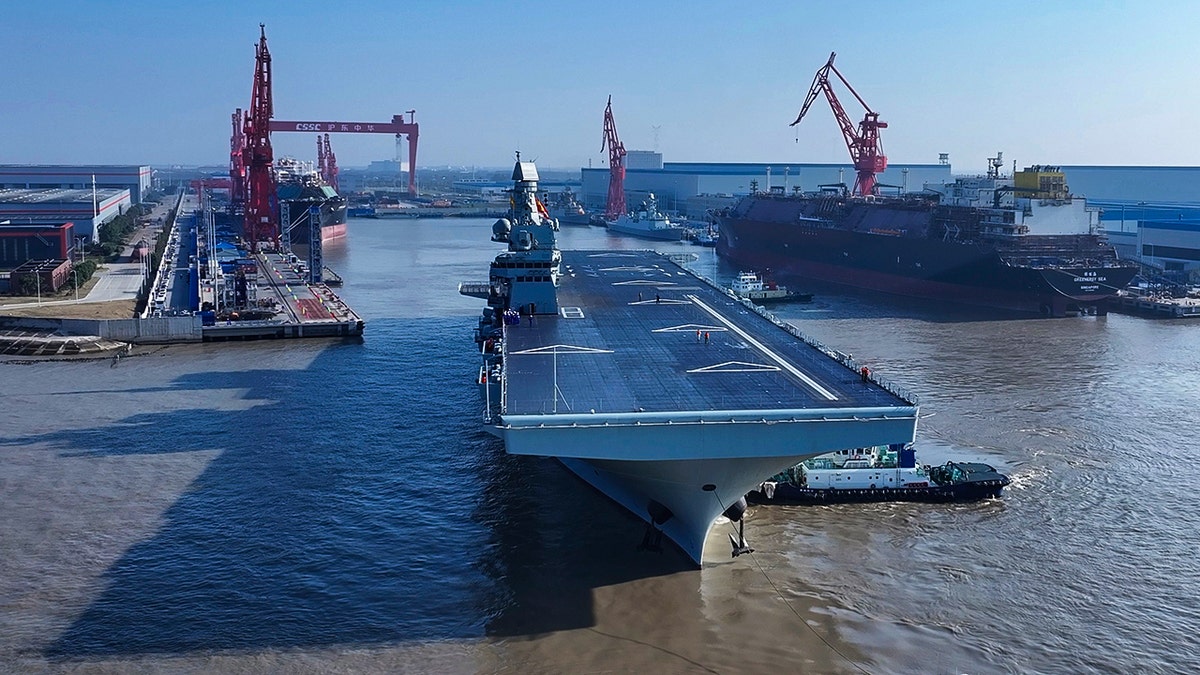
China is also expanding its navy. Its latest warship, an amphibious ship capable of launching drones and aircraft, begins sea trials to test power and stability. (Zhang Liang/Xinhua via AP)
Beijing is extending its military reach as well. The Pentagon says China is developing a global logistics and basing network that could include permanent bases, shared facilities, military sites beside commercial infrastructure and temporary access to foreign ports. A joint logistics center opened at Cambodia’s Ream Naval Base in April 2025, while China continues to explore access along the sea lanes through the Malacca Strait, the Strait of Hormuz, Africa and the Middle East.
THREE KEY REASONS WHY AMERICA CANNOT AFFORD TO LOSE TAIWAN TO COMMUNIST CHINA
Beijing is building the ships that carry power and the access network that keeps them supplied.
The factories behind the fleet
China’s advantage is not confined to ships already afloat. It has built an industrial system able to manufacture and repair them. A U.S. Trade Representative investigation found that China’s share of global shipbuilding tonnage rose from less than 5% in 1999 to more than 50% in 2023. Commercial orders sustain the workers, steel mills, dry docks and suppliers that also strengthen the Chinese navy.
TIM SHEEHY EXPOSES A 'SCARY' SHIPBUILDING COLLAPSE THAT LEAVES THE US VULNERABLE TO CHINA
The same pattern is visible in the air. The Royal United Services Institute estimates that production of the upgraded J-20 stealth fighter reached about 120 aircraft a year by late 2025. An open-source assessment places the total delivered by mid-2026 at roughly 500. The exact number matters less than the lesson: China can mass-produce a sophisticated combat aircraft once dismissed as experimental.

On July 6, a Chinese nuclear-powered submarine launched a long-range ballistic missile into the Pacific. Whatever Beijing’s characterization, the test demonstrated greater sea-based nuclear reach and complicated any American calculation about intervening in a regional war.
China is not simply buying a military. It is building the means to replace one after losses begin.
Control the next missile
Modern weapons depend on minerals, chips and data. The International Energy Agency reports that China is the leading refiner for 19 of 20 strategic minerals it tracks, with an average market share of about 70%. Those materials feed batteries, power grids, jet engines, electronics and defense systems. In a long confrontation, control over the ingredients needed to build the next missile may matter as much as the missile already in the launcher.
Beijing is shrinking its semiconductor vulnerability too. Chinese companies held 33% of global production capacity for foundational logic chips in 2023, up from 19% in 2015. These are not the most advanced chips, but they are workhorses inside vehicles, industrial equipment, communications systems and many weapons.
The ship does not prove that war is imminent. It does, however, fit a larger pattern. China is building the physical, industrial and technological capacity to absorb economic punishment, replace battlefield losses and project power long after a crisis begins.
Advanced computing power fits inside this strategy too. At the World Artificial Intelligence Conference in Shanghai, Xi Jinping promoted Chinese open-source models, training for developing countries and a new coalition called the World Artificial Intelligence Cooperation Organization. Beijing wants Chinese technology and standards embedded across the Global South.
Space ties these systems together. The U.S. Space Force says China ended 2025 with more than 1,353 satellites in orbit, including more than 510 capable of intelligence, surveillance and reconnaissance. Those systems improve Beijing’s ability to locate American carriers, track deployed forces and support long-range targeting.
Preparing for financial and political pressure
China’s Cross-Border Interbank Payment System now has 210 direct participants and 1,619 indirect participants. It does not replace the dollar; the renminbi accounted for only 1.99% of reported global currency reserves in the first quarter of 2026. Its purpose is more practical: keep essential trade moving if Western financial channels are restricted.
The campaign also reaches inside the United States. In June, the Justice Department and FBI disabled 13 websites allegedly backed by Chinese intelligence personnel. The sites posed as consulting businesses and targeted current and former U.S. officials and military personnel, especially security-clearance holders. Investigators said the operation used computer-generated profile photographs, professional networking sites and online payments to appear legitimate.
China is preparing to sustain power abroad while seeking leverage inside the societies most capable of resisting it.
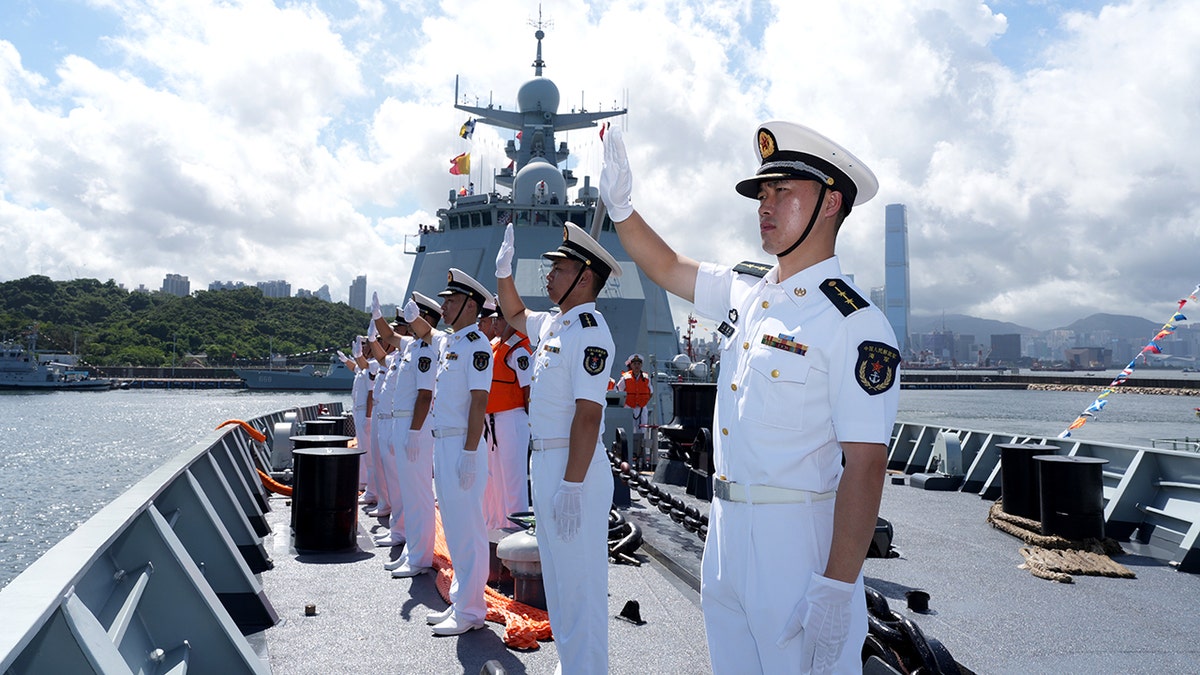
Officers and soldiers aboard the Chinese People's Liberation Army PLA Navy's guided-missile destroyer Nanning wave as the ship enters the waters of the Hong Kong Special Administrative Region in south China, July 2, 2026. (Ji Peng/Xinhua via Getty Images)
China can still fail
Beijing has serious weaknesses. China’s population fell by 3.39 million in 2025. Its property slump continues to depress confidence and domestic demand. The People’s Liberation Army has not fought a war since 1979 and lacks extensive modern combat experience, and the renminbi remains far from challenging the dollar.
Those weaknesses do not disprove the strategy. They explain why Beijing is building buffers. Xi understands where China is vulnerable and is methodically reducing those vulnerabilities before a major crisis.
America’s problem
Washington still treats shipbuilding as a Navy issue, semiconductors as a Commerce Department issue, minerals as a trade issue, espionage as an FBI issue and Taiwan as an Indo-Pacific Command issue. Beijing sees one contest.
America must do the same. We need larger stockpiles of munitions and strategic materials, sustained investment in shipbuilding and repair, secure allied supply chains, hardened space and communications networks, and deeper coordination with Japan, Australia, South Korea, the Philippines, Taiwan and Europe. We must also warn current and former officials about Chinese recruitment methods without treating Chinese Americans as suspects.

The giant vessel near Guangzhou may never dominate a television broadcast. It lacks the drama of a missile launch or a stealth fighter crossing the Taiwan Strait.
But it may tell us more about China’s plans than either.
CLICK HERE FOR MORE FOX NEWS OPINION
Xi is building a country capable of fueling its forces, replacing losses, protecting industry and operating beyond the reach of a quick American knockout. China is preparing not only for a battle, but for the long contest that follows.
CLICK HERE TO DOWNLOAD THE FOX NEWS APP
The urgent question is whether America is doing the same.
Nations that lose that race rarely get to run it twice. Beijing is spending every year of American hesitation to build its advantage. Washington still has time to close the gap, but not much of it remains.
