




















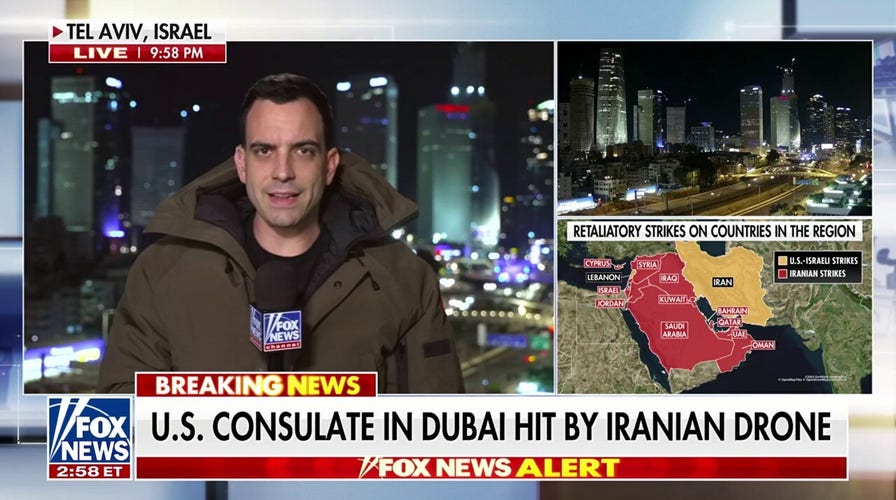
Iranian drone strikes US consulate in Dubai
Fox News chief foreign correspondent Trey Yingst has the latest on the Iranian conflict on 'America Reports.'
Operation Epic Fury has the potential to be a game changer in America’s fight against terrorism. President Donald Trump has taken decisive steps to cripple a known state sponsor of terror, one that has targeted innocent civilians — including Americans — for almost 50 years.
Unfortunately, we can’t assume retaliation by Iran and its proxies will be limited to the region. Nor can we expect that other proponents of terrorism will stop targeting the United States. The FBI and Department of Homeland Security have both announced they are now on high alert for homeland attacks.
The strikes against Iran come as America nears the 25th anniversary of the attacks of September 11, 2001. This anniversary is an opportunity to evaluate how the country has fared in its fight against terrorism and where we must focus our efforts going forward.
LIZ PEEK: DEMOCRATS RAGE OVER TRUMP’S IRAN STRIKES AS EXILES CHEER AYATOLLAH’S FALL

The U.S. Privacy and Civil Liberties Oversight Board (PCLOB), on which I serve, takes this as its mission. The 9/11 Commission recommended the creation of PCLOB to help ensure that government actions taken to protect the nation from terrorism are balanced with the protection of privacy and civil liberties. A bipartisan congressional panel, chaired by Rep. Elise Stefanik (R-NY) and co-chaired by Rep. Josh Gottheimer (D-NJ), is now evaluating how the Intelligence Community has implemented the 9/11 Commission’s recommendations and whether our intelligence agencies are equipped to counter the threats the United States will face over the next 25 years.
Based on PCLOB’s work reviewing government counterterrorism programs for national security value and privacy and civil liberties protections, here are some things the panel should consider:
Don’t Forget About Terrorism
While attention turns toward "great power" competition with China and Russia, 25 years without another large-scale mass casualty terrorist attack is not the result of luck. Military operations like Operation Epic Fury have disrupted terror networks overseas. And constant vigilance by law enforcement and intelligence officers has consistently and quietly thwarted numerous attacks. A new generation must be trained and appropriately resourced to fight terrorism.
TRUMP PLEDGES TO 'AVENGE' FALLEN US SERVICE MEMBERS AS TENSIONS WITH IRAN INTENSIFY
Don’t Rebuild "The Wall"
The 9/11 Commission identified a policy prohibiting information sharing between FBI personnel working on intelligence matters and those working on law enforcement investigations — known as "the wall" — as a major factor that prevented discovery of the 9/11 plot. The Commission even found records of a dispute between an agent trying to track down two of the terrorists and an intelligence analyst who refused to share useful information, a refusal the analyst believed was required by the wall. The agent presciently warned that if the information were withheld, "someone will die." The Executive Branch and Congress must make sure that any efforts to regulate counterterrorism programs do not rebuild the wall or create new bureaucratic barriers to foiling future attacks.

Prepare for New Forms of Terrorism
The 9/11 terrorists succeeded partly because they employed a tactic no one expected: using airplanes as missiles. Counterterrorism strategists had previously assumed that if terrorists hijacked an airplane, they would hold the passengers hostage or explode the aircraft. The failure to predict new methods of terrorism led to gaps in preparedness. It would be an error to fall back into complacency about terrorists’ capabilities and intentions. New forms of terrorism — such as drone attacks on the homeland, or AI-enabled cyberterrorism and bioterrorism — need to be anticipated.
Provide Transparency
To be effective, national security operations generally must remain secret. But the United States is far ahead of most other countries, including our democratic allies, in providing public information about intelligence programs operated by the government. This is consistent with our values and helps ensure public support for the intelligence community. Transparency is a central function of PCLOB, which published five public reports in 2025 — our most productive year on record — on subjects ranging from the Terrorist Watchlist to the FBI’s use of open source information. The intelligence community should continue its transparency, and when possible improve reporting of both its successes and failures.
Utilize Technology in Privacy-Protective Ways
CLICK HERE TO DOWNLOAD THE FOX NEWS APP
Adopting new technology does not have to mean endangering privacy and civil liberties, and building safeguards into systems at the outset is crucial. PCLOB staff concluded, for example, that TSA’s installation of facial recognition technology at airport security checkpoints is a well-designed program that in its current form significantly mitigates privacy and civil liberties risks. Expansion of artificial intelligence capabilities in the counterterrorism space has the potential to provide similar benefits if designed and deployed responsibly.
Twenty-five years after September 11, 2001, Congress is wisely looking back to see if our intelligence community has corrected the mistakes that led to the worst terrorist attack in our nation’s history, and if it has done so consistent with America’s founding principles. The challenges ahead require us to continue to preserve that balance.
