
Iran fires on 2 ships in Strait of Hormuz after Trump extends ceasefire
President Donald Trump extended the U.S. ceasefire with Iran until Tehran presents a "unified proposal" for talks in Pakistan. Initial talks scheduled for Wednesday have been cancelled.
Coverage for this event has ended.
Hannity says this is a 'nightmare scenario' for Iran
Fox News host Sean Hannity said the situation in Iran is a "nightmare scenario" for the country's government and its people.
"According to the White House, a beaten, a battered, now near close to bankrupt Iran and government there will have no more than 3 to 5 days to present what would be a unified response to the president's peace proposal, let me make this very simple. If anyone in the Islamic Revolutionary Guard or any other faction of Iran's well remaining government is watching or you hear about this, your unified response, it better look like this: no nukes, no terrorism, no attacks on the straight of Hormuz. And yeah, nuclear dust, you can't have it. This is not a crazy list. Not that complicated. And it's not too much to ask. In return, in return, you will get to live. In return, your own people will have a shot at an economy that is not destroyed. Not the radical Islamists who for 47 years have been terrorizing their very own people," he said on his show, "Hannity."
"In 3 to 5 days, Iran will cease hostilities, agree to the president's terms, come to a negotiated settlement, or they will face total destruction. Now, if they are foolish, for those of you in Iran tonight, you might hear about this. If you're foolish enough to think the president working at the request of Pakistan's prime minister to exhaust every possible path to peace and a negotiated settlement is just another opportunity to stall. Well, you're clearly the dumbest people on the planet, especially after Midnight Hammer and Epic Fury, he continued.
Hannity added: "Now, Kharg Island is already largely defenseless, responsible for 90% of Iran's oil exports. And in just, well, frankly, less than an hour, the U.S. military could level the entire island, obliterate Iran's oil industry, and with it their entire economy. In about the same amount of time, the U.S. military can level critical infrastructure all across the country, force what's left of the regime to have to rebuild everything without almost any revenue. Remember, they're losing four to 500 million a day right now."
He went on to say that "it is a nightmare scenario for both the people and the government of Iran."
"But President Trump is prepared to act if the regime will not commit to opening the straight of Hormuz, giving up their nuclear material," he said. "Though time will tell. We will wait. We will all hope for peace. Although all hope for a negotiated settlement. Frankly, you have to expect the worst. They have made one dumb decision after another. But as President Trump has stated, America's military, they are locked. They are loaded. They're ready to go."
Get the latest coverage
German airline Lufthansa slashing 20K flights to save jet fuel amid energy crisis
German airline Lufthansa announced it would cut around 20,000 flights in the coming months as it faces rising jet fuel costs linked to the U.S.-Israeli war on Iran.
The Lufthansa Group said in a press release that the schedule changes would affect "unprofitable short-haul flights" in Europe through the end of October.
Flight changes through the end of May have already been made, with passengers on those flights being notified earlier this week.
Changes to flights through October will be published by the end of this month.
The airline said some of the schedule changes include cancellations of routes in Frankfurt and Munich as well as the expansion of routes in Zurich, Vienna and Brussels.
Rep Moulton says Iran in 'better position today' than before war began
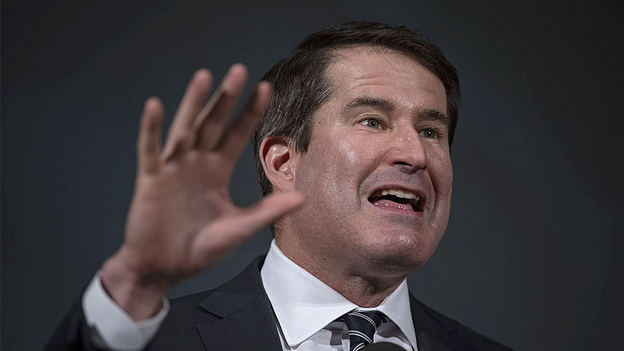
Rep. Seth Moulton, D-Mass., said on Tuesday that Iran is in a "better position" now than before the U.S. and Israel began attacks in late February.
Moulton said Iran has "the willingness to endure the pain and stick this out."
"They are in a better position today than they were before this war started," he said during an appearance on CNN.
"I mean, remember what was happening right before Trump started his war of choice. We were negotiating with the Iranians to curtail their nuclear weapons program. We were asking them to cut back on their nuclear weapons development," he continued.
Iran war driving up costs, disrupting supply chains for companies from consumer goods to travel
Companies from various sectors, including consumer goods, travel and mining, warned on Wednesday that the U.S.-Israeli war on Iran is driving up costs, disrupting supply chains and harming consumer confidence.
While some companies stuck to their full‑year forecasts, executives reported rising transport and raw material costs, particularly those linked to the blockade in the Strait of Hormuz that has disrupted shipping and production.
Dulux paint maker AkzoNobel said the conflict was pushing up supply costs, although higher prices helped it beat market expectations.
"Our raw material basket is going to go up by something like the high teens (percentage), given the disruption of the Strait of Hormuz," CEO Greg Poux‑Guillaume told Reuters, adding that the full impact would be felt over the next two quarters.
United Airlines also noted pressure on demand, forecasting second-quarter and full-year profits falling short of Wall Street estimates on Tuesday.
Reuters contributed to this report.
EU weighing jet fuel stockpile requirements as countries continue to face shortages
The European Union is considering possible requirements for countries to hold stockpiles of jet fuel, which would potentially be redistributed based on regional shortages tied to the U.S.-Israeli war with Iran, according to Europe’s energy policy chief.
The European Commission proposed measures on Wednesday to deal with the energy crisis triggered by the U.S.-Israeli war with Iran, including EU-wide monitoring of refinery output in an attempt to maximize fuel capacity.
EU Energy Commissioner Dan Jorgensen said the countries could adopt rules on jet fuel reserves and sharing.
"We will be able to, if necessary, introduce redistribution tools and other things that we don’t normally do in this sector," he told Reuters. "Normally, we let the market decide, but we can end up in a crisis where it is indeed security of supply that is the problem, and not only prices."
Reuters contributed to this report.
US stocks hit record highs as Trump extends ceasefire indefinitely
U.S. stocks hit record highs as President Donald Trump said an Iran ceasefire would be extended indefinitely Wednesday, easing some concerns even as oil prices rose.
According to The Associated Press, the S&P 500 climbed 1% to surpass its previous all-time high, while the Dow Jones Industrial Average added 340 points, or 0.7%. The Nasdaq Composite jumped 1.6%, also reaching a record high.
Stronger-than-expected earnings were reported from companies including GE Vernova and Boston Scientific.
The price for a barrel of Brent crude oil, the international standard, climbed 3.5% to $101.91 amid uncertainty about when the war with Iran could ease and allow petroleum out of the Persian Gulf again.
Panama accuses Iran of violating law after vessel seized in Hormuz
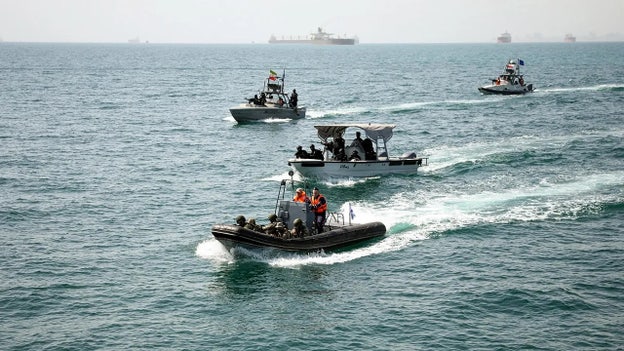
Panama has condemned the “illegal seizure” of a vessel transiting the Strait of Hormuz under its flag, according to reports.
The Times of Israel reported that the Central American nation’s foreign ministry said the boat, owned by the Italian company MSC Francesca, was “forcibly taken” into Iranian waters.
The ministry also accused Iran of violating international law.
The seizure “represents a serious attack on maritime security and constitutes an unnecessary escalation,” the ministry said.
US forces in the Middle East among the strongest, 'most lethal' ever deployed: CENTCOM
U.S. forces deployed across the Middle East are among the strongest and most lethal ever, U.S. Central Command (CENTCOM) said Wednesday.
The command shared a montage of images showcasing soldiers, Marines and airmen on duty across the region amid the war with Iran.
“U.S. Soldiers, Sailors, Marines, Airmen, Guardians and Coast Guardsmen are deployed across the Middle East as part of the strongest and most lethal military the world has ever known,” the command said in a post on X.
Pentagon says clearing Iran's naval mines in the Strait of Hormuz will take six months: report
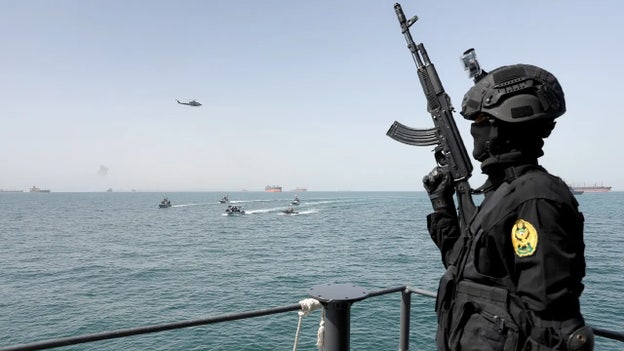
Clearing the naval mines set by Iran in the Strait of Hormuz will take six months, according to the Pentagon, the Associated Press reported Wednesday.
The outlet also said officials from the Department of Defense provided the information at a classified House Armed Services Committee briefing on April 20, according to a source.
At the briefing, lawmakers also asked for information about the cost of the Iran war, strategy, and objectives, the source said.
Trump envoy asks FIFA to replace Iran with Italy at 2026 World Cup: report
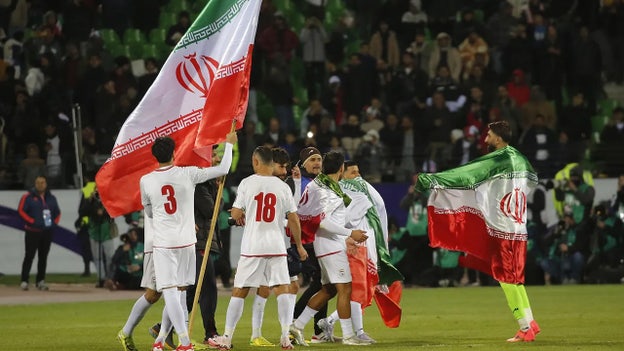
A U.S. administration envoy has asked FIFA to replace Iran with Italy in the 2026 World Cup, citing geopolitical tensions and safety concerns, according to reports.
The plan was to help repair relations between President Donald Trump and Italian Prime Minister Giorgia Meloni after the two disagreed over communications with Pope Leo XIV over the war in Iran, the Financial Times reported.
"I confirm I have suggested to Trump and (FIFA President Gianni) Infantino that Italy replace Iran at the World Cup. I'm an Italian native, and it would be a dream to see the Azzurri at a U.S.-hosted tournament. With four titles, they have the pedigree to justify inclusion," U.S. special envoy Paolo Zampolli told the outlet.
Italy missed out on the World Cup for the third time following a defeat to Bosnia and Herzegovina in its qualifying playoff final.
The Financial Times reported that Iran issued a statement Wednesday saying it was prepared for the tournament and planned to participate.
Schumer demands Trump 'end his war immediately,' says US getting 'deeper into hole'
Senate Minority Leader Chuck Schumer said President Donald Trump must “end his war immediately,” before adding that each day the conflict goes on, Washington gets “deeper and deeper” into a hole.
Schumer also said the war has weakened the U.S. economy, military readiness and national security.
“We must end Trump’s war immediately,” Schumer said in a post shared on X.
“Every day this disastrous war continues, @POTUS digs himself deeper and deeper and deeper into a hole,” he added.
“Everything Trump has done with this war has left our economy, military readiness and national security in worse shape than before,” Schumer said.
IRGC-linked outlet maps Gulf undersea cables, flags infrastructure as targets
Tasnim, an outlet linked to the IRGC, has mapped undersea internet cables and cloud infrastructure in the Persian Gulf as a warning.
In an article Tasmin highlights the Strait of Hormuz as an energy chokepoint and critical route for cables serving Gulf states like the UAE, Qatar and Saudi Arabia.
Iran International said the report notes that southern Gulf countries rely heavily on maritime internet links, framing cables, landing stations and data hubs and are vulnerabilities rather than neutral infrastructure.
Tasnim’s report also points to the concentration of cloud and data centers in the UAE and Bahrain and notes their exposure after drone strikes on AWS facilities.
The article suggests Iran-linked media are claiming undersea cables and regional data hubs are joining ports, shipping lanes and energy facilities as strategic targets, Iran International said.
CENTCOM confirms 29 vessels turned back under blockade, denies evasion reports
U.S. Central Command (CENTCOM) has confirmed the U.S. Navy turned back 29 vessels under the blockade of Iranian ports.
The command also said evasion reports were “inaccurate.”
“U.S. forces have directed 29 vessels to turn around or return to port as part of the U.S. blockade against Iran,” CENTCOM said in a post shared on X.
“Over the past 24 hours, media reports have alleged that several commercial ships evaded the blockade, citing M/V Hero II, M/V Hedy, and M/V Dorena as examples. These reports are inaccurate,” it said.
The command went on to say that Hero II and Hedy did not sail past the blockade as part of a flotilla that “ferried” millions of barrels of oil to the market.
“In fact, the Iranian-flagged tankers are anchored in Chabahar, Iran, after being intercepted by U.S. forces earlier this week,” it said.
“Dorena has been under the escort of a U.S. Navy destroyer in the Indian Ocean after previously attempting to violate the blockade.”
The U.S. military has global reach, and American forces are operating and enforcing the blockade across the Middle East and beyond, CENTCOM added.
Senate GOP blocks fifth Dem bid to end Trump’s Iran war as divisions grow
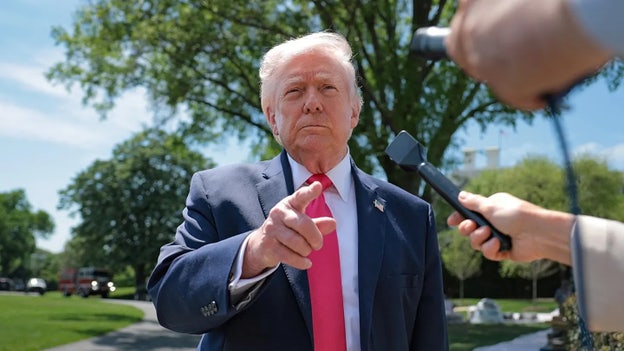
Senate Republicans are still backing President Donald Trump's war in Iran as the deadline for Congress to get involved is rapidly approaching.
Republicans beat back a fifth attempt by Democrats to call for an end to the war in the Middle East, a day after Trump extended the fragile ceasefire for next several days on the grounds that Iran's government was "seriously fractured."
The failed vote to rein in Trump’s war authorities came on the 54th day of the conflict.
Whether the administration can strike a long-lasting peace deal remains unclear. Lawmakers are also growing more concerned about the cost, length and end game of the war.
"This war has simply been a disaster, and there is absolutely no reason we should go full steam ahead back into it," said Sen. Tammy Baldwin, D-Wis., who forced the vote.
And next week, the conflict will officially hit the 60-day mark. Congress is required to weigh in on continuing the conflict under the War Powers Resolution.
Still, the fast-approaching inflection did little to sway Republicans, who have stayed largely unified against Democrats’ deluge of war powers resolutions since the conflict began. Democrats aren’t done forcing votes, either, and have another six resolutions teed up.
"Our caucus is united and focused on ending the war in Iran," Senate Minority Leader Chuck Schumer, D-N.Y., said. "And we're going to keep voting on those resolutions again and again and again."
And Republicans aren't totally united on whether to put an Authorization for Use of Military Force (AUMF) on the floor.
Sen. Lisa Murkowski, R-Alaska, has been working on an AUMF in the background that would allow lawmakers to have a say on what comes next in Iran.
"We'll see what our kind of conference's will is on that and where our members are," Senate Majority Leader John Thune, R-S.D., said.
This is an excerpt from a report by Alex Miller.
US blockade already working, vessels turning back, Iran port calls abandoned, says watchdog
The U.S. naval blockade targeting Iran’s ports and oil exports is already effective, according to United Against Nuclear Iran (UANI), which says the operation is disrupting shipments and pressuring its economy.
UANI, a nonprofit group focused on countering Iranian threats, says the blockade is working as intended by targeting high-value oil shipments rather than all Iran-linked vessels, with early signs of deterrence including diverted ships and abandoned port calls.
“We commend President Trump for ordering the continued blockade of Iranian ports and the U.S. Navy for its highly professional and highly effective, but yet prudently selective, use of force against key Iranian shipping interests,” United Against Nuclear Iran (UANI) Chairman Gov. Jeb Bush and CEO Ambassador Mark D. Wallace said in a statement.
“The confusion in media reports constitutes a misunderstanding of the naval blockade,” they said.
The blockade took effect April 13 as U.S. Central Command (CENTCOM) confirmed that forces were “executing the mission to blockade ships entering and departing Iranian ports,” UANI said in a statement.
“The administration aims to cut off the regime's primary revenue source from crude exports, primarily to China,” the statement said.
“This applies critical pressure on the regime to open the Strait of Hormuz to international shipping and return to ceasefire talks.”
CENTCOM has reported at least 29 vessels turned around or went back to port, with several VLCCs abandoning Iranian port calls, with the organization saying the successes “demonstrate early deterrence against major sanctions-evading shipments.”
Under the U.S. Commander’s Handbook on the Law of Naval Operations (NWP 1-14M), a blockade is “a belligerent operation to prevent vessels and/or aircraft of all nations, enemy as well as neutral, from entering or exiting specified ports, airfields, or coastal areas belonging to, occupied by, or under the control of an enemy.”
“The U.S. is not attempting to interdict every vessel with any connection to Iran. Rather, enforcement efforts are focused on vessels entering or departing Iranian ports; and ships engaged in the transport of declared contraband cargos, as well as U.S.-sanctioned Iranian cargoes, particularly crude oil and petroleum products,” the statement said.
Just because “Iran-linked” vessels are still transiting international waters, this is “not evidence of failure—it reflects the reality that many such vessels are not engaged in activity covered by the blockade,” the UANI said.
Scott calls on US to 'finish the job' on Iran, end nuclear threat
Sen. Rick Scott called on the United States Wednesday to escalate its efforts against Iran, urging leaders to “finish the job” and permanently eliminate the country’s nuclear threat.
“Iran has spent 47 YEARS funding terror, killing Americans, and trying to get its hands on a nuclear weapon to do more damage,” Scott said in a post shared on X.
“We went after this terrorist regime for a reason, and now it’s time to FINISH THE JOB,” he added.
“We need to END their nuclear ambitions, stand firmly with our allies, and NEUTRALIZE THE THREAT for good,” Scott said.
Iran must surrender enriched uranium, Trump awaits unified proposal, says Leavitt
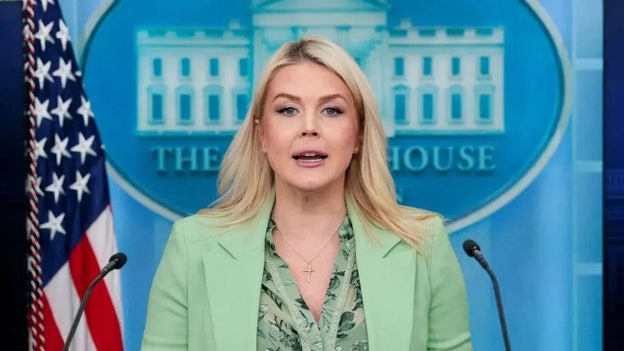
White House press secretary Karoline Leavitt said Wednesday that President Donald Trump is giving Iran room to respond to U.S. demands, but expects Tehran to present a “unified proposal.”
Leavitt told reporters that Trump has not imposed a specific cutoff for Iran to act, emphasizing that the president also offered Tehran “flexibility.”
“So, again, the president's offering them a little bit of flexibility because we want to see a unified proposal to the president's very strong proposal. And he's made his red lines very clear,” Leavitt said.
“The president has not set a deadline himself. Ultimately, he will dictate the timetable,” she said.
Addressing the naval blockade on Iranian ports set on April 13, Leavitt said the administration believes it holds the upper hand.
“And again, he is satisfied with the naval blockade. And he understands that Iran is in a very weak position and the cards are in President Trump's hands right now,” she said.
Leavitt also pointed to Trump’s decision to extend the ceasefire indefinitely, saying it reflects pressure on Iran to respond.
She said that Trump chose to extend the ceasefire because it's Iran that needs to "get their act together.”
“The White House and our intelligence community certainly have a good understanding. However, we want to see a unified response and a unified proposal to the previous question’s point,” she clarified.
In another interview, Leavitt said that Iran must turn over its enriched uranium to the United States.
US Embassy urges Americans to leave Lebanon amid terrorism, kidnapping risks
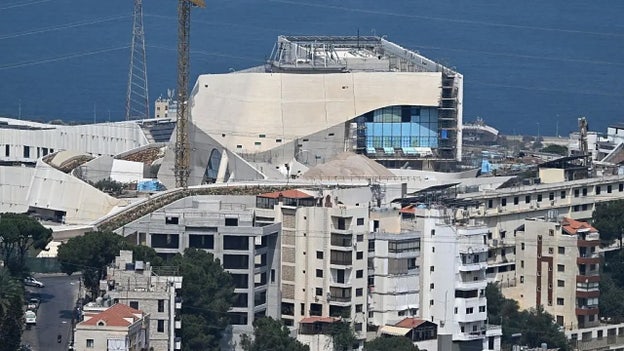
The U.S. Embassy in Beirut urged U.S. citizens to leave Lebanon in a security alert issued Wednesday.
While commercial flight options remain available, the embassy also recommended that “U.S. citizens in Lebanon who choose not to leave prepare contingency plans for emergency situations.”
“The security environment remains complex and can change quickly,” the embassy said in a statement.
It also warned Americans not to visit areas where there had been military activity, as these might contain unexploded ordnance.
The notice warned of “ongoing risks of terrorism and kidnapping throughout Lebanon” and said “locations frequented by U.S. citizens and tourists in Beirut or elsewhere in Lebanon may become a target for these attacks.”
“U.S. citizens should avoid demonstrations, protests, or any large gatherings as these have the potential to quickly turn violent and with little notice,” the statement also said.
A 10-day ceasefire between Israel and Lebanon has been in place since April 16.
French soldier dies after attack on UN force in Lebanon, Macron blames Hezbollah
A second French soldier has died after an attack on United Nations peacekeepers in Lebanon, French President Macron said Wednesday.
The soldier, Chief Corporal Anicet Girardin, had been severely wounded on April 18 and died of his wounds on April 21 after being evacuated to France, the president said in a post on X.
“Corporal Anicet Girardin of the 132nd Cynotechnical Infantry Regiment of Suippes, repatriated yesterday from Lebanon where he had been seriously wounded by Hezbollah fighters, died this morning from his injuries,” Macron said, before adding that “he died for France.”
“The Nation, which will pay tribute tomorrow to Warrant Officer Florian Montorio, mortally wounded during the same ambush, salutes with emotion the memory of Corporal Anicet Girardin and his sacrifice. It also extends its most sincere thoughts and deepest compassion to his family, his loved ones, as well as to the families of the other wounded,” Macron said.
“It pays homage to the exemplary commitment of our armed forces within UNIFIL, which work with courage and determination in the service of France and peace in Lebanon,” he added.