


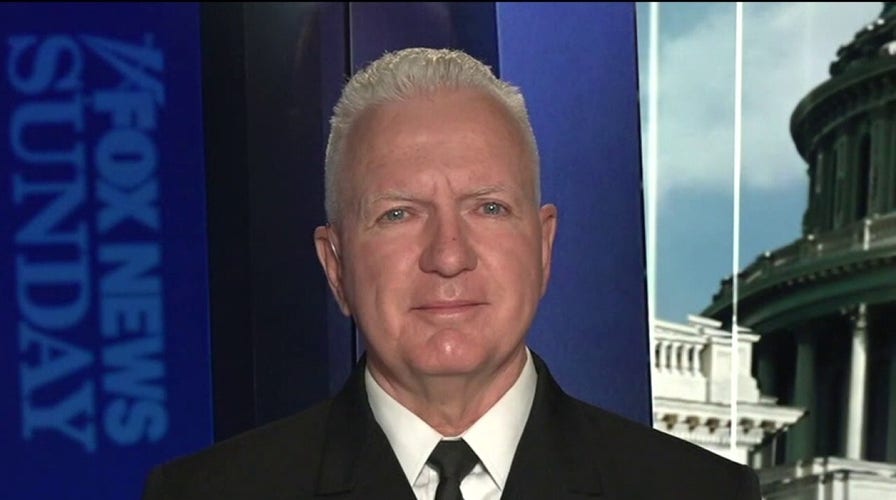
‘We do believe the vaccine will be effective’ against new coronavirus strain: Giroir
HHS Assistant Secretary Admiral Brett Giroir tells ‘Fox News Sunday’ the COVID-19 vaccines will be ‘highly effective’ against all strains. He also discusses the vaccine rollout process.
This is a rush transcript from "Fox News Sunday" December 27, 2020. This copy may not be in its final form and may be updated.
MIKE EMANUEL, FOX NEWS HOST: I'm Mike Emanuel, in for Chris Wallace.
Relief for millions of struggling Americans in jeopardy as President Trump
suddenly objects to the bipartisan COVID deal.
(BEGIN VIDEOTAPE)
DONALD TRUMP, PRESIDENT OF THE UNITED STATES: It really is a disgrace.
EMANUEL (voice-over): The outgoing president's demand to increase the aid
checks for American family sending Congress scrambling, testing the
allegiance of Republicans and potentially leading to a government shutdown;
as the president grants dozens of pardons to longtime allies and associates
and continues to contest the results of the election.
We'll discuss it all with Republican Senator Pat Toomey, only on "FOX News
Sunday".
Then --
JOE BIDEN (D), PRESIDENT-ELECT: Our darkest days in the battle against
COVID are ahead of us, not behind us.
EMANUEL: Concerns about new, more contagious strains of the virus and
increased tension over who's next in line for the vaccine as millions of
Americans travel this holiday despite health warnings.
We are joined by Admiral Brett Giroir of the White House Coronavirus Task
Force.
Plus --
MIKE PENCE, VICE PRESIDENT OF THE UNITED STATES: We're going to keep
fighting until every legal vote is counted.
EMANUEL: How the president's focus on overturning Joe Biden's victory
could impact the Georgia Senate runoffs.
We'll ask our Sunday panel whether it could derail Republicans efforts to
win a Senate majority, all right now, on "FOX News Sunday".
(END VIDEOTAPE)
EMANUEL (on camera): And hello again and happy New Year from FOX News in
Washington.
A Christmas holiday season like none other as Americans isolated by COVID
precautions and looking for an economic boost now face more uncertainty.
The president in Florida after throwing a wrench into relief proceedings.
In Washington, time is running out, and tomorrow is shaping up to be one of
the most consequential days of the congressional year. The House is
scheduled to vote on the president's demand for $2,000 direct payments to
some Americans, although it will likely die in the Republican-controlled
Senate. The country also facing a looming shutdown in the middle of a
pandemic which has killed more than 330,000 people in this country.
In a moment, we'll speak with Republican Senator Pat Toomey of
Pennsylvania, but first, let's bring in Mark Meredith with the latest from
the president's Mar-a-Lago retreat in Florida -- Mark.
MARK MEREDITH, FOX NEWS CORRESPONDENT: Mike, lawmakers from both parties
are pleading with the president to sign the stimulus and funding bill
already in front of them all in an effort to prevent the government
shutdown and keep pandemic assistance alive for millions of Americans.
(BEGIN VIDEOTAPE)
MEREDITH (voice-over): This weekend, President Trump doubled down on
demands Congress rewrite its stimulus package tweeting overnight: $2,000
plus $2,000 plus other family members, not 600. Remember, it was China's
fault.
On Christmas Eve, Democrats tried to amend the $900 billion bill and
increase direct payments, but House Republicans blocked the effort.
REP. DEBBIE DINGELL (D-MI): We do not have unanimous consent.
MEREDITH: With both the stimulus and $1.4 trillion government funding bill
in limbo, Democrats say the consequences of inaction could be dire.
DINGELL: People are scared, people are desperate.
MEREDITH: On Saturday, enhanced unemployment benefits lapsed for some
Americans. An eviction moratorium will expire later this week. President-
elect Joe Biden urging the president to sign the deal already worked out
to, quote, make sure millions of Americans can put food on the table and
keep a roof over their heads in this holiday season.
As Biden weighs his final cabinet picks, President Trump is demanding
Congress not certify the November election when lawmakers meet for a joint
session in early January.
UNIDENTIFIED MALE: Thank you all for being here.
MEREDITH: Meantime, the White House says the president is receiving
constant updates on the ongoing investigation into the Christmas Day
explosion in Nashville. The FBI, which is leading the investigation,
believes the blast was intentional.
(END VIDEOTAPE)
MEREDITH (on camera): Tennessee's governor is asking for federal
assistance to help with the cleanup. Overnight, Tennessee's congressional
delegation sent a letter to the president urging him to support that
assistance with officials saying there is so much help needed not only for
the city of Nashville, but for local businesses as well -- Mike.
EMANUEL: Mark Meredith reporting from West Palm Beach -- Mark, thanks.
Joining us from Pennsylvania, Republican Senator Pat Toomey.
Senator, welcome back to "FOX News Sunday."
SEN. PAT TOOMEY (R-PA): Good morning, Mike. Thanks for having me.
EMANUEL: Enhanced unemployment benefits ran out Saturday. We could be
facing a government shutdown midnight Monday night.
Senator, you disagree with some of the provisions in this massive funding
package. Why should the president sign it?
TOOMEY: Well, because you don't get everything you want even if you're the
president of the United States. We have two legislative bodies and
Democrats control one, Republicans the other.
Look, if it were just a freestanding government funding bill, I would
almost certainly be voting against that, but I think the COVID relief
measures are really, really important. And, you know, in my state, as in
many other states, we have governors who are closing down businesses again.
People are out of work, certainly through no fault of their own.
I think we need the extended on employment benefits. I think we need
another round of the PPP loans, which really grants the small businesses to
keep their workforce, you know, part of their business. And time is running
out.
So I understand the president would like to send bigger checks everybody. I
think we ought to do is sign this bill and then make the case. Congress can
pass another bill. I don't agree with $2,000 checks to people who have had
no lost income whatsoever, which is the vast majority of Americans.
But the president is free to make that case. Democrats will agree with that
and see where it ends up. But we've got a bill right now that his
administration helped negotiate. I think we ought to get that done.
EMANUEL: Your colleague, Senator Lindsey Graham, has tweeted: After
spending some time with President @RealDonaldTrump, today I am convinced he
is more determined than ever to increase stimulus payments to $2,000 per
person and challenge Section 230, big tech liability protection. Both are
reasonable demands.
Do you worry we are heading for a government shutdown, sir?
TOOMEY: I really don't know. I think the president has not actually
explicitly said he is going to veto this bill. I take that as a hopeful
sign.
I think as he leaves office, he will -- I understand he wants to be
remembered for advocating for big checks, but the danger is he'll be
remembered for chaos and misery and erratic behavior if he allows this to
expire.
So I think the best thing to do, as I said, sign this and then make the
case for subsequent legislation.
EMANUEL: House Speaker Nancy Pelosi is going to hold a floor vote on the
$2,000 stimulus item President Trump has requested, putting all House
Republicans on the record.
How can Republicans vote against more aid when millions of Americans are
still unemployed through no fault of their own?
TOOMEY: Yeah, because it's terribly untargeted, right? Why would we be
sending $2,000 to people with a six-figure income who had no suspension, no
reduction of their income at all?
Consider the millions of federal employees, never missed a check. They're
not going to miss object. Their expenses are probably somewhat diminished.
Savings rate went through the roof. Why would we be standing several
thousand dollars to these folks?
This money isn't sitting on a shelf. We're going to print it or we are
going to borrow it, and I think that the aid should be much, much more
targeted. It should be targeted to people who have actually lost their job,
small businesses that are actually in danger of going under. Those are very
real categories.
The numbers are significant. That's where the aid should go, not to people
who've never had any loss of income.
EMANUEL: President Trump pardoned some former campaign aides, former GOP
congressman, his son-in-law Jared Kushner's father, former Blackwater
security operatives.
Your colleague Senator Ben Sasse saying, quote: This is rotten to the core.
While the president certainly has the power, do you disagree with how he's
using it?
TOOMEY: In some cases, I do.
I think the case of Mike Flynn, for instance, was completely legitimate to
pardon him because the prosecution was an abuse of power. I don't think
Michael Flynn ever committed a crime.
But some of these other cases -- I mean, my goodness, we have tax fraud and
bank fraud, witness tampering, obstruction of justice, but because they
were close to the president, they got pardoned?
This is unfortunately reminiscent of the Marc Rich pardon by President
Clinton. It is legal, it is constitutional but I think it's a misuse of the
power.
EMANUEL: Some are suggesting it's time to reform presidential powers. Do
you agree?
TOOMEY: You know, it's a good discussion to have but it's -- it's a tough
call. This is obviously a constitutional power, so I don't know how we
would do it without amending the Constitution and I think -- I think -- I
think it would be very challenging.
EMANUEL: Do you anticipate a lot more pardons before he leaves office,
Senator?
TOOMEY: I don't know what to anticipate. This president, he's often
unpredictable.
EMANUEL: President Trump continues disputing the outcome of the 2020
presidential contest. You have concerns about it hurting Republicans in
Georgia, where those critical runoffs will decide the Senate majority?
TOOMEY: Well, I think the president should accept the outcome of the
election. He had every right to challenge these votes. He had every right
to recounts and to litigate. He has done all of those things.
In my state of Pennsylvania, he's drawn conservative, Republican judges who
have dismissed these cases for a lack of any credible evidence.
In the case of Georgia, I think the reason we're going to win is we have
better candidates. I think that's just an objective fact. Better candidates
and people who better reflect the wishes of the people of Georgia in Kelly
Loeffler and David Perdue, two terrific senators. So, I'm -- I'm still
cautiously optimistic about Georgia.
EMANUEL: What are the stakes there in Georgia in terms of what's the big
difference between a Senate led by Majority Leader Mitch McConnell or
perhaps a Majority Leader Chuck Schumer?
TOOMEY: Well, the difference is if Republicans hold the Senate, then
legislation will necessarily reflect broad compromise, because both parties
will have some say and neither party will be able to simply run off at
will.
If Republicans were to lose both Senate races in Georgia, then the
Democrats will have complete control of the elected government, and I'm
afraid that much of that party has been taken over by this radical woke
left and a very liberal agenda openly advocating socialism, calling
themselves socialists, advocating for the elimination of police
departments.
I mean, just all kind of crazy policies, and there will be no check on
those policies accept whatever they choose who -- however they choose to
limit themselves, and that's not very reassuring.
So I think for the sake of some balance and some consensus government, it's
really important that Republicans hold on to the Senate.
EMANUEL: Back to the 2020 presidential contest, front and center is the
president's fight, your state of Pennsylvania, the president's campaign has
asked the Supreme Court to throw out three state Supreme Court rulings
about mail-in ballots and asking the general assembly be allowed to pick
its own slate of electors. Even if it doesn't overturn the entire election,
is that argument valid?
TOOMEY: So, again, it gets complicated. The Pennsylvania state Supreme
Court sadly is a rogue court where Democrats have decided to be extremely
political and disregard the law. That's a fact. And one of the examples is
we have a statute that says in order to be counted, the ballots have to
arrive by 8:00 on Election Day.
It's black-and-white. it's very easy to read. That's what the law says.
And then the Pennsylvania Supreme Court came along and said, we'll
disregard that and allow votes to be counted for up to three days after
that. They have no legal authority to do that. It's outrageous.
But here's the important point, Mike -- it's fewer than 10,000 votes.
President Trump lost Pennsylvania by over 80,000 votes. So even though that
was a very bad decision, I think it should be overturned by the U.S.
Supreme Court, it wouldn't have changed the outcome of the election and
that's something we -- we have to recognize.
EMANUEL: You're not running again in 2022, but what are your concerns
looking forward about elections in your home state when at least the
president's supporters think this election was a disaster?
TOOMEY: Well, I think there are some lessons we should learn. There are
some changes we should make. We should overturn these completely illegal
Pennsylvania state Supreme Court rules.
I, for one, think it's perfectly okay for us to go back to the rules we had
before the pandemic where the vast majority of people voted in person. That
served us for, I don't know, over 200 years, it probably still works.
If you really can't make it to the polls on Election Day, you can get an
absentee ballot, but I think that would make all the sense in the world to
go back to that system. It's easier to monitor, it's easier to verify, and
people would have more confidence in it.
EMANUEL: President Trump waited until the final hour on Wednesday to veto
the National Defense Authorization Act, which you voted in favor of. The
defense bill affirms 3 percent pay raises for U.S. troops and authorizes
more than $740 billion in military programs and construction.
Do you have the votes to override President Trump's veto?
TOOMEY: Well, I think we'll find out pretty soon. This legislation has
been passed by Congress every year for I think about 60 years running. It's
when signed by presidents. I think it does put the right priorities behind
our defense policy and it passed both houses with huge overwhelming votes.
But we'll see. That's why you have the vote.
EMANUEL: Senator Toomey, thank you. Thanks for joining us this Christmas
holiday we can.
I'll see you back on the Hill.
Up next, we'll bring in our Sunday group to discuss the president's actions
in the final stretch of his days in office.
(COMMERCIAL BREAK)
(BEGIN VIDEO CLIP)
DINGELL: The president, when we finally thought that would be able to give
people hope, doesn't give a damn about people. He sowed more fear. He threw
kerosene on a terror fire.
REP. KEN BUCK (R-CO): We are giving money to Pakistan. We are giving money
all over the world, really and not focusing on those who need it the most
here at home.
(END VIDEO CLIP)
EMANUEL: Members of both parties in the House expecting serious
frustration over the relief package that the president is now threatening
not to sign.
And it's time now for our Sunday group. Jason Riley of "The Wall Street
Journal", pollster and FOX News contributor, Kristen Soltis Anderson, and
former DNC chair Donna Brazile.
Panel, welcome.
JASON RILEY, FOX NEWS CONTRIBUTOR: Thank you.
EMANUEL: It doesn't look like Republicans are going to go along with
President Trump's demand of $2,000 stimulus checks.
Jason, are we heading for a government shutdown?
JASON RILEY, FOX NEWS CONTRIBUTOR: I don't know if we are headed for a
shutdown, Mike. I do think that Republicans however feel like the president
has really pulled out the rug from under them at the last minute here.
You know, people don't elect Republicans because Democrats don't spend
enough money. They elect them because they want some fiscal responsibility.
And the president's own negotiator, Treasury Secretary Steven Mnuchin,
thought he was negotiating in good faith for a $600 payment.
I understand the president wanting to give people more money, but frankly,
that is not I think what the country needs right now, so much as they need
for businesses to reopen, for the economy to get back up to speed in these
lockdowns are the problem, not the fact that checks are supposedly too
small.
People need to get back to work and to the extent that some of the
unemployment insurance relief supplements in this bill are too high, there
will be a disincentive for people to go back to work if they can be paid
more to not work, so we have to worry about that as well.
EMANUEL: To be clear, House Speaker Nancy Pelosi initially accepted the
$600 stimulus payment.
Donna, did she cut a bad deal?
DONNA BRAZILE, FOX NEWS CONTRIBUTOR: Absolutely not. Look, since the
spring of 2020, the speaker and Democrats have been trying to give the
American people relief.
We know that this virus is not going to disappear overnight and what the
House Democrats along with those in the Senate tried to do was to negotiate
a fair deal, something that will help the American people.
You know, the $300 that the federal government will provide to the states
in addition to what they will receive is a lifeline to people getting back
on their feet. Many of these workers who have lost their jobs, they've lost
their health care, they are struggling to make ends meet and at a time when
they are trying to stay in their apartments or pay their mortgage, all they
want is relief.
So I agree with vice president -- I mean the President-elect Joe Biden,
it's an abdication of President Trump's responsibility not to sign this
bill and not to allow the government to continue to operate
EMANUEL: House lawmakers return tomorrow to start the process of trying to
override President Trump's veto of the National Defense Authorization.
How awkward is this for the GOP to be clashing with the president on
defense and stimulus, Kristen?
KRISTEN SOLTIS ANDERSON, FOX NEWS CONTRIBUTOR: It's putting a lot of
Republicans in a very tough spot because some of the president 's most
vocal advocates are also those who would say we need to be getting a lot of
funding to our defense, we cannot be allowing this collapse, and so, it's
putting them in a very tough spot.
But I think it's sort of ironic, is that, on the one hand, you know, the
president is right to complain abut the fact that these bills are enormous,
things like the stimulus bill or the COVID relief bill that they are
enormous bills, full of tons of stuff, and yet at the same time, the
president is calling to add a tech policy piece to a military bill, sort of
asking to add something to a bill where it would be better if it was just
kept clean and about with the bill should be about, which is our military
and our nation's defenses.
So it's putting a lot of Republicans in a very tough spot and we always
tend to find Congress getting to the end of the year whether it's in 2012
with the fiscal cliff, 2018 with the government shutdown we faced there. It
always seems like the holidays are the time for Congress to really struggle
to be able to do its job properly.
EMANUEL: No doubt about that.
Do you expect your Republicans to stick together and override the veto and
what about section 230 concerns, Jason?
RILEY: I do expect Republicans to stick together. I think they will
override the veto if, in fact, the president pushes them to do so.
I understand the president's concerns about Section 230. I don't think this
is the place to hash that out however. I think that needs to be done
separately.
EMANUEL: To presidential pardons, there was controversy when Bill Clinton
pardoned Marc Rich and Patty Hearst. So this isn't new. But, Donna, is it
time to reform pardon power?
BRAZILE: Well, as Senator Toomey said, I mean, these constitutional powers
are going to be difficult but he undermines the rule of law. If he makes
justice system looks so small when he basically rewards those who have been
convicted of crimes. I mean, stealing from charities.
But this is the president throwing as much chaos as he departs Washington
than we saw when he first arrived.
EMANUEL: Well, and there's no indication this is the end of President
Trump granting pardons. We've heard names like Julian Assange, Rudy
Giuliani, Steve Bannon.
Kristen, what are your expectations?
SOLTIS ANDERSON: Well, I expect there to be more pardons. I think it's a
real shame to see the way the powers being used in many of these instances.
I can't help but think about the president's actions on criminal justice
reform where he was taking those that had been charged with crimes that
were very small, sentenced to absolutely unfair sentences, having their
lives taken away, that's the appropriate use, to undo wrongs that have been
done to those who are effectively innocent or who have been far too harshly
than they deserve, not to use it to pardon your political allies. It's
simply wrong.
EMANUEL: Donna, what are expectations over the next couple of days? We've
got the override vote in the NDAA. We've got the vote on the House floor
about the $2,000 payments, probably not going to go anywhere in the
Republican-led Senate. What are your expectations in the immediate days
ahead?
BRAZILE: Well, I do believe that it is the responsibility of Congress to
return to Washington, D.C., and to try to get as much done, especially now.
The stimulus is absolutely needed. We should -- this is not the time to
allow the government to shut down.
And look, I understand the president is not -- he does not like the results
of the election. I'm trying to be charitable this morning, but the fact is
that this is a time for a peaceful transfer of power and it's perhaps more
prudent for him right now to begin to think about his legacy and not throw
anymore chaos into the room.
EMANUEL: Jason, looking ahead, what do expect this week and how awkward is
it for Republicans to be battling with president from their own party?
RILEY: Well, Republicans I think are used to this. This president has been
pretty unpredictable from day one, so I mean, it's a little surprising that
he pulled this again right at the end but not entirely, so it's pretty much
in character. About the pardons, some of them are more controversial
pardons, at least in terms of what's -- with the Washington crowd said. I
don't find particularly controversial.
When you look at people like Paul Manafort or Roger Stone, these are people
who were only prosecuted because Robert Mueller thought he could flip them
in the Russia investigation and the Russia investigation turned out to be a
huge waste of time.
And I see no problem with the president doing this for people who stayed
loyal to him during an investigation that shouldn't have taken place in the
first place. So yeah, some of the pardons I think were out of line. Some of
the congressman, Chris Collins, Duncan Hunter, I think they violated the
public trust and I'm not sure they deserve pardons. But some of the ones
that have gotten the most attention I think were well-deserved
EMANUEL: All right. You guys are off to a fast start. Panel, we have to
take a break here.
When we come back, public health guidance doesn't stop millions of
Americans from traveling this holiday. We will speak with Admiral Brett
Giroir, member of the coronavirus task force, about what we can expect in
the New Year next.
(COMMERCIAL BREAK)
EMANUEL: Coming up, the U.S. approves to coronavirus vaccines and
frontline workers line up to get the first dosages.
(BEGIN VIDEO CLIP)
DR. ANTHONY FAUCI, DIRECTOR, NATIONAL INSTITUTE OF ALLERGY AND INFECTIOUS
DISEASES: I want to encourage everyone who has the opportunity to get
vaccinated so that we can have a veil of protection over this country.
(END VIDEO CLIP)
EMANUEL: We'll ask Admiral Brett Giroir of the White House task force how
the rollout is going, next.
(COMMERCIAL BREAK)
EMANUEL: Holiday season less merry and bright as COVID-19 continues to
hammer the U.S., as new strains emerge overseas.
Joining us now, Admiral Brett Giroir, a member of the White House
coronavirus task force.
Admiral, welcome to "FOX News Sunday."
ADMIRAL BRETT GIROIR, MEMBER, WHITE HOUSE CORONAVIRUS TASK FORCE: Great to
be here. Thank you for having me on
EMANUEL: TSA checkpoint travel numbers reveal more than 1 million per day
traveling leading up to Christmas despite those COVID warnings.
Do you expect a spike in new cases as a result, sir?
GIROIR: Well, it really depends on what the travelers do when they get
where they're going. We know the actual physical act of traveling in
airplanes, for example, can be quite safe because of the air purification
systems. What we really worry about is the mingling of different bubbles
once you get to your destination.
Over Thanksgiving, we saw a mixed picture. In the Midwest and in the
northern plains, cases continued to go down despite the travel, which meant
that people really did the kinds of things we talked to them about, like
wearing a mask and limiting your gatherings. So we really have to wait and
see. I really encourage people to follow the CDC guidelines, make your
family gatherings small, safe, protect the elderly and we can get through
this.
EMANUEL: There are concerns about a new variant or mutations of the virus
in places like United Kingdom, Japan, even Canada. Ontario's chief medical
officer announced Saturday that they had confirmed two cases there.
Considering global travel, do you think this new strain is now here in the
United States?
GIROIR: Well, we don't know if it's here or not. We would say that there is
certainly a possibility that it's here already because of global travel and
it's in so many countries now.
Let me tell you what we know about the strain. It is -- number one, it is
not any more serious than the normal strains of COVID. However, it does
appear to be more transmissible. There's not direct evidence of that, but
there's lots of suggestive evidence. But again, you can still protect
yourself by the mitigation measures.
And we have no evidence to suggest, nor do we believe, that this vaccine --
that the vaccine would not be effective. In other words, we do believe the
vaccine will be effective against this variance. So that's why we're, you
know, so excited and still very enthusiastic about the vaccine program,
which is being rolled out on time, on schedule with almost 15 and a half
million doses being distributive by this week upcoming.
EMANUEL: The United States is requiring negative test from travelers coming
from the United Kingdom. Do we need that elsewhere? Is that enough at this
point?
GIROIR: So I think what's often not talked about is since March there's
been a very substantial travel restriction on U.K. and a variety of
countries from -- from Europe. So, since March, we have had a decrease of
90 to 95 percent of travelers coming from the U.K., which is our first line
of defense, which other countries did not have.
The added testing puts an extra layer, and that's very important. There's
no perfect silver bullet, but a test three days before. Now, the CDC can't
order testing once you're in states after that, but we would certainly
encourage states to have quarantine orders or to have testing once these
travelers arrive. So 95 percent decrease already. The extra testing puts
another barrier and the states could also impose things. So I think we're
going to be pretty safe with these as again we roll out vaccines, which are
going to be highly effective against all the strings that are out there.
EMANUEL: To those vaccines. We've seem first responders, some high-profile
politicians rolling up their sleeves.
Who's next in line to receive the shots?
GIROIR: Well, in the first wave, it is really been our health care workers
and those in nursing homes. The next wave is going to be different by
state. The general recommendations are those over 75 and certain frontline
workers. But it's going to very state-by-state.
Let me talk about Governor Abbott in Texas. He really is going to
prioritize anyone over 65 because those are the people who go to the
hospitals. It's not the frontline 24-year-old worker who is at low risk of
getting the infection and at very, very low risk of getting serious results
from that. But over 65, yes, that's who's in the hospital and certain other
people, like cancer patients or people with sickle cell disease. Governor
DeSantis in Florida is prioritizing everyone over 70.
So I think you're going to see variability and I think that variability is
critically important because as the hospitals fill up, the first priority
really needs to be to save lives and to reduce the burden on hospitals.
You're seeing that in Texas and Florida and you will probably see that in
many other states.
EMANUEL: Interesting. OK. So how important is that for President Trump to
receive the vaccine in terms of building that critical, public confidence?
GIROIR: Well, I, of course, think that the president should get a vaccine
at the right time. Seventy-five million people voted for him. He has devout
followers and I think it would set an example.
I would say that there is a medical reason and I don't know, I'm not his
physician, so I don't know exactly right, but he did receive monoclonal
antibodies within the last couple of months. And there is sort of, you
know, guidance about waiting 60 to 90 days after a monoclonal antibody
because it could interfere with the -- with the actual vaccine. But, of
course, President Trump, for his own protection, and to set an example for
the 75 million people who voted for him, I think it's a great idea.
EMANUEL: Currently the Emergency Authorization is for people at least 16
and older. What about younger children? Isn't that important in terms of
getting them back to school?
GIROIR: Well, we all -- as a pediatrician, we certainly want to have the
data to show that it's safe and effective in children. We don't have that
yet. That is coming though. Sixteen and above for one vaccine, 18 and above
for the Moderna vaccine. But I think it's very important for listeners to
understand that getting children back to school right now is safe now.
There's data upon data upon data that children could go back to school
safely in person.
There was a recent study in the MMWR that says of all the places children
are likely to turn positive, school is not one of them. So it is safe and
very important to get children back in school, even before they are
vaccinated. Now, with the community rates going down we hope after the
holidays, because we're seeing that trend right now, and with vaccines it
will be even safer because there will be less spread in the community. But
children do not need a vaccine to go back to school safely. It's vital for
their health to get them back physically present as soon as possible.
EMANUEL: What about their teachers? Should they be higher on the priority
list in terms of vaccinations with millions of American parents worried
their children are not learning in online school?
GIROIR: Well, they're probably going to be higher on the list than the
general public, but they certainly don't fall into the category of the
current ACIP recommendations or what's happening in Texas or Florida and
many other states.
Young, healthy teachers should be at no more risk than young, healthy
individuals in any other profession. So I would imagine that those -- and
they are critical infrastructure. We love our teachers -- that they're
going to be higher than the general public, but they're certainly not going
to be in -- in the next level on almost any state because they're not at
higher risk, unless they are at higher risk if they have hypertension or
sickle cell disease or a cancer survivor or over 65, of course they go in
that category. But, otherwise, they're probably going to be furthered down
the priority scale because we need to take care of those who are
vulnerable, who will die, who will be hospitalized first and I think you're
-- you're seeing that both by the ACIP recommendations, as well as by
several states.
EMANUEL: It feels like we're waiting for the point when the United States
gets to herd immunity. What's your current estimate?
GIROIR: So, herd immunity, when we get to herd immunity, that is when the
pandemic is essentially over. Now, there could be pockets in certain places
where there are vaccine hesitancy and people don't get vaccinated.
The truth is, nobody knows exactly the number, but based on mathematical
models as we have it right now, it is somewhere between 70 and 80 percent
of individuals having gotten the vaccine or having gotten the natural
infection. Now, obviously, we want to develop herd immunity by people
getting the vaccine because they're at no risk of ill health effects or
spreading it to other individuals. Somewhere in that 70 to 80 percent range
is probably the sweet spot. Nobody knows for sure. But based on
mathematical models, people kind of converge at that number.
EMANUEL: Admiral, we're running out of time, but final question, when do
you expect that any American who wants a vaccine should be able to get the
vaccine?
GIROIR: Well, we are clearly on schedule, 20 million vaccinations
distributed by the first week in January. We expect another 30 million in
January, another 50 million in February. And with the current contracts,
even with just the vaccines we have right now, we still expect that any
American who wants a vaccine can be vaccinated by June. That's really very
exciting. That means a couple hundred million people being able to be
vaccinated by that time.
So, with good mitigation steps, with increasing vaccinations, particularly
among the -- those who are vulnerable, we should see clearly light at the
end of the tunnel, but we've got to keep disciplines, got to keep vigilant
right now as we vaccinate.
EMANUEL: Admiral, thank you for joining us. Thanks for your service. We
wish you a happy and very healthy new year.
Up next, when our Sunday panel returns, control of the Senate puts Georgia
in the national spotlight with both parties sending in reinforcements to
turn out the base.
(COMMERCIAL BREAK)
(BEGIN VIDEO CLIP)
SEN. KAMALA HARRIS (D-CA), VICE PRESIDENT-ELECT FOR THE UNITED STATES:
Everything is at stake. Everything that was at stake in November is at
stake leading up to January 5th.
IVANKA TRUMP, ADVISER TO THE PRESIDENT: I am confident that Senators David
Perdue and Kelly Loeffler will keep the Senate Republican and win an
historic victory for American liberty.
(END VIDEO CLIP)
EMANUEL: Vice President-elect Kamala Harris and Ivanka Trump in Georgia
with very different messages ahead of the critical January 5th run off
races.
And we're back now with our panel, Jason, Kristen, and Donna.
So with the president's focus still on overturning the election, there are
concerns, Jason, about this dividing Republicans and even putting Vice
President Mike Pence in an awkward spot.
JASON RILEY, "THE WALL STREET JOURNAL," FOX NEWS CONTRIBUTOR, AND
MANHATTAN
INSTITUTE SENIOR FELLOW: Yes, I think those concerns are warranted. Even
with what's going on with the defense bill and the COVID relief package
that's still being negotiated in Washington, I think it's having a big
impact on this race. Both David Perdue and Kelly Loeffler supported both
the defense bill and a COVID relief package. In fact, David Perdue ran an
ad after the relief package passed Congress that said, I have delivered for
Georgia. So now he has to decide whether to -- to switch positions on that,
because the president has, or to stick with what he said and crossed the
president.
And -- and you see this writ large when it comes to -- to the sort of dual
messages the president has been sending. On the one hand he's saying to his
supporters, go out in Georgia and vote for these Republican candidates. But
then in the next breath he's saying, your votes don't count, the system is
rigged, that's why Joe Biden stole the election.
So these mixed messages, I think, are -- are creating all kinds of problems
for these -- for these Republican candidates in Georgia.
EMANUEL: So about those critical runoffs in Georgia, what about the concern
of this ongoing election hangover hurting Republicans, Kristen, in their
efforts to hold onto that critical Senate majority?
SOLTIS ANDERSON: Well, it certainly doesn't help that there is a mixed
message situation going on. However, I do think that Republicans had been
feeling pretty good about those runoffs until the events of the last week,
which have really kind of thrown things up into the air. Typically, in a
runoff election like this, you would expect Republicans to be favored.
There are more Republicans in Georgia. If turnout drops off, typically
those more high turnout voters tend to be more Republican.
But what we're seeing now is already over 2 million early votes cast in
Georgia with still some more time to go until that election. So there's
going to be unbelievable and unprecedented turnout.
You're also seeing incredible amounts of money go into the state of
Georgia. Just this week, Jon Ossoff reportedly raising over $100 million.
That is beyond eclipsing the most money that any Senate candidate had
previously raised in any Senate race. At a certain point, the poor people
of the state of Georgia are not going to be able to turn anywhere without
seeing ads from these candidates.
So this is a very high-stakes contest. Both parties really feel it. And
that's why I do think that the idea that the president's messaging about,
you know, his allegations of election fraud, et cetera, may not have as
much of an effect because there are so many other things on the line, most
notably control of the United States Senate in a moment where it could hand
a united democratic government to Democrats if it goes a certain direction.
EMANUEL: Donna, let's get your read.
More than two million people have already voted in those Georgia runoffs.
How do you analyze it?
DONNA BRAZILE, FORMER DNC CHAIR AND FOX NEWS CONTRIBUTOR: Yes, I still
believe it will be a nail-biter. I liked the numbers. There are some
counties that are over performing based on what happened on November 3rd,
but it's going to be a tight race. I do believe that both Democratic
candidates have run an exceptionally good campaign, forcing Senator Perdue
and Loeffler to explain the gridlock in Washington, why the checks are
being held up. I do believe that Mitch McConnell move as a result of those
two races.
But, at the end of the day, turnout on Election Day will probably matter
most. We do know that Georgia is one of those states with 159 counties.
We've seen the recount happen on several occasions that if -- if they're
losing candidates -- lose by less than one percentage point, they can -- it
could be another couple weeks of recounts.
But, overall, I feel good about Democratic performance. The fact that we
are able to draw in some independent voters and a lot of young voters,
especially in the metro Atlanta area, they're also turning out in these
early days before the -- the race next week.
EMANUEL: To the political dynamics on Capitol Hill, Speaker Nancy Pelosi
has an historically slim majority looking forward and a split between the
moderate and progressive wings.
Jason, if their common enemy has been President Trump and he's due to
leave, how do they function?
RILEY: Yes, she's -- she's -- she's going to have her hands full and so
will President-elect Biden. You know, he's going to have the progressives
pulling him one way. He's going to have moderates pulling him another.
Nancy Pelosi knows that she is the speaker of the House because of those
moderates and not because of those progressives, so she's going to have to
toe that line as well.
It's going to be difficult, but I -- you know, this is, I think, with the
American people voted for. They apparently did not want to give President
Trump a second term, but they did not want to give Democrats overwhelming
majorities to have the run of Washington. And so this is -- this is the --
I think this is what the American people want.
EMANUEL: Kristen, how do you sense things will work in the House of
Representatives, a very narrow majority and -- and really there are some
moderate Democrats who saw some of their colleagues lose by basically going
along with the agenda?
ANDERSON: Democrats had a good election at the presidential level, but
everything else was a bit of a disappointment. And I think it's really left
a lot of folks in the Democratic Party wondering, is it time for a change
in leadership in Congress?
That right now the Democrats have really failed to, I think, have a very
adequate pipeline for those who are younger and in their ranks and who
might be moving up to be the rising stars of the party in the future. They
just haven't had an opportunity to do so because the very same people who
have been running the Democratic Party have been doing so for a very long
time.
And so to the extent that we wind up in a situation where there's still
gridlock or progressives feel like, hey, we have a lot more control in
Washington than we used to and we still can't get things done, that is
going to place enormous pressure on Nancy Pelosi. She's -- she's held
control for a really long time. I don't expect that she'll face a challenge
that's significant to her speakership, but she's going to have to do a lot
more, I think, to try to create a sense that she is allowing younger
Democrats to have a seat at the table in the leadership of their party.
EMANUEL: Let's get Donna to weigh in on that.
Expectations are high, particularly among progressives. How do Speaker
Pelosi balance these competing interests, Donna?
BRAZILE: She has shown incredible leadership in bringing everyone into the
room so that everybody has a seat at the table.
Look, we have Hakeem Jeffries. We have, you know, Elissa Slotkin. We have
so many young Democrats who are basically at the table, helping to lead
this great party. We don't throw people away or tell them to sit -- go in
the back of the room simply because of their age. She loves and values the
experience that every Democrat bring to the caucus and she's going to
continue to lead the Democratic Party in the House. And I think she's going
to be an incredible force, along with President-elect Joe Biden and Vice
President-elect Kamala Harris in moving the country forward in 2021 and
beyond.
EMANUEL: Jason, it may not be an easy job for Senate Democratic Leader
Chuck Schumer, who may be looking over his shoulder wondering whether
Congresswoman Alexandria Ocasio-Cortez may give him a primary challenge in
two years. Your thoughts?
RILEY: Oh, I think he's -- he's absolutely worried about that and -- and he
should be. I think she's -- she's very ambitious.
But the thing is that no matter who wins down in Georgia, whether it's the
Democratic candidates or the -- or the Republicans or they split, these
will be very, very narrow majorities one way or the other. I -- I -- I
don't think the Democrats will be able to do much that is overly ambitious.
There -- there -- there will be no green new deals. There will be no
statehood for -- for D.C. or Puerto Rico and so forth. The -- some of the -
- some of the -- the -- the things they were talking about during the
campaigns. That -- that is not what the American people voted for. And --
and I also think that this COVID situation is going to concentrate the
political minds in Washington for some time to come. That -- that will be
the focus. And certainly it will be one way for -- for Joe Biden to put off
the progressives by saying, listen, we have to get this virus under control
first before we -- we turn to the rest of your agenda.
EMANUEL: A big issue early in the new year will be confirming a new
cabinet. Mitch McConnell told "The Louisville Courier-Journal," quote, they
(Biden nominees) aren't all going to pass on a voice vote, and they aren't
all going to make it, but I will put them on the floor.
With Biden's son, Hunter Biden, under federal investigation, picking an
attorney general nominee is going to be tricky.
(BEGIN VIDEO CLIP)
JOE BIDEN, PRESIDENT-ELECT FOR THE UNITED STATES: I guarantee you I'm going
to do what I said. The attorney general of the United States of America is
not the president's lawyer. I will appoint someone who I expect to enforce
the law as the law is written, not guided by me.
(END VIDEO CLIP)
EMANUEL: I'm sorry we're nearly out of time, but, Kristen, which nominees
do you anticipate could be in real trouble already?
ANDERSON: I think the most challenging ones are going to be Neera Tanden,
who has come from a progressive think tank and is facing more opposition
because she's taken shots at Republican senators.
EMANUEL: Right.
ANDERSON: That's going to be the toughest nomination to get through.
EMANUEL: All right. Sorry I didn't do a great job of clock management.
Thank you, panel. See you next Sunday.
Up next, we revisit a few of the interesting people who were "Power Players
of the Week" in 2020.
(COMMERCIAL BREAK)
EMANUEL: Most Sundays at this time you'll find Chris Wallace here sharing
the inspiring or interesting stories of those he's met in and around
Washington. 2020 brought some particularly memorable encounters. Here are a
few highlights from this year's "Power Players of the Week."
(BEGIN VIDEOTAPE)
CHRIS WALLACE, FOX NEWS ANCHOR: I was talking to Dana Perino yesterday and
I said I'm talking to Franco Harris, and she said, Frank O'Harris? And she
--
FRANCO HARRIS, NFL HALL OF FAMER: I get that all the time. And I tell
people, that's why the Rooney's (ph) drafted me. They thought my name was
Frank O'Harris.
WALLACE: They thought you were Irish.
HARRIS: They thought I was Irish. And, walah (ph).
WALLACE: It worked out.
COLIN O'BRADY, PROFESSIONAL ENDURANCE ATHLETE: Yes, you know, for me, I
think it's twofold. One, I want to push my own limits for the human
potential, but I also, for me, my larger purpose is really to inspire
others.
WALLACE (voice over): Colin O'Brady is talking about his athletic endurance
achievement.
O'BRADY: It's the tallest mountain I've ever climbed.
WALLACE: In a world full of records, his are astonishing.
O'BRADY: Summit of Mt. Vincent! Whoo!
WALLACE: Becoming the first person to walk across Antarctica solo.
O'BRADY: It's official.
WALLACE: And rowing across some of the world's most treacherous waters from
South America to Antarctica.
O'BRADY: We did it!
UNIDENTIFIED MALE: We did it!
WALLACE (on camera): Do you ever think in the middle of one of these
challenges, expeditions, what the hell am I doing?
O'BRADY: All the time! All the time. You know, I've deftly thought like,
whose idea was this anyways? Oh, wait, it was my idea.
VANILLA BEANE, BENE MILLINERY: This is my home, my second home.
Let's try this one.
WALLACE (voice over): Vanilla Beane's second home is her famed hat shop, a
special part of Washington for 40 years.
WALLACE (on camera): Why do you think hats are important for women?
BEANE: Because it completes the outfit.
WALLACE (voice over): Her creations are beautiful and intricate. No two are
alike. And each one makes a statement.
WALLACE (on camera): What's a proper church hat?
BEANE: Well, any hat that's not too fancy, not too wild.
PHYLLIS WILSON, WOMEN IN MILITARY SERVICE FOR AMERICA MEMORIAL: I've always
wanted to just be a soldier and not a woman soldier. Many times we find
when you go to other museums, we're almost a footnote in the storyline.
WALLACE (voice over): Phyllis Wilson is trying to change that at the Women
in Military Service for America Memorial at Arlington National Cemetery.
Opened in 1997, the museum is built into Arlington's iconic ceremonial
gate.
Wilson took us to the memorial's roof terrace where glass tablets carry
quotes about women's service.
WILSON: Let the generations know that the women in uniform also guaranteed
their freedom.
WALLACE: And visitors get a view of this hallowed ground.
WILSON: There are 400,000 people that are buried here, and many of those
are women. We are here at the memorial to tell the story not only of all of
those that have passed before us, but those that are still here to carry
the torch forward.
WALLACE: Ben Folds is all about breaking down barriers, musical barriers
between pop and classical.
BEN FOLDS: It's about unformalizing the symphony orchestra in a way that
doesn't intimidate people. People go to the symphony and they think, oh,
how do I dress? They don't even know. So, you know, we make it informal in
a way for them to feel comfortable to be there.
WALLACE (on camera): Walk us through when you're sitting at a piano, how
you come up with an idea.
FOLDS: I don't know. You know, like, I'm -- if I was going to say, hello,
Chris Wallace, you know, then I'd find it. So it would be, hello, Chris
Wallace, how are you today. You know, like then I would -- I would find it
on the piano.
WALLACE: That's the Chris Wallace song?
FOLDS: That's the Chris Wallace song, yes.
WALLACE: Well, let me hear that again.
FOLDS: Here's the happy version. Hello, Chris Wallace, how are you today.
We make it minor and it becomes sad because he has more work to do. You
know, I just -- you find it.
WALLACE: I love that.
(END VIDEOTAPE)
EMANUEL: We love it too. Can't wait to see what "Power Players" Chris has
in store for 2021.
A program note, we'll see you next Sunday with Bret Baier live from Atlanta
ahead of the critical Georgia runoffs which will determine the balance of
power in the United States Senate.
That's it for today. Have a happy, healthy, and very successful new year
and we'll see you next FOX NEWS SUNDAY.
(COMMERCIAL BREAK)
Content and Programming Copyright 2020 Fox News Network, LLC. ALL
RIGHTS RESERVED. Copyright 2020 ASC Services II Media, LLC. All materials
herein are protected by United States copyright law and may not be
reproduced, distributed, transmitted, displayed, published or broadcast
without the prior written permission of ASC Services II Media, LLC. You may
not alter or remove any trademark, copyright or other notice from copies of
the content.
