


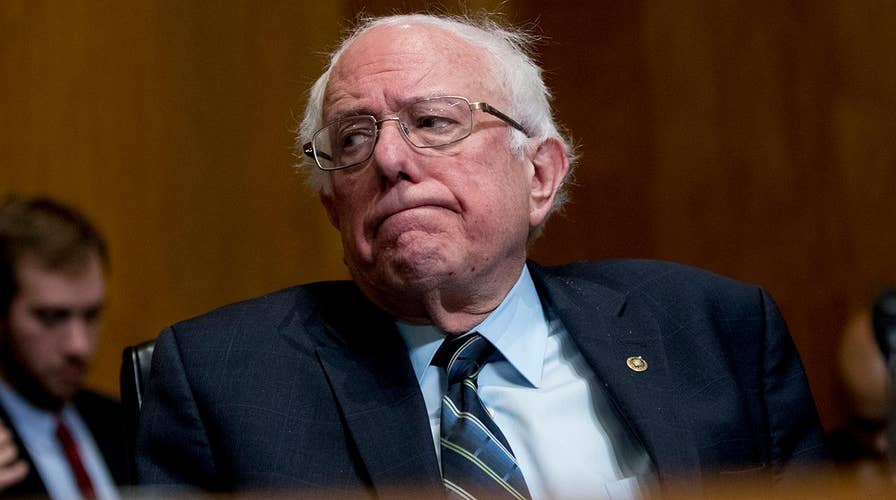
The new socialism: Calls growing on the left for free college for all
White House hopefuls and Democrats on Capitol Hill are joining in on the free college push, but is it a good idea?
This is a rush transcript from "Journal Editorial Report," January 26, 2019. This copy may not be in its final form and may be updated.
PAUL GIGOT, HOST: Welcome to the "Journal Editorial Report." I'm Paul Gigot.
Amid mounting pressure, President Trump Friday announced a short-term deal to reopen the federal government, putting an end to the longest shut down in history. The president and congressional Democrats agreeing to a bill that would fund shuttered agencies for three weeks as lawmakers try to hash out a larger agreement on immigration and border security. Though the deal does not include funding for a border wall, the president warned that he would not give up that fight.
(BEGIN VIDEO CLIP)
PRESIDENT DONALD TRUMP: We really have no choice but to build a powerful wall or steel barrier. If we don't get a fair deal from Congress, the government will either shut down on February 15th again, or I will use the powers afforded to me under the laws and the Constitution of the United States to address this emergency.
(END VIDEO CLIP)
GIGOT: Let's bring in Wall Street Journal columnist and deputy editor, Dan Henninger, and Columnist Kim Strassel.
Kim, the president, within 24 hours, moving from no opening of the government unless you fully fund the wall to, well, OK, a down payment on the wall. Now no money for the wall and a temporary government opening. What caused him to finally give in?
KIM STRASSEL, WASHINGTON COLUMNIST: Yes. The pressure just simply hit breaking point. Look, Paul, you looked out there, voters blamed Republicans, blamed him for the shutdown. It was hurting their approval ratings out there in the polls. You had it doing damage, according to the White House's own economists, to the economy. You saw the consequences of the shutdown really starting to ratchet up, people not showing up for work, airlines being delayed, things not happening. And also you had members of the Republican Party who had, up to this point, stuck with this president but were beginning to both publicly and privately express their concerns and urge him to change course.
GIGOT: Yes. That seems like a pretty comprehensive list to me, Dan. But the president didn't really go into this with a strategy to persuade Nancy Pelosi in the first place. All she had to do was nothing, essentially, and she would win, and that's what happened. He couldn't move her politically.
DAN HENNINGER, COLUMNIST & DEPUTY EDITOR: Yes. And the question is whether he's going to be able to move her over the next three weeks. I mean, let's go back. The key event here, surely, was nationally televised meeting at the White House between President Trump, Nancy Pelosi and Chuck Schumer over this subject at which the president abruptly said that he would shut down the government, take responsibility for it, I'll take the mantel. At that point, there really wasn't anything that Schumer or Pelosi needed to do other than to roll forward and let the president, indeed, take responsibility. And that is what came to pass this week as the government shutdown really began to bite. And I think the key event was the FAA's stop order on the airports of LaGuardia, Newark, Philadelphia. You started to have scenes of people jammed up in the airports. And I think at that point, Paul -- up to a point, the border security, the wall and shutdown had equal political weight in the public mind. But I think the president's wall priority was beginning to really drop down in the public's mind. It was being overwhelmed by the government shutdown.
GIGOT: Right.
HENNINGER: The question is, how is he going to get that back in the public eye.
GIGOT: I want to get there.
I want to ask you, Kim, a lot of the Restrictionists on immigration, the people who have been pushing the president to do the shutdown, do whatever it takes to get the border funding for the wall, are now blaming him for following their advice. I guess they wanted to see his approval rating fall even lower? Is that fair criticism?
STRASSEL: No, and it's mystifying, Paul. Look, here's what we just learned from this shutdown, OK? For years now we've had a number of people on the conservative right say, you know, shutdowns can work if only you are just tough enough, OK? But you go back to 2013, when the Republicans shut down the government over Obamacare, it didn't work. It wasn't a successful strategy. You still have those people who go, oh, well, if you held out even longer, it might have. We just had a president hold out for 35 days. Things were getting worse, not better. The Democrats weren't moving. And to continue to go ahead would just have brought more pain upon the White House and given them even less room to maneuver.
GIGOT: Dan, now we have the president saying he's going to shut it down again if he can't get a deal. How do you think these negotiations are going to go? You're already hearing the Democrats say they're not going to give him money for the wall. That's out. We talk about other things. The president's put extended legal status on the table for the DREAMers, 800,000 of them or so who came here illegally as children and are now young adults, and those with temporary protected status from Central America and elsewhere. Any incentive for the Democrats to do a deal?
HENNINGER: Well, not really, not today. But I think if the White House gets its messaging clearer on what is -- what they want on -- the border security, the wall, I mean, I don't think the wall is really floating anymore. But there's a problem down on the border, for sure, with these caravans, mothers and children coming up. And the White House has not quite made it clear whether the problem is the flow of tens of thousands of people, like these mothers and children, or, as the president keeps saying, crime, drugs and homicidal aliens. They just haven't gotten their message clear. The Democrats aren't proposing much of anything. And I think at some point the public will begin to regard Nancy Pelosi as simply obstinate on this issue if the White House found a way to make a better argument for what they're trying to get. Otherwise, she'll just roll towards that government shutdown which, I think, in three weeks is really unthinkable. The White House can't possibly believe they could survive another government shutdown.
GIGOT: I don't think he's going to shut it down again. All right.
Thank you, Dan.
Thank you, Kim.
When we come back, former Trump adviser, Roger Stone, indicted by Special Counsel Robert Mueller. We'll take a look at the charges against him and what they could mean for the Trump presidency.
(COMMERCIAL BREAK)
GIGOT: Former Trump adviser, Roger Stone, was arrested Friday and charged with seven counts, including witness tampering, obstruction and making false statements to Congress.
President Trump's attorney, Rudy Giuliani, responding to the charges saying, quote: "The indictment today is yet again nothing more than another false-statement charge. It doesn't allege collusion. Indeed, it charges no underlying wrongdoing by Mr. Stone or anyone else. Seems like we are coming to an end."
We're back with Dan Henninger and Bill McGurn.
Dan, you've read the indictment. Is Rudy right about that?
HENNINGER: Well, the thing people have to keep in mind here is this is an indictment of Roger Stone, a guy who's literally out of central casting. He's been around American politics, the fringes, the whole time, for 40 or 50 or years.
GIGOT: Right.
HENNINGER: And the charge against him in this indictment is that he lied to the FBI. And anyone who knows Roger Stone is going, Roger Stone lied? Really? This is a guy who probably lies to the mirror in the morning.
The real issue here has been from the beginning, started with the FBI's counterintelligence investigation of the campaign back in 2016. And this is a long remove from what the original collusion charge was all about, which I think people have to keep in mind. The collusion charge was that Russian intelligence was interfering in the campaign of 2016. Russian intelligence was interfering in a lot of campaigns around the world. But the idea that the Trump campaign at a high level was doing that is far removed from what this Stone indictment is about.
GIGOT: What this indictment does do is it says he lied about his attempts to deal, to get in contact with Julian Assange from WikiLeaks --
BILL MCGURN, COLUMNIST: Right.
GIGOT: -- which ultimately leaked some of the documents from the DNC, presumably, getting it from the Russians who hack had had it.
MCGURN: Right.
GIGOT: OK. So that's the connection to the potential collusion, Bill.
MCGURN: Right. But you say "potential," and that's a big word here. The important part about this indictment is Roger Stone has been a swamp creature for a long time, and he thrives in it, right? He seems to be in trouble for, during the campaign, having exaggerated his contacts with Julian Assange at WikiLeaks --
(CROSSTALK)
GIGOT: He even talked about them on the air.
MCGURN: Right. Pretending that he had close ties that he didn't, and then he pretended that he didn't do that during the campaign, so he's in trouble for that. But these are all crimes, as Dan points out, these are after the investigation began. Also Donald Trump cut him off before his campaign and so forth. These are process crimes.
GIGOT: In 2016.
MCGURN: Doesn't mean they're not serious. You lied. Doesn't mean he's not going to be punished. But again, as Dan pointed out, this is supposed to be a counterintelligence investigation. And the crimes that they're unearthing are crimes that occurred after the investigation started.
GIGOT: But let me push back on you guys at this point. Julian Assange, we know, from his previous experience, is anti-American. He hates America. He has been responsible for tangible harm to American national security. Why in the world would anyone, if associated with the Trump campaign, want to have anything to do with Julian Assange? And isn't that sleazy behavior that should be rejected politically?
HENNINGER: Well, it is sleazily behavior. Roger Stone specializes in sleazy behavior. But again, I want to emphasize there's the idea here that the Trump campaign was in collusion with the Russians in Moscow --
(CROSSTALK)
GIGOT: Right. And there's no evidence in the four corners of this indictment of any of that.
HENNINGER: Yes. And think back to the Trump campaign through this period of 2015-2016. Paul if, it was virtually a pick-up basketball team --
GIGOT: And a bad one.
HENNINGER: And a bad one. They were just throwing a campaign together. Paul Manafort became the director of the campaign partly because Stone recommended him, and partly because Donald Trump knew him because he lived in Trump Tower. The idea that they could have orchestrated something this sophisticated really kind of defies common sense.
GIGOT: There's some back and forth in the indictment about Stone's conversations or communications with, they call, Trump officials. One of which looks to be an associate of Steve Bannon, who was then with the campaign.
MCGURN: Right.
GIGOT: And when -- even complimenting Stone, saying good job or -- I forget what the exact phrase was -- after the leaks came out -in October, a WikiLeaks batch. That's, again, not collusion, but it is - it's --
(CROSSTALK)
MCGURN: Yes, it's sleazily. But are we going to, again, the special counsel was appointed mostly for a counterintelligence investigation alleging that Donald Trump worked with Putin --
GIGOT: Right.
MCGURN: -- to steal the election. I think it's kind of outrageous. We have no evidence of that. And people are charged with crimes that occurred after this began on process crimes. So, yes, if you want to stipulate that Roger Stone was sleazy, that campaigns looked for dirt on --
(CROSSTALK)
GIGOT: And he lied.
MCGURN: But we're going to have the whole legitimacy of the election questioned. I think this is another reason the special counsel should wrap up his investigation. No prosecutor, as an ordinary prosecutor would keep this going this long just in search of crimes.
GIGOT: Quickly, Dan, that gets to the key point, which is we don't know if Robert Mueller has some big information --
HENNINGER: Right.
GIGOT: -- something that would connect all of these various dots together and make a case of collusion that we don't have yet, isn't that the big question?
HENNINGER: That is the big question. This came up in the confirmation hearings for attorney general, Bill Barr, whether he would step in at some point. And I think he said he would to try to sit down and find out whether this can be brought to a resolution quickly, as Bill just suggested.
GIGOT: Thank you, gentlemen.
When we come back, after years of poverty and deprivation, a Democratic revolt against Nicolas Maduro and the government in Venezuela. So what should we make of the uprising and what happens next?
(COMMERCIAL BREAK)
GIGOT: A democratic revolt this week against Dictator Nicolas Maduro and the government of Venezuela. The 35-year-old head of the national assembly, Juan Guaido, declared himself interim president Wednesday as hundreds of thousands of protesters took to the streets. The Trump administration formally recognizing Guaido and praising his plan to hold elections, with the president tweeting, quote: "The citizens of Venezuela have suffered for too long at the hands of the illegitimate Maduro regime. Today, I have officially recognized the president of the Venezuelan national assembly, Juan Guaido, as the interim president of Venezuela."
Wall Street Journal columnist, Mary Anastasia O'Grady, is back with a look at what it all means.
You've been covering Venezuela for years, Mary, for your sins.
(LAUGHTER)
Why is the Guaido government more legitimate than Maduro.
MARY ANASTASIA O'GRADY, COLUMNIST: Well, Juan Guaido was elected as part of the national assembly back in 2015. That was a free and fair election. And don't forget that Chavez, who was the founder of --
GIGOT: Hugo Chavez.
O'GRADY: Yes. He had basically defeated the opposition by rigging the elections so much that, basically, everybody stayed home. So he got control of the national assembly. And in this particular if election, people came back out, and they said we think we can win. So they --
GIGOT: They took it back?
O'GRADY: They took it back, yes. This year, Juan Guaido was elected president of the national assembly, so he's the head of the national assembly. In the Venezuelan constitution, it says when the national assembly deems certain things about the current president as being illegitimate, then the job falls to the president of the national assembly to become the interim president and to call for new elections. So it's completely constitutional, a constitution, by the way, that was written by Hugo Chavez's supporters.
GIGOT: And Maduro claims he won an election last year and has swore himself in here, but you're saying that was a rigged election?
O'GRADY: Yes. I mean, not only am I saying that, a lot of international organizations said that. The European Union did not recognize it. The OAS did not recognize it.
GIGOT: Organization of American States.
O'GRADY: Yes. And, basically, one of the many things that made that a rigged election, of course, the Cubans control the voter rolls and all of that, but the other thing is that they basically disqualified all of the leading candidates and the most important leaders in the opposition from even running. So it is a completely sham election.
GIGOT: OK. So now you have two presidents saying they're both, have power.
O'GRADY: Right.
GIGOT: Is -- how -- will this come down to where the military comes down?
O'GRADY: I think it will. And what's interesting is a lot of people are paying attention to the minister of defense. But the minister of defense is a guy called Padrino Lopez. And this guy is -- you know, there are photographs of him basically kneeling before Fidel Castro. I mean, he's part of the status quo of the regime dictatorship. The real question is the lieutenant colonels, the sergeants, the rank and file. And my information -- and this could be wrong but, I mean, as best as I can tell - - they want to move, but they -- you know, that's where you might see a possible break.
GIGOT: And so if they're ordered by the generals, for example, to arrest Guaido, which they could, or to shoot, fire on demonstrators to put them off, that would be the acid test to what happens, whether those soldier and those middle ranking officers willing to do that.
O'GRADY: Exactly. And you're already seeing pockets of violence. So there's already a body count that's going up. There are people being arrested, demonstrators being arrested. I mean, they're trying to put this down with repression. But that's coming largely from the National Guard, which has always -- does a lot of the drug trafficking under the protection of Maduro, and also this paramilitary that has been armed by the Cubans and the Russians.
GIGOT: Now, the Cubans have an extensive intelligence network operating in Cuba -- in Venezuela, and you believe that, in fact, they are essentially controlling Maduro, is that correct?
O'GRADY: It is -- they're not just controlling Maduro, they're controlling the upper ranks of the military as well. Because you have all these flag officers, east admirals or generals, and they're kind of siloed. They built the system specifically for this reason. There's lots of counterintelligence, they're really good at spying on people. So if you can't organize, if you can't communicate, you can't organize, you know, an overthrow.
GIGOT: So how should the people of Venezuela and Americans, who have now endorsed this new interim government, how do you counter that with Cuban influence?
O'GRADY: Well, I mean, the most important thing is that you support the people on the streets, and you support Juan Guaido. And --
GIGOT: They've done that.
O'GRADY: Pompeo's already done that. As you say, the big test will be if the military's asked to fire on the crowd and they refuse to do it. That's where I think you can anticipate --
(CROSSTALK)
GIGOT: How do you squeeze Cuba?
O'GRADY: Well, there's a lot of things. First of all, we should get all of our allies in the region, and there are now at least 11 countries that agree with the United States. And they're actually the ones who are leading this. Cuba wants it to be about the U.S., the empire. But, actually, these other countries are the ones who have led this since January 4th when they came out and said, without the U.S. as part of the group of Lima, they announced that Maduro is illegitimate. And now what we need to do is squeeze the Cuban leadership. That means travel sanctions, freezing bank accounts, diplomatic pressure and so forth, until you get them to decide that it's easier for them to do the right thing.
GIGOT: OK. Thank you very much, Mary. Appreciate it.
When we come back, California Senator Kamala Harris the latest high-profile Democrat to jump into the 2020 presidential race. What Harris has to offer and what to make of the rest of the growing 2020 field.
(COMMERCIAL BREAK)
GIGOT: The 2020 presidential field seemingly growing by the day. California Senator Kamala Harris is the latest high-profile Democrat to make it official, announcing Monday that she'll seek her party's nomination to take on President Trump, and raising $1.5 million in the first 24 hours of her campaign.
Here with a look at a what Harris has to offer and who else has jumped into the race in recent week, "Wall Street Journal" editorial board members, Allysia Finley and Kyle Peterson.
So, Allysia, we've talked about Elizabeth Warren. She was in a while ago. Now Kamala Harris, often mentioned as one of the top-tier candidates. Why?
ALLYSIA FINLEY, EDIORIAL BOARD MEMBER: Well, she's got an interesting background. She has -- she's a mix between her mother, who is Indian, an immigrant, and her father, who is Jamaican. So it fits in with the identity politics that the left has been so obsessed with. She's also had a very strong record as -- strong, I say that somewhat ironically -- as a prosecutor going after liberal targets when she was attorney general in California, ExxonMobil, for-profit colleges, payday lenders.
PAUL GIGOT, FOX HOST: Democrats love those as political targets.
FINLEY: Right.
GIGOT: But attorney general now, she's only been in the Senate two years - -
FINLEY: Right. And she hasn't really accomplished much.
GIGOT: Is that a barrier --
(CROSSTALK)
FINLEY: Well, look at Barack Obama, right?
GIGOT: So it's not a real barrier?
FINLEY: No. I think it's actually down to her benefit that she hasn't done much or hasn't had to make many tough votes. So I think that'll actually make it easier for her to skate through a primary.
GIGOT: What are her weaknesses, Kyle? What do you think?
KYLE PETERSON, EDITORIAL BOARD MEMBER: Yes. One of them is if Democratic voters really want American carnage that Elizabeth Warren is selling. That's not what Kamala Harris was providing. She was talking about fighting for the best in us. It's interesting --
(CROSSTALK)
GIGOT: It's a more optimistic message?
PETERSON: It is a more optimistic message. One of the emerging distinctions is whether Democratic voters are going to be won with honey or vinegar. Elizabeth Warren, this week, the news is she's thinking about proposing a wealth tax, a tax on assets above a certain amount of income. Her message is we're going to get those millionaires.
(CROSSTALK)
PETERSON: Harris is going the other direction. She's talking about tax credits for renters, tax credits for working Americans. It's still a redistributionist policy, but it's being sold from the other end.
FINLEY: I think she's very much running like Obama. She's not disclosing all her plans for taxes, especially because she's, like, a lot of her donors are in Silicon Valley and they are the millionaires and billionaires.
DAN HENNINGER, COLUMNIST & DEPUTY EDITOR: The phrase "like Obama did" is key, because Barack Obama had this extraordinary skill of just running on this warm personality and kind of subsumed the policies of, like the Elizabeth Warren type stuff. It is not at all clear that even Kamala Harris or any of the rest of them are going to be able to pull off what Obama did. A warm guy, appealing to everyone. These people have a harder edge to them.
GIGOT: And she got her start in politics from Willie Brown, the former speaker of the California assembly, who she dated, two or three decades her senior, but connected her to all kinds of Democratic money people and really gave her her big jump in California politics.
FINLEY: Right. And she does not discuss that fact in her --
GIGOT: Didn't put it in the book.
FINLEY: -- in her book at all. He appointed her to some state commissions, she earned six figures basically not doing much. And then he connected her to the well-heeled elites in San Francisco and L.A.
GIGOT: That'll be something to watch.
Kirsten Gillibrand, Senator from New York, basically also getting in. What do we make of her?
PETERSON: Well, what's interesting about her is that she has basically wiped her whole policy record clean in between 2008 and 2009. So she was in the House from an Upstate New York district. She was railing against amnesty for illegal immigrants. She had an A rating from the National Rifle Association. And then in 2009, she was appointed to Hillary Clinton -- the Senate seat being vacated by Hillary Clinton. And by 2010, she had an F from the National Rifle Association. She now says President Trump's immigration policies are outright racist. The question is whether people are going to buy this idea that she's had a conversion to liberal views.
GIGOT: And, Dan, she was -- wrapped herself around the Clintons for a long time as she was climbing the ladder. Then when the "Me Too" issue broke out, she basically came out and said, well, I think Bill Clinton should have resigned. So they threw them over the side. She used to play squash with Al Franken in the Senate. When the accusations came out against him, she was of the first Senator to come out and say he should resign. So she's really had one to have great makeovers in American politics. Is that -- I mean, I guess you could say authenticity will not be her strong selling point.
HENNINGER: Well, I guess if you're running for president, the level of ambition that has to be something outside the human scale of most of the rest of us.
(LAUGHTER)
Just try anything.
But there's a political baseline here, I think, which is that all of these Democrats believe that Donald Trump's disapproval rating is rising and all that he has held on to is that base down in the 30s. Hasn't expanded his base. A lot of them think all they have to do is get that nomination, and they're in the White House.
GIGOT: I agree with you, that's what they think.
Briefly, Tulsi Gabbard, congresswoman from Hawaii, seems like a long shot, but what does she bring?
FINLEY: She has some authenticity, but she's been all over the place on positions like religious liberty. She's made some comments -- she's been culturally conservative in the past, but she's going to have to run to the left --
GIGOT: Against same-sex marriage.
FINLEY: Against same-sex marriage, exactly.
GIGOT: Now she's for it.
FINLEY: Exactly. But, you know, she'll be another idiosyncratic candidate in the mix.
GIGOT: And, Pete Buttigieg, the mayor of South Bend, Indiana, which has not normally been a launching point for presidents, but is this, is this a lark or is this serious?
PETERTSON: You've got to think that he's running for an MSNBC contract.
(LAUGHTER)
You know, it's going to provide a lot of color. We're still two years from the election. We've got nine candidates in this clown car so far. I think we can fit another 15 or 20 in, you know? Bring it on.
(LAUGHTER)
GIGOT: You want to just -- this is basically your lifetime employment --
(LAUGHTER)
GIGOT: -- contract.
Still ahead, as the Democratic presidential field starts to take shape, we continue our look at the new Socialism and growing calls on the left for free college for all.
(BEGIN VIDEO CLIP)
REP. JOAQUIN CASTRO, D- TEXAS: To insure if we want to be competitive that every single American who wants a higher education can get one. And that's why with I believe that we need to work toward a tuition-free system.
(END VIDEO CLIP)
(COMMERCIAL BREAK)
(BEGIN VIDEO CLIP)
SEN. BERNIE SANDERS, I-VT.: Got a lot of people living in poverty, people on top are doing very, very well. It is not wrong to say to those people, you're going to have to start paying your fair share of taxes. And that is how we're going to fund making sure that college is available for all.
(END VIDEO CLIP)
GIGOT: That was Vermont Senator Bernie Sanders in South Carolina this week testing the waters for his potential 2020 presidential run and renewing his 2016 campaign push for free college for all. It's a growing refrain on the political left, with other White House hopefuls and Democrats on Capitol Hill taking up the call. But is it a good idea?
Let's ask Richard Vedder, distinguished professor of economics emeritus at Ohio University.
Richard, good to see you again.
He's also author of the forthcoming book, "Restoring the Promise: Higher Education in America."
I know it doesn't surprise you that this is a call coming from the Democrats. What's the case against it?
RICHARD VEDDER, PROFESSOR OF ECONOMIC EMERITUS, OHIO UNIVERSITY & AUTHOR: Well, first of all, we, in economics, say there's no free lunches. I would say there's no free college. Someone is paying for college. And it's -- I'm a little surprised in a way at some of the Democrats for pushing free college, particularly if they're talking about four-year colleges.
GIGOT: Right.
VEDDER: Because most of the people who go to college, to a four-year college, getting bachelor's degrees, come from relatively well-off families. And I'm not talking about just the elite eastern private schools such as the one, frankly, Paul, that you went to, where the average income, the average family income is about a half a million a year and the --
(CROSSTALK)
GIGOT: Richard, it was 6,000 bucks --
(CROSSTALK)
GIGOT: It was 6000 bucks when I went there!
(LAUGHTER)
VEDDER: Yes, hell, I understand. It was $450 when I went. I'm a little older than you are, Paul.
(LAUGHTER)
I went to Northwestern, you know? A cheeky Midwestern school.
But even at the, say, flagship state universities this is the case. The university of Virginia, for example, the median family income of people going to UVA is over $150,000 a year. If you used average income, it's over $200,000 a year. So here we have a bunch of rich kids or at least moderately middle-class kids going to college. And Bernie is saying and others are sawing let's give them free tuition. That doesn't sound like a progressive message to me.
GIGOT: What if they said, OK, fine, we'll go to four-year college, but we're also going to subsidize vocational school, two-year colleges, all of those as well. And if you, you -- a relatively well-off person -- want to go to Harvard, we'll pay for you, too. That's still appealing to an awful lot of people.
VEDDER: Sure. The first question that comes to mind is -- and it goes back to my first comment -- how are you going to pay for this? Here we have a government that has the better part of a trillion-dollar deficit in a period of 4 percent or less than 4 percent unemployment. Crazy. We've never had anything like this before. Our national debt is over 100 percent, the gross national debt's over 100 percent of our GDP right now. We're getting up there. We're not at the Greece level yet, but we're kind of moving in that direction. We've got to put some limits on what we do as a nation. And giving away college to rich kids or even to middle-income kids isn't doing any good, and it's not doing some of the kids good. Paul, do you know what the average graduation rate is for most community colleges? Well, it's under 30, 40 percent. I took governor -- what's his name -- Governor Murphy in New Jersey wants free college.
GIGOT: Right.
VEDDER: A 21 percent graduation rate, 24 percent graduation. The kids aren't even graduating!
GIGOT: But here's a question, I think, when it gets to your equity point, and that is if you go to college, all of the statistics show that if you graduate from college, your lifetime earnings are going to be higher than if you don't. So that's a lot of the reason that most parents when they say to -- when their kids say, you know, I want -- when they're deciding what to do, they'll say go to college, because they know those statistics.
VEDDER: Yes. It is true that kids who go to college earn more than kids that don't. Why do I they earn more? Partly -- in fact, I would say mostly, Brian Kaplan, at George Mason, would say almost entirely, it's because they're smarter, they have higher I.Q.s, they work harder, they did better in high school, they're less likely to skip class, etc., etc. They have attributes many of which have nothing to do with what they learn in college that give them an edge. I think we have overrated college. I do think, if we are going to provide federal aid, provide it to vocational schools is a good idea. We probably should. Why don't we give vouchers to low-income kids to learn how to become welders. Send them to a career college for a year, give them $20,000 and let them become welders? I think that would do more good than providing free college to everyone.
GIGOT: And you have argued that the subsidies for college really do also increase tuition rates and the cost of college, and that kind of is a ratchet that keeps going. I assume that you think that would be even more so if you gave free college to everybody.
VEDDER: Yes. If you give free college, first of all, where are the colleges going to get their money? Right now, they get some of it from student tuition. The presumption here is somehow the government is going to write checks to colleges for whatever tuition fee they set. Well, we know how that's worked over the last 30, 40 years. Since we put in the federal student loan programs, fees have soared. And the evidence is inconvertible on this. The New York Fed, the National Bureau of Economic Research, others have done studies that show there's a very strong correlation between the increases in federal student aid and tuition fees. It's going to get worse.
GIGOT: OK. Thank you, Richard Vedder. Appreciate your being here.
Still ahead, the high school deplorables. What the Catholic controversy says about the state of our political culture.
(COMMERCIAL BREAK)
GIGOT: Covington Catholic High School in Kentucky reopened with a police presence on Wednesday following threats stemming from a viral video recorded during last weekend's March for Life in Washington. The school and its students came under fire after a small portion of the incident was posted on social media, giving some the impression that teens were harassing a Native American man, Nathan Phillips, following the pro-life demonstration. Subsequent footage painted a different picture of the confrontation and prompted some media mea culpas.
Nick Sandmann, the teenage student involved in the confrontation, spoke out this week on NBC.
(BEGIN VIDEO CLIP)
NICK SANDMANN, HIGH SCHOOL STUDENT: I wanted the situation to die down, and I just wish he would have walked away. But I knew as long as I kept my composure and didn't do anything that he might perceive as aggressive or elevation in the conflict, that it would hopefully die.
(END VIDEO CLIP)
GIGOT: We're back with Dan Henninger, Mary Anastasia O'Grady and Bill McGurn.
Dan, why did these boys become targets?
DAN HENNINGER, COLUMNIST & DEPUTY EDITOR: Well, they became targets because of the short version of the video, which a lot of people interpreted as an aggressive of act against this fellow with the drum. And the other reason they became targets is because of social media. Social media immediately causes people to react almost without thinking, and so you have this torrent of published accusations against this kid. And people were taken aback. I mean, most of the country isn't doing this sort of thing every day, and they just looked at it -- when they found out later that nothing had really happened, it became one of the most, perhaps the most embarrassing moments ever for social media.
GIGOT: But don't we have to also say there was a white --
BILL MCGURN, COLUMNIST: Right.
GIGOT: -- white boys from a Christian school --
MCGURN: Right.
GIGOT: -- who had attended a March for Life rally, who were wearing MAGA hats. If you're looking at the boxes to check, progressive Americans dislike all of those disfavored groups. They checked them all.
MCGURN: Yes. Look, that's why everyone jumped. It was too good to be true or to resist, right? So what we've learned since then is almost nothing that was said was true. The gentleman in question, the Native American leader, was not a Vietnam vet, as had been claimed. He -- the boys did not confront him, he walked into their circle. Almost everything was wrong.
What's more amazing to me is that even after it's been exposed -- and some people have apologized, and give them credit, they've manned up -- what's amazing to me is a lot of people giving this half apology. Well, you know, yes, we got everything wrong, but, you know, they were wearing MAGA hats.
(LAUGHTER)
And that's really incredible to me. Because if the definition of a bigot is someone that judges people not by the merits of their opinion, but they have a different opinion, different group, aren't they as guilty as anything Trump has done?
GIGOT: Used to be, Mary, that you could say social media, well, it was only on social media, you can ignore it. In this case, we saw the ramifications. They just, they blew up. I mean, these, the school -- the diocese, the school said we're going to investigate, maybe even look at expulsion. And presumably, now if you're one of these kids and you go for a job in the future or you apply to a school, the admissions officer might Google you and look and say, oh, my gosh, you're one of those Covington kids, and you were involved there. And say, sorry, we can't hire you.
MARY ANASTASIA O'GRADY, COLUMNIST: You know, Paul, this incident took me back to 2016 when people looked at Donald Trump up on that stage and said, who could possibly be supporting this guy? And, you know, when you looked at what happened here, people both on the left and the right had piled on these kids right away. And, you know, the right basically retreating and apologizing even before they knew what happened. I think it's sort of a metaphor for, you know, the idea that if you have these traditional values, if you're at the March for Life, you know, you're fair game and there's no one to defend you. And I think people felt like Donald Trump was the first person that came along that said, wait a minute, these people are entitled to their opinions also. And this -- you know, we've been lectured about tolerance for 40 years. And all of a sudden tolerance except when it comes to these traditional --
(CROSSTALK)
MCGURN: Yes. I think Mary's absolutely right. People have been lectured about this and told that -- look, this is the triumph of Hillary Clinton.
GIGOT: You mean the deplorables?
MCGURN: The deplorables. She said half of his supporters, just by being a supporter, and I think that's a bigotry, too.
HENNINGER: But it was also Barack Obama. Remember, he said people out there clinging to guns and religion. These are not accidents, slips of the tongue. This is the way the left think thinks about the broad range of America. As Mary is suggesting, there's a lot of suburban parents out there watching this incident, saying that could be us. And their only outlet they have is a presidential vote.
GIGOT: That they hate us.
MCGURN: They hate us.
GIGOT: And they don't hate us because they know us. They hate us just because of who we are.
HENNINGER: Yes.
GIGOT: That's a very scary thought.
MCGURN: Wearing a hat.
O'GRADY: Well, they --
GIGOT: Or going to a Catholic school, let's face it. Going to a Catholic school.
O'GRADY: Having different values.
GIGOT: Is there going to be any fallout from this at all other than for the kids?
HENNINGER: Well, there could be. I mean, apparently, the young fellow has gotten himself a lawyer, there could be some lawsuits filed against people. You know, social media is so free-wheeling it's like the author, Reza Aslan, immediately saying about this 15-year-old, that looks like a really punchable face to me. People ought to be more careful about what they say on Twitter.
GIGOT: I guess, good luck, unfortunately.
(LAUGHTER)
HENNINGER: From the top, down.
GIGOT: We have to take one more -- from Trump, too.
We have to take one more break. When we come back, "Hits & Misses" of the week.
(COMMERCIAL BREAK)
GIGOT: Time now for "Hits & Misses" of the week.
Kyle, first to you.
PETERSON: I'll give a miss to anti-science progressives in suburban Portland, Oregon, where there is now a measles outbreak that infected dozens of people, most of them kids whose parents declined to vaccinate them. So this is a tragedy because vaccines are safe. But it's a public health crisis since the authorities are warning that contagious individuals, went to a Trail Blazers game and Costco and international airport.
GIGOT: Terrible stuff.
Allysia?
FINLEY: A miss to L.A., Los Angeles Teacher's Union, which went on strike for six days, supposedly for the students. They called out of their strike this week after reaching labor agreement with the district. But they cost teachers 3 percent in their salaries and the district $100 million without actually achieving anything for students.
GIGOT: All right.
Bill?
MCGURN: A double miss for Ireland. Last year, the upper senate passed a bill that would criminalize trade with the West Bank and, you know, part of the anti-Israel movement. Now the lower House is debating the bill. "Bloomberg's" Eli Lake quote the Israel ambassador to Ireland, saying if they pass this, they'll become most anti-Israel country outside Iran in Middle East. It's also nuts because they're a capital haven. They have a lot of U.S. companies there who will have to choose between having a base in Israel and having a base in Ireland.
GIGOT: Bill, thank you.
Remember, if you have your own hit or miss, be sure to tweet it to us, @JERonFNC.
That's it for this week's show. Thanks to my panel. Thanks to all of you for watching. I'm Paul Gigot. We hope to see you right here next week.
Content and Programming Copyright 2019 Fox News Network, LLC. ALL RIGHTS RESERVED. Copyright 2019 CQ-Roll Call, Inc. All materials herein are protected by United States copyright law and may not be reproduced, distributed, transmitted, displayed, published or broadcast without the prior written permission of CQ-Roll Call. You may not alter or remove any trademark, copyright or other notice from copies of the content.
