





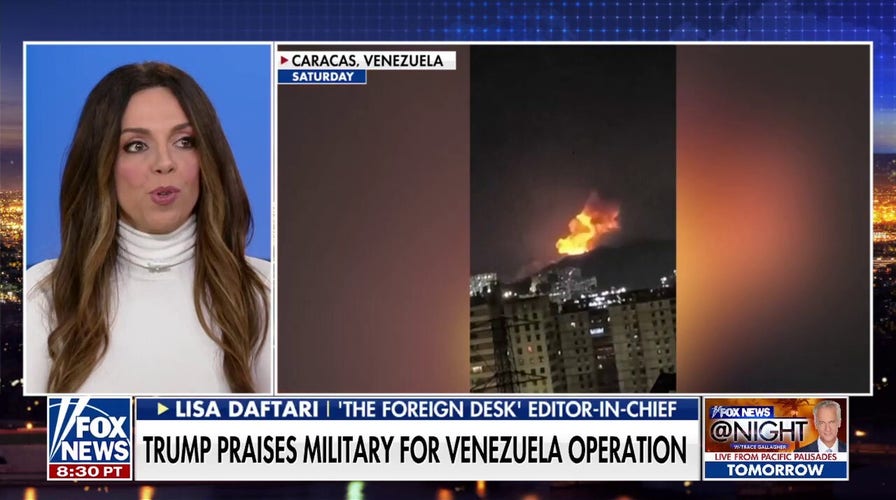
Tensions rise between US, Colombia following Maduro capture
Fox News correspondent Steve Harrigan, Venezuelan political refugee Franklin Camargo and 'The Foreign Desk' editor-in-chief Lisa Daftari react to rising tensions between the U.S., Colombia and Cuba in the aftermath of Nicolás Maduro's capture.
The abduction of Nicolás Maduro from Venezuela’s capital has set off extensive debates about its legality. International law scholars overwhelmingly assume that, regardless of its constitutionality, the action violated Venezuela’s sovereignty. In fact, there are strong international legal justifications for the operation.
Indeed, at first glance, the invasion and abduction of Maduro would seem to be a "use of force... against the... political independence of any state," in the language of the U.N. Charter Article 2(4). However, this is true when the attacked state's government objects (as is typically the case). If the attacked state's government consents, there is no violation of sovereignty, and this is the common case of what is known as "interventions" and military assistance.
Certainly Maduro and his vice president strongly object to the U.S. operation. But, the United States "does not recognize Nicolás Maduro as the president of Venezuela," a policy established by then-Secretary of State Anthony Blinken. So his lack of consent is irrelevant from Washington's perspective.
TRUMP'S MADURO TAKEDOWN RESETS THE GLOBAL CHESSBOARD AND REASSERTS AMERICAN POWER

Instead, since the Biden administration, the U.S. has recognized Edmundo Gonzalez, the winner of the 2024 elections, as the legitimate head of the government. Gonzalez has certainly not opposed the operation. Instead, his sole public response has been to say, "Venezuelans, these are decisive hours, know that we are ready for the great operation of the reconstruction of our nation," while reposting a statement by Maria Corina Machado, the Nobel Prize laureate and opposition leader, that "the hour of freedom has arrived." That could certainly be seen as consent, and even endorsement for the operation.
Some may object that the legality of the operation should not depend on America’s own recognition or non-recognition. But in international law, there can be no other way, as any dealing with a foreign entity requires making determinations about who its government is.
For example, when the United States intervened militarily in Haiti in 1991 at the behest of deposed President Jean-Bertrand Aristide, it was based on the judgment that the military junta was not the lawful government in Port-au-Prince. When the U.S. decides whether to assist Taiwan in the event of a Chinese invasion, it would have to be based on a prior decision that the Chinese Communist Party is not the lawful government of the island.
In international law, each country makes such decisions by itself. This, of course, leaves the door open for abuse, as when Russia invaded Crimea at the purported bequest of ousted Ukrainian President Viktor Yanukovych. But this is inevitable in international law, where, lacking any central authority, in most situations, countries are left to interpret for themselves.
CLICK HERE FOR MORE FOX NEWS OPINION
In the present context, there is no concern that the non-recognition of the Maduro regime is opportunistic, as the position was first adopted by the Biden administration, which clearly was not contemplating military action. Moreover, many other countries, from Canada and Argentina to Italy and France, recognize Gonzalez as the legitimate president. By contrast, very few states recognize Maduro’s de jure rule.

CLICK HERE TO DOWNLOAD THE FOX NEWS APP
Alternatively, it could be that Venezuela could have no recognized government, which technically means there is no one who could consent to foreign intervention. This is a fairly harsh and formalist implication of legal doctrine, as, in practice, such countries are ones quite likely to create harmful externalities for third-world countries, who in this view would have no recourse.
Given the bipartisan U.S. view that Maduro is not actually president, and that his regime control was heavily supported by foreign troops (dozens of Cuban security forces died resisting the U.S. operation, Hezbollah has reportedly been welcomed as well), the action to remove him would not be against the "political independence" of Venezuela, and thus not implicate Article 2(4) at all. It would be odd to read 2(4) as allowing foreign powers to use troops to prop up an illegitimate, unelected dictator, but not to remove him.
