





















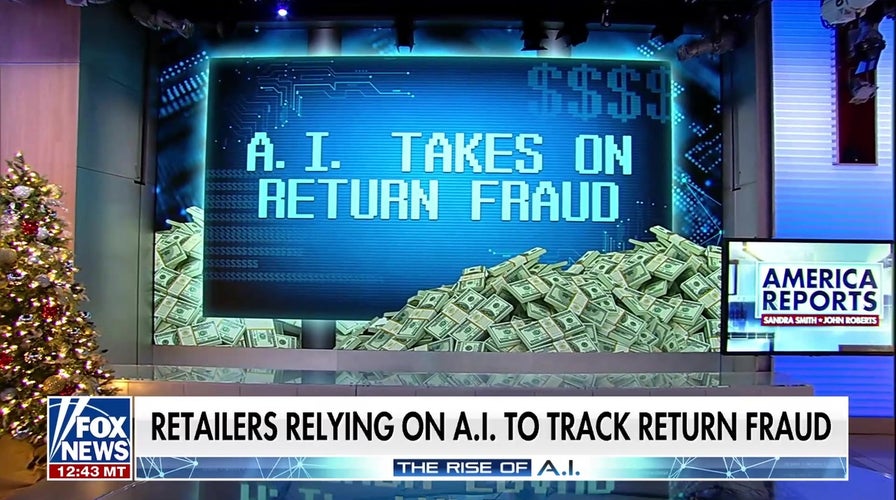
Retailers using artificial intelligence to track return fraud
FOX Business correspondent Max Gorden explains how Happy Returns is using artificial intelligence to audit legitimacy of customer returns on ‘America Reports.’
Artificial intelligence is one of the most influential technologies of our time. It writes our emails, tutors our children and increasingly counsels us through life's hardest moments. According to research published in Harvard Business Review, the most common use of generative AI in 2025 is therapy and companionship.
People are asking AI the questions they once brought to mentors, counselors and pastors: How do I forgive betrayal? How do I manage my anxiety? How do I lead my family through a crisis?
What responses do they get back? At best, therapeutic generalities. "Consider mindfulness." "Connect with your values." "Seek a higher power." At worst, guidance that lacks moral clarity, and in some reported cases, has already endangered lives.
AI has quietly become America's most influential spiritual advisor. And it doesn't believe in anything. This isn't speculation. My team at Gloo just released the Flourishing AI Christian (FAI-C) Benchmark, an evaluation measuring how well today’s leading AI models support human flourishing through a Christian lens. We assessed responses across seven core dimensions — Finances, Character, Happiness, Relationships, Meaning, Faith, Health — looking for biblical grounding, theological coherence and moral clarity.
LAWMAKERS UNVEIL BIPARTISAN GUARD ACT AFTER PARENTS BLAME AI CHATBOTS FOR TEEN SUICIDES, VIOLENCE
Among the seven core dimensions assessed, the Faith dimension scored the lowest, averaging 48 out of 100 across the 20 AI models evaluated by the FAI-C Benchmark. Most models struggled to coherently discuss foundational Christian concepts like grace, sin, forgiveness and biblical authority. Instead, they substituted vague spirituality for Scripture and neutrality for conviction.
These results should alarm anyone who cares about human values, future generations or the role faith plays in America.
The Erasure Is Structural, Not Accidental
These models weren't trained to be hostile to Christianity. They were trained to avoid it. Built on predominantly secular data and optimized to offend no one, today’s AI systems default to lowest-common-denominator spirituality. The result is language that sounds supportive, but lacks substance.
That matters because AI isn't just answering questions. It's shaping worldviews. If the next generation turns to AI for moral guidance and receives only platitudes instead of principled reasoning, we're not just losing theological literacy. We're losing the capacity for moral formation itself.
For over two-thirds of Americans, faith is not a lifestyle preference or a cultural accessory. It's the foundation of meaning, purpose and human dignity. When AI systematically sidelines that foundation, it's not being neutral. It's taking a position.
A Better Path Forward
I've spent over 40 years developing foundational technologies and industry standards. One lesson has been consistent; systems reflect the values embedded in them. If we want AI that strengthens moral conviction rather than flattening it, two things must change.
First, AI models must be trained to understand faith with the same seriousness as they apply to science, history or literature. Not to preach, but to accurately and respectfully engage with the worldviews users actually hold.
Second, there must be benchmarks that measure this rigorously. Without measurement, there's no accountability. Without accountability, there's no improvement.
That's why FAI-C exists — not to demand every AI system adopt a Christian worldview, but to expose where today's models fail to understand the people they're meant to serve.
CLICK HERE FOR MORE FOX NEWS OPINION

The Stakes Are Higher Than We Think
Used well, AI can extend wisdom, strengthen communities and support genuine human flourishing. Used carelessly, as the unbounded travails of social media have already shown us, it can accelerate moral erosion, replacing depth with sentiment, conviction with comfort and truth with whatever feels less controversial.
A thriving society needs strong moral frameworks. For billions of people around the world, that framework is Christianity. If AI cannot recognize, respect and engage with that reality, it will become a tool of cultural flattening rather than human elevation.
CLICK HERE TO DOWNLOAD THE FOX NEWS APP
The goal isn't to make AI preach. It's to ensure AI doesn't erase. By building models to engage with a faith-based worldview, we can ensure that as AI becomes more powerful, it also becomes more humane.
Because the question isn't whether AI will shape the next generation. It's whether we'll ensure it shapes them well.
