





















US must outcompete China's 'closed society' to win AI race, Rep Steil warns
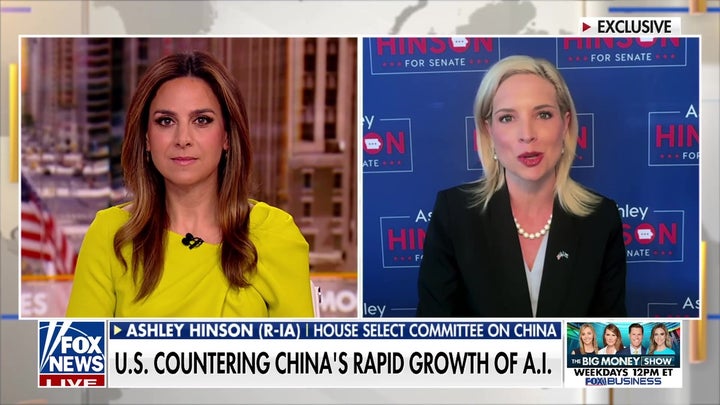
Rep. Bryan Steil, R-Wis., discusses the AI race between the U.S. and China, emphasizing the need to maintain our innovation edge and protect infrastructure against Chinese intellectual property theft to ensure national security.
For more than two decades on the Army Staff, part of my job was recommending which nations received American weapons, training and doctrine, and which did not. The choice rarely came down to which weapon system performed best on a range. It came down to alliance.
A country that trained on American equipment, spoke our tactical language and built its systems around our supply chains stayed tied to Washington for a generation. One that turned to Moscow or Beijing drifted into someone else’s orbit.
That lesson has stayed with me. Great powers rarely prevail because they possess the single best weapon; they prevail because other nations choose to build their militaries, economies and, ultimately, their futures around their systems. Washington risks forgetting that lesson in today’s race to build the world’s dominant computing platform.
ROBERT MAGINNIS: TRUMP’S ANKARA REMARKS REVEAL A GRAND STRATEGY HIDING IN PLAIN SIGHT
Not just a software race
While Washington argues over which chatbot drafts the sharper essay, Beijing is building something far more ambitious than a single flagship model. That distinction separates today’s technology race from tomorrow’s world order. Consider that China’s Huawei is preparing to double production of its Ascend processors in 2026, pushing toward 1.6 million chips, and Chinese developers at DeepSeek have already tuned their newest models to run specifically on that Huawei silicon.
SEN TODD YOUNG: THE HIDDEN DANGER CHINA’S SHIPS COULD BRING TO OUR SHORES

Wang Jianwei C, a professor at Peking University, tests an integrated photonic quantum chip with doctoral students Jia Xinyu L and Zhai Chonghao in a laboratory of Peking University in Beijing, China, Feb. 18, 2025. (Xinhua via Getty Images)
Meanwhile, congressional hearings and cable news segments keep asking which model scores highest on the latest benchmark, an interesting question but not the decisive one.
History’s great wars were won not by the single best weapon, but by nations able to generate energy, build factories and produce the industrial output needed to prevail.
CHINA’S ROBOT-RUN HOTEL OPENS TO PUBLIC IN 2027
This technology is no different.
America is treating this contest as a technology race. China is treating it as a civilization-building project.

The mistake Washington keeps making is assuming there is a single technology race. There isn’t. There are multiple competitions unfolding simultaneously, each reinforcing the others.
The AI Power Stack
National competitiveness in this contest rests on what I call the AI Power Stack: interdependent layers that together determine technological power. Everything begins with abundant, reliable electricity. The newest data centers can draw more than a gigawatt each, roughly the output of a nuclear reactor, and China now generates more than twice as much electric power as the United States, power its centralized system can direct toward computing clusters far more easily than our fragmented grid allows.
Above energy sits semiconductors, the steel mills of the digital age. America’s effort to rebuild domestic chip manufacturing is genuine progress.
Above the chips sits computing infrastructure: the data centers, networking and cooling that turn processors into usable capability. Only once those foundations exist do the models built atop them become decisive, and models are almost all what Washington debates.
Above the models sit applications: the factories, hospitals, farms and command posts where this technology gets used. And above every layer sits the one Washington discusses least: the ecosystem of developers, companies, universities, investors and allied nations that decide which technology becomes the world’s standard.
History’s great wars were won not by the single best weapon, but by nations able to generate energy, build factories and produce the industrial output needed to prevail.
Beijing understands the ecosystem
China is not merely trying to invent tomorrow’s technology. It is trying to become the platform upon which tomorrow’s technology operates.
Beijing grasps that top layer better than Washington credits it. Rather than chasing a single breakthrough model, Chinese firms are pricing their models aggressively, betting that adoption compounds over time.
By February 2026, Chinese open-source models were drawing more weekly token traffic on the world’s largest model marketplace than American models, with four of the five most-used systems globally built in China. One venture capital partner has estimated that most American startups now build on Chinese base models simply because they are cheaper to run.
Banks in Singapore, telecom carriers in Indonesia, and government platforms in Malaysia are already operating on Chinese models and Huawei hardware. History suggests the technologies that reshape civilization are rarely the ones engineers admire most. They are the ones businesses, governments and consumers adopt, and continue building upon, for decades.
Why adoption beats elegance
This pattern is not new. The internet did not prevail because it was the most secure network ever engineered. It prevailed because millions of people built on it. Cloud computing reshaped global commerce for the same reason. This technology will follow the identical path.
That reality explains why today’s debate over open and closed models is far more than a technical disagreement. Closed models emphasize security, control and carefully managed deployment. Open models let universities, startups and allied nations build new applications and accelerate adoption.
The debate is not simply about protecting intellectual property. It is about determining whose technology ecosystem the next billion users, and the nations they inhabit, will trust. That larger strategic competition is one I explored in greater detail in my book, "The New AI Cold War: Liberty vs. Tyranny in the Age of Machine Empires."
America still has the better hand
Washington is not standing still. President Donald Trump’s AI Action Plan, released in July 2025, directs the Commerce and State Departments to assemble full-stack American export packages: hardware, models, software and standards bundled together for allies and partners abroad. That is precisely the right instinct.
National competitiveness in this contest rests on what I call the AI Power Stack: interdependent layers that together determine technological power. Everything begins with abundant, reliable electricity.
That strategy recognizes the central truth of this race: America cannot export chips alone; it must export an entire technology ecosystem.
It treats this technology the way effective security cooperation treats weapons systems: as a decades-long relationship, not a single sale.
CLICK HERE FOR MORE FOX NEWS OPINION
But the plan will only succeed if Washington backs it with the same urgency it gives defense budgets and semiconductor legislation: faster permitting for energy generation and transmission, sustained investment in domestic chip manufacturing and a willingness to compete on price, not just capability, in the developing markets China is actively courting.
Bottom line
CLICK HERE TO DOWNLOAD THE FOX NEWS APP
The nation that wins the AI Cold War will not necessarily build the smartest chatbot. It will build the ecosystem the rest of the world chooses to trust, adopt and expand. History suggests that once those ecosystems take root, they shape alliances, commerce, military power and political influence for generations.
Right now, Beijing appears to understand that reality better than Washington. America still holds the strategic advantage, but only if it recognizes the true battlefield before the decisive campaigns have already begun.
