
Trump says Iran ceasefire deal is 'over' after new round of strikes
Tensions with Iran slipped back into chaos Wednesday as the U.S. struck nearly 100 targets within Iran in response to Tehran's attacks on trade vessels in the Strait of Hormuz.
Coverage for this event has ended.
U.S., Iran war strikes over the management of the Strait of Hormuz continues Thursday, July 9
Coverage of the renewed U.S. and Iran battle over navigation in the Strait of Hormuz continues on the July 9 blog. Follow the latest there.
Trump addresses Air Force One switch after Turkey trip
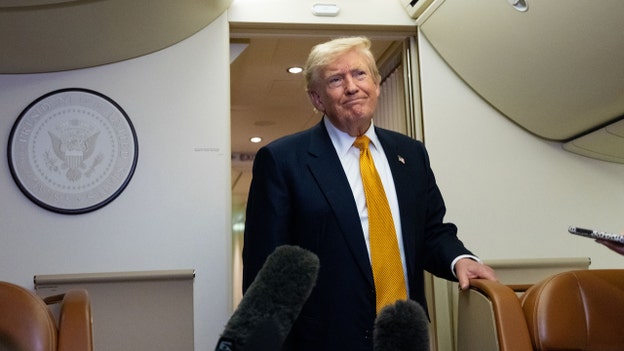
President Donald Trump on Wednesday disputed a report that security concerns prompted him to leave Turkey aboard the older Air Force One instead of the newly renovated aircraft.
The New York Times reported Trump departed Turkey on the older presidential aircraft rather than the new Qatari-donated Boeing 747-8 as a "security precaution" tied to ongoing hostilities with Iran. The newspaper, citing people briefed on the plans, reported the change was made at the recommendation of the U.S. Secret Service.
Asked about the aircraft change, Trump told reporters the newer Air Force One had been flown separately to RAF Mildenhall in the United Kingdom so U.S. service members stationed there could tour it before he boarded for the flight back to Washington.
Trump was also asked why reporters traveling aboard Air Force One had been instructed to close the window shades during the flight.
The president said it was probably because it was a “dangerous flight because of the sleaze bags that we have to deal with.”
When asked whether he was aware of any credible Iranian threat against Air Force One, Trump said he was under threat “all the time.”
“I'm number one on their list,” he added.
The report comes after the United States launched a new round of strikes against Iran on Wednesday.
Fox News Digital has reached out to the U.S. Secret Service for comment.
Iranian official warns of 'hard slap' after latest US strikes
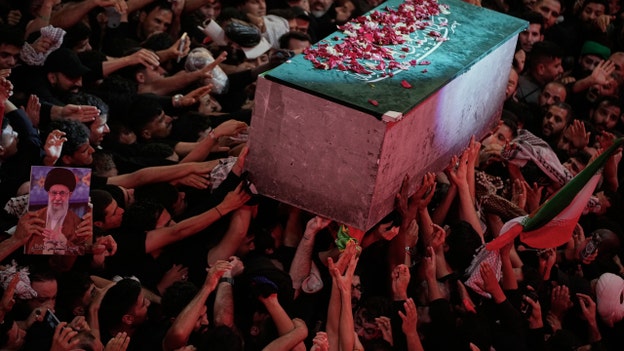
A spokesperson for the Iranian Parliament's National Security and Foreign Policy Commission on Wednesday said Iranians would deliver a “hard slap” in response to the latest U.S. military strikes.
Ebrahim Rezaei wrote in a post on X that Iran's late supreme leader taught Iranians “not to fear America.”
He urged people to “wait for the hard slap by Iranians.”
The remarks came after U.S. Central Command (CENTCOM) said Wednesday that U.S. forces struck approximately 90 targets in Iran.
One day earlier, the U.S. military said it carried out strikes against roughly 80 military targets.
New US strikes on Iran push oil prices higher
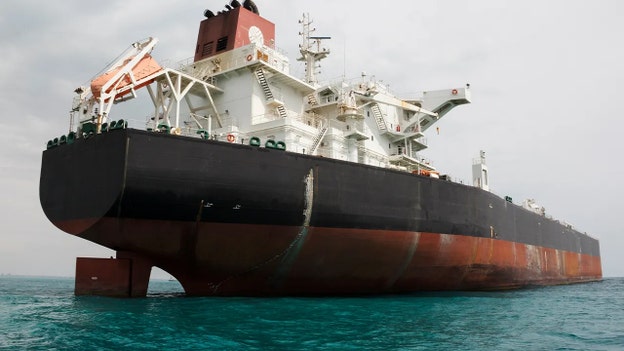
Oil prices climbed Thursday after the United States launched a new round of strikes against Iran.
U.S. West Texas Intermediate crude futures rose 74 cents, or 1.01%, to $74.26 a barrel.
Brent crude futures gained 78 cents, or 1%, to $78.80 a barrel.
Both crude benchmarks, WTI and Brent, rose more than $1 in post-settlement trading Wednesday.
Reuters contributed to this report.
US military strikes approximately 90 targets in Iran in latest operation
U.S. Central Command (CENTCOM) said Wednesday that U.S. forces struck more than 90 targets in Iran to further degrade Tehran's ability to attack commercial shipping and civilian mariners in the Strait of Hormuz.
“U.S. forces struck approximately 90 Iranian military targets including air defense systems, coastal surveillance assets, missile and drone storage sites, naval capabilities, and military logistics infrastructure along Iran’s coastline,” CENTCOM said in a statement.
The latest strikes came one day after U.S. forces carried out what CENTCOM described as “offensive” strikes in Iran, hitting roughly 80 military targets, including more than 60 Islamic Revolutionary Guard Corps small boats.
Iran warns of 'grave consequences' for US allies after strikes
An Iranian Foreign Ministry spokesman warned Wednesday of "grave consequences" for U.S. allies that participated in any American strikes against Iran.
Foreign Ministry spokesman Esmaeil Baqaei also criticized NATO Secretary General Mark Rutte, who earlier Wednesday called the recent U.S. strikes on Iran "absolutely necessary."
“Mark Rutte’s repeated admissions of Europe’s willful complicity in the US-Israeli war of aggression against Iran only confirms, once again, that they were not impartial in this brutal unlawful aggression,” Baqaei said in a statement.
“Those who provided their territories, military bases, and infrastructure to enable the aggression cannot evade responsibility for their contribution to an unprovoked aggression and its grave consequences,” he continued.
Baqaei also referred to Rutte as a "courtier," accusing the NATO chief of trying to curry favor with Washington by backing what Iran considers an unlawful U.S. military operation.
Iran undeterred by US military campaign, think tank says
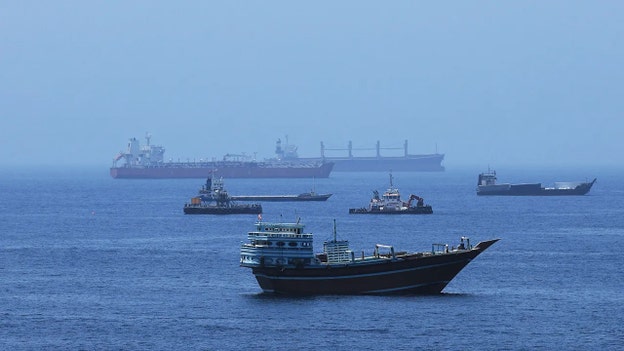
The Institute for the Study of War (ISW) and the Critical Threats Project (CTP) argued in a new analysis Wednesday that recent U.S. strikes on Iran do not appear to be altering Tehran's strategy in the Strait of Hormuz.
Over the past two days, the United States has launched a new round of strikes in response to Iranian attacks on commercial vessels transiting the strategic waterway.
According to the analysis, Iran is attempting to pressure neighboring Gulf states into helping it secure control of the Strait of Hormuz after failing to achieve that objective through diplomacy.
The analysis also said Iran is seeking to impose its vision for the strait's "arrangements," which, according to ISW and CTP, are intended to be established through dialogue with neighboring Gulf states rather than coercion.
Fox News' Liz Friden contributed to this reporting.
Analysis says Iran prioritizing Strait of Hormuz over avoiding US conflict
The Institute for the Study of War (ISW) and the Critical Threats Project (CTP) said in a new analysis Wednesday that Iran appears willing to risk renewed large-scale conflict with the United States in an effort to maintain control of the Strait of Hormuz.
The analysis concluded that Tehran's response to the latest U.S. strikes suggests Iranian leaders place a higher priority on controlling the strategic waterway than on avoiding further military escalation with Washington.
Earlier Wednesday, President Donald Trump told reporters he considered the tentative ceasefire with Iran to be "over."
Later in the day, after U.S. forces launched another round of strikes on Iran, Trump said Tehran wants "to make a deal so badly."
Fox News' Liz Friden contributed to this reporting.
Iranian parliament speaker warns US: 'If you strike, you'll get hit'
Iranian Parliament Speaker Mohammad Baqer Qalibaf issued a warning to the United States on Wednesday after Washington launched a new round of strikes against Iran.
“America still hasn’t learned that bullying and breaking promises are no longer cost-free,” Qalibaf wrote in a post on X. “Let me put it plainly: if you strike, you’ll get hit.”
“Don’t flail around pointlessly, or you’ll sink even deeper: the Strait of Hormuz will only open with ‘Iranian arrangements,’ not American threats,” he added.
Earlier Wednesday, U.S. Central Command (CENTCOM) said American forces were conducting a new round of strikes against Iran.
President Donald Trump said later Wednesday that Iran had reached out seeking a deal following the latest U.S. strikes, but he questioned whether Tehran would honor any agreement.
Kuwait says air defenses intercepting ‘hostile’ missiles and drones
Kuwait’s armed forces said Wednesday that the country’s air defense systems are actively intercepting what it described as “hostile” missiles and drones amid escalating regional tensions.
“The Kuwaiti air defenses are currently confronting hostile missile and drone attacks,” the General Staff of the Army said in a statement.
Military officials said any explosion sounds heard by residents are the result of air defense systems intercepting the incoming threats and urged the public to follow safety instructions issued by authorities.
The announcement comes after the U.S. launched another round of strikes against Iran, prompting concerns of broader regional retaliation.
Bahrain sounds air raid sirens as regional tensions escalate
Bahrain’s Interior Ministry said air raid sirens were activated Wednesday night, urging residents to seek shelter as tensions escalated following a new round of U.S. strikes on Iran.
“The siren has been sounded. Citizens and residents are urged to remain calm and head to the nearest safe place,” the ministry wrote on X.
The alert comes shortly after U.S. Central Command (CENTCOM) announced additional strikes against Iran targeting its ability to threaten commercial shipping in the Strait of Hormuz, raising fears of further Iranian retaliation across the region.
Trump says Iran reached out after US strikes: ‘They want to make a deal so badly’
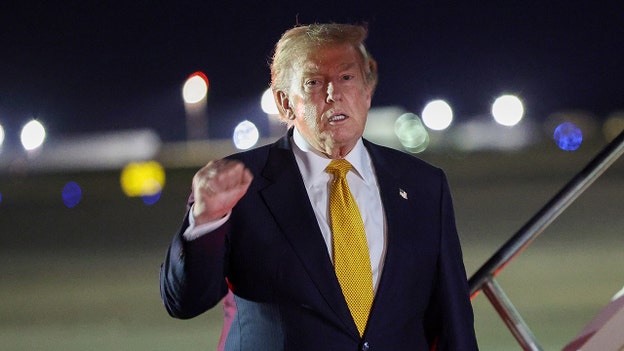
President Donald Trump said Wednesday that Iran has again reached out seeking a deal after the U.S. launched a new round of strikes, but questioned whether Tehran can be trusted to honor any agreement.
“They want to make a deal so badly,” Trump told reporters aboard Air Force One. “They called a little while ago.”
“I just don’t know if they’re worthy of making a deal,” he added. “I don’t know that they’re going to honor the deal. That’s the problem.”
Trump also defended the latest U.S. strikes, saying they were retaliation for Iran’s attacks on commercial vessels in the Strait of Hormuz.
“We hit back much harder,” Trump said, adding that the U.S. would respond “20 to 1 every time they hit us.”
When asked whether the conflict had returned to full-scale war, Trump replied, “I don’t know,” but argued the U.S. had already achieved its military objectives and said Iran has “very little left.”
Mark Levin says Iran ‘needs to be finished off’ after ceasefire collapses
Fox News host Mark Levin argued Wednesday that Iran, not the U.S., was responsible for the collapse of the ceasefire after Tehran resumed attacks on commercial shipping in the Strait of Hormuz.
“The enemy sabotaged the MOU, nobody else,” Levin wrote on X. “It was always going to undermine it, as I and others said repeatedly.”
Levin said Iran has been “violating deals for 47 years,” describing the government as “a terrorist regime” whose ideology “compels the elimination of all others on the planet.”
“They need to be finished off,” he added. “Thankfully, hundreds of billions of dollars was not transferred to it.”
Trump switches to new Air Force One in UK after flying older jet from Turkey
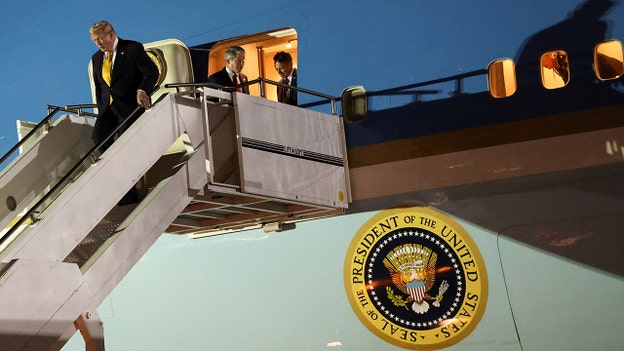
President Donald Trump boarded the new Air Force One at RAF Mildenhall on Wednesday after initially flying from Turkey aboard the older presidential aircraft.
Pool reporters traveling with the president said Trump deplaned the older Air Force One before walking across the tarmac to board the newer aircraft for the remainder of the trip back to Washington.
Earlier Wednesday, Trump said the decision to leave Turkey on the older aircraft was not driven by security concerns despite escalating tensions with Iran. Instead, he said the new Air Force One was being flown to RAF Mildenhall so U.S. service members stationed there could tour the aircraft before he continued home aboard it.
The aircraft swap comes as the U.S. launched a new round of strikes against Iran following Tehran’s attacks on commercial shipping in the Strait of Hormuz.
Trump warns Iran strikes will intensify if attacks on shipping continue: 'It will get much worse!'
President Donald Trump on Wednesday said recent U.S. strikes against Iran were carried out in response to Tehran’s attacks on commercial shipping, warning that additional Iranian aggression would trigger an even stronger military response.
“This is in retribution for yesterday’s bombing of ships by Iran,” Trump wrote on Truth Social while sharing an image purporting to show a strike in Chabahar, Iran. “If it happens again, it will get much worse!”
The warning comes after U.S. Central Command announced additional strikes against Iran aimed at degrading its ability to threaten freedom of navigation in the Strait of Hormuz.
Bernie Sanders calls for end to Iran war after Trump says ceasefire is over
Sen. Bernie Sanders, I-Vt., called for an end to the war with Iran on Wednesday after President Donald Trump said the ceasefire with Tehran was “over.”
“After getting the United States into a war based on lies, Trump has now declared the ceasefire with Iran ‘over’ after less than a month,” Sanders wrote on X.
“Restarting his reckless war with Iran won’t make America stronger. It will cost more lives and waste more taxpayer dollars,” he added. “END THIS WAR.”
The post comes as Sanders recently rescinded his endorsement of Democrat Socialist Graham Platner in his Senatorial bid against Republican Susan Collins.
Trump says 'Iran lies and cheats' as IRGC emerges as dominant force in negotiations with US
As President Donald Trump voiced growing frustration Wednesday with Iranian negotiators, accusing them of lying and cheating, the latest escalation has exposed an even more fundamental problem for Washington: whether the officials at the negotiating table have the power to deliver an agreement — or whether anyone in Tehran does.
"I don’t know if we’re going to have a deal. We may just do it without a deal," Trump said at the NATO summit in Ankara. "These people, they lie and they cheat."
But Trump’s frustration with Iran’s negotiators is only part of the problem. Since the death of Ayatollah Ali Khamenei, it has become increasingly unclear who in Tehran has the authority to make — and enforce — an agreement.
Mojtaba Khamenei succeeded his father as supreme leader after the elder Khamenei was killed in the opening U.S.-Israeli attacks on Feb. 28. But Mojtaba has not appeared publicly since the attack, and U.S. assessments cited by Reuters have described authority as dispersed among senior Revolutionary Guard commanders and powerful civilian officials.
Parliament Speaker Mohammad Bagher Ghalibaf, a former IRGC commander who led Iran’s negotiating delegation, has emerged as one of the country’s most powerful surviving political figures.
Banafsheh Zand, an Iranian-American journalist and editor of the Iran So Far Away Substack, said power inside the Islamic Republic has fractured since the death of Ayatollah Ali Khamenei, leaving the Islamic Revolutionary Guard Corps as the country’s dominant force.
"The person who is negotiating with the U.S. is not necessarily someone who is endorsed by the others," Zand told Fox News Digital.
She described Ghalibaf as one power center competing with figures including IRGC commander-in-chief Ahmad Vahidi, Quds Force commander Esmail Qaani and former Foreign Minister Mohammad Javad Zarif.Vahidi controls the IRGC’s overall military structure, while Qaani oversees its external operations and relationships with Iran-aligned armed groups across the region.
Zarif, by contrast, remains closely identified with the more accommodationist political camp that previously championed negotiations and sanctions relief.
"The hardliners, in terms of their political presence, have also been pushed aside," Zand said. "So really, it’s the IRGC. And within the IRGC, whoever signs the deal is not necessarily signing on behalf of everybody else. They’re signing on behalf of themselves."
Her assessment reflects a central problem facing Washington: Iran’s negotiators, political institutions and military commanders may not share the same interpretation of what was agreed — or the same willingness to implement it.
This is an excerpt of an article by Fox News Digital's Efrat Lachter.
CENTCOM says additional US strikes against Iran are underway
U.S. Central Command (CENTCOM) said Wednesday that American forces have begun conducting additional strikes against Iran at President Donald Trump’s direction.
CENTCOM said the strikes are aimed at further degrading Iran’s ability to threaten freedom of navigation in the Strait of Hormuz, where Tehran has recently targeted commercial vessels.
“The United States is holding Iran accountable for recent unjustified aggression against commercial shipping and civilian crews freely navigating a vital international waterway,” CENTCOM said.
Iran FM fires back after Trump’s criticism, vows response through ‘action’
Iranian Foreign Minister Seyed Abbas Araghchi pushed back Wednesday after President Donald Trump sharply criticized Iran’s leadership, saying insults directed at the Iranian people “do not diminish” the country’s greatness.
“Iranians are known for their civility, culture, and strong moral values,” Araghchi wrote on X. “We do not answer vulgarity with vulgarity, but with action: fearlessly and with great valor.”
The comments come after Trump intensified his rhetoric against Tehran amid renewed U.S. military strikes and the collapse of the U.S.-Iran ceasefire agreement.
In a separate post, translated from Arabic, Araghchi thanked Iraq’s government, people and religious authorities for what he called their “warm hospitality” and “dignified farewell” for Iran’s “martyred Imam,” adding that the relationship between Iran and Iraq is rooted in “shared values” and “a common destiny.”
State Department moves to remove Syria from state sponsor of terrorism list
Secretary of State Marco Rubio announced Wednesday that President Donald Trump has formally notified Congress of his intent to rescind Syria’s designation as a state sponsor of terrorism, beginning the required 45-day congressional notification period.
Rubio said the move follows Trump’s sanctions relief executive order, counterterrorism actions taken by the Syrian government under President Ahmed al-Sharaa and assurances that Syria “will not support acts of international terrorism in the future.”
“Today marks a significant milestone in the revived U.S.-Syria bilateral relationship,” Rubio said, adding that lifting sanctions is intended to help unlock trade and investment while supporting Syria’s reconstruction.