December 7, 2015 Second time lucky for Japan's Venus orbiter? Japan’s Akatsuki Venus probe tried to enter the planet’s orbit Sunday, five years after its last attempt ended in failure.
December 5, 2015 New Pluto photos show breathtaking views of dwarf planet Get ready to be amazed: NASA today unveiled the best-ever images of Pluto, revealing the dwarf planet's varied and exotic landscape in amazing detail.
December 4, 2015 Check out this stunning Cassini image of Saturn's rings and its moon Enceladus In the latest image from NASA’s Cassini spacecraft, Enceladus can be seen floating above the rings of Saturn. Made up of water ice, the rings are frozen and geologically dead.
December 4, 2015 Russian spacewalkers forced to remove videocameras outside space station Two Russian astronauts took a seven and a half hour spacewalk outside of the International Space Station, but were unable to successfully complete their mission: installing cameras that will allow anyone, anywhere to watch the Earth lazily spin against the inky black emptiness of space.
November 29, 2015 Daylight saving time: Set clocks ahead 1 hour Spring is closer than you think, and here's a sure sign: Daylight saving time arrives this weekend.
November 24, 2015 NASA: Earth may have 'hairy' dark matter Clearly, facial hair really is extremely popular at the moment. New research suggests that even the solar system may be ‘hairier’ than originally thought.
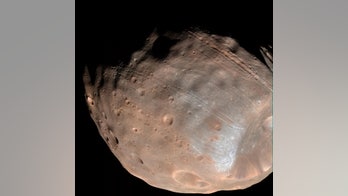
November 23, 2015 Mars will become a ringed planet when Phobos dies Mars’ doomed moon Phobos may leave its parent planet a parting gift. A new study shows the moon is likely to break apart before it hits the atmosphere, creating a debris ring that will encircle Mars for millions of years.
November 23, 2015 Cool NASA images reveal day in the life of Pluto Ever wonder what a day on Pluto looks like? Well, NASA has the answer. Thanks to images captured by the New Horizon, we can see Pluto rotating over the course of a full “Pluto day,” which equates to 6.4 Earth days.
November 20, 2015 Stars in distant galaxies found to have a pulse This behavior has been seen in our own Milky Way but it has been difficult to document in distant galaxies. Now, a team of researchers from Harvard and Yale have for the first time show that stars that are located tens of millions of light years away have a heartbeat if you will.
November 18, 2015 Attempt to better define planets could make our Moon one You'll remember the International Astronomical Union's redefinition of a planet in 2006 as the move that demoted Pluto to a mere dwarf planet.