








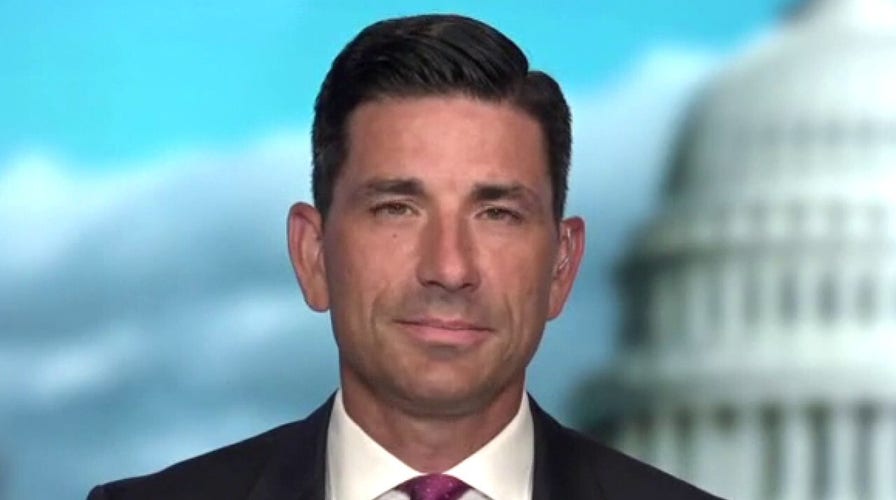
Wolf: Kamala Harris' Guatemala trip should include support for border patrol
Former acting DHS secretary Chad Wolf discusses the importance of the vice president's border visit amid immigration surge.
This is a rush transcript from "Your World with Neil Cavuto," June 7, 2021. This copy may not be in its final form and may be updated.
DAVID ASMAN, FOX NEWS ANCHOR: And, right now, Vice President Kamala Harris is in Guatemala as we speak, meeting earlier today with President Alejandro Giammattei, trying to get to the root cause of the border surge. She calls it ground zero, but border officials in this country may beg to differ.
They continue to deal with a surge of migrants into this country.
Welcome, everyone. I'm David Asman, in for Neil Cavuto. And this is "Your World."
Coming up, we're going to be talking to former acting DHS Secretary Chad Wolf.
But, first, FOX's Bryan Llenas is in Guatemala City and filed this report - - Bryan.
(BEGIN VIDEOTAPE)
BRYAN LLENAS, FOX NEWS CORRESPONDENT: David, good afternoon.
Vice President Kamala Harris making it clear that she believes making Guatemala her first foreign trip is symbolic enough to show just how serious she's taking the border crisis at the U.S. Southern border; 127,000 Guatemalans have made their way to the border and have been apprehended there thus far this year.
Today, standing next to Guatemala's president, Alejandro Giammattei, this is what she had to say to the Guatemalans.
KAMALA HARRIS, VICE PRESIDENT OF THE UNITED STATES: The president and I share a firm belief that our responsibility and our capacity is to give people a sense of hope.
I want to be clear to folks in this region who are thinking about making that dangerous trek to the United States Mexico border, do not come. Do not come. The United States will continue to enforce our laws and secure our border.
There are legal methods by which migration can and should occur. But we, as one of our priorities, will discourage illegal migration. And I believe, if you come to our border, you will be turned back.
LLENAS: The vice president believes that investing some $4 billion to Guatemala, as well as the Northern Triangle, will help add economic development and keep people from wanting to flee this country.
And she also, though, announced the formation of an anti-corruption task force, the Treasury, the State Department all working together with Guatemalan authorities to help stop corruption among the political elites in this country.
They're also working on an anti-smuggling task force that will also work with Guatemala. We visited Villa Nueva. This is home to where the largest slum in Guatemala is, some 400,000 people living in some pretty dire conditions, some making $2 a day, others making nothing at all.
They said that they're leaving and wanting to leave because of lack of opportunity.
I asked, who's thought about going to the United States? And everybody has forget. Why? The money. No, there's no money. That's the number one reason.
The mayor of Villa Nueva says the problem is, is that the money given to the national government rarely ever makes it to the local municipalities. People do not feel or see the difference. And then they flee their country -- David.
(END VIDEOTAPE)
ASMAN: Bryan Llenas reporting from Guatemala.
Well, Vice President Harris signaling she will not be going to the border anytime soon, even though she's going to be traveling to Mexico after Guatemala, saying she's focused on results, not grand gestures.
With me now is former acting DHS Secretary Chad Wolf.
Chad, good to see you.
I'm wondering how serious our vice president can be about the border if she doesn't go to the border?
CHAD WOLF, FORMER ACTING U.S. SECRETARY OF HOMELAND SECURITY: Well, I certainly agree with you.
I think, again, addressing the root causes of this illegal migration is one step in the overall solution here. But visiting that Southwest border, talking to the men and women of Border Patrol and the law enforcement agents, as well as the migrants, she needs to understand what is causing them to make this very dangerous journey.
Is it jobs, is it economic opportunity, or is it the persecution that they're talking about? And so she can talk with some of these individuals firsthand, so as she talks with Guatemala and others, she has a firsthand account of what some of these migrants are going through.
But probably the most important is -- to visit that Southwest border is to show support to the men and women of Border Patrol. These are law enforcement officers that are -- go to work every day that are facing a historic crisis and surge of individuals at that border and are doing their very best to keep that border under control and secure and safe.
And having the vice president or the president of the United States come down there and show their support goes a long way for these patriots.
ASMAN: Yes.
WOLF: And not doing that is just -- it's not the right move.
ASMAN: I have seen a list of agents and seen their pictures next to them who have died in the line of duty. There are dozens of agents, a lot of whom have Hispanic surnames.
The point is, is that people on the left have denigrated the character of border agents and denigrated the character of ICE agents. We need them desperately. And they are putting their lives on the line at the border every day.
Just to emphasize your point, don't they deserve the respect of a visit from the vice president?
WOLF: Well, absolutely.
These are sworn civil law enforcement officers that are simply following the law and trying to enforce the law, laws that Congress has passed regarding border security, regarding deportation and removal of individuals that have no legal right to remain here in the United States.
ASMAN: Yes.
WOLF: And those are ICE law enforcement officials that do that.
And so they're carrying out their duties.
ASMAN: Right.
WOLF: And they don't deserve the criticism and the harsh words that even members of this administration during the campaign and in previous roles certainly gave to them.
So, they don't deserve that. They deserve the respect and the support.
ASMAN: The problem, Chad, is that if she goes to the border and talks to these border agents, they're going to tell her a story about a border in crisis that she doesn't want to hear, that the administration doesn't admit exists, right?
WOLF: Well, they certainly could.
I think they will tell her the unvarnished truth of what's going on down there. And, obviously, it is a border in crisis. But that's part of her job, right, is to understand the reality of what's going on there, so that she can make informed decisions, along with the president, and certainly on her international trips, and start talking to them with some firsthand knowledge.
She had visited the border as a senator and as someone during the campaign when she was running for president. There's absolutely no reason for her not to visit the border as a sitting vice president.
ASMAN: But we have had these tremendous increases in the number of encounters with immigrants, of course, the tragedy of children that have been deserted by their human traffickers along the border, some of whom were close to death, and yet they won't recognize it as a crisis.
Secretary Mayorkas continues to say that we have a closed border. Is there any agent along that border that would agree with him?
WOLF: I don't believe that there is.
And I think the messaging coming out -- and we heard the vice president earlier in your segment talking about, do not come. The problem is, is their messaging does not reflect reality...
ASMAN: Right.
WOLF: ... and the policies that are going on.
So, if you're a minor or if you're a family member, the odds of you being released into the United States, getting across that border are very, very high. And the Border Patrol agents and officers that are working that border know that.
ASMAN: Yes.
WOLF: And so when they hear leadership, either from the department or the White House, say that the border is closed and secure, they know that that's not the reality. That's not what they see each and every day.
ASMAN: Chad, finally, I just want to play a sound bite from the vice president earlier today of how she is addressing the border crisis. Let's listen.
(BEGIN VIDEO CLIP)
HARRIS: The president and I discussed the importance of anti-corruption and the importance of an independent judiciary.
The United States will create an anti-corruption task force, the first of its kind. Our Justice Department, our Treasury Department and our State Department will work together to conduct investigations and train local law enforcement to conduct their own.
Our task force will support Guatemalan prosecutors, including FECI, and, listen, no corruption.
(END VIDEO CLIP)
ASMAN: Chad, it's got to be quick, but I covered Latin America for 12 years. I can't tell you how many task forces on corruption or commissions on corruption I have seen. It didn't change a thing after years and years and years. Do you think this one's any different?
WOLF: Well, I think that's yet to be seen.
And I'm all for anti-corruption task forces and measures that you can do that. But until you secure the border, until you enforce that law along that border, these migrants will continue to come to the border, knowing that they can come into the U.S. and stay here.
ASMAN: All right, Chad Wolf.
Good to see you, Chad. Thank you very much.
WOLF: Thank you.
ASMAN: Well, climate entrepreneurs, empowering women, these are just some of the initiatives being looked at to stop the flow of migrants to the U.S. from this administration. Will they work?
With me now is Republican pollster Lee Carter, GOP strategist Amanda Makki, and Democratic strategist Jason Nichols.
Good to see all three of you.
Lee, first to you.
I'm just wondering what these things have to do with border security. What do you think?
LEE CARTER, REPUBLICAN POLLSTER: Well, I think that they're trying to say that we're trying to create a pathway to citizenship for more people and create more legal citizenship.
I think there are symbolic gestures at that. But the bottom line is this. People are concerned about the process today. They want to see the vice president or even the president visit the border. They want this issue addressed.
Now, certainly, it's not one of the most pressing issues to the American people right now. We are just coming over a pandemic. When you look at the issues that are most important to Americans, immigration is no longer in the top three. It's now about the fifth issue.
So, you can see the reason they probably deprioritize it is because of public sentiment and all the other things that they have going on.
But, certainly, this is something that the American people care about. It's certainly something that people don't approve of right now how Joe Biden and his administration has handled it.
ASMAN: Yes.
Well, Jason, when you see children that are left by human smugglers in the middle of nowhere barely alive, and you see increases -- in one case, in April, we had a 900 percent increase year over year of encounters with immigrants along the border -- you realize that this is a crisis that deserves to be dealt with at the border, as well as in other countries, no?
JASON NICHOLS, DEMOCRATIC STRATEGIST: Well, I have done enough home improvement to know that you don't stop a leak by putting a bucket down. You stop it at the source.
And so I think that's what they're trying to do. And you mentioned efforts on climate change. That's because there are food shortages in Guatemala, and the fact that a lot of farmland has been ruined. There are people who are food-insecure. When people can't feed their babies, what do they do? They leave.
So, this is -- these are issues that I think this administration is trying to address in order to make things safer for people in Guatemala and in the Northern Triangle and also...
(CROSSTALK)
ASMAN: And, Amanda, to pick up on what Jason was saying -- forgive me, Jason, but you do get to the source of the leak. But you also have to deal with the damage from the leak itself.
And the leakage on the border is tremendous. Do you think it amounts to the level of crisis?
AMANDA MAKKI, REPUBLICAN STRATEGIST: It does amount to a crisis.
NICHOLS: Sure. I think it's a very important issue.
I'm -- oh, I'm sorry.
ASMAN: Hold on.
Go ahead, Amanda.
NICHOLS: I apologize.
MAKKI: It absolutely amounts to a crisis.
And even the president of Mexico, Obrador, in March said, Joe Biden, you caused this crisis. And now you have the president of Guatemala, Giammattei, saying the very same thing. It's been 75 days since Kamala Harris was tasked with this role. And all she has done is go 2,000 miles away from the Southern border to have a photo-op with a world leader.
That's all this is about. She needs to go to the border. She needs to hear from, as Chad was saying, the people who are working this every day, the Customs and Border Patrol agents.
ASMAN: Yes.
MAKKI: She needs to hear and see that. She shouldn't be going just for photo-ops, instead of attacking what the problem actually is, which is really doing away with President Trump's policies, the catch and release, the remain in Mexico policy and building the wall.
ASMAN: Jason, just to come back to you for a second. Then I'll get back to Lee.
But don't you think she needs to go to the border at some point?
NICHOLS: Yes, I do. I think it would be good for her to go to the border and, like your previous guests in the other segment said, to go and speak to law enforcement, speak to some of the detainees, speak to all of them, and get a better perspective.
ASMAN: Yes.
NICHOLS: But I also think that the way you stop this is by going to the source and where this is all coming from, where you have had two devastating hurricanes that occurred. You had all this ruin farmland and food shortages. You have violence in El Salvador and in Honduras.
These things need to be addressed. I think that this administration...
(CROSSTALK)
ASMAN: OK.
Well, Lee, part of the problem is, is that refugee status does not recognize an economic means for applying for refugee. Isn't that the kind of thing that needs to be dealt with through legal immigration, not illegal immigration, Lee?
CARTER: Yes, absolutely.
And I think that most people understand that this is a complex issue, but it needs to have a serious, serious answer.
ASMAN: Yes.
CARTER: And even though -- I mean, if you look at Joe Biden's approval rating right now, he's doing very well on every issue except for immigration.
And that is up to Kamala Harris to try and address right now. And she's simply not -- she's not up to the task right now.
ASMAN: Yes.
CARTER: And I think, if she did go to the border herself, it would have an impact, and she would understand the issues in front of her much better.
ASMAN: I think it's over time. It's more than two months since she was tasked with the job of dealing with the border, and still no press conference, still no visit to the border.
Gang, thank you very much. Appreciate it.
To the fight to uncover COVID-19's origins, the Biden administration vowing to get to the bottom of it all, but will China provide the transparency needed for it?
And with a deal for a global minimum tax now looming, why Congressman Kevin Brady is worrying it could have you paying the bill.
The congressman is coming up.
(COMMERCIAL BREAK)
(BEGIN VIDEO CLIP)
ANTONY BLINKEN, U.S. SECRETARY OF STATE: I don't want to get into hypotheticals going forward in the future about what we would or would not do.
But I think I can say with confidence that there is going to be an increasing international demand that countries, including China, meet their responsibilities when it comes to providing information, access and transparency on global health, including COVID.
(END VIDEO CLIP)
ASMAN: Secretary of State Antony Blinken facing questions from lawmakers on Capitol Hill today over COVID-19's origins and the Wuhan lab leak theory.
FOX News White House correspondent Peter Doocy has more on that debate heating up.
Hi, Peter.
PETER DOOCY, FOX NEWS WHITE HOUSE CORRESPONDENT: David, good afternoon.
The national security adviser, Jake Sullivan, also told us today he hopes there will be a phase two of a World Health Organization investigation into the origins of COVID. But because China has not been cooperating and providing data from the earliest days of the pandemic, there might be some problems with that.
(BEGIN VIDEO CLIP)
DOOCY: China has basically already said they think their part in an international investigation is done. So why is Jake Sullivan still here saying he thinks it's possible that they're going to provide the preliminary data at some point?
JEN PSAKI, WHITE HOUSE PRESS SECRETARY: Well, I don't think we just give up that easily.
We are going to continue to press, in coordination with the international community, China to be transparent, to be forthcoming with data and information. We're not going to just stand by and accept that they have said they're not going to participate.
(END VIDEO CLIP)
DOOCY: So the White House is banking on diplomacy. And they're also standing by Dr. Anthony Fauci.
The White House says there's no circumstance under which Fauci would be fired. And the secretary of state, Antony Blinken, said today he's not sure how likely that lab leak theory is yet.
(BEGIN VIDEO CLIP)
BLINKEN: And I can't put a percentage on it. I think there are two possible and like scenarios.
One is the one you just described, that it emerged from the laboratory. The other is that it was naturally occurring.
(END VIDEO CLIP)
DOOCY: We did not see the president today on camera, and he doesn't have any more events scheduled. He has occupied -- or his day, his schedule has been filled with meetings with the head of NATO ahead of a trip overseas this week -- David.
ASMAN: Peter Doocy.
Good to see you, Peter. Thank you very much.
So, what is the likelihood of China providing transparency?
I want to bring in former State Department official Christian Whiton for that.
I let that word transparency breathe a little, because everybody's using that word. And it's interesting that Peter touched on Dr. Fauci as well. The two things come together in a sound bite that I want to play for you of Dr. Fauci, an interview I had with him a year-and-a-half ago, January 2020, about China and transparency. Listen.
(BEGIN VIDEO CLIP)
ASMAN: China has been known to fiddle with their stats before. Do you trust what they are telling us about this illness?
DR. ANTHONY FAUCI, CHIEF MEDICAL ADVISER TO PRESIDENT BIDEN: From what I can see right now, they really are being much, much more transparent than what happened with SARS, where they really kept back information for a while.
ASMAN: Yes.
FAUCI: It was embarrassing to them. They're really transparent now.
ASMAN: Wow.
FAUCI: Hey put the sequence of the virus up on the public database right away. So, in that respect, they have been transparent.
(END VIDEO CLIP)
ASMAN: I think it's fair to say they were anything but transparent in the beginning of this crisis and all through the crisis, including the WHO investigation, in which they kept out independent investigators.
And now they say no more at all, even if it's Chinese investigations. Why should anyone believe that they would be transparent after that history?
CHRISTIAN WHITON, FORMER U.S. DEPUTY SPECIAL ENVOY: It's a complete mystery to me. And it's not just a mystery today, given what we have learned over the last couple of months.
It should have been obvious to Fauci when you interviewed him in January 20, just as this thing was starting to spread. If you go back throughout the course of the modern history of the Chinese Communist Party, their first instinct is to lie, to cover up, to control inflammation.
And they have done that with aplomb throughout this crisis. Have they made people available, the people who got sick or who were working at the Wuhan Institute of Virology? No.
Have they provided data to us and the WHO? No.
And for Fauci to say that, it's a good thing that he's unfireable. I guess it's good work if you can get it, because he has been wrong throughout this whole process.
ASMAN: Well, and there were people, there were individuals who were being jailed and worse. Some people suggest that there were actually people being killed in China as a result of wanting to reveal the truth of what was going on, exactly when Fauci was saying they were being transparent.
WHITON: Right.
And one of those people was actually a recipient of a grant from the National Institute for Health, which is something that Fauci has supported. This is someone who worked on Chinese military research, probably not someone we should be giving money to who also was involved in this.
He actually filed a patent application for a vaccine for COVID-19 right. When this thing was starting to bloom in March or February of last year, he died under mysterious circumstances. It's not suggested he died from coronavirus.
ASMAN: Yes.
WHITON: He probably was just an inconvenient person for the Chinese.
ASMAN: Christian, final question. It's got to be short.
But the question of whether this lab was being used by the military -- you suggested that the military had some influence with the lab researchers. Were they trying to develop bioweapons? And could that the way that COVID- 19 developed?
WHITON: It certainly could.
We envision there are all these borders and boundaries and silos in China. But when it comes to the need of the military, whether it's semiconductors or artificial intelligence or biological weapons, those boundaries disappear. The interests of the party, the interests of the state trump everything else.
We don't know if that happened. Certainly, I would hope our $50-billion-a- year intelligence community could get that information and not rely on the Chinese being nice, but it's a possibility David.
ASMAN: Christian Whiton.
Good to see you, Christian. Thank you very much.
Well, a new tax aimed at taking money from the big guys, but Congressman Kevin Brady says it's us little guys who may end up paying the bill. He is here coming next.
(COMMERCIAL BREAK)
ASMAN: Well, is the White House getting ready to make taxation without representation a thing of the future? It's pushed for a global minimum tax. Might be doing it.
Congressman Kevin Brady on that in 60 seconds.
(COMMERCIAL BREAK)
ASMAN: A 15 percent minimum global corporate tax rate, the White House wants it. The biggest economies in the world are now backing it. But will you be the one who ends up paying for it?
The Wall Street Journal editorial board saying American workers and consumers will bear the brunt of the new tax.
And it is something my next guest is very worried about. And you should be too, so he says.
Texas Republican Congressman and Ranking Member of the Ways and Means Committee Kevin Brady joining us now.
Good to see you, Congressman.
I want to pull back a little bit and get a larger issue. That is, we had something called the Declaration of Independence. I go way back when they taught those things in school. And the basis of that was, we shouldn't give foreigners the right to decide how much our taxes are. Isn't that the direction that this is going?
REP. KEVIN BRADY (R-TX): Yes, that absolutely is.
This is not, as the president said, a victory for America. It is a surrender. What the president essentially did was to go to China, Japan, our other foreign competitors and say, look, we're raising taxes. Our companies will be less competitive. We're going to move and lose jobs, manufacturing, headquarters overseas. Won't you help us?
And what our foreign competitors essentially said, we will be glad to take both your jobs and your tax base, the same tax base you will need to fund your government in the future.
ASMAN: Right.
BRADY: And so, in essence, President Biden is turning over the sovereignty of tax policy to foreign countries.
ASMAN: And we saw the British just recently, in the past couple of years, pull away from all these faceless bureaucrats in the E.U. that were directing tax policy, or at least trying to. They were certainly directing regulations.
They were getting more and more involved in fiscal affairs of the country. That's what led to Brexit. And, again, to see us going in the opposite direction, shouldn't we learn from what just happened in the U.K.?
BRADY: This is without question the biggest economic blunder in our lifetimes.
Look, the president inherited a very strong economy, lifesaving vaccines, an opening economy. And we're already seeing half-a-million jobs less under President Biden than we did under President Trump during the height of COVID.
We're seeing slower paychecks. We're seeing less growth. Our long-term unemployment is worse than it was before the pandemic. So, all -- my point in all this is that we don't need more stimulus and endless government checks.
ASMAN: Right.
BRADY: We need less Joe Biden.
ASMAN: Yes.
BRADY: If we had less of his policies, frankly, our economy would be moving on much more strongly.
ASMAN: Well, I want to do one more question about international. Then I will bring it back home.
But if we cede tax policy to the European bureaucrats, how long before we cede spending policy to them, that is things like climate change and stuff like that, where they actually use our tax dollars for their programs?
BRADY: Yes, in effect, what you have with the Paris accord and a number of these climate agreements, that's exactly what we're doing, putting our economic future in the hands of other countries.
The Tax Cuts and Jobs Act, the Republican, under President Trump, tax cuts, did the opposite. By lowering our tax rate, redesigning our tax code, we leapfrogged to the most competitive economy in the world. We created a giant sucking sound of jobs, research, manufacturing, investment back into the U.S.
For some reason, President Biden seems determined to reverse all that.
ASMAN: All right, and he says he's going to pay for all of his spending plans, his trillion-dollar spending plan, including infrastructure, by increasing corporate taxes.
Now, corporate taxes, it's just a tiny slice. It's 7 percent, if I have it right, of all the taxes that are paid. Most of it is payroll and income taxes. So, is -- are you going to spend -- are you going to pay for trillion-dollar programs with a small sliver of what is collected in income tax or corporate tax?
BRADY: Yes, so, as you know, the president over Memorial Day weekend, the administration sort of slipped out their tax proposals, over $6 trillion of them.
But the problem is, all of them land one way or another on working families. As you know, corporates -- corporations don't pay taxes. They collect them. And so those taxes land on, the burden lands on the workers in the company, the families who've invested for their retirement, the communities where those companies are located.
ASMAN: Right.
BRADY: And there's no doubt that, if these tax increases go through, and America has a tax rate worse than China, and on par with Syria, we will see a second wave of U.S. jobs and manufacturing moving overseas.
ASMAN: Right.
BRADY: So, who gets hurt there? It's working families.
ASMAN: Well, and, of course, inflation is another sign of how Americans pay for the spending of big government. And we're seeing a lot of that.
I wish I had more time, but got to call it quits.
Good to see you, sir. Thank you very much for being here, Kevin Brady from Congress.
BRADY: Thank you, David.
ASMAN: Coming up: Amazon's Jeff Bezos announcing travel plans that are literally out of this world.
But, meantime, a little closer to home, at least one cruise line will not require vaccinations for your vacation, as the industry moves closer to setting sail.
(COMMERCIAL BREAK)
ASMAN: So, Royal Caribbean changing course on COVID shots, as Florida Governor Ron DeSantis continues to rock the boat on vaccine mandates.
FOX News' Phil Keating has been following it all from the Port of Miami.
Hi, Phil.
PHIL KEATING, FOX NEWS CORRESPONDENT: Hey there, Dave.
So, Royal Caribbean, headquartered here in Port Miami, reversed its previous stance and now is saying, we're not going to require any cruise passengers absolutely have a vaccine. We still recommend it. But they don't have to be mandatory. You still don't have to wear masks on the ships.
And you can go out and have some fun. Cruising, though, from Florida ports -- and that's Port of Miami, the cruise ship capital of the world, Port Everglades in Fort Lauderdale, and Port Canaveral, the top three ports, still remains in flux, because the state of Florida, led by Governor Ron DeSantis, has filed suit against the CDC, challenging its authority to mandate vaccinated passengers.
Well, take a listen to the governor.
(BEGIN VIDEO CLIP)
GOV. RON DESANTIS (R-FL): We're going to be sailing hopefully very soon. But there's not been a single elected official in this country who's done more to liberate the cruise lines from a bureaucracy that is totally out of touch and that, quite frankly, is exercising authority that they do not possess under the law.
(END VIDEO CLIP)
KEATING: Well, the Celebrity Millennium this week becomes the first American cruise ship to take paying passengers on the first Caribbean cruise since the CDC's no-sail order froze the industry 15 months ago, when the pandemic began, but not out of here at Port Miami.
U.S. cruises from U.S. ports still at least a couple weeks ago away. The millennium left St. Maarten Saturday on its way to Barbados, where it is today, Curacao and Aruba.
Since this is an international-only cruise, the CDC guidelines and recommendations don't apply. But, still, all passengers 16 and older and 100 percent of the crew had to be vaccinated, which is what the CDC wants and the industry has mostly gone along with. There was COVID testing available before boarding. And the ship is fully rigged with new air purifiers and an abundance of disinfectant and cleaning.
We spoke with a guy who is on the boat. And he says it's wonderful. It's 30 percent packed, which is pretty much like an empty cruise ship, like a private yacht, but that everybody on board is super happy to be cruising again, David.
(BEGIN VIDEO CLIP)
STEWART CHIRON, THE CRUISE GUY: It's the first one out of the gate. So, this is the first cruise that they have to test the safety protocols, test the onboard safety mechanisms that have been put in place to ensure that the passengers and crew are healthy.
This was the first one out of the gate. And (INAUDIBLE) for the rest of the industry.
(END VIDEO CLIP)
KEATING: So, the lawsuit that Florida filed against the CDC, the issue, ultimately, is, who dictates what are the policies for cruise ships coming out of U.S. ports? Does the state actually decide or does the federal government decide? And that's what a federal judge in Tampa is still mulling over.
So far, mediation between both sides has failed -- David.
ASMAN: coming out of a pandemic.
Phil, thank you very much. I appreciate it.
Dr. Bob Lahita from the Institute of Autoimmune and Rheumatic Diseases, director at St. Joseph's Health is here to discuss this.
So, Doctor, I'm not going to ask you to get into legal stuff, a lot of which judges are having difficulty to figure out now, whether the CDC has the power to do this.
But can you blame Governor DeSantis, after all of the missteps that the CDC has made just on masks alone, one time saying one thing and next week saying another, one week saying that kids outside in summer camps have to wear masks, the next week saying, indoors, you don't have to wear?
I mean, there have been so many mixed messages from the CDC. DeSantis is saying, hey, we're going to with our standards, not the CDC's.
DR. BOB LAHITA, ST. JOSEPH UNIVERSITY HOSPITAL: I agree with that, David
I think that the governor is absolutely right. First of all, I am against mandating vaccines, especially those for emergency use authorization. If these were FDA-approved solidly, I guess there would be some legal ground to mandate them.
But I don't think, based on Governor DeSantis' experience opening up Florida, I think is a wonderful thing. And he's been exceedingly successful in doing this. So I think, if you get on a cruise ship these days, and you know you're not vaccinated, that's your decision.
If you want to take that chance, that's fine. I'm presuming the CDC thinks this is like a goldfish bowl, where everybody is a captive audience on the ship. But I think people are smart enough to realize that...
ASMAN: Yes.
LAHITA: ... if they're in a group of people that could be infected, they're going to have to take care of themselves.
ASMAN: Doctor, I want to switch gears dramatically, because this is sort of breaking news, that this new Alzheimer's drug has come out, shows tremendous promise.
LAHITA: Thank you.
ASMAN: It's very expensive. I understand it's about $2,000 a year to get the treatment, but a lot of people would pay that, if it was good. Do you believe in this new drug?
LAHITA: Well, I'm aware of this new drug. I'm aware of amyloid, which is what the drug, which is a monoclonal antibody is specific targeting antibody against a specific protein in the brain, I'm aware of that this is research has been going on for many, many years.
Now this new monoclonal is supposed to be effective. I think that the FDA is a little split on the data. Some of the committee members did not think it was that efficacious. So, anything that helps the underlying disease process be controlled -- and I think all the relatives agree with that -- we go -- we should go for it.
ASMAN: Absolutely. Anybody -- we have all been through it, and it is a tragedy to live through. Anything that could help is a bright light at this point.
Dr. Lahita, great to see you. Thank you very much. Appreciate it.
LAHITA: Great to see you, David. Thanks, David.
ASMAN: Well, the Department of Justice just announcing a major development in its efforts to fight ransomware -- how cryptocurrency is now playing into national security.
Plus: Amazon's Jeff Bezos heading to space, taking his brother with him. Would you go?
We will talk about that after this.
(COMMERCIAL BREAK)
(BEGIN VIDEO CLIP)
LISA MONACO, U.S. DEPUTY ATTORNEY GENERAL: The Department of Justice has found and recaptured the majority of the ransom Colonial paid to the DarkSide network in the wake of last month's ransomware attack.
Ransomware attacks are...
(END VIDEO CLIP)
ASMAN: The Department of Justice just announcing it seized 63.7 Bitcoins - - they were valued, as you just heard, $2.3 million -- in that ransom that was paid by Colonial Pipeline for the hack a couple of weeks ago.
The deputy attorney general adding that ransomware and digital extortion pose a national security threat to the U.S. Well, I would think so.
Here to discuss is retired U.S. Army Lieutenant Colonel Bob Maginnis.
Colonel, good to see you.
First of all, this is good news. I mean, we were able to somehow break through to the hackers' source of income, if you will, and retrieve some of it. There hasn't been any sign of any arrests, though. But does this show that we may have turned a little corner here in figuring out how these hackers work?
LT. COL. BOB MAGINNIS (RET.), U.S. ARMY: Well, Dave, it's no doubt it's we have to aggressively go after these people no matter where they are, whether they're in Russia or China or elsewhere, either through proxies or by forcing the states to make sure that they aren't operating from them and giving safe harbor.
But this is a $6-trillion-a-year problem...
ASMAN: Wow.
MAGINNIS: ... that -- the cyber criminal problem. And it's not going to get any better, as the secretary indicates.
Half the companies in this country have faced at one time or another in the recent years some sort of ransomware attack. And, quite frankly, 26 percent have actually paid up, like Colonial did. So, this is a very serious cyber national security issue. And it just doesn't impact our economy, which is robbing us blind, but it impacts our national security in a broader way as well.
ASMAN: Yes.
Well, when the president announced, and he wouldn't answer the question of whether he advised Colonial to pay the ransom, a lot of people were critical saying, gee, they shouldn't have paid, because you don't pay for - - pay ransom to a terrorist. And this is a similar situation.
But could there have been -- or maybe I'm giving them too much credit -- some knowledge that paying the ransom, and then finding a backdoor in to retrieving it back might have been the plan from the beginning?
MAGINNIS: Well, there are -- there are certainly backup systems and defensive systems that we have. And large companies expense that out.
However, we have to recognize that this is going to continue. As long as they can get Bitcoin or some type of financial gain from this type of criminal activity, it will continue. Now, I wouldn't put it past certain governments, some of the rogue governments, the North Koreas, even the Irans of the world, to use proxies to cause this to happen.
I'm more concerned, Dave, about not just the economic impact, but the national impact in terms of taking down our very infrastructure. Yes, the Colonial Pipeline was very serious, but if we're talking something like the electric grid...
ASMAN: Yes.
MAGINNIS: ... this could seriously cripple this country and cause us to react in a way that most people don't understand.
ASMAN: Yes.
Well, no, you think of the hospitals, people on life support who would die as a result of that. It'd be horrendous. But do we -- is there a price that the governments, if not complicit, at least know about some of these ransomware attacks, that they -- a price that we should make them pay for not doing enough to stop them from happening quickly?
MAGINNIS: Well, I think that's something that Mr. Biden has to talk to Putin about.
We know that there are proxies that the Russian intelligence hires over there to do all sorts of criminal activities. And they just allow them to operate. So, if they aren't going to go after him, we have to persuade them through incentives, sanctions, or even something more aggressive, some offensive capabilities that we have in hand right now.
ASMAN: Yes.
Colonel Bob Maginnis.
Always a pleasure, Colonel. Thank you for being here. Appreciate it.
MAGINNIS: Thanks, Dave.
ASMAN: Well, Amazon's Jeff Bezos and his brother, Mark, are heading into space next month, and there is a seat available to tag along. Would you join them?
(COMMERCIAL BREAK)
ASMAN: So, have you always dreamed of going to space? Well, maybe just maybe you can hitch a ride with Amazon's Jeff Bezos and his brother Mark.
The two are going to be joining the first crewed flight of Jeff Bezos' company Blue Origin, which is scheduled to lift off on July 20. If you want to join them, they're auctioning off a seat on the flight. All you need is $3.2 million. That's the current bid, the highest bid. So, would you go?
Joining me now is The Daily Mail's Charlie Lankston and Internet radio host Mike Gunzelman.
Good to see you both.
So, Charlie, assuming just for the moment that it was paid for, would you go?
CHARLIE LANKSTON, EDITOR, DAILY MAIL: I would absolutely go. I think it's an incredible opportunity.
And while I don't have $3.2 million to pay for a 10-minute experience, I think it would be incredible to be a part of that.
ASMAN: Mike, 10 minutes. You pay -- somebody is willing to pay three million bucks for 10 minutes. Imagine.
MIKE GUNZELMAN, FOX NEWS HEADLINES ENTERTAINMENT REPORTER: Listen, after how bad 2020 was, I'll be the first volunteer. Ship me right out. Strap me in, ship me straight to the moon.
But I definitely love this story. I have always kind of been fascinated with space and whatever else is out there. And then also I kind of like this story because that Elon Musk is probably so mad that Bezos is doing this before he is.
ASMAN: Well, that's a good point.
GUNZELMAN: So it's only going to ramp up the competition. And space tourism is definitely going to become a thing in the near future, I think.
ASMAN: Charlie, I remember very well in 1986 the Challenger disaster and that horrible -- that horrible explosion. We all knew immediately that there were going to be no survivors from that.
That was a trip that had civilians on board. They were trying to build the idea of civilians in space. That ended -- primarily ended. There were -- there have been some civilians in space since then, but not a lot.
Do you think this could encourage travel by civilians on a larger basis now?
LANKSTON: Absolutely.
And I think we have come so far since that devastating incident. Technology has advanced so much. And I think that you really have to take risks in life. As we have said, 2020 was a disastrous year. But I think it proved to us all that you really can't predict anything that's going to happen.
And if we all took every possible precaution in our day-to-day lives, we wouldn't even step out of our front doors.
ASMAN: Yes.
LANKSTON: What's more exciting than stepping out of your front door and getting on the subway is getting on a spaceship and getting up and being one of the first civilians to actually make that trip?
(LAUGHTER)
ASMAN: And, frankly, getting on a subway can be a lot more dangerous than getting into a spacecraft like that.
GUNZELMAN: Very true. Very true.
(LAUGHTER)
(CROSSTALK)
ASMAN: Yes, I want to switch gears.
And I -- Mike, I'll come to you, but I want to first go to Charlie on this, bringing up the birth of Prince Harry and Meghan Merkel's baby girl, Lilibet Diana, who was named after Queen Elizabeth and Princess Diana.
What do you think of the name, Charlie?
LANKSTON: Honestly, I'm on the fence about it. I think it is a wonderful, beautiful name. It makes perfect sense for Harry to have paid tribute to his mother, Diana.
But Lilibet is a very private nickname. It's not really a name that was used very widely.
ASMAN: Yes, I have never heard it.
LANKSTON: And I also find it slightly awkward for Harry and Meghan to have given their daughter the name Lilibet shortly after kind of publicly blasting the royal family for all to hear.
ASMAN: Right.
LANKSTON: I think that's a little bit of a kind of touchy subject, as far as I'm concerned.
ASMAN: Mike, you only got 15 seconds. Go ahead.
GUNZELMAN: Listen, congratulations.
I'm just kind of confused why Meghan Markle and Prince Harry wants to stay away from the media, yet, every single week, they keep doing something that puts them back in the spotlight.
ASMAN: Yes.
GUNZELMAN: Come on, right?
ASMAN: Guess what? Guess what? There's a lot of money in being a celebrity. That's what they are finding out.
GUNZELMAN: Yes, there is.
ASMAN: Charlie, Mike, good to see you both. Thank you very much. I appreciate it.
LANKSTON: Thank you.
ASMAN: That's it for now from here.
You will be happy to know that Neil Cavuto is going to be back with you tomorrow.
Until then, guess who's coming now? Here comes "The Five."
Content and Programming Copyright 2021 Fox News Network, LLC. ALL RIGHTS RESERVED. Copyright 2021 VIQ Media Transcription, Inc. All materials herein are protected by United States copyright law and may not be reproduced, distributed, transmitted, displayed, published or broadcast without the prior written permission of VIQ Media Transcription, Inc. You may not alter or remove any trademark, copyright or other notice from copies of the content.
