






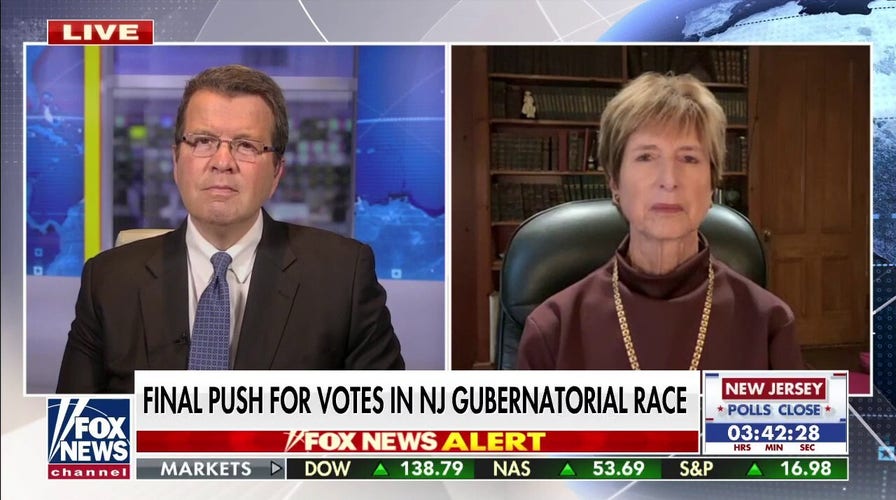
Why do Democratic governors have difficulty getting reelected in NJ?
Former New Jersey Gov. Christine Todd Whitman reveals why Democratic governors have trouble getting reelected in the Garden State.
This is a rush transcript from "Your World," November 2, 2021. This copy may not be in its final form and may be updated.
NEIL CAVUTO, FOX NEWS ANCHOR: All right, we are focusing on Virginia. We are focusing on New Jersey.
There are a smattering of other contests, including who will be the next mayor of New York City. But, for now, these are the two big enchilada contests. And, in Virginia, the race is as tight as a tick. And if some swings in polls are a sign of things to come, a purple, then a blue state could be on the verge of change.
Welcome, everybody. I'm Neil Cavuto. And this is YOUR WORLD.
And what in the world to make of some contests that weren't supposed to be contests little more than a couple of months ago, but are very much so right now?
Let's go to Rich Edson in McLean, Virginia, with campaign Terry McAuliffe and his fight to get his old job back as governor -- Rich.
RICH EDSON, FOX NEWS CORRESPONDENT: Hey. Good afternoon, Neil.
And we're here at McAuliffe headquarters. They are setting up for their big celebration or their big watch party or event tonight, waiting for the polls to come in. They close here at 7:00 p.m. They say that they're encouraged by some of the reports that they're hearing from around the state as to where people are showing up on this Election Day.
Of course, show me a pessimistic politician, at least who will acknowledge something pessimistic on Election Day, it'll be a pretty tough ask here. Terry McAuliffe himself has had a pretty quiet day today. He showed up earlier today in Falls Church, Virginia, met with a number of union supporters from the Service Employees International Union, or SEIU.
He's also been getting a boost from politicians in the Democratic Party from Washington, congressional Democrats, and especially from President Joe Biden, who campaigned with him last week, and now from across the pond and Europe is doing so again today.
(BEGIN VIDEO CLIP)
JOE BIDEN, PRESIDENT OF THE UNITED STATES: I think we're going to win in Virginia. And you know. You're reporting it being close. The race is very close.
So it's about who shows up, who turns out. And, granted, I did win by a large margin, but the point of the matter is that I think that this is this is going to be what we all knew from the beginning. This is going to be a tight race.
(END VIDEO CLIP)
EDSON: So, it's President Biden in Europe and last week. Vice President Kamala Harris, also campaigning for the Democratic candidate here in Virginia, along with a number of congressional Democrats, Senator Tim Kaine, Congressman Jim Clyburn from South Carolina.
We talked to a Clyburn aide, said that he wanted to come out and wanted to support McAuliffe here to turn out the African-American vote in the state because he said it is so important.
Now, early voting started in this state in the middle part of September. And that process ended on Saturday. McAuliffe's folks said that they are encouraged by where those early vote totals are coming from. About a fifth of the electorate voted by Saturday in this race.
But we have had a full day of open polls here. They close at 7:00 p.m. And what happens between then and where we are at 7:00 p.m. is going to determine what kind of an event they have here in Northern Virginia.
Back to you.
CAVUTO: All right, Rich Edson, thank you very much, my friend.
Now let's go to Glenn Youngkin's campaign. If you think about a few months ago, he was, what, polling at about 2 percent. And that was with a 3 percent margin of error. That was then, a very different and tight race right now.
Alexandria Hoff joins us right now from Chantilly, Virginia -- Alexandria.
ALEXANDRIA HOFF, FOX NEWS CORRESPONDENT: Hi. Hi, Neil.
Yes, at that point, he had no right name recognition. Today, he's trending on Twitter. And his bus just arrived here to his election headquarters here in Chantilly. He has put literally thousands of miles on this bus in the past week-and-a-half. And he is confident that all of that voter engagement will lead to a celebration here tonight.
Now, earlier today, he had -- the Republicans started on this rainy day shooting some hoops, of all things. Of course, that came after meeting with voters this morning at a polling place in Fairfax County, where he told us enthusiasm is on his side.
(BEGIN VIDEO CLIP)
GLENN YOUNGKIN (R), VIRGINIA GUBERNATORIAL CANDIDATE: Well, I will be honest. I have just felt this great surge of momentum for the last six to eight weeks.
And when you get to travel around this amazing state and meet with -- I think we met with between 25,000 and 50,000 Virginians in the last 10 days and just see everybody coming together.
(END VIDEO CLIP)
HOFF: He says he's felt increasing support coming not only from his base, but independents as well, which could be crucial in counties in Northern Virginia that have recently turned blue.
And despite being the most expensive governor's race in Virginia history, Youngkin has wanted to put forth a grassroots feel to this, stopping in 38 counties during his 10-day bus tour.
And he has left the big names and the big party players off the campaign trail. But whether he -- where he really found his footing, I mean, that was clearly on the issue of education, promising to combat what he sees as government overreach in schools.
And so this push for parents is big. And lots of people are watching this, because, it if that pays off, we will likely see parents front and center in nationwide elections to come, Neil.
CAVUTO: Alexandria Hoff.
Thank you very, very much, Alexandria.
Well, this was not lost on the president half-a-world away in Edinburgh, Scotland, wrapping up that climate summit there, whether he was in fact a drag on Democrats and getting out the Democratic vote in Virginia or, for that matter, anywhere else. Take a look.
(BEGIN VIDEO CLIP)
BIDEN: I don't believe and I have not seen any evidence that whether or not I am doing well or poorly, whether or not I have got my agenda passed or not is going to have any real impact on winning or losing.
(END VIDEO CLIP)
CAVUTO: All right, so let's go to Bob Cusack, my friend at the Hill, the editor in chief there.
Bob, I can't imagine that he's not a factor. The question becomes how much of one.
BOB CUSACK, THE HILL: Yes, I think he's a significant factor.
And if that -- if the race were in July, then Terry McAuliffe would have easily won. But the race is today. And Youngkin, as you mentioned, does have all the momentum. I think you got to be looking at a county like Loudoun County, which is in the outskirts of Washington, D.C., the suburbs, which went for Democrats in the last election.
That county went heavily for Biden, less so, but still heavily for Hillary Clinton. If Youngkin can keep that to the single digits, just lose that by five or six points, he's going to win this. I see a lot of signs of Youngkin in Northern Virginia, which trends blue.
So that's a good sign for Youngkin. He's been a good candidate, and the Biden numbers really hurt McAuliffe. They really do.
CAVUTO: I'm curious, too, about what you make of this failure on the part of Democrats thus far to get either of the infrastructure packages even close to fruition. Is it that much of an issue?
I know, as you remind me, local races are local races. State races, it's more about the state. But is there frustration among Democratic voters who say, all right, we were on the verge of getting something, now it looks like it's delayed, maybe even denied? What do you think?
CUSACK: I think it matters.
It may be a little bit overstated. If the bipartisan bill had passed, would that make the difference in this race, let's say, had it passed three weeks ago or four weeks ago? But, I mean, Neil, you look at it. As far as Biden victories, yes, he got the COVID-19 bill through, that was a big victory. That was an eternity ago in politics.
CAVUTO: Yes.
CUSACK: And since then, you had Afghanistan. And you have had all these headlines of Democratic infighting.
And, listen, if Youngkin wins, this infighting is going to be turning into a civil war tomorrow.
CAVUTO: Now, I was thinking of that, and knowing that you were coming on, wondering the finger-pointing that would begin, if it turns out that way, that will moderates blame progressives for forcing an issue, delaying things, confusing the American people?
You can take a lot of leaps here, but where would it go?
CUSACK: I don't think it's going to lead to any productive resolution, because the moderates are going to say exactly that.
And they're going to -- and the progressives are going to say, hey, we should have gotten bigger. We went small ball. So they're going to be blaming each other.
CAVUTO: So let's sort of look at the world environment right here. The president's half-a-world away in Scotland. He's leading this climate change charge.
But none of that seems to be resonating. Now, it might, and we might be premature in dismissing it. But the president looks powerless in the face of a potential wave. How would you describe his predicament?
CUSACK: I think it's a very bad sign that Biden, who was over 50 percent, doing well this summer, has dropped basically 10-plus points, depending on which poll you look at.
And this is the first year of his presidency. So that's the problem for the midterms going forward. And, of course, there are a lot of lawmakers that we talk to in the House and Senate, Democratic lawmakers, who know their history and know that the House is likely to flip to Republicans. The Senate's tougher, because Republicans defending a lot more seats.
But that could also flip. So there's a lot of angst in the Democratic Party right now, because they haven't gotten the legislative wins that they thought they would have got to by the end of October.
CAVUTO: Do you get a sense -- I know I'm dating myself here because of some of these gray hairs, but I can remember almost at this point, a little later, actually, in the Reagan presidency, his first term, that with stagflation continuing, rates still rising, there was a real concern that he might not get reelected.
CUSACK: Yes.
CAVUTO: Now, we know what happened. So is there a danger here in seizing on this as a snapshot that's like a permanent shot?
CUSACK: There is.
And you have to also look at history. Look at Barack Obama. He lost the House and Senate, but won a second term.
CAVUTO: Right.
CUSACK: The House was in the first term. And look at Bill Clinton. He lost both houses in the first term, and everyone thought he was done. And you mentioned Reagan.
CAVUTO: Right.
CUSACK: So -- but we -- the White House has to change after this. They have got to change direction, because, if they lose Virginia, the status quo is just not going to work. They have got to mix it up.
I don't know what they're going to do, but doing the same thing they have been doing just will not work.
CAVUTO: All right, Bob, I was only reading my history books. I don't remember that whole thing. But I understand it was a big deal at the time with Reagan.
(LAUGHTER)
CAVUTO: Thank you very much my friend, Bob Cusack, The Hill editor in chief.
CUSACK: Thanks, Neil.
CAVUTO: We're going to be going to New Jersey, taking a close-up look on that, because, while Virginia rightfully gets a good deal of the attention as a state that could have a full swing, it's not only the governorship that's at stake there, but the entire Assembly, the legislature.
So they're going to watch how many hold onto their jobs, all the way up to Phil Murphy himself, because remember this about New Jersey. It rarely reelects Democratic governors. In fact, the last time it did so was back in 1977 with Brendan Byrne. So, Phil Murphy isn't only fighting Republicans. He could be fighting history.
Christie Todd Whitman, the former Republican governor, on that -- after this.
(COMMERCIAL BREAK)
CAVUTO: New Jersey is actually one of the bluest of blue states in this country.
But a number of Republicans have won the governorship there, just as they have in states that are also liberal, like Massachusetts, for example. But the anomaly in New Jersey for a Democratic governor seeking reelection is remarkable, that no Democratic governor has gotten reelected in his own right since Brendan Byrne did it back in 1977.
So it does raise questions that Phil Murphy isn't only battling the Grand Old Party, but some very stubborn grand old history.
Let's get the very latest from Alexis McAdams in Jersey City, New Jersey -- Alexis.
ALEXIS MCADAMS, FOX NEWS CORRESPONDENT: Good afternoon, Neil.
Well, that's right. New Jersey's deciding if they want to keep a Democratic Governor Phil Murphy for a second term or replace him. Voters here in the Garden State say that taxes, as well as the COVID response during the pandemic, are some of the most important issues for them during this election.
I caught up with both candidates out on the campaign trail in just the last few days. Jack Ciattarelli, who's running as a moderate has been highly critical of the governor's handling of the COVID-19 pandemic and tells us he's now focused on fixing New Jersey's taxes, which are the highest in the nation.
The former assemblyman says that he has to get out and make sure he gets the votes that he needs.
(BEGIN VIDEO CLIP)
JACK CIATTARELLI (R), NEW JERSEY GUBERNATORIAL CANDIDATE: Good.
Over these last 10 days, we have done at least five to six rallies all around New Jersey in diners and VFWs and town halls. The crowds have been overwhelming. The energy is great. The momentum is great. We're right where we need to be.
(END VIDEO CLIP)
MCADAMS: Now, New Jersey Governor Phil Murphy, a Democrat, is the favorite in this race. He's been focusing on what he believes are his first-term accomplishments. Some of those include raising the minimum wage, enacting a tax on wealthy residents here in the state and expanding paid family leave.
(BEGIN VIDEO CLIP)
GOV. PHIL MURPHY (D-NJ): We take nothing for granted. It's why I'm running around the state. We have never put our feet up, and we won't. We're going to run through the ticket.
(END VIDEO CLIP)
MCADAMS: And both candidates have been out campaigning across the state today, having several stops just to make sure they can get those voters out to the polls.
Here in Jersey City, they say it's been pretty steady throughout the afternoon, people coming out and casting their vote here at this polling location. Although New Jersey has more registered Democrats than Republicans, this race has actually become pretty tight, more tight than people have expected leading up to Election Day.
And it's been 44 years since a Democratic governor has been reelected in New Jersey, more than 40 years since that's happened. It's a wild statistic. And polls close tonight at 8:00. So, we will have to see how this all plays out.
From here, though, we will send it back to you -- Neil.
CAVUTO: All right, Alexis, we really have you hitting the ground running.
Let me be the latest to welcome you aboard. It's great to have you.
MCADAMS: Thank you very much. Happy to be part of the FOX family.
CAVUTO: All right, as are we.
Let's go to Christie Todd Whitman. Of course, you remember her, the former New Jersey governor, reelected, one of those governors who was reelected, along with the likes of Tom Kean and Chris Christie after her.
But it's interesting, Governor Whitman. It's very tough for a Democrat to get reelected. And that's always amazed me, because it's such an overwhelmingly Democratic state. What do you think it is?
FMR. GOV. CHRISTINE TODD WHITMAN (R-NJ): Well, the first thing I always go back to is, actually, the first time an incumbent of either party was defeated in a general election was 1993. So, you keep hearing 40 years. It's not really that long that this has been the history.
CAVUTO: That's a good point.
WHITMAN: But because the Democrats have such a huge advantage in registration, Democrats, I think, get lazy. And this is an off-year election.
They are -- they assume they're going to win, unfortunately. They have in the past. And that's going to be a key factor here. And it's certainly what the Republicans are counting on. Jack Ciattarelli has -- is counting on the conservative Republican base. That's how he's been running.
And that's where he -- those people come out to vote. He knows that. He has to get them out. And that's what he's still doing today. And Murphy is trying his hardest. He's not perhaps the most exciting candidate that gets people's passions up. But he has to overcome that basic Democratic legacy in the off-year elections.
CAVUTO: You know, it's interesting, Governor.
Where he gets high marks is his handling of COVID in the state. Now, I guess it depends on voters in different states who don't like heavy-handed approaches to things and mandates and all the rest, even though he tried to juggle that. It's on that issue that he seems to be running the most favorable among voters.
The concern about high property taxes in the state, which remain among the nation's highest, that hasn't been able to -- at least early on to sting him. But I'm wondering if that's a sleeper issue that no one appreciates.
WHITMAN: Well, it's been an issue forever in New Jersey.
CAVUTO: Right.
WHITMAN: The main reason being that the state doesn't impose the property tax or spend it. That's local spending that does that.
Now, the federal -- the state government obviously can have a lot of impact by relieving some of the local government of their responsibility, some of the services they provide by giving them more money, but they don't actually directly correct it.
And everybody who runs says they're going to go after this issue. And so I think -- I think voters here in the state have sort of said, OK, we have heard that before. We wish you luck. We hope you do it. But the most important thing to my immediate future is what's happened with COVID. And we feel very comfortable, they -- the voters in general have felt very comfortable with the way that Phil Murphy has handled it, because the results have been good here in this state.
CAVUTO: You know, a lot of people are making a big deal of these taped conversations that were picked up, I don't know actually what's true or not, Governor, where he was secretly planning to launch after the election mandates and the like that would be far wider than anything he seemed to telegraph on the stump.
Would that come back as an issue? Would that be something that could hurt him?
WHITMAN: I don't think so. I haven't heard anything about that here.
It's not something that we -- that has been talked about a lot. It's -- that sounds to me like more a conspiracy theory thing, because it hasn't been at the forefront of this election campaign.
CAVUTO: Right.
WHITMAN: And Jack Ciattarelli has not -- has not been promoting that. I haven't heard him say that the campaign trail at all.
CAVUTO: So, that move to say that the governor is going to change stripes and maybe establish some crackdowns and all the rest, you don't think that's in the cards at all?
WHITMAN: I just have no way of knowing.
CAVUTO: Right.
WHITMAN: But I'm just saying, I haven't heard anything about it. So I don't think that it is going to be a major factor in people's deciding how to vote today.
CAVUTO: Now, a lot of people look at the message of New Jersey, and we forget, Governor, that there's a legislature here, that a number of seats could be lost, Democrats could lose them.
How would you look at this, even if it's a close contest in the end, but Governor Murphy hangs on, what do you look at?
WHITMAN: Well, the important thing is what's happening -- as you point out, what's happening in the legislature, because that's going to determine a great deal of what the governor can or can't accomplish.
And so if many seats change hands, that's going to be a warning for the Democrats in the state that they're going to have a lot more work to do if those seats go Republican, the ones that change. That's also obviously going to set up a lot of discussion about what's going to happen in '22.
But, as you well know, two years is a lifetime.
CAVUTO: It is.
WHITMAN: Six months is a lifetime in politics. So, so much could change between now and then.
But, certainly, it's going to be -- if the Democrats lose a lot of seats in the Senate or the Assembly, it's going to be a real wakeup call to them. And if Republicans, on the other hand, are the ones that lose seats, they have got to stop and reevaluate how they campaign in this state.
CAVUTO: Yes, you're right. Things can change in a -- long-term, when you get to be my age, Governor, is breakfast tomorrow morning, and you just take it from there.
WHITMAN: Yes.
CAVUTO: Very good seeing you again.
WHITMAN: Good to see you. Take care.
CAVUTO: Christie Todd Whitman, the former two-term governor of New Jersey.
We have a lot more on this, too, by the way. If the markets are worried about how things are going to factor out, they certainly had a funny way of showing it today, all the major averages hitting records again, including the Dow for the first time closing above 36000, S&P, Nasdaq also up into record territory.
More after this.
(COMMERCIAL BREAK)
CAVUTO: All right, well, Joe Manchin is blaming the progressives for holding up an infrastructure bill, actually calling it a hostage situation.
What does Virginia Senator Mark Warner think of the intramural Democratic food fight that's gotten nasty?
(COMMERCIAL BREAK)
CAVUTO: All right, the president's trip in Europe wrapping up now, the president addressing reporters at summing up a journey from Rome to Scotland that he says was very, very productive.
Alex Hogan joins us from Edinburgh, Scotland, with all of that -- Alex.
ALEX HOGAN, FOX NEWS CORRESPONDENT: Hi, Neil.
The president highlighting the importance of this summit here in Scotland and also underscoring the U.S.' commitment to combat climate change. However, some scientists say that they remain skeptical because really none of this is a done deal.
Senator Joe Manchin vowing to not get behind this $1.7 trillion infrastructure plan, Joe Biden tonight responding, saying that he believes that he can get Manchin on board and that this plan will not raise inflation.
Other topics in the briefing, Biden calling out China, Russia and Saudi Arabia for not showing up at COP 26, calling it really a great failure, saying it shows the lack of leadership on the world stage.
(BEGIN VIDEO CLIP)
BIDEN: ... showing up. The rest of the world is going to look to China and say, what value added are they providing? And they have lost an ability to influence people around the world and all the people here at COP, the same way...
(END VIDEO CLIP)
HOGAN: Biden also touched on everything from the Build Back Better framework, his goal that a climate focus could create more jobs. He also talked about the success of the summit so far.
Among positive outcomes, the president touting the strides towards ending deforestation by 2030; 114 countries are promising to restore land access and address wildfires and also plant more trees around the globe.
The president also talked about the importance for activists, those with this passion for conserving the environment, both young adults and as well as teens, and the ability that they have had so far in pushing this movement forward -- Neil.
CAVUTO: Alex Hogan, thank you very, very much here.
One of the other things that you have heard championed by Joe Manchin and some other maybe more moderate Democrats, certainly a whole slew of economists, is, all of this government spending is going to be inflationary and the proof is in the pudding right now. By the way, pudding prices have doubled. I didn't know that.
But the fact of the matter is, it is a worry. I'm just wondering how much of it worry and a concern today in all of these crucial contests.
Let's go to Hans Nichols of Axios, pick his fine brain on this.
Hans, what do you think, inflation as a factor in these races? What do you think?
HANS NICHOLS, AXIOS: Maybe not right now.
It might be playing on the margins in Virginia. It seems like the race in Virginia has been defined by schools, by Critical Race Theory, by COVID, by mask mandates.
But when you talk to Democrats privately -- and Republicans are pushing this very publicly -- inflation is front and center. And when you look at the latest lines of the Federal Reserve, they're basically suggesting that this isn't going to be transitory, that this could be with us for some time.
They give an indeterminate timeline, though, for how long it will be with us. And the crucial question, at least politically, is whether or not this will affect the midterms. So will there still be 4 percent, 5 percent annualized inflations when voters go to the poll -- polls in one year?
And, of course, overlaying all this is the decision on who Biden will appoint to the Federal Reserve. He just gave us a little bit of tease there, Neil. He said he will be making an announcement fairly quickly.
So I will let you tease that out on just how imminent a Fed announcement might be -- Neil.
CAVUTO: I'm throwing this out there as a wild card event, but, of course, the Federal Reserve has wrapped up the first of a two-day meeting. Tomorrow, they might give their first signal as to when they start taking the proverbial punchbowl away, all this tapering they have been doing.
They have been buying a lot of Treasury notes and bonds ad nauseum to the tune of $120 billion a month. Now, if the guy orchestrating that is out and not going to be reappointed, then what's the fallout from that?
NICHOLS: Oh, depends what the market does, right?
CAVUTO: Yes.
NICHOLS: I mean, if they go with someone that's more sort of dovish on inflation, which would be the natural place -- if they don't go with Jay Powell, if the White House doesn't go with Jay Powell, and they go with someone like Lael Brainard or someone even to the left of Lael Brainard, then you could have markets be more concerned about inflation.
We do know, we get a sense, at least from the senators that are talking to the White House about the appointment, that they are concerned about market reaction. And that's one of the reasons why you have some Democrats like Senator Jon Tester who says, markets like Powell, Powell has done a good job, he deserves a second term.
So, to what extent all that factors into the White House's calculus on this, we don't quite know, but it's clearly in the ether.
CAVUTO: Hans, I get a read from a lot of moderate Democrats who aren't keen on certainly the bigger spending package, not the roughly $1 trillion infrastructure-only package...
NICHOLS: Yes.
CAVUTO: ... that the better part of valor might be to lose it, and just to stake your claim on getting the infrastructure-only package through, because that one is so controversial, and could make this inflation situation worse.
Now, they might be getting a little past their legislative skis here. But what did you make of that?
NICHOLS: Well, maybe not lose it, but certainly delay it.
And we have got some news that just broke here in the last couple of minutes here, where you have five House moderates, Gottheimer, you have Stephanie Murphy, names that you and your viewers are all aware of, but basically House centrists in the Democratic Party, they're saying they will not vote for the big package, the $1.75 trillion to $2 trillion, whatever the final number is, unless the Congressional Budget Office has a firm score.
And that just means how much it's going to cost and how much they're going to raise, and that they want 72 hours to read it all. All that tells you, Neil, is that don't plan for a vote this week, OK? They could work out a lot of things.
When you listen to Manchin and take a step back, Manchin's basically always been on a 2022 time frame. That doesn't mean he couldn't be for something in December. But he seems at least talking about next year for all this, because he wants to, to your point, see what the effects are on all this spending that has happened on inflation.
Just real quickly, on the other side, and that is the White House says that this is going to increase supply, help supply chains, and, therefore, it would have downward pressure on inflation. And they say it's going to be fully paid for, so, therefore, it won't tip the ledger in terms of any additional money out there in the overall monetary supply -- Neil.
CAVUTO: Interesting.
Well, hope springs eternal, I guess.
Hans Nichols, thank you very, very much.
NICHOLS: Yes.
CAVUTO: To Hans' point, though, a nod from the Congressional Budget Office could take days, maybe even longer. And, of course, that's something that Senator Manchin is saying he's perfectly willing to wait for.
Now, is his Virginia Democratic colleague Mark Warner? We will ask him. He's next.
(COMMERCIAL BREAK)
(BEGIN VIDEO CLIP)
BIDEN: If you take a look at what economy is growing? The United States. It's growing. It has problems, mainly because of COVID and supply chain. But it's growing.
(END VIDEO CLIP)
CAVUTO: Always unsettles me a little bit when he does that whisper thing. It's growing, because then I just feel, am I missing something?
It was like, the rich, pay your fair share.
Anyway, it hurts my voice when I do that. So, anyway, this kind of unsettles me. It has nothing to do with the president, just that whisper thing. But that's OK. Whatever works for him.
Anyway, Larry Glazer is here, Mayflower advisers.
Whatever is going on is working for the markets. Maybe they're ignoring all this back and forth, Larry, but all the major averages hitting records. A lot of them convinced that, say what you will the politics and the nastiness, corporate earnings keep churning. They keep coming in better than expected. Even those worried about supply chain issues say it's not derailing them for the time being.
So what's really driving this?
LARRY GLAZER, MAYFLOWER ADVISORS: Neil, I knew I was in trouble last night when my wife said to me, you better get the Thanksgiving day turkey now. Actually, get two just in case.
(LAUGHTER)
GLAZER: And I think that's the world we're living in.
And, look, the markets are relieved because they think the tax hikes won't be as bad as they had feared for the last six months. And at the end of the day, when a president's approval rating starts coming down, and people see the sausage-making going on in Washington, they lose confidence that policy is going to happen.
And that's actually good for the markets. So a low approval rating is actually good, because the markets like gridlock. And that may not be the market that we like. That's the market that we have. And I think what we have seen here is, American business has been so resilient in the face of increased regulation, increased costs, supply chain issues, labor issues, everything -- COVID -- everything that's been thrown at it.
People get up in the morning, they go to work. And these small business owners have proven that America is the place to be. And we want to keep it that way. We want to keep it as a pro-business economy.
So let's not screw it up in Washington. And sausage-making, again, has been front and center. And I think a lot of businesses have looked at it.
CAVUTO: Yes.
GLAZER: And they say independents realize it's getting old.
And, Neil, nobody likes old sausage, and that's for certain here.
CAVUTO: Well, sausage prices have doubled, especially Italian sausage. But I am digress.
(LAUGHTER)
CAVUTO: I am curious, though, what drives the thinking, though.
GLAZER: Yes.
CAVUTO: You mentioned how the Street has been running through these tax hikes that have been proposed.
GLAZER: Sure.
CAVUTO: I'm wondering.
I can understand maybe the glee that they won't be as big tax hikes if they come to pass, they might be delayed, but they might not happen at all.
GLAZER: That's right.
CAVUTO: And I'm wondering if the markets are sniffing around that possibility that these tax hikes they're fearing might not come to fruition.
GLAZER: I think you're absolutely right.
I think, again, people are looking at the -- there's a sense of optimism out there that things could actually be OK, we're going to get through this, some of these fearful policies, the fearmongering coming out of Washington may not come to fruition, business is going to be OK, we're going to get through COVID, get to the other side, open up the economy, get people traveling, get people back to work.
And the biggest concern is, we have these massive supply chain issues. And everybody knows your Christmas gift is on a container ship off of Long Beach, and it may never get here. And that's really the frustration is, people want to work. Demand has never been the issue. And Washington keeps stoking demand. It's the supply chain issues.
And that's where Washington has been tone-deaf. They have yet to really address the supply chain issues, the labor challenges, all these business concerns. Families are struggling. They're having to make a choice this winter between food and fuel, that there's nothing in this legislation.
You're spending trillions of dollars, and you're going to make the situation worse. So I think that's where people -- independents today are voting with their wallets. And that's what you're seeing in key gubernatorial races. That is a preview of midterm elections, where economic issues for middle-class families are going to take center stage.
And rising costs every day are hurting working families. It's a regressive tax. Go to the gas pump, and you get punched in the stomach every day. And it didn't have to be that way.
CAVUTO: But I know there's a consensus building around how awfully the president is doing, but he is presiding, all of these issues notwithstanding, over a pretty strong economy, hence the inflation that's stirring up right now.
And I just wonder if we get ahead of ourselves thinking, all right, he's done, he's like three-day-old FISHER:, get rid of him. I can remember a rough period in the middle of Ronald Reagan's first term I was mentioning with another guest, where he looked like a certain one-termer.
So I always wonder whether we get ahead of ourselves on this stuff.
GLAZER: And we have a lot of data points coming up. And we know consumer sentiment, ironically, actually has been coming down to decade lows, but the Fed is meeting. And that's a big Fed meeting coming up.
We have got jobs data coming up. We have got a whole slew of economic data. And I think there's a lot of optimism in the economy, despite the frustrations and the concerns with what's going on in Washington. And I think most people, they have had enough. They want less Washington, more Main Street economy. They want less stimulus that's going to create more supply chain issues, and they want less inflation.
That's for certain, and they want to go back to work. And that's the economy that we want to be in. And that's the economy, hopefully, we will see going forward, despite anything Washington's going to throw at us the next 12 months.
CAVUTO: Yes, because the overall big macro picture is pretty stable.
GLAZER: Yes, it is.
CAVUTO: I mean, for all the screaming back and forth, but it can play out a variety of ways, my friend.
GLAZER: That's exactly right.
CAVUTO: All right, thank you very much, Larry Glazer following these developments.
GLAZER: Great seeing you.
CAVUTO: We're following these five moderate Democrats who are talking of maybe a deal to get soon sort of a price score on all of this from the Congressional Budget Office, and then and only then to take the next step as to whether they should proceed vote on this.
We're a long way from solving this. We have got Mark Warner of Virginia coming up. We have also got the latest on where this drama now stands on Capitol Hill with our Chad Pergram.
Stay with us. You're watching "Your World."
(COMMERCIAL BREAK)
CAVUTO: All right, some movement beneath the surface here on all this spending.
Let's go to Chad Pergram at the Capitol.
Chad. What have you learned?
CHAD PERGRAM, FOX NEWS CONGRESSIONAL CORRESPONDENT: Good afternoon, Neil.
Well, it comes down to the votes of two senators, Joe Manchin and Kyrsten Sinema. Manchin threw on the brakes yesterday.
(BEGIN VIDEO CLIP)
SEN. JOE MANCHIN (D-WV): The White House knew exactly where I stood. There was a couple concerns that we had that we had to work through. And to say that you're automatically signed off on things, I have been here long enough to know that when you say you signed off on things, you ought to keep your word.
And I'm not going to be a liar or make anyone else a liar.
(END VIDEO CLIP)
PERGRAM: President Biden says he believes Manchin will ultimately vote for the bill.
The GOP knows the problems Democrats have passing this bill. And they are not so secretly rooting for Manchin and Sinema.
(BEGIN VIDEO CLIP)
SEN. MITCH MCCONNELL (R-KY): Manchin and/or Sinema are going to write the bill.
I would observe this seems to be quite a challenging exercise for them. I'm glad it is.
(END VIDEO CLIP)
PERGRAM: Senate Majority Leader Chuck Schumer just announced a deal with Sinema to bring down the cost of medicine covered by Medicare.
(BEGIN VIDEO CLIP)
SEN. CHARLES SCHUMER (D-NY): By empowering Medicare to directly negotiate prices in Part B and Part D, this deal will directly reduce out-of-pocket drug spending for millions of patients every time they visit the pharmacy or doctor.
And Senator Sinema has told me she supports this agreement. So I think we're there.
(END VIDEO CLIP)
PERGRAM: We're starting to get clarity on timing.
House Speaker Nancy Pelosi believes we should have built text tonight. Schumer says the Senate needs next week to scrub the bill to comply with Senate budget rules. Schumer intends to put the bill on the floor the week of November 15. That's why the House could vote later this week. But it's unclear if the House can handle potential changes by the Senate -- Neil.
CAVUTO: Chad Pergram, thank you very much.
When we last spoke to Senator Mark Warner of the beautiful state of Virginia, he said that nothing would come quickly on this, but it would be deliberate. Well, he was right on both counts.
Now what? We will ask him.
(COMMERCIAL BREAK)
(BEGIN VIDEO CLIP)
MANCHIN: The president's over there. He went there. He asked for something before he left. And everyone ignored it. I didn't ignore it. And I thought of something that we could have been done. It was a very easy ask, just vote for the bipartisan infrastructure bill.
Perfect is going to be the enemy of the good if we don't sit down and be rational about what we're doing.
BIDEN: He will vote for this if we have in this proposal what he has anticipated. And that is looking at the fine print and the detail of what comes out of the House in terms of the actual legislative initiatives.
I believe that Joe will be there.
(END VIDEO CLIP)
CAVUTO: All right, "I believe that Joe will be there," the words of the president of the United States, referring to Joe Manchin.
will Joe Manchin be there?
Let's ask his colleague Mark Warner, the Democratic senator, also a former governor of Virginia, so obviously quite attuned to what's happening today in that fine state.
Senator Warner, very good to have you.
SEN. MARK WARNER (D-VA): Thanks, Neil.
CAVUTO: Do you think in the end, Senator, the president's right that Joe Manchin will get on board with this?
WARNER: Listen, Neil, I wasn't surprised at all by what Joe Manchin said yesterday. It's what he's been telling me. It's what he's been telling, I think, everybody.
I also agree that, candidly, we should have voted for the bipartisan infrastructure deal back in September, when it first came up. I think that would have helped the president. I think it would have helped Terry McAuliffe in Virginia. I think it would have actually shown the economy in terms of relief on whether it be roads and bridges long-term or broadband or resiliency.
But we are where we are. And the final details -- as I told you, this has taken more time than then I even predicted a while back. But when you're talking about tax policy changes, taking time to get it right is the right thing to do.
I think one of my biggest critiques of the 2017 Trump tax cuts were that some of them were rushed through, and people didn't get the full implications. As a finance guy, there is some devil in the details on the tax policy.
CAVUTO: But you did raise, I know, recently, and you said it again, Senator, that this lack of action and watching them could have blowback for Terry McAuliffe.
If he were to lose today -- and I know you're convinced he will still pull out a victory -- could it be traced to this lack of action?
WARNER: Neil, I will let you draw any kind of conclusions.
I will tell you this much about -- I will tell you this. I feel better today than I did yesterday afternoon, and, basically, because the early vote ended up coming in about 1.2 million votes. Again, we don't have much to compare it to. Last year, obviously, we'd had a high, but we had COVID.
But the vote in Northern Virginia, in Charlottesville, and in some of the cities from Richmond through Hampton Roads is coming in really strong. So, I feel much better, but it's going to be -- it's going to be a close race.
I mean, Glenn Youngkin, first-time candidate, did a strong job.
CAVUTO: Is the president hurting the candidate right now? Is he hurting Democrats nationwide in some of these select contests?
WARNER: What I think -- what I wished the Democrats would have done -- and I say that as a Democrat -- that we should have taken the win we had in the spring in terms of coming out of COVID, the bipartisan infrastructure bill, which got 69 votes, first time in 50 years we addressed infrastructure -- I remember it became almost a joke line under President Trump.
Every other week was infrastructure week, and nothing happened. We produced a broad bipartisan bill. And then I agree with the vast majority of the president's agenda in the Build Back Better agenda. And I think we could have sequenced that infrastructure vote in September.
But I think we get this done, the sausage-making, people will forget very quickly. And what they will remember is, the country stepped up on climate change, the country stepped up on child care, so that women could get back to work, we did it in a way that was paid for, in a way that makes our tax code fairer.
And, as you heard today, something I think even the vast majority of FOX viewers support, is, we got to bring down our prescription drug costs. It makes no sense that Americans pay five and 10 times more for the same drugs that are sold cheaper in Canada and in the U.K.
CAVUTO: All right, let me ask you then about where we go from here.
A lot of presidents and/or parties also change after midterm. Bill Clinton famously did that in working with Newt Gingrich after his party was shaken and lost so many seats in the '94 Republican landslide. This is not a midterm election. But if his key candidates go down to defeat, do you think it should be treated that way?
Do you think that Democrats should moderate? Some of the progressives, with their dominant role in the party, should tone it down?
WARNER: I mean, are you referring to just Virginia or the New Jersey race?
Or what happens if Eric Adams wins in New York City or the mayor in Boston?
CAVUTO: I would say primarily Virginia. I would say primarily.
WARNER: Well...
(CROSSTALK)
CAVUTO: So, you don't think he should change his posture one way or the other? This isn't -- this is too soon to start recalibrating?
WARNER: It's hard for me not to argue that Virginia shouldn't be the center of the universe. And I'm all in on that.
But I'm still very optimistic that Terry's going to pull it out. But, listen, I have been on your show many, many times. I come at this a little more business-minded than some of my colleagues. I think the numbers need to always add up.
And, candidly, having a bit more time, we are going to have that regardless of what happens in the House this week, just because of the craziness of the reconciliation process, to get some of these details right, I think that's a step...
CAVUTO: Yes.
WARNER: I think that's a better product at the end of the day.
CAVUTO: Well, the fact that you said -- and you are -- a good financial background -- that the numbers should add up, the rap against your progressive colleagues is they're not good at numbers adding up and they're not good at money in and out.
Do you think that's a problem?
WARNER: Well, Neil, I would say that the very same shell games tricks of the trade that were used to pay for the Republican tax cuts in 2017, dynamic scoring and other cliffs that were created, putting tax cuts in place for a couple years that would end, these are tried-and-true tactics that both sides have used.
And, frankly, I think both sides come with relatively unclean hands on these -- on these tools.
CAVUTO: All right, we will have to watch it very, very closely.
Senator Mark Warner, thank you very much. We will see how the races ensue in your state and obviously in New Jersey, and, as he pointed out, a number of crucial contests, in New York City for mayor.
FOX will be watching it all tonight. And we will be looking at the market impact of all of this tomorrow.
Content and Programming Copyright 2021 Fox News Network, LLC. ALL RIGHTS RESERVED. Copyright 2021 VIQ Media Transcription, Inc. All materials herein are protected by United States copyright law and may not be reproduced, distributed, transmitted, displayed, published or broadcast without the prior written permission of VIQ Media Transcription, Inc. You may not alter or remove any trademark, copyright or other notice from copies of the content.
