


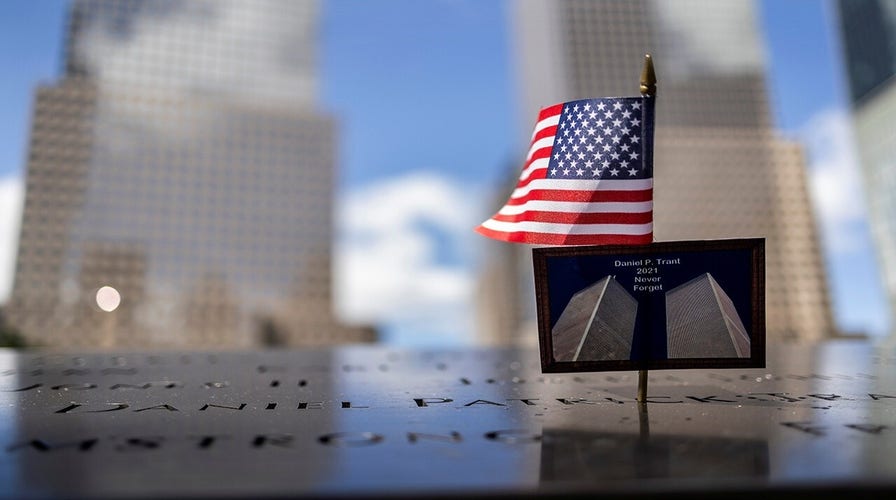
Neil Cavuto pays tribute to the victims of 9/11
'Your World' host reflects on the events September 11, 2001
This is a rush transcript of "Your World with Neil Cavuto" on September 10, 2021. This copy may not be in its final form and may be updated.
NEIL CAVUTO, FOX NEWS ANCHOR: The closing bell on the New York Stock Exchange being rung by first responders, including the New York police commissioner, Dermot Shea, this a very different day than the trading day that they had six days after 9/11, when it was a who's-who of bipartisan political players and the rest of that were trying to come together after the markets had been closed.
Today celebrating not only their eventual reopening and the comeback, but what had been a reminder of that, while New York and the financial capital was hit hard, it has come storming back, a testament to capitalism, and this country, and our resolve.
Welcome, everybody. I'm Neil Cavuto. And this is "Your World."
You know, 20 years ago today, well, it was a Monday. And that day, the last day of innocence, as some have called it, would in no way hint of the trauma and the nightmare that would come and change America forever. But when it hit, it hit badly. And for the financial community, it hit badly as well, not only in terms of financial capital, but human capital.
Hundreds in the investment community died that day, more than 650 individuals that one firm, Cantor Fitzgerald, alone. There were many others, the death of firefighters and first responders that went into the hundreds, and growing questions as to whether New York could or would ever come back.
My next guest remembers it.
Ted Weisberg joins us right now, Seaport Securities. He's been through many crises.
Where were you that day, Ted?
TED WEISBERG, PRESIDENT, SEAPORT SECURITIES CORPORATION: Well, the day started out, I -- actually the reverse of where I am today. I was on the phone in my office, 60 Broad Street, 31st floor, beautiful, beautiful, crystal-clear New York days, looking out over the harbor.
We couldn't see the World Trade Center from our office, but we have a panoramic view of Lower Manhattan. And I was on the phone talking with a good friend and client in Bermuda. And, as we speak today, Neil, I'm remote in Bermuda talking to you in New York. And it's exactly 20 years later, just a little later in the afternoon.
And he said to me, a plane just hit the World Trade Center. And I said, you're kidding? He said, no, no, I'm not kidding. And then the horror began to unfold. I got off the phone, I went down the elevator to go to the stock exchange, where I had been going every day probably for 40-some-odd years prior to that day.
And I never got inside the building. When I hit the street, it was complete (AUDIO GAP) dust in the air. I call the office upstairs and said, everybody, get out. We will meet on the street, on Broad Street in front of the exchange.
I called the exchange. And some of our people didn't want to leave, and some did. And those that did, we all met on the street. And while we were standing out there, I don't know how long we were there, but we were there for certainly a good 20, 30 minutes, both towers collapsed.
You couldn't breathe. We have all seen pictures. It was like, I guess if you're a skier, like a whiteout if you're skiing or driving in the mountains in a snowstorm. And you couldn't breathe because the dust was just in your -- getting everywhere.
And, eventually, our group decided we need to get out from underneath the dust cloud. And so we walked over to the (AUDIO GAP) river and, eventually, three hours later walked all the way uptown, no cell phones because they were no towers, because the towers had collapsed and most of the cell towers were on top of the World Trade Center.
And you would look behind you and all you saw was smoke, piles of smoke going into the sky. And, eventually, we got up to the Upper East Side. Some folks bunked with each other.
But, at that point, most of the people that were with me all lived (AUDIO
GAP) Manhattan. And then we kind of hunkered down until the morning of 9/17, the September of 17, when the stock exchange reopened and there we were at 9:30 good to go. It was very emotional, very sad.
CAVUTO: Yes, that was -- yes, that was a crazy day.
Ted, we're having some audio problems with you. And I apologize, my friend, but Ted Weisberg following all of that.
And he was referring to the markets eventually open -- opening again. That was about six days later. They careened. We had the quickest descent into a bear market then. But Wall Street did come back.
But there were a lot of losses there. I'm not talking financial losses. All the investment heavyweights of the world really were centered in the financial community that was downtown New York, including Keefe, Bruyette & Woods.
John Duffy headed that firm at the time. And he lost his son in that calamity.
Let's go back.
(BEGIN VIDEO CLIP)
CAVUTO: You had no communication with Christopher that day, but one of your other sons going to school in Vermont did. And that was after the second plane had already hit the tower.
JOHN DUFFY, FORMER CEO, KEEFE, BRUYETTE & WOODS: That's correct.
CAVUTO: And he was, I believe trapped, in a stairway or--
DUFFY: Christopher was on the trading desk at KBW. And I did call the office after the first plane had hit the North Tower and had spoken with one of my assistants.
People in the South Tower at that point were fine. They weren't sure what had happened in North Tower, even at that point in time. This was five to
10 minutes after the first plane had struck.
When I attempted to call Christopher later, cell phone service was out. And that was after the second plane had hit. There were a group of them, a group of employees from the trading desk, that were trying to access the different stairwells to find an exit route, but were unable to.
So, Kevin was actually the last person who spoke to Christopher.
(END VIDEO CLIP)
CAVUTO: So, when we talk about Wall Street, we always talk about the money and all that, but these were personal events, CEOs, whole entire investment firms essentially gone in a moment, as I said, 658 at Cantor Fitzgerald alone.
Keefe, Bruyette, as were pointing out, had lost about a third of its work force. Not only were people wondering whether the firm could survive, but whether they personally could move on after such huge personal losses.
But Keefe, Bruyette is doing just fine, thank you.
Its CEO joins us right now, Tom Michaud. We should point out that Keefe, Bruyette is now a part of the A Stifel Company financial empire.
Tom, it's very good to have you, and remembering and looking back at that day and what your firm lost. But it came back. You guys came back.
And I understand a lot of it had to do with the fact that firms started helping each other get back on their feet, right?
TOM MICHAUD, CEO, KEEFE, BRUYETTE & WOODS: It was incredible.
There -- the amount of goodwill and unity that existed at our company and around Wall Street and around the country was really part of the fuel that helped us go about and rebuild. And after this happened -- and I saw the tape that you just played with John.
John, myself and others, we sat down and we said, look, we're going to do two things. We're going to, number one, do everything we can to help the victims and their families. And number two is we're going to go about rebuilding the firm. That way, we will be able to do more to help the families, and because we can't let the firm end that way.
We're not going to let the firm run by terrorists flying planes into our buildings. And, in many ways, it was almost therapeutic to be able to go out and to rebuild. And that was the energy afterwards.
But that was the feeling after those first couple of weeks and the fuel that caused us to move forward.
CAVUTO: Yes, because everyone talks about personnel and money lost and exchanges that were silenced for upwards of a week. And I get that.
But, for you, it was personal. Certainly, at the time, for John, losing his son, it was personal, a third of your firm gone. The idea of somehow getting back, forget the financial losses, the human losses, and some of our best financial minds of that time were all gone.
Did you ever wonder whether at least the way capitalism was known in the U.S. at that time would come back?
MICHAUD: I was a believer in that regards.
And we just had a whole series of goals in front of us. And I keep saying it was like pushing a big rock up the hill. But behind me right now is a flag that one of our survivors' wife painted for us shortly after 9/11 with all the names of those who passed away on 9/11.
And it was the energy of rebuilding the firm, because it just felt to us like it was the right thing to do. And, like I said earlier, that was the fuel.
But I got to tell you, Neil, something now I think is interesting at the 20th anniversary, because while we always honor the victims, I think it's important that we remember what it took for the country to rebuild, because I -- over a quarter of the country today is probably too young to remember the events live.
And I'm worried that 9/11 may become just a couple of paragraphs in a history book. Meanwhile, you have to think about that goodwill, the unity and the resilience that was in our country.
And so that's why I'm not sure if you're aware, but I'm a member of a organization called 9/11 Day. And we convinced President Bush to start and President Obama to sign a proclamation making 9/11 a national day of service and remembrance.
And so we have been encouraging Americans to not let the last chapter that gets written by the terrorists on what happened that day, but, instead, what do we do with it? And so we're encouraging a day of service to remember those who lost their lives and the effort that went into rebuilding.
And I was confident that the American system would survive. I don't think I was ever worried about that. I was worried about New York City.
CAVUTO: Right. Right.
MICHAUD: But New York City did come back.
And I did wonder, Neil, if I was ever going to come back to New York as I was -- I had been on the sidewalk and saw the attacks and the two planes hit the buildings. And as I was walking north towards Midtown, and after the buildings collapsed, I did wonder if I'd ever even come back to New York again.
But rebuilding was actually therapeutic for us. And it felt like it was the right thing to do.
CAVUTO: Well, I'm glad you did, not only come back to New York, but just being a key part of the rebuilding.
Tom Michaud, thank you very much. Very good seeing you.
MICHAUD: Thank you, Neil.
CAVUTO: The questions is always asked, could it happen again?
I had a chance to catch up with Governor Tom Kean of New Jersey, the former governor of New Jersey. He was the co-chair of the 9/11 Commission. And he raised with me to possibly, with everything going on now, yes, it could.
Take a look.
(BEGIN VIDEO CLIP)
CAVUTO: The notion that it could happen again, do you think it could?
THOMAS KEAN, FORMER CO-CHAIRMAN, 9/11 COMMISSION: Well, we know what's happened in Afghanistan. And I worry that are there again going to be places, ungoverned places in Afghanistan where people can plot against the homeland?
And, if they do, though, unfortunately, we got to go back in, because we cannot let anybody have the time they had last time to plan that attack.
(END VIDEO CLIP)
CAVUTO: To Rob O'Neill, the retired Navy SEAL who shot of Usama bin Laden.
Rob, what do you think of that? There's a guy who did all the investigations about what led up to 9/11 fearful, concerned that it could happen again, especially in light of these developments in Afghanistan.
What do you think?
ROB O'NEILL, FORMER U.S. NAVY SEAL: Good to be with you, Neil. thanks again.
Yes, I think he's right. The issue right here is, the Taliban, Al Qaeda, ISIS, the Haqqani Network, they are true believers in their cause. They really believe, if they martyr themselves or kill infidels, they're going to go to paradise. It's like -- it's a simple reward that they really want.
And what they see this now, our retreat from Afghanistan, is a win for their God. Allah gave them this victory. So that I think will empower a lot of the sleeper cells. People in New York City, Saint Louis, London, France, they're going to see a win like this. And that's not going to stop them from getting a big truck and running people over or grabbing scissors or a knife and trying to continue the jihad because God wants them to win.
And that's the sad truth, the way it works. So I'm concerned about that.
Really want people to be visual and keep your head on a swivel, because just because you don't think you're at war doesn't mean someone's not at war with you.
CAVUTO: Do you ever worry, Rob -- and one of the things that I raised with the governor, as the co-chair of the commission, was the lack of communication and sharing information with intelligence agents in the CIA and FBI.
He says a lot of that has been addressed since the commission report. But we still often see things slip through the cracks. Does that worry you that we might not be ready for something because agencies aren't on the same page?
O'NEILL: I don't think it's as bad as it was before 9/11.
But there are still people out there that simply want to get promoted for their own good, so they won't let people share their pie. And that's one of the problems. Now, don't get me wrong. They're wonderful men and women in federal law enforcement and intelligence agencies that are sharing it.
But there's also the issue of people not telling their bosses the truth, because, if they make them mad -- we see it in the military all the time -- if they make their boss mad, they might not get promoted. If they're a general, they don't want to make the politicians mad because they might lose their job that they get at a contractor, a contracting firm after they get out of the Navy.
So some people, I'm concerned, have gotten rid of the greater good for personal power. That's what concerns me too, is a lot of people aren't telling each other the truth, because a lot of times the truth can get you fired. And we see it in everything from Twitter to getting banned to people losing their jobs because they said something to offend someone who's woke.
CAVUTO: Rob O'Neill, thank you very much, at the least, for taking out Usama bin Laden, and you and some of your brave colleagues who did that.
Why the questions still remain whether that could continue to be galvanized now in a new Afghanistan, something we were just starting to explore 20 years ago.
(BEGIN VIDEO CLIP)
CAVUTO: The USS Roosevelt is already en route, destination unknown.
As you indicated, John, that's as it should be. We're not going to start giving away any military secrets, even if we did know them. But the Roosevelt is now leaving port here. It will take about 10 to 12 minutes to leave port, again, destination unknown.
We will be following this very closely for you, as America's response to the terrorist activities in this country eight days ago begins feel its full measure now.
(END VIDEO CLIP)
(COMMERCIAL BREAK)
CAVUTO: More of this vaccination thing: I'm going to force the issue.
That response to all of that today at the White House.
Peter Doocy is there.
Hey, Peter.
PETER DOOCY, FOX NEWS WHITE HOUSE CORRESPONDENT: And Neil, the president is starting to narrow down or at least be more clear with the American people about which Americans he is upset about with regard to the pandemic.
Yesterday, he just vaguely talked about a small minority of Americans and a small minority of elected leaders that he thought were not allowing the U.S. to get past where we are in the Delta variant. Today, he came clean.
He said it's Republican governors.
And one of the -- and some of these Republican lawmakers here in Washington, D.C., think that is the wrong tone.
(BEGIN VIDEO CLIP)
SEN. TOM COTTON (R-AR): Scolding and condescending to Americans, dripping with scorn that somehow this is their fault that they have been infected with a virus, they're not going to persuade people to get more vaccine.
Look, the vaccines the Trump administration -- are very safe and effective.
(END VIDEO CLIP)
DOOCY: So, at the heart of this six-point presidential plan to require vaccines for millions of American workers and students is a new rule that is being worked on by OSHA.
But the administration, despite coming forward with their intentions, can't tell us how long it's going to take for that rule to be written. They can't tell us whether or not it's going to be ready before the Delta spike is done.
And they're also now revealing that there is a very big loophole in this six-point plan. I asked Jen Psaki a few minutes ago why it is that there is a new vaccine mandate for workers, but not for people walking across the border.
(BEGIN VIDEO CLIP)
JEN PSAKI, WHITE HOUSE PRESS SECRETARY: Certainly, we want everybody to get vaccinated. And more people are vaccinated, whether they are migrants are whether they are workers, protects more people in the United States.
DOOCY: But it's a requirement for people at a business with more than 100 people, and it's not a requirement for migrants at the Southern border.
Why?
PSAKI: That's correct.
(END VIDEO CLIP)
DOOCY: That's correct.
The president pitched his plan at a middle school earlier today. We expect to see him head up to New York for tomorrow's commemoration of 9/11 at Ground Zero later on this evening -- Neil.
CAVUTO: All right, Peter, thank you very much for that, Peter Doocy.
A lot of companies already doing this, and mandates are already fully in effect for a lot of companies that are saying no jab, no job.
Grady Trimble in Chicago with more on that side of this.
Hey, Grady.
GRADY TRIMBLE, FOX NEWS CORRESPONDENT: Hey, Neil.
The Business Roundtable, which represents some of the largest companies in the world, says it supports the president's plan. But many of the companies whose CEOs are members of the Roundtable didn't already have vaccine mandates in place, but that could soon change.
American Airlines' CEO, for one, sent a letter to employees after the announcement came through yesterday, saying: "We are reviewing the executive order and are awaiting additional details. But based on what we see so far, it appears we will be impacted by these federally mandated efforts to increase vaccination rates."
Many of the other companies we reached out to had something similar to say, but none has changed its policy just yet. Several labor unions are also chiming in. They want a say in how the mandates are implemented.
A handful of companies had already required employees to get vaccinated, United Airlines, CVS, Kraft Heinz among them. United is going so far as to place workers who get a religious exemption on unpaid leave.
The other facet to this is how workers will respond. A recent poll from ABC News and The Washington Post found that seven in 10 unvaccinated employees would likely quit their job if their employer required them to get vaccinated and didn't allow for medical or religious exemption.
So, if as many people who say they would quit actually do, there could be major fallout from that, Neil, and likely a lot of legal challenges ahead as well.
CAVUTO: Oh, I can just see the lawyers lining up.
Grady, thank you very much.
Grady Trimble on all of that.
Well, he lost his brother in the 9/11 attacks, but if you think that was going to stop Frank Siller, think again.
(BEGIN VIDEO CLIP)
FRANK SILLER, CEO, TUNNEL TO TOWERS FOUNDATION: Our first mission is to make sure we never forget what happened 20 years ago.
(END VIDEO CLIP)
(COMMERCIAL BREAK)
CAVUTO: You know Ken Feinberg is a big deal when Michael Keaton is playing him in the role of disbursing billions of dollars to victims of the 9/11 attacks. It wasn't even-steven, and it was controversial.
Ken Feinberg coming up.
(COMMERCIAL BREAK)
CAVUTO: Did Frank Siller come to your town?
Well, he came to mind and hundreds across the Northeast as he trekked better than 537 miles to remember his brother and to remember what happened that day, because, you see, Frank's brother, a New York City fireman, was killed in those attacks.
Frank has started what has been a great way to make some goodness come of this horror. And he is very involved, in fact, now the foundation CEO for the Tunnel to Towers Foundation that has involved this great walk that I had the pleasure of witnessing myself.
Frank, it's good to have you.
You finished. How did it go?
SILLER: It was unbelievable, Neil.
And it was so nice to see you out there. All of a sudden, I'm walking. I think it was Mendham, New Jersey.
CAVUTO: Right. Right.
SILLER: And I'm walking (AUDIO GAP) and there you are greeting the great caravan that I had with us. And it was good to see you, your son, a volunteer firefighter. You must be so proud.
CAVUTO: That's right. I am.
SILLER: But I will tell you, I have been greeted -- I'm sure you are, sir.
And well you should be.
I have been greeted by so many beautiful Americans who love America, who get it. They will never forget what happened 20 years ago. But what is very encouraging to me, that there was so many young families that have greeted me along the way.
Morristown had an unbelievable parade the day after I saw you. They -- thousands of people had come out. And it was raining too, by the way. And we had a wonderful day. East--
CAVUTO: No, they wanted to see you, Frank. They wanted to see you.
SILLER: Listen--
CAVUTO: And you know what? What I noticed about -- go ahead.
SILLER: No, you go.
CAVUTO: OK. Fine.
What I noticed about you that was so beautiful is, you would stop, and everyone wanted to take a picture with you, be with you, shake your had.
You stopped. However long it took, you wanted to be there, and on you walked again.
And I kept saying, why don't you just drive the 537 miles? But you kept walking. And it was amazing.
But -- and some of these pictures prove it, when you were in my particular town. But I know you have repeated this across all of these places you visited. And it touches people.
What do they tell you? I'd be curious, Frank, what do they want to hear?
SILLER: Well, it's -- it was so uplifting, because they were saying thank you.
And the reason why I wanted to do this, first of all, I wanted to honor my brother. I mean, he's such a hero. He gave up his life on 9/11. He ran through the Brooklyn-Battery Tunnel with his gear on his back to get there.
He was a father of five. He was just a beautiful person.
And I wanted to do something. Of course, I know it's nothing compared to what he did. But I wanted to do something to say, Stephen, we're so proud of you as a family, and I'm so proud of you as your brother. He's our little brother, and we all look up to him.
But so many people say thanks for doing this, because they don't want 9/11 to be -- ever be forgotten. And I just -- once again, I'm encouraged by seeing so many young people out there.
But, also, the reason why it's successful, the foundation's successful, because we're helping the greatest of all Americans. And you know who they are, those who are willing to die for you and I every single day, our men and women uniform and our first responders.
And we're delivering them mortgage-free homes or smart homes when they give their bodies for our country. And it's been 20 years of doing glorious, joyful work for the greatest of all Americans.
CAVUTO: You know, you have turned such horror into something that's done so much good for so many.
And when I see these, I mean, it's tough to watch some of these commercials and still have a dry eye afterwards, when you talk about families who've lost everything or their loved one is so incapacitated. And, there, you provide at home. You take out the mortgage, and that they have a chance, they have a shot in a new, very different life.
What gave you that idea?
SILLER: Well, look, first -- we built the first smart home in 2011, delivered it by June 11, 2011. First quadruple amputee to ever survive any war from Staten Island, same place where I was born, my brother Stephen was born and all my family, seven brothers and sisters.
Then, in 2014, December 20, Liu and Ramos get assassinated. They're worried about their mortgage payments. We heard about that. We went -- on Christmas Eve, I went, I sat down with these families, and I told them the Tunnel to Towers was going to pay off their mortgage.
We saw the difference that these smart homes are making in these great heroes' lives. We saw the difference that these mortgage payoffs, so they can stay in their homes where they were having the dreams with their families. They have enough going on. They just lost their loved one. And then Gold Star families last, certainly not least, what we're doing for Gold Star families.
And you know we just lost 13 grade service members over in Afghanistan.
CAVUTO: Right.
SILLER: One of them is Lance McCollum.
And Lance Corporal left behind a wife, and a pregnant wife, who's going to give birth any day. I am talking her tomorrow. She knows our intentions already because I sent a letter stating that the Tunnel to Towers -- because I didn't want to call her up too soon after her loss, because she is pregnant, and let her know that we're building a house.
But I'm talking to her tomorrow, on 9/11. You know why? Because I want to do good on a day that was so evil 20 years ago. Because of what my brother did, I'm going to always make sure, my family's always going to make sure that good steps on evil every single time. And that's what I'm doing tomorrow.
CAVUTO: You know, Frank, you're a remarkable man. I think you already know that. You honor your brother beautifully.
But to go to this extent is amazing, because I have already told my brother, if something happens, I wouldn't -- I would do the same for him.
But you are that much a wonderful human being.
And I saw it myself. I saw it play out with people who wanted just a second with you. And you gave every single one of them that time.
Frank, thank you very, very much.
SILLER: Please join us, t2t.org. Tell people to join us. Can't get it done unless the goodness of America takes care of the greatness of America, $11 a month.
Thank you. God bless you. And let us never forget.
CAVUTO: Frank, thank you very much.
And it is an amazing charity. And, folks, the -- you always hear about administrative costs and all this. This is recognized around the world as one of the most important and productive and cash-efficient charities on the planet. It gets to where it's intended to go, no doubt because Frank is probably calling the shots.
All right, we have a lot more. In fact, remembering what was started on 9/11, that still goes on to this day.
(BEGIN VIDEO CLIP)
CAVUTO: Having come up here and just look what's going on half-a-world away, it seems, in downtown New York. I can't tell you, John, just the number of times I have been at both World Trade Center towers in my 20 years of covering business news, talking to really some of the mightiest in the corporate community, and that community, of course, gone now.
(END VIDEO CLIP)
(COMMERCIAL BREAK)
CAVUTO: You know, almost 3,000 people lost their lives on 9/11. You have probably heard the statistics repeatedly. But it could, again, could have been much, much worse.
Mike Curley is a survivor who escaped from the South Tower on the day of the attacks. And it was nothing short of a miracle.
Mike Curley joins us right now.
Mike, how you doing?
MIKE CURLEY, SEPTEMBER 11 ATTACK SURVIVOR: I'm doing fine. Thank you. How about you?
CAVUTO: Good.
Tell us about that day, if you can, Mike.
CURLEY: Well, I was teaching for the New York Institute of Finance. I was on the 17th floor of the South Tower.
And I got there early. And I got my coffee. And I started preparing for the class and putting out my handouts. And about a quarter to 9:00, the North Tower got hit. And there was a tremendous amount of debris coming down, huge amounts, the size of a kitchen table, and paper all over the place, I mean, unbelievable amounts of paper.
And I kept telling the people -- I arrived early -- keep away from the windows, and stuff like that, because you could see some of the debris was pretty heavy.
Then I decided something was wrong, that it was time for me to leave anyways. So I told the woman I was in charge of the institute at that time, I'm leaving, and I think you should evacuate the whole floor. So, she had a whistle. I guess it was a whistle for fire and things like that.
And she started blowing the whistle. And she told everybody to go down the floor. So, we went down to the 17th floor.
CAVUTO: But not everyone was evacuating, right?
You -- your gut was right. But what were you being told to do in the building or on the intercom system?
CURLEY: We weren't being told to do anything at that particular point.
CAVUTO: Wow.
CURLEY: We got down to the -- when I got down to the lobby, then there was a Port Authority or police officer that said it was safe to go back up there.
But I decided that this was not a place to be safe. So, I went out. And I was heading toward the E Train and going through the various stores and lobbies that was there. And some detective grabbed me and he said: "Where you going?"
And I said: "I'm taking the E Train."
Well, told me that there was -- there's no trains running. He says -- so, I
said: "Well, can I go out on the Dey Street?"
He said: "Go ahead."
So, when I went out to Dey Street, they had -- there was a cop on one side of the street and a cop on the other side. And he would signal to the cop to say let five people cross. And he would wait until the debris started to lessen. And we would run across the street.
And we started going up. And it was at that point that the South Tower got hit. And I still remember that, and not that I saw the plane, but I saw that big orange ball that we all saw so many times on TV hit.
CAVUTO: Right.
CURLEY: And now -- and the amount of glass that came down -- and it was glass that was on the buildings right by me, I guess, from the explosion.
CAVUTO: Right.
CURLEY: And that's when a lot of people got hurt, or particularly the women, because they took off their high heels so they could run a little faster and because they were running on glass, and then they got their feet cut.
CAVUTO: Oh.
CURLEY: And nothing life-threatening, but they were certainly in a lot of pain. And they were reaching to the other side.
CAVUTO: That was a scary time. That was a scary time.
CURLEY: Oh, it was, because--
CAVUTO: But you got out, Mike. You got out. And that's what counts.
And now you can live to tell about it. I wish we were -- we're kind of rushed for time here, Mike, but I'm so glad you're well. You were wise to follow your gut and get others to follow you as well. They're alive today in no short measure because of your warning.
Mike Curley, thank you very, very much.
When we step back, and we look at all the lives lost, how would you like to be in charge of the Compensation Fund that would decide how much money you get? And it's decided not necessarily all even, but based on who you were and how much you made. There was a formula to it. And Ken Feinberg was the guy responsible for delivering it.
In fact, it got to be such a key moment in human history that it is now being played out in a Michael Keaton movie on Netflix in which he plays Ken Feinberg, and you realize the story behind the story is even more fascinating.
Ken Feinberg is next.
(COMMERCIAL BREAK)
(BEGIN VIDEO CLIP)
MICHAEL KEATON, ACTOR: And their families will be compensated based on economic value lost.
UNIDENTIFIED ACTRESS: You're a lawyer.
KEATON: And that's exactly what these people need right now.
(END VIDEO CLIP)
CAVUTO: Well, you know you're a big deal when Michael Keaton is playing you in a very popular and widely and critically acclaimed Netflix movie.
It's all about the story of Ken Feinberg, who was responsible for handling the multibillion-dollar Compensation Fund for victims of the 9/11 attacks.
And I didn't realize the backstory on this was as hazardous as it was.
Ken Feinberg with us right now.
Ken, good to see you.
KENNETH FEINBERG, VICTIM COMPENSATION ATTORNEY: Nice to be here again, Neil. Thanks.
CAVUTO: I know Michael Keaton was trying to get your Massachusetts accent down, but I felt it wasn't as good as yours. So maybe that was just my opinion.
But it really was a riveting movie, Ken.
FEINBERG: Oh, there might have been dramatic license also.
(CROSSTALK)
(LAUGHTER)
CAVUTO: I think so. maybe
I didn't realize -- and maybe there was a little dramatic effect here. But you had a hell of a task on your hands. This money was not going to be divided evenly, that you had to recognize there were some high-paid brokers and bankers and others in these buildings who were not going to get the same compensation check that, let's say, a fireman would or a dishwasher would.
FEINBERG: That's right.
CAVUTO: That was fascinating, how you arrived -- how did you arrive at that?
FEINBERG: Well, first of all, Congress in the law creating the fund made it pretty clear--
CAVUTO: Right.
FEINBERG: -- that I was to follow, in principle, state law.
Every state in the country has courts and juries that provide more compensation to stockbrokers or bankers than waiters or busboys. That's the American legal system.
CAVUTO: Never on a level like this. Never on a level like this, right?
FEINBERG: No. No.
That was the problem, you see. When you have 5,000 claims for death and physical injury, everybody counts other people's money. And that is a response that was almost uniform.
"Mr. Feinberg, you're giving me $3 million, but you're giving my next-door neighbor $4 million. What do you have against my wife? You didn't even know her."
And that the law promoted the very type of dismissiveness you're trying to avoid. And, ultimately, we overcame that dismissiveness.
CAVUTO: There was much talk about how you changed your formula or whatever it was after meeting with a number of victims' families and that there -- I wouldn't call it necessary an epiphany, but something happened to move this forward, because up until this so-called change, I mean, it wasn't looking like you would have signed up enough to write off on the fund itself.
Explain what happened.
FEINBERG: The biggest problem we confronted in this whole program was not financial. And it wasn't calculating formulas.
The biggest problem, as you know, Neil, the law creating the fund occurred just 13 days after the attacks, emotion incredibly raw, angry, frustrated people.
"Mr. Feinberg, you're providing me $3 million. They haven't even found my son's body yet. How dare you come here talking about dollars and cents?"
And it did take time for empathy and I think a somewhat calmness in terms of evaluating financial uncertainty, at least. But it was difficult, it was emotional, and it was debilitating.
CAVUTO: How did you expand it for those who we later learned to discover what would get sick and later die working on site or having to do with rescuing people on 9/11?
I mean, then you had to revisit things, right?
FEINBERG: Of course.
Don't forget, the statute expired. The fund was over in December of 2003.
CAVUTO: Right.
FEINBERG: That meant that people were first responders and others who had the latent illnesses, they hadn't manifested themselves yet, cancer, emphysema, other diseases.
Those diseases didn't bear fruit a decade later. So, Congress, I think correctly, had very little choice. Elementary fairness required that they reactivate the fund for purposes of compensating first responders and others who only in 2013, '14, '15, today are now manifesting those physical illnesses.
CAVUTO: And did the compensation, the way you went about compensating people, did that same method applied to this latest group of people who needed help?
FEINBERG: Yes, I think there were some variations.
But, basically, the victim compensation one that I administered vs. victim compensation two very ably being administered today, they basically follow the same format. There may be some differences in eligibility and valuation, but they're basically the same.
CAVUTO: You know, a lot of people look at this.
And, obviously, you have been called in to do this again and again since 9/11. And it's changed the notion of how we reward people. That was part of the way Congress wanted it. But did it ever envision the controversy around it, that a fireman's family or policeman's family or Port Authority worker's family would not be as generously compensated as, let's say, a broker?
FEINBERG: Congress didn't think that way, no.
Congress wanted to make sure that whatever I had to do to entice incentivize people into the program, do it. We don't want lawsuits. We don't want airlines being sued, the World Trade Center being sued. We want a better system in this particular tragedy to avoid litigation.
I don't think you will see a 9/11 Fund again, I think it was a -- sort of a unique a reaction to an unprecedented disaster in American history.
CAVUTO: Right.
FEINBERG: But I don't believe it will be replicated. I'm not sure it should be replicated.
Bad things happen to good people every day in this country. There's no 9/11 Fund.
CAVUTO: That's a very good point, Ken Feinberg, special master of the September 11 Victim Compensation Fund.
I urge you to watch the Michael Keaton movie on this, "Worth," because it puts in perspective the Herculean task Ken had.
Ken, thank you very, very much.
Looking back at that day and all that would come as a result of that day, compensating, everything else, it was the sheer, sheer enormity of the loss that hits home.
(BEGIN VIDEO CLIP)
CAVUTO: Whoever committed this heinous act today, if the gist was not only to cause tremendous physical damage, and obviously a tremendous loss of life, they have also cut the financial capital of the world to the core.
UNIDENTIFIED MALE: I was here shortly after 9:00 this morning.
Police and fire were racing to the scene. And that, of course, soon thereafter, is when the buildings themselves began to give way. I was a few blocks away. One of the buildings collapsed. I ran, as did a number of the police and fire who were in the nearby streets, but a great many officers, New York's finest and New York's bravest, were trapped inside.
UNIDENTIFIED MALE: There were three blasts. And it was just total panic, cops, sheriffs, construction, workers, welders just dropping everything, running up the street for cover.
UNIDENTIFIED FEMALE: He was last seen when he left the house at 6:00 in the morning. I haven't heard from him, not a phone call from him. And I'm looking for him. I'm looking for him, anybody with information.
UNIDENTIFIED MALE: The FAA, the Department of Transportation have said they will begin allowing limited flights, most of the flights that were diverted yesterday to other airports and, in essence, are stranded.
But those flights will not fly until the airports they are flying away from are thoroughly searched and the passengers once again checked in with even tougher security.
UNIDENTIFIED FEMALE: We're making it away towards the water and running away from the building. And she said she couldn't run. And we said, we have
-- you have to do whatever you have to do. Just keep moving.
And every time people would look back, unfortunately, they looked back and they saw the second plane hit, which was a very gruesome experience, because you--
CAVUTO: So they're running back. They were trying to get out of there. And they look back they see the second plane hit.
UNIDENTIFIED FEMALE: Second plane hit, yes.
CAVUTO: And that one was quite severe, because, all of a sudden, everything is falling out of the sky.
(CROSSTALK)
UNIDENTIFIED FEMALE: Including bodies.
CAVUTO: The human dimension of this, of course, is incalculable.
But that's the question, Brian. When trading does resume Monday, yes, you got the machines back, the wires back, the keyboards are up and running, and all of that, the data terminals connecting here to London, to Frankfurt, to Beijing. They're all working again.
But you're all of a sudden looking at a lot of empty desks.
We have heard about the lives lost and the buildings lost. I want to end tonight talking about the friends I have lost, the guests I have lost.
I'm being a little selfish here, so many. But, finally, I'd like to focus on two, two eerily prescient gentlemen who were regulars on this show, Bill Meehan of Cantor Fitzgerald, and David Alger of Fred Alger Manager.
BILL MEEHAN, CANTOR FITZGERALD: There's a true mania that's going on surrounding Wall Street that's unlike anything we have seen since the '20s.
And a lot of it--
CAVUTO: But it has been going on for a while.
MEEHAN: It has been going on for a while.
CAVUTO: At what point do you the signals are enough that you pause?
MEEHAN: I don't think the signals will be enough, Neil, until the Fed actually does something, as opposed to says something.
CAVUTO: People might find it so paltry, they will spend it.
DAVID ALGER, FRED ALGER MANAGEMENT: Right, exactly.
I think they will spend it. And when you multiply that paltry amount by the number of taxpayers we have in this country, what, 100 million people all spending $300 a pop right off right off the bat--
CAVUTO: Yes, why save it, in other words?
(CROSSTALK)
ALGER: Yes, exactly. Why save it? It's going to be a nice leavening factor for the economy.
CAVUTO: Bill Meehan, David Alger, gone now, but not forgotten ever. That's what September 11 means to me.
(END VIDEO CLIP)
CAVUTO: There were many more who were lost that day, guests on this show, those who provided their financial expertise of America and where we were headed, with no idea about where they were headed, and how short those days would be before they were gone, in one case, someone who was on with me just a couple of days before the attacks.
You never know, they say, in life, the unpredictability of it all, the rich and the poor and everyone in between who at any moment can be taken when they least expect it, leaving behind families who needed help and healing and, as Ken Feinberg would say, compensation as well.
All of that was to be worked out, but not before the magnitude of the events that unfolded. If you think about it, 20 years ago this day was a Monday, the last innocent day before everything hit the fan, when all we were talking about were, well, a New York mayoral race and, at least in this city, the hope that maybe the Yankees or the Mets would surprise us.
That was then. This weekend, we look into what is now.
I will see you tomorrow for special coverage, 11:00 a.m. Eastern time, as we look back and look forward.
Content and Programming Copyright 2021 Fox News Network, LLC. ALL
RIGHTS RESERVED. Copyright 2021 VIQ Media Transcription, Inc. All materials
herein are protected by United States copyright law and may not be
reproduced, distributed, transmitted, displayed, published or broadcast
without the prior written permission of VIQ Media Transcription, Inc. You
may not alter or remove any trademark, copyright or other notice from
copies of the content.
