


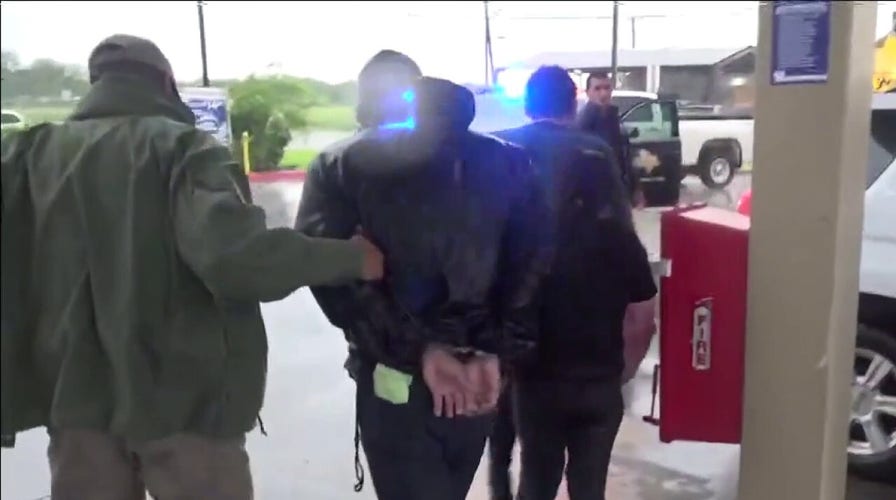
Fox team covers inside perspective of Biden's border crisis
Exclusive video shows a first-hand look at the immigration crisis on the southern border on 'Your World'
This is a rush transcript from "Your World with Neil Cavuto," May 20, 2021. This copy may not be in its final form and may be updated.
CHARLES PAYNE, FOX NEWS ANCHOR: A cease-fire declared, but will it hold?
The move ending an 11-day conflict between Israel and Hamas, the news coming amid intense pressure by the White House. It is still unclear when exactly the truce will take effect.
This hour, we will be speaking to combat veteran and Iowa Republican Senator Joni Ernst on this major development.
Welcome, everyone. I'm Charles Payne, in for Neil Cavuto. And this is "Your World."
First to Trey Yingst on the Israel-Gaza border with the very latest -- Trey.
TREY YINGST, FOX NEWS FOREIGN CORRESPONDENT: Charles, good afternoon.
Breaking tonight, the Israeli Security Cabinet has approved a cease-fire deal with Hamas, the group in control of Gaza, basically ending 11 straight days of fighting between the two sides.
We are getting reports right now. According to Israeli media, this is set to go into place and into effect around 2:00 a.m. local time. And there are no preconditions. This is significant, because we spoke earlier today with Hamas, who said there would have to be preconditions in order to stop the fire.
Now, after the report started to circulate that the Israelis were on board with this cease-fire agreement, after a week of being urged not only by the United States, but also the United Nations ,to stop this fighting, we are not really sure if it's going to hold.
One example of that is, off in the distance now, you can still hear Israeli helicopters and fighter jets. They're continuing operations against Gaza up until this cease-fire actually goes into effect. And also, just a few minutes ago, there were mortars and rockets fired into this area in Southern Israel, the city of Ashkelon.
Earlier today, in that conversation with Hamas, we tried to get an understanding of their perspective about this conflict and the involvement of the Americans.
I want you to take a listen to this senior official on what they had to say about the Biden administration.
(BEGIN VIDEO CLIP)
DR. BASEM NAIM, SENIOR HAMAS OFFICIAL: All in all, I think the efforts done by the American administration in this round of escalation was much, much less than expected.
And they have more power to or to legislate to stop this fighting.
(END VIDEO CLIP)
YINGST: We saw this sort of hands-off approach by President Biden and the U.S. State Department, as an estimated 80,000 Gazans are internally displaced right now, caught between Hamas rockets and Israeli airstrikes.
The humanitarian situation quickly unraveling, as Palestinian civilians run out of food, electricity and clean water. Reports do indicate that areas crossing on the northern part of the Gaza Strip will be open tomorrow for humanitarian aid.
But as we saw earlier in the week, sometimes ,those convoys are actually targeted with rockets and mortars. And it makes it very difficult to get that aid into the Gaza Strip, but, tonight, again, that breaking news, the Israeli Security Cabinet approving a cease-fire that will effectively end 11 days of fighting between the Israeli military and Hamas -- Charles.
PAYNE: Trey, thank you very much.
I want to get the read from Rebeccah Heinrichs, senior fellow at the Hudson Institute.
Rebeccah, your thoughts on this, particularly in the last 24 or 48 hours, where there was, obviously, extreme pressure from the White House? At one point, President Biden, according to some reports, demanding a de- escalation on the part of Israel with this fighting. What do you think?
REBECCAH HEINRICHS, THE HUDSON INSTITUTE: Well, I'm tentatively very encouraged. Of course, the fighting is going to continue all the way up to the cease-fire.
The cease-fire, the early reports are, that it will take into effect, it'll be about 7:00 p.m. Thursday night, so that's tonight, Eastern time. And, of course, Israel is going to continue to take out the targets that it believes that are necessary, where Hamas is still hiding and where it's still conducting operations.
I thought Trey made the important point too, the reporter, right before that you and I begin chatting, Charles, that the humanitarian aid that is coming in, it's coming in -- it's important to be clear about where it's coming from. Israel is delivering aid to those civilians that are in the crossfire, and Hamas continues to fire upon those delivering aid in that area.
So it's important to keep in mind who the aggressors are here and who is trying to go to extremes to make sure that we minimize the civilian casualties that are -- that are caught in the middle of this.
PAYNE: Rebeccah, obviously, it's a cease-fire. It's tenuous. It will be tenuous, at best.
What steps have to be taken immediately during this period to maybe come to a conclusion of this latest round of violence?
HEINRICHS: Well, they need to begin winding down.
So, even, as I just said, Israel is going to continue to take out some targets, that's going to have to be very clearly decreasing towards the end. But they're not -- the Israelis are not going to stop if they're still taking incoming from the Hamas militants.
And so that has to -- that has to stop, because, of course, Israel is under enormous international scrutiny right now. The Palestinian side has taken on more casualties. And that does not mean that they are the ones that are more innocent, though that is the narrative that's going to continue to be painted.
Remember, Hamas is still hiding among civilian targets. And so, as Israel tries to warn civilians to evacuate those areas, it's very difficult, because the Hamas militants are hiding there.
So what needs to happen is, Hamas has got to stop. They have got to stop launching these attacks against civilian targets inside of Israel.
PAYNE: Yes, winning the public relations war and losing these unnecessary skirmishes does no -- serves no one. That's for sure.
Rebeccah, we always appreciate your expertise on this. Thank you so much for helping us with this fast breaking news.
Meanwhile, folks, the White House clearing the way for a Russian pipeline to proceed, even though they say it's a bad idea. Now, of course, remember, this is while they canceled work on the Keystone Pipeline right here in the USA.
Scrapping that deal, by the way, costs more than 11,000 Americans their jobs. We will talk to one of them, in fact, in a moment, but first to Peter Doocy, who's at the White House with the very latest -- Peter.
PETER DOOCY, FOX NEWS WHITE HOUSE CORRESPONDENT: Charles, good afternoon.
And the White House has made clear they know most greenhouse gases are emitted beyond U.S. borders. So, when they canceled the Keystone XL Pipeline project, they said they were hoping others in the world would follow our lead.
(BEGIN VIDEO CLIP)
DOOCY: President Biden blocked the Keystone XL pipeline here because he said it would undermine U.S. climate leadership and undercut our ability to urge other countries to take ambitious climate action.
So how is he urging other countries to take ambitious climate action, if he's letting other countries build Nord Stream II?
JEN PSAKI, WHITE HOUSE PRESS SECRETARY: First, we're hardly letting any country or other countries build Nord Stream II. When the president took office, 95 percent of this pipeline was built. We have continued to convey that we believe it's a bad -- a bad idea, a bad plan.
(END VIDEO CLIP)
DOOCY: The White House is basically saying today the decision to identify officials, they say, deserve sanctions, which would have made it tough for the Nord Stream II pipeline to proceed and then waive those sanctions, making it easier for the Nord Stream II pipeline to proceed, was diplomatic to help allies in Germany out.
But critics are saying it really helps Russia.
(BEGIN VIDEO CLIP)
RICHARD GRENELL, FORMER ACTING U.S. DIRECTOR OF NATIONAL INTELLIGENCE: There's a whole bunch of Democrats who called President Trump a Russian asset that now have egg on their face, because they're going to need to call Biden a Russian asset for this move.
This is exactly what President Putin wanted. Joe Biden just gave him the biggest gift.
(END VIDEO CLIP)
DOOCY: And the White House still says their position is that this pipeline should not go forward, should not be completed. But it appears their actions in waiving these sanctions on officials who are involved made it easier to be completed -- Charles.
PAYNE: Yes, it feels like certainly Vladimir Putin a big winner here. Thank you so much, Peter.
Well, Neal Crabtree lost his job on the Keystone pipeline when President Biden scrapped the project. And he joins me now.
So, Neal, just what do you make of this latest move from the White House?
NEAL CRABTREE, LAID-OFF PIPELINE WORKER: Man, it's -- well, thanks for having me to begin with.
But it's a gut punch to the blue-collar American energy workers in this company, when we're told to sit on the sidelines. And then the administration wants to let their Russian comrades into the game. It's tough for us.
And the only explanation that we can get is, we have got to keep good relations with Germany. And I'm keeping thinking to myself, what about our good neighbors to the north, Canada? This Keystone XL Pipeline was going to bit benefit both of our economies.
I'm kind of wondering what they're thinking right now.
PAYNE: Yes, Canada didn't mince any words about their displeasure with this.
And you're right, Neal. It felt like it was a box to be checked as you come in. And it was a sort of a nod to the left. But other than that, from an economic point of view, it doesn't make a lot of sense.
And I want to point out, you are -- work with Local Union 798. You're a union man. This is supposed to be the greatest union president in history. And the first act is to destroy the jobs of 11,000 union workers. I mean, how do you deal with that?
CRABTREE: Well, I'd like to take just one second here to apologize to Canada myself, because I have got a lot of blue-collar workers up there.
I didn't vote for this guy or whoever's running the show up there right now. Like I said, I just want to take one second to apologize to them.
PAYNE: Yes. Yes.
Neal, I don't have a lot of time, but I do want to see -- ask how you're doing. Has there been any help? I know green energy jobs were promised to all the folks who lost their jobs. Have they materialized yet?
CRABTREE: No, they ain't materialized, and they're not going to.
I mean, a prime example of this is what's going on in Germany right now. You hear so much about they're pushing to a green new economy, but yet they're having to beg from a pipeline from, of all places, from Russia, when we were -- we could have provided that fuel to Germany. That's one of the reasons that President Trump put the sanctions in on it, because he knew Russia didn't need to be providing this fuel.
We're set up to where we could have done this here in the United States, got that gas to Germany.
PAYNE: Yes. Yes.
CRABTREE: The only thing it's doing is costing Americans jobs.
PAYNE: Well, Neal, we want you to stay strong. We appreciate you coming on.
And, believe me, we will continue to check up on you and your colleagues. Talk to you again real soon.
CRABTREE: All right, thank you. Thank you.
PAYNE: Meanwhile, folks: Could bank soon be giving the IRS access to your accounts without your permission? The story you're not hearing, but you should be.
And something Bernie Sanders is trying to do to Israel has Iowa Republican Senator Joni Ernst fired up and wondering if Democrats are bailing out on one of our top allies. She will be joining us on that and this reported cease-fire coming up.
(COMMERCIAL BREAK)
PAYNE: Now to Blake Burman, who is pressing the White House for answers on potential new banking powers -- Blake.
BLAKE BURMAN, FOX NEWS CORRESPONDENT: Charles, hi there. Good afternoon.
As you know, the president and the Biden administration are trying to pay for, at least in part, for the American Families Plan by cracking down on tax cheats, trying to build up the IRS and to bring in more money to the federal government.
In fact, the Biden administration says that, by building up IRS reinforcements, that could potentially bring in some $700 billion over the course of a decade. One of the ways that they are intending to do this is to have financial institutions report outflows and inflows as it relates to bank accounts.
Earlier today, I asked the White House press secretary, Jen Psaki, about this, essentially why the federal government should be able to monitor the inflows and outflows of bank accounts, but also, secondly, the Treasury Department is saying that those who make under $400,000 a year would not be audited more under this plan.
So, would it amount to a two-tiered audit system? And this was part of her response.
(BEGIN VIDEO CLIP)
PSAKI: I would say that lower- and middle-income Americans who are working hard, making -- getting their paychecks are not typically the issue at hand here.
The wealthiest Americans and corporations, because they often operate under different tax systems, it already is a system that is living in two Americas. They are able to pay lower tax rates. That's not fair. That's basically what the president is conveying.
(END VIDEO CLIP)
BURMAN: So, about this idea, Charles, of having financial institutions report outflows and inflows, I followed up with her by saying, well, what about those who have done well and have paid their taxes and just don't want the possibility of maybe the federal government having more insight as to what comes into and out of their bank accounts?
And she responded by saying, look, if you pay your taxes, you're going to be aboveboard. She also noted at least part of what the administration, the case that they're making is that the IRS has been underfunded and understaffed, they say, for the past decade -- Charles.
PAYNE: Yes, they keep pressing out one, for sure.
Blake, thank you very much.
I want to go to FOX Business Network's Edward Lawrence on privacy concerns coming out from all of this -- Edward.
EDWARD LAWRENCE, FOX BUSINESS CORRESPONDENT: Yes, privacy concerns, exactly.
And it's not just bank accounts that they're going to have access to. The proposal says they would like to have access to any financial firm that transfers money.
So, they're talking about Venmo. You're talking about crypto wallets, any type of service like that goes back and forth. So, there are concerns out there about what information that the federal government would be able to have. And many people are now pointing to the 2013 scandals, where the IRS, some claim, was weaponized against some conservative voices and Republican- based organizations going forward.
So, there is an issue here. And Blake touched on it, too. They're saying the Treasury -- the Treasury officials are saying that the IRS is underfunded. They want to put $80 billion back into the IRS, to grow it at 10 percent per year over the next 10 years, adding agents, auditors to audit folks, as well as new technology to come up with algorithms that can flow information different ways.
PAYNE: Right.
LAWRENCE: Treasury officials tell me that they're going to figure out how to use this information as sort of the technology evolves. So there's no telling what they could do with it.
PAYNE: Well, Edward, I know there was a bunch of news from Treasury today with respect to bolstering the IRS.
And one of them derailed cryptocurrency. Bitcoin, in fact, came down a lot, because now, apparently, they also say, hey, you can use it for evading taxes, and they want a record of transactions using cryptocurrency of $10,000. That certainly doesn't include -- that's not millionaires and billionaires.
Again, it looks like any reason they can to bolster an army, an $80 billion army of IRS agents. They're going for it. But I think people better be careful, because it ain't just after the millionaires, is it?
LAWRENCE: No, no, exactly. And they're trying to squeeze $700 billion. They say these proposals will bring in a net revenue of $700 billion over the next 10 years. The 10 years beyond that, it will go up to $1.6 trillion.
So they are planning to go after all this money.
PAYNE: Edward Lawrence, thank you so much, my friend.
Meanwhile, folks, Senate Minority Leader McConnell fired up over the Biden administration's claims that migrant numbers are coming down. What is the head of the Border Patrol union seeing?
Well, Brandon Judd is here. And he's coming right up.
And how did one of California's biggest hot spots for tours become one for the homeless? Lawrence Jones is getting those answers.
(COMMERCIAL BREAK)
PAYNE: Iowa Republican Senator and key member of the Armed Services Committee Joni Ernst joining us to talk about that potential cease-fire between Israel and Hamas. Does she think it will stick?
We will ask her in about 60 -- we will be back in 60 seconds.
(COMMERCIAL BREAK)
PAYNE: To the Southern border.
FOX News getting an exclusive look, as the flow of migrants continues to surge.
FOX News' Alex Hogan is in the Rio Grande Valley with a firsthand look at this crisis -- Alex.
ALEX HOGAN, FOX NEWS CORRESPONDENT: Hi, Charles.
A very different look at the daytime to the night-side side of looking at the border. We joined the Texas Department of Public Safety, and within minutes upon arriving at the Rio Grande Valley, we saw rafts begin to cross, 80 people waiting in the darkness to reach this side of the border.
And it began as a game of cat and mouse between law enforcement and the smugglers.
(BEGIN VIDEO CLIP)
HOGAN: This is the second raft we have seen so far tonight, on board, just women and their children, conversation back and forth between law enforcement and the smuggler who is seen swimming them to shore.
But he's already getting tired swimming across the current. Now his partner is joining him in the water, again, conversations back and forth as they try to drop off these migrants and swim back to Mexico without losing their boat.
(END VIDEO CLIP)
HOGAN: Children and families surrendered to border agents, a very different sight from earlier on in the day during our ride-along, catching those unwilling to turn themselves in.
Our troopers spotted vehicle suspiciously laying in a parking lot. Chasing them down, he found that the smuggler ditched this red truck, leaving a man stuck in the bed, another vehicle parked in a gas station as an attempt to blend in.
(BEGIN VIDEO CLIP)
UNIDENTIFIED MALE: Get out! Get out of the car!
(END VIDEO CLIP)
HOGAN: Law enforcement finding five people hidden in the vehicle.
As the number of migrant apprehensions increases, DPS says more stash houses are popping up in the last two months. DPS has conducted 254 high- speed chases.
Now, anywhere you drive here along the Southern border, you will see white vans., the Border Patrol vehicles. They practically are everywhere. Still, there's not enough support. So ,as a result of that, Texas has Operation Lone Star. It's brought 1,000 members here to the South, people working 12- hour shifts for 12 days straight.
And even with all of that extra help, Charles, they say their days are still not slowing down -- Charles.
PAYNE: Alex, thank you very much.
Meanwhile, Senate Minority Leader Mitch McConnell today slamming administration's handling over the border.
(BEGIN VIDEO CLIP)
SEN. MITCH MCCONNELL (R-KY): The administration has tried to boast that the number of unaccompanied kids in the custody of the Department of Homeland Security has gone down.
It has, because they have transferred large numbers of kids from DHS to HHS. There are now more than 19,000 children in the custody of Health and Human Services and hundreds more arriving every single day.
We know why all this is happening. When Washington Democrats spent years reciting the mantra abolish ICE, abolish ICE, people listened.
(END VIDEO CLIP)
PAYNE: Well, my next guest has been dealing with this crisis firsthand, border Patrol Union President Brandon Judd.
And I do want to mention we did call DHS Secretary Alejandro Mayorkas, and have not heard back, as well as ICE acting Director Tae Johnson, who was unavailable to join us.
Brandon, it's good to see you.
Fill us in on what's really happening behind the public relations from the White House, their efforts.
BRANDON JUDD, PRESIDENT, NATIONAL BORDER PATROL COUNCIL: Well, they're trying to spin it in a way to make the American public think that there's nothing going on right here.
And they couldn't be more incorrect. I mean, I'm grateful that the American public understands that there is a crisis, and if we don't do something, we're going to continue to see these unaccompanied children put themselves in the hands of these dangerous smugglers.
We have got to get a hold of this, so that we can protect the innocent individuals that these smugglers are preying upon. This administration just isn't doing anything to help us. There's been no new operations. There's been no new policies. There's been nothing out of the White House that is going to give Border Patrol agents support in order to help us get this crisis under control.
PAYNE: Yes, it really is mind-boggling to so many that everyone now acknowledges that this is indeed a crisis.
And the victims are the folks who are being lured to this country with the notion that, hey, all you have to do is make it to the finish line, and it's -- and you're home-free. And that message is emanating from this administration. But they're not doing anything. They're not re-tailoring their message.
And they certainly, to your point, haven't made any concrete actions to secure the border.
JUDD: Well, last night, I was in processing, and I can personally tell you that the people that we apprehend, the people that we take in custody are flat out telling us that they're coming here because they know that the Biden administration is going to let them go.
That's that magnet that is drawing all these people here. And what it's doing is, it's enriching these cartels. These cartels, these dangerous, dangerous organizations are making billions of dollars off of U.S. policy.
If we go back and we look at what the Trump administration was able to do, they were able to put a stop to the catch-and-release. And this administration has brought it back. And that's why we're currently seeing this surge.
PAYNE: We had Alex Hogan talk or mention the protection, Lone Star and some of these other folks who are trying to help out down there.
I'm sure you appreciate the help, but it must come with some additional risk as well. Wouldn't it just be better if our own government stepped up and provided the necessary help that everyone's begging for?
JUDD: Well, it would be phenomenal if they would just let the Border Patrol do the job that we were hired to do.
If they would do that, we wouldn't have to have Texas DPS deploy 1,000 of their officers to the border. I mean, I'm grateful that they're doing it. And I'm thankful that Governor Abbott is actually stepping up to the plate and doing his job. But he's only doing it because the federal government is failing the American public.
The federal government needs to take the -- a front role in this to give us the resources untie, uncuff the good guys' hands to allow us to do our job, so that we can secure the border. But because they're not doing that, we have to rely on departments like the Department of Public Safety in Texas.
PAYNE: Yes, it's really a shame.
Maybe if the polling numbers change on this, you may get some help.
Brandon, you have always done an amazing job. And we appreciate you taking out the time. We will talk to you again real soon.
JUDD: Thank you, Charles. You have a good day.
PAYNE: Well, an Israel-Hamas cease-fire is nearing. Combat veteran and Republican Senator Joni Ernst is coming up to talk about it.
But, first, forget a hot spot for tourists. Try the homeless. Lawrence Jones on how one of California's most scenic cities turned into this.
(BEGIN VIDEO CLIP)
UNIDENTIFIED MALE: I'm going to break your face! I really should!
UNIDENTIFIED MALE: I have been in California my whole life. I honestly feel like this is not California anymore.
LAWRENCE JONES, FOX NEWS CONTRIBUTOR: Is this safe out here for families just to roam around?
UNIDENTIFIED MALE: Absolutely not.
(END VIDEO CLIP)
(COMMERCIAL BREAK)
(BEGIN VIDEO CLIP)
UNIDENTIFIED MALE: Look with your own eyes. Look what the beach is now. This is what's happened to Venice Beach. This is what I want people to see.
JONES: This isn't camping. These are homes.
You see fighting guns, knives, fires, drug use day in and day out.
UNIDENTIFIED FEMALE: You don't realize sometimes what you're living in the middle of until you see some -- a video, and you think, wait a minute, that's where I live.
(END VIDEO CLIP)
PAYNE: FOX's Lawrence Jones was reporting from Venice Beach, California, on how those homeless camps have been taking over the city. He had a chance to speak with residents and businesses about how their famous beach is now grappling with a major homeless problem. And he joins me now.
Just fascinating stuff, Lawrence. Tell us about it.
JONES: Hey, Charles.
Yes, it's an interesting story, because I think, so often, when we cover this crisis, that either you're picking one side, either you're just supporting the businesses, or you are covering the crisis from the homeless perspective. But we had the opportunity to talk with all of them.
L.A. is not a place where you have a lot of people that aren't compassionate. This is not a matter of people wanting to force people out. As a matter of fact, there is a lot of resources that have been dedicated to these people that are there.
And I talked with them. A lot of them are addicted to drugs. They have been on the street ever since they were 13 and 15 years old. Many of them are my age today. And they have been offered resources for drug addiction. They have been offered housing. They get a meal every single day, sometimes three times a day.
But they haven't been able to hit that rock bottom point, because the state won't allow them to. And it's a safety issue. One of the guys that I interviewed that day actually overdosed two hours before I gave him -- I talked with him.
And it was because the city gave him the needles, as well as the drugs to be able to revive -- revive himself, the Narcan that saved his life. There's a real crisis that is happening there. And I talked with LAPD. They finally released the statement with us.
It's not a matter of them not wanting to clean up the area. It's the fact that the city has implemented all these policies that essentially say they cannot clean up the area, that lawlessness is acceptable.
PAYNE: Well, granted, unintended consequences. We come from a place where we believe everyone has good intentions, but now we see the results of those intentions.
Any sort of movement to figure out a plan B?
JONES: I don't see it right now. I mean, the residents are to the point right now that they're angry.
And it's interesting. The folks that I spoke with, the homeless population there, they said they totally get why the residents are angry about it. They agree that it's really not safe for children to be walking. They agree that they have taken over the beach.
I mean, these are millions of millions of dollar homes that are surrounding this area. And the fact that they get to just live there rent-free and do criminal activity, there's fires, gunshots, stabbings.
So they get that there's a problem there. But, again, when you when you have a city council that is all about heart, and not thinking from a logical standpoint, you really aren't getting any movement. The only movement that they're getting is when we come out there to cover this story to put pressure on the elected officials to make a change.
PAYNE: Lawrence, fantastic reporting, as always.
And I do want to, since I have you, switch gears momentarily.
JONES: Yes.
PAYNE: Because I want to ask you about some news that the University of North Carolina, Chapel Hill, denied The 1619 Project author, Nikole Hannah- Jones, tenure, which is sparking major protests, cries of racism, just saying the GOP or Republican conservative cancel culture, you name it.
By the way, I want to let the audience know we have reached out to the University of North Carolina, Chapel Hill. They haven't gotten back to us yet.
But what do you make of this? Because some people are saying, it just has more to do -- she's got the job. But this may be a reflection of the work itself.
JONES: Well, it's not like -- I covered campuses, colleges and universities, when I ran Campus Reform for two-and-a-half years. It's not like that these universities are a place for conservatives and the academics there are rallying and or would be influenced by some conservative perspective.
I don't see that happening. It could be baked in. But I think that is rare. What is interesting is that I think the historians and people that are academics have pushed back against some of her work.
But she is an accomplished writer.
PAYNE: Sure.
JONES: The liberals that give these awards have said that she's a Pulitzer Prize winner. Those are her peers.
So I guess they're just going to have to account for that when it comes from the college standpoint. But I don't buy the narrative that this is cancel culture on a liberal campus, where a lot of this ideology is welcomed there.
They got to give me something more than that.
PAYNE: Yes, well, I mean, you will get more, I'm sure. This is not going to go away.
And, again, I just want to say fantastic work. It's such a heartbreaking scene, of course, to see the rise of that homelessness in California, but particularly in that area where, again, the juxtaposition against so much wealth, and you just wonder what can be done.
The policies have to change.
Lawrence, thank you so much, my friend.
JONES: Thank you, Charles.
PAYNE: Nancy Pelosi, well, doesn't fancy dropping the mask mandate on the floor.
So, what does the nation's top doc think about this? NIH Director Dr. Francis Collins is next.
(COMMERCIAL BREAK)
PAYNE: Think Nancy, House Speaker Nancy Pelosi, is ready to back down to a GOP revolt on mask mandates on the House floor?
(BEGIN VIDEO CLIP)
REP. NANCY PELOSI (D-CA): And I have to make judgments based on what the vulnerability are of our members as well.
But it's not a, shall we say, subjective decision. The attending physician has said, until everybody's vaccinated, we wear masks.
(END VIDEO CLIP)
PAYNE: All right, so let's get the read from Dr. Francis Collins, director of the National Institutes of Health.
Dr. Collins, thanks for joining us.
DR. FRANCIS COLLINS, DIRECTOR, NATIONAL INSTITUTES OF HEALTH: Thank you, Charles.
PAYNE: Oh, I mean, golly, this whole -- this whole -- this whole pandemic has been marked by a whole lot of confusing, mixed messages. And this is another one of these things that has a lot of people frustrated, particularly members of Congress.
Is this -- can they go without masks in the halls of Congress now?
COLLINS: Well, I think the critical question is, what does the attending physician say?
Because that's the person who's charged with trying to keep people safe. And Dr. Brian Monahan says, based upon the fact that there's still lots of unvaccinated members of Congress, something like a little more than half of the Republican members, that he does not judge that it is safe for everybody to go around without a mask.
I'm faced with the same thing. I run the National Institutes of Health. I have 45,000 employees. We aren't able to let our employees go into the laboratory unmasked, even though most of them are vaccinated. They're not all. So we're stuck in the same place.
It really troubles me that, somehow, this has become a big story in and big political battle. Could we just stop a minute and celebrate the fact that masks are coming off if you're fully vaccinated? Somehow, in our country, we have to turn this one into a battle and a problem. And that's a little disheartening.
Hey, I am a scientist. I'm a doctor. I was proud to serve President Trump. I'm now proud to serve President Biden. The vaccines we're talking about were mostly designed and tested under President Trump.
Why is it that less than half of House Republicans have gotten vaccinated? How does that make sense?
PAYNE: I'm not sure. I can't speak for them.
But what I will say is, again, if you -- there have been messages where, get the vaccine, vaccination, but still wear your mask. And some of that's come from the CDC and other organizations that are supposed to influence us in a way that's not confusing.
So, do you take any responsibility for maybe these mixed messages that have maybe caused some of these problems? Maybe it's not political, as much as the fact that people just aren't sure what to believe anymore.
COLLINS: Well, it is complicated. Let's be honest about that.
And things are changing in terms of the new data about just how good the vaccines are, and they're looking better and better in the real world, where it looks like 95 percent protection against illness. And the rates of illness are coming down, which means the risks also of being in a community are somewhat lower.
Putting those things together, it's different now than it was six or eight weeks ago. So you would kind of want that message to change, wouldn't you?
And now, at this point, somebody like myself, fully immunized, I can go outside with a mask off.
PAYNE: Right.
COLLINS: I can interact with people indoors with my mask off, if I know they are also fully immunized, but not in close quarters with mixed company, with people who are and who are not.
It just makes sense, if people could calm down, not the emotional reaction.
(CROSSTALK)
PAYNE: A lot of major companies -- Dr. Collins, a lot of major companies have said, OK, you can come into the store without masks. And people are doing that.
So, the country is going without masks for the most part.
COLLINS: Oh, I was at the hardware store yesterday, and--
PAYNE: And Target says it's OK. Walmart says it's OK. If -- many states say it's OK.
And then, of course, there was a big shindig at the White House today. I'm not sure what they were celebrating. I know it was National Corndog Day. But I saw members of Congress -- forget about being six feet apart. They weren't even six inches apart. They had a great time. I was a little jealous I wasn't there.
But, again, the mixed messages, Nancy Pelosi in the White House yukking it up with everybody else, and yet still this sort of hard line in the House. It just -- to your point, it doesn't help the political situation.
COLLINS: But hang on, Charles.
The recommendations about being safe without your mask off, that applies to fully immunized people. It does not apply to people who have not been vaccinated or who haven't gotten all the way through their course. They still need to wear a mask. They are still potentially at risk of getting sick and making other people get sick.
I think that's gotten all mixed up. When CDC says, OK, masks off ,vaccinated people, people thought they said, masks off, everybody? No. There's still 100 million people in the United States who haven't even started their vaccination effort.
They still need to protect others from them, and they need to protect themselves. But we have got time to fix that.
PAYNE: All right.
COLLINS: Let's talk about, we can do this.
PAYNE: All right.
COLLINS: Let's get the rest of America ready to enjoy this kind of liberation that I now have, and I wish everybody else did too.
PAYNE: Yes.
And, again -- and that was at the White House today, this big event. Again, I'm not sure what it was.
Where are we with that? We -- after the -- after one of the vaccines was halted, perhaps prematurely, we know the vaccination rates declined a little bit.
Have they resumed to the same pace? And are you comfortable that we're on track to get this -- the vaccination levels you're seeking?
COLLINS: I would like to see them go all the way to 100 percent of adults.
And let's think about particularly those people with cancer who can't necessarily mount a response to the vaccines. It's kind of up to us to take care of immunity, so that they don't put -- be put at risk.
We're on a pretty good path to get to 70 percent of adults immunized by at least one dose by July 4. It'd be great if we blew through that.
And, again, please listen to me. I am not a politician. I am not coming at you with anything that you would want to say is other than just good scientific sense.
PAYNE: OK.
COLLINS: We will all benefit the more of us that get immunized by these highly safe and effective vaccines. They really work.
PAYNE: Dr. Collins, I want to thank you for your service and appearing on this show. Thank you very much. And I sincerely mean that.
And, by the way, folks, that event was a COVID hate crimes signing event at the White House.
So, will a cease-fire hold? And is it time for the Biden administration to put the idea of reentering the Iranian nuclear deal on hold?
Republican Senator Joni Ernst is next.
(COMMERCIAL BREAK)
PAYNE: Israel and Hamas approving a cease-fire, ending 11 days of fighting, but tensions remain high in the Gaza Strip and on Capitol Hill.
Vermont independent Senator Bernie Sanders introduced a resolution to block a previously planned $735 million arms sales to Israel.
Where does my next guest stand on this?
Iowa Republican and Senate Armed Services Committee member Joni Ernst joins me now.
Senator Ernst, did this move by Senator Sanders to block this arms sale, your thoughts on that?
SEN. JONI ERNST (R-IA): Well, thank you, Charles.
And I believe it is absolutely the wrong move by Senator Sanders. Our country, the United States of America, is a strong ally to the nation of Israel. And we need our federal government, our president, our United States Senate standing firm on the fact that we are showing unequivocal support of the nation of Israel.
PAYNE: We just got word President Biden will deliver remarks on the Middle East at 5:45 p.m.
What would you like to hear from him?
ERNST: Well, again, I would love the president to come forward and say that he supports the nation of Israel, and that Hamas, who is backed by the primary state sponsor of terrorism, Iran, that we have the support, we have got Israel's back.
Hamas needs to stop lobbing these rockets into the nation of Israel. So, again, just strong support for Israel, he needs to state that over and over again. We can't be wishy-washy on this, Charles. We have to be supporters of Israel.
PAYNE: Do you sense, though, that that has not been the case, particularly in the last 24 or 48 hours, the demand for Israel to de-escalate and some other things that I have read in the media that seemed really like veiled threats that, if they don't sort of -- if they don't stop, if Israel doesn't stop, they would receive less support from America, particularly the White House?
ERNST: Right, Charles.
And this is disheartening to many of us that recognize that Israel is a nation we can count on when we need their support. It's the only democratic nation in the Middle East. They are there for us. We need to be there for them.
And for the president to really be not firm when he is speaking about potential cease-fires by Israel, but not going after Hamas, it's wrong. And it has led our nation to believe that maybe we're not strong friends with Israel anymore. And I'm here to counter that argument. We will always stand by Israel, again, the only democratic nation in the Middle East, a strong supporter and ally.
And we need to project that widely and broadly.
PAYNE: The big question a lot of people are asking, I mean, this went on for 11 days.
And many are wondering, Hamas, where does Hamas get the money? Where do they get the backing? Where do they even derive the nerve to try this -- these sorts of attacks? And it all seems to trace back to Iran. And you believe this is one reason maybe the White House should step back from the eagerness to reengage with Iran and perhaps reengage this nuclear deal.
Is that right?
ERNST: That is absolutely correct.
Iran is the number one state sponsor of terrorism. And, absolutely, they are funding money into proxy terrorist organizations like Hamas. And we know that Hamas -- they have stated it -- they want to see the destruction of the nation of Israel. Iran wants to see the destruction of the United States of America.
I think it is absolutely ludicrous that our president and other Democratic members here in Congress would ever want to reengage in a nuclear deal with Iran, which just puts off the inevitable. They are continuing to develop nuclear weapons. We know that.
PAYNE: Right.
ERNST: So, again, it is ludicrous to think that they would abide by any agreement we drew up.
PAYNE: I want to follow up on that.
The support Hamas has received, and in the halls of Congress, obviously, in the American media, it goes without saying around the world, how much does that, in your mind, embolden Iran, embolden Hamas, and the eagerness of this administration to do a deal with them?
Because it sort of reminds me of when President Obama was in office. It felt like Iran knew that he so badly wanted a deal, they drove an amazing bargain. And they have used all of that cash, a lot of it, for nefarious reasons.
ERNST: Yes.
And that is the point, is that, through these negotiations, the infusion of cash from the United States into Iran, it has enabled this country to support proxy terrorist organizations like Hamas.
Now, Hamas is hiding behind people in Palestine. We know that.
PAYNE: Right.
ERNST: And they are lobbing rockets into the nation of Israel.
PAYNE: Yes.
ERNST: And those rockets probably were paid for using American dollars.
That's a very sad state.
PAYNE: Well, Senator Ernst, we appreciate your time and really all that you're doing.
Thank you so much.
And, folks, that will do it for me. You can catch me tomorrow at 2:00 p.m. on "Making Money" on the FOX Business Network. A lot of craziness in the market.
For now, here's "The Five."
Content and Programming Copyright 2021 Fox News Network, LLC. ALL RIGHTS RESERVED. Copyright 2021 VIQ Media Transcription, Inc. All materials herein are protected by United States copyright law and may not be reproduced, distributed, transmitted, displayed, published or broadcast without the prior written permission of VIQ Media Transcription, Inc. You may not alter or remove any trademark, copyright or other notice from copies of the content.
