


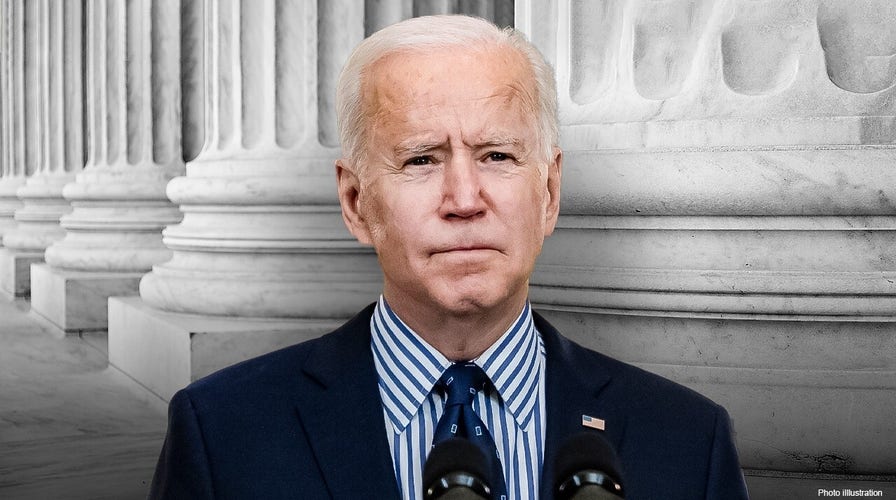
Biden admin's new steps in vaccination campaign could face legal hurdles
Fox News host Shannon Bream joins 'Your World' to weigh in on Biden's vaccine push: 'We'll see if it ends up all the way at the Supreme Court.'
This is a rush transcript from "Your World with Neil Cavuto," July 29, 2021. This copy may not be in its final form and may be updated.
CHARLES PAYNE, FOX NEWS ANCHOR: You're looking live at the White House, where President Joe Biden is set to make a series of announcements regarding COVID vaccinations.
He is expected to lay out new requirements for federal workers, get that shot or get tested. Why major U.S. companies and now members of the military are watching this closely.
Welcome, everyone. I'm Charles Payne, in for Neil Cavuto. And this is "Your World."
As we wait for the president, we will have FOX team coverage with former White House Press Secretary Ari Fleischer, Dr. Marc Siegel, former Health and Human Services Secretary Tom Price, Shannon Bream, and Andy McCarthy.
But, first, let's go to Griff Jenkins at the White House with a preview of what we can expect -- Griff.
GRIFF JENKINS, FOX NEWS CORRESPONDENT: Good afternoon, Charles.
We expect the president momentarily to lay out several new actions to help get more people vaccinated. Now, that list includes several items which are getting all federal workers to attest to being fully vaccinated, or they will have to wear a mask regardless of their geographic location and submit to a routine testing.
That is what a lot of people are calling the mandate. But in addition to that, we expect him to announce that he will instruct the DOJ to look into how and when they will add the COVID vaccine to the list of required vaccines for the military.
Plus, small and medium-sized businesses are apparently going to get reimbursed for offering employees paid leave for going to get vaccinations. And get this. He's encouraging state and local governments to offer 100 bucks to anyone who gets a shot. That would be paid for by existing money in the American Rescue Plan.
But, Charles, there's a lot of confusion for the president to clear up. Remember, he said he's against lockdowns, but yet he also said that, if you got vaccinated, you didn't have to wear a mask. Now you can't go into the White House without wearing a mask.
Now, when Peter Doocy asked the White House deputy press secretary, Karine Jean-Pierre, about the possibilities of lockdowns, she didn't rule them out, simply saying that they will continue to listen to the science and to the CDC -- Charles.
PAYNE: Griff, thank you very much. Let's bring in our panel, Ari Fleischer, former White House press secretary, Dr. Marc Siegel, FOX News medical contributor, Dr. Tom Price, former health and human services secretary, Shannon Bream, anchor of "FOX News @ Night," and Andy McCarthy, former assistant U.S. attorney and FOX News contributor.
Dr. Siegel, I have got to go to you first. What do you make of these new steps?
DR. MARC SIEGEL, FOX NEWS MEDICAL CORRESPONDENT: Well, I think the goal is to get more people to take the vaccine, but it's seeming more like the stick than the carrot.
I mean, there's not enough flexibility, Charles, to the idea that maybe people that got over COVID have antibodies. Maybe, after one shot, somebody had a side effect. Maybe somebody is afraid of vaccines and needs to be talked to.
So the mandate aspect of it is -- and I don't think legally there's a problem with the emergency use authorization. But people feel like there's a problem. So, there's that issue.
I definitely think federal employees should be vaccinated before the president starts ordering the rest of the country what to do. But I think the thing that they have done wrong from the beginning and they continue to do wrong is, they're constantly sounding condescending and bully-ish and shaming people into this, when the real way to do it is to say, protect yourself, protect your community.
PAYNE: Right.
SIEGEL: There will be less risk of this Delta variant if you get vaccinated. And they also have overdone it with the masks, by the way, because the science of the masks show that, if you're vaccinated, if you're not sick, and if you're vaccinated, you do not need a mask.
PAYNE: Shannon Bream, the legal implications here, it seems like this thing is ripe for a whole lot of court appearances.
SHANNON BREAM, HOST, "FOX NEWS @ NIGHT": Yes, we have already seen a number of cases.
Now we know a number of state employees or unionized employees are now talking about pushing back and exerting their rights. We have seen that from New York to California to a number of the top labor unions, who, of course, were on board with the Biden/Harris ticket. They were huge supporters financially and otherwise.
And now they are among those who are issuing these statements over the last couple of days saying, you can't just mandate things for our employees, many of them saying, we encourage our employees to get vaccinated, we are in support of the vaccinations, we think it's a good idea, but, as part of our collective bargaining, you can't just tell all of our people that there's going to be a mandate.
So I think unions are going to be a big headache for the administration as it tries to move forward, a huge ally for them, but now they're going to be speaking up on behalf of their workers, saying, we don't think the mandate is legit. You have got to come to the bargaining table with us.
We have already seen a number of lawsuits so far. They have been pretty successful for schools, for employers who want to mandate vaccines. We will see if it ends up all the way at the Supreme Court.
PAYNE: Ari, here's the thing, a lot of self-inflicted wounds.
Dr. Siegel talked about the mixed messages. I feel like, certainly now, there's a sense of frustration perhaps coming out in the White House. And that's not helping. I mean, someone who's on the fence, if you're hesitant in the first place, I'm not seeing anything in the recent communications that will make me feel more confident. Your thoughts?
ARI FLEISCHER, FOX NEWS CONTRIBUTOR: It just strikes me as one of those issues where, if the data starts to look bad, it's the government is hurrying up to do something.
And there are two somethings that can be done, I suppose. One is make people wear masks, which I think is a terrible idea. If you're immune -- immunized and you have got your shots, there really should be no reason to make you wear a mask. So I just don't get that entire push. It's counterproductive.
But on the vaccines, Charles, I look at it. I'm an employer. And if I had employees who were not vaccinated, it really would cause a lot of concern. I would worry about bring them in. I'd worry about having meetings. I'd worry that they're taking risks with their lives.
It's the same reason I'm worried about people playing Russian roulette. I hope people won't play Russian roulette with their lives. And so, therefore, I do think there is merit to employers, in this case, the federal government, saying, our employees need to be vaccinated. There's merit to that.
PAYNE: So, this is what the President Biden told our own Peter Doocy last year when he was asked about the vaccine mandates. Take a listen.
(BEGIN VIDEO CLIP)
PETER DOOCY, FOX NEWS WHITE HOUSE CORRESPONDENT: Do you think COVID vaccines should be mandatory?
JOE BIDEN, PRESIDENT OF THE UNITED STATES: No, I don't think it should be mandatory. I wouldn't demand it to be mandatory, but I would do everything in my power, just like I don't think masks have to be made mandatory nationwide.
(END VIDEO CLIP)
PAYNE: Dr. Siegel, I want to go back to you quickly. And that's because I took a look.
And, again, it's about the midst messages to a degree. Johnson & Johnson, their vaccine was paused on April 14. It was brought back on April 23. Coincidentally, the seven-day average peaked the day before that. Ever since then, it's been going down. It's gone down almost like a rock.
Between that and, again -- I know science evolves. I know this is a brand- new situation for everyone. But, again, it feels like sort of a sense of desperation, and feeling it out in the dark that is making a lot of people still wait on the fence.
SIEGEL: Well, I think the science is their, Charles. This vaccine is terrific and been given over 300 million doses safely. And I think that that's really clear, that the vaccine works, it's effective.
The reason it's not working as well right now is because there are more and more cases out there. And it's only about 85 percent effective against the Delta variant. That's not 100 percent. So you could still get sick. But it tends to be really mild.
One thing that government is really not doing, Charles, is they're not actually differentiating between one group and the next. It's all lumped together. Let's talk about health care workers for a second. I don't think health care workers should be on the wards with patients who are immunocompromised and not be vaccinated.
So, if they want to use the bully whip on this, that's who should get it. People like me should not be on the wards not vaccinated. Let's get tough with the health care workers first. What about CDC? What about HHS? Those health care -- what about people at Walter Reed? Those doctors and nurses need to be vaccinated first.
PAYNE: Right.
SIEGEL: That would set an example.
PAYNE: I want to bring in Bret Baier, host of "Special Report."
Bret, we have got the intersections of a lot of things there, obviously, the public health, public safety, individualism, people who are concerned about personal -- about what they want to do with their own body and control of their own bodies. You have got the unknown, some confusion, particularly with the messaging.
And it's created this cauldron that brings us to this place now. How do you see it all working out from here?
BRET BAIER, FOX NEWS ANCHOR: Well, listen, the administration -- Charles, good afternoon -- is trying to I think walk the line here and understanding the mandate and what they have said in the past, to say either these employees, federal employees, are going to get vaccinated and have proof of that, or they're going to make it fairly painful.
You're going to have to get tested twice a week. You're going to have to wear masks and social distance in your place of work. So I think that that's how they're trying to walk the line, although the Office of Legal Counsel has given them the authorization to go ahead and say, get vaccinated and mandate it in different places.
The other thing they're going to try to do, I think, in the speech is, President Biden will try to incentivize people to get the vaccine and will offer $100 to people getting the vaccine from money that they have already appropriated. So here we go with money trying to entice people to get the vaccine.
PAYNE: Right.
But, Bret, money hasn't really worked. These lotteries have not necessarily worked. And, by the same token, saying to unvaccinated people that you're murdering people, you're killing people, whether it's an off-the-cuff remark and not, that hasn't worked either.
So, again, you mentioned this delicate balancing act that the president's walking here. What happens next? I think a lot of people believe, if this doesn't work, if it doesn't move the needle sufficiently, we're going to go down that path where maybe there will be the federal government saying vaccination is mandatory for everyone.
BAIER: Listen, Charles, I think this is a really big moment, because, if the country goes back into that place where we were locking everything down, there wasn't a lot of data that supported any of that to begin with.
And they have not laid out all the data of where they are. As you said, the messaging and the communication on the specifics has been lacking. You look at other countries. You look at Great Britain is starting to get over this Delta variant, it appears, at some places. Israel is now doing a booster shot for all its elder citizens.
So where are we going to be? I don't know. But this is the start of what could be a tough couple of months.
PAYNE: And I want to get your reaction here.
Former Assistant HHS Secretary for Health Admiral Brett Giroir, he was on FOX earlier today with this warning. Take a listen.
(BEGIN VIDEO CLIP)
ADM. BRETT GIROIR, FORMER U.S. ASSISTANT SECRETARY FOR HEALTH AND HUMAN SERVICES: Delta is really a new strain that is different than everything we have seen. So, I am real concerned that natural immunity, although real, is not going to be sufficient against Delta.
And if you don't have natural immunity, and you're not vaccinated, you're going to get Delta.
(END VIDEO CLIP)
PAYNE: So, Dr. Price, I want to bring you in. What do you make of that?
TOM PRICE, FORMER U.S. HEALTH AND HUMAN SERVICES SECRETARY: Well, I think about Dr. Giroir is accurate, in that you're at much greater risk of getting the Delta variant infection if you haven't been vaccinated.
But a couple of the folks on this panel have suggested that we ought to be following the science. And if you follow the science, it will tell you exactly what you need to do.
The reason that I think folks, some folks, are having difficulty getting the vaccine themselves, saying, yes, it's a good idea for me, is because the administration hasn't shared the science, that it's imperative that we talk about, if you get the Delta, if you are unvaccinated, and you get infected, you're much more likely to be part of those individuals that are going to create a new variant.
And science knows that extremely well. But to just say that everybody has to get the vaccine, and you have got to wear a mask regardless of where you are, which it looks like that's where we're headed, doesn't make any sense. And it's not targeted. It's not smart. It doesn't listen to the science.
And that's what we ought to be doing.
PAYNE: This -- in the beginning, though, the onus was always on the science.
So, Dr. Price, why would they hold back that very key? You're saying that's the linchpin. It seems like it would be pretty easy to share that with the American public.
PRICE: Well, it's -- much of it isn't known yet, because we're so early in all of this.
But then don't say that you have got the science and -- behind you, and then make policy because of it. We need to be honest with the American people. We need to talk about what we do know and what we don't know. The American people are smart.
PAYNE: Right.
PRICE: They can figure this out. But if you try to scare them, if you try to intimidate them into doing what needs to be done, then that's when they get stiff-armed.
PAYNE: Bret?
BAIER: Well, I just want to say one thing about following the science.
Peter Doocy in the press briefing today in the White House had a great question. And he said, why is it that the federal government is asking vaccinated Americans to wear masks to stop the spread of COVID-19, but, at the same time, federal agents are releasing COVID-19-positive border crossers into small towns in Texas?
So, if following the science is really where this administration is, its policy along the Southern border is really in question.
PAYNE: Yes.
Shannon, I want to ask you about that. We have got to talk about this, because a large part of this dark cloud of our all of this is politics. And it feels like, if you look across the media, there's villainizing people who live in red states, villainizing registered Republicans.
And yet, when I look at some of these polls, for instance, a YouGov poll 23 percent of independent voters say they're not going to take the vaccine. According to Gallup, 31 percent of independent voters say they're not going to take the vaccine.
So this sort of finger-pointing at a certain group of Americans and saying that they're harming the rest of the nation, how much is that hurting the cause?
BREAM: Yes, I think that along with what's going on at the border puts together quite a stew that does turn very political.
We saw Texas Congressman Chip Roy yesterday on the House floor saying, I'm trying to meet with elected officials and I'm meeting with groups who are trying to cut down on trafficking of human beings at our border. We have got people being released, as Bret said, without knowing their status or knowing that they're COVID-positive, into all kinds of Texas communities.
You have got Democrats, you have got law enforcement officials and Republicans all over Texas saying, if you are serious about stopping this virus, you have to help us at the border.
So, when you have Chip Roy going to the floor saying, OK, now the speaker says we have to put our masks back on in the House buildings because of the guidance from the physician there, and yet what's happening at our border is happening, people lose confidence in the messaging of the administration, because it seems incongruent. For them, it doesn't match.
So I think that most Americans, as we have seen over the last year-plus, are willing to step up and do things like wear a mask, get vaccinated, do special things with their kids, with the elderly, whatever they think needs to happen, if they think their leaders are in it with them.
When they see them leaving their kids unmasked at a camp or going to a restaurant or getting their hair done without wearing a mask, all of those things, or they look at the border, it creates a political problem, a perception problem, and a messaging problem for this administration.
PAYNE: Right.
Andy, a couple of days ago, Representative Massie of Kentucky, Republican out of Kentucky, introduced legislation to prohibit mandatory vaccinations of members in the military, of our armed services. There's a lot of folks who are concerned. There's a lot of pressure on the left trying to get the administration to make it mandatory for folks in the military.
Of course, Massie and others are pushing back. This is just one of major legal obstacles that are out there. What do you make of them all?
ANDY MCCARTHY, FOX NEWS CONTRIBUTOR: Well, look, Charles, the history of the United States is that the courts, during a period of crisis, give a very wide berth to the executive branch to deal with it.
And, generally speaking, what happens is, where you have these tense civil rights disputes, they don't really get resolved in favor of liberty until after the crisis has passed. And that may create norms for the next crisis. But in the here and now, I think the courts are going to give the administration a very wide berth.
We saw a case, I guess it was about a week ago, where the University of Indiana, their vaccine mandate was upheld against students who wanted an exemption. And what the court basically said -- and this was a Trump judge in Indiana, a federal judge who made this ruling -- what they basically said is, look, getting -- preventing getting a vaccine or refusing to get a vaccine is not a fundamental right.
The Supreme Court jurisprudence that goes back to the beginning of the 20th century, that holds for that proposition. And as long as they have exemptions in there for things that are fundamental rights, like if you have a religious objection to getting a vaccine, the courts are going to uphold these mandates.
Now, that doesn't mean they're a good idea. Policy-wise, we can argue it until the cows get home. But I don't think the courts are going to stop the executive branch from imposing mandates.
PAYNE: Today, White House Principal Deputy Press Secretary Karine Jean- Pierre, she was asked about how businesses could respond to today's announcement. Let's take a listen.
(BEGIN VIDEO CLIP)
QUESTION: Do you believe that the president's announcement of today, is one of the goals of this to spark more private businesses to follow suit, as we have already seen in the last coming days?
KARINE JEAN-PIERRE, WHITE HOUSE PRINCIPAL DEPUTY PRESS SECRETARY: Well I don't want to get ahead of the president's announcement. But like I said when talking about today, the federal government, we see ourselves as a model for other -- for other companies and other organizations.
(END VIDEO CLIP)
PAYNE: Ari, we haven't talked about the economy.
This morning, we saw two major economic misses. We saw 400,000 Americans file for initial jobless claims. That numbers should have been significantly below there at this particular point. And the GDP, the report card on our economy, for the second quarter came in woefully below estimates, I mean, really shocking.
And now we do have some businesses, Google, Facebook, Netflix, BlackRock, and others, who are following the government's lead. But we're going back down a path that -- and Bret kind of brought it up -- where more restrictions and even lockdowns, it's hard to fathom we could survive that economically.
It's a miracle that we did the first time. Your thoughts?
FLEISCHER: Well, I think you have to draw a distinction between two issues, one, again, meritorious vaccines, and, two, absolutely nonmeritorious shutdowns.
In order to prevent even anybody from getting into the shutdown debate, lockdown debate, I do think it makes sense for employers to follow the lead. Federal governments do lead on these issues. Private sector then does follow about trying to enhance the number of people who are vaccinated through whatever means employers have.
But when it comes to lockdowns, Charles, I can just simply predict to you, if anybody in the Biden administration, particularly the president, tries to go down that road of lockdowns again, there will be a rebellion. Businesses will not do it. Restaurants will not do it. People will rebel against their governors if they're ordered to shut down again.
This country is exhausted from it. And there's really no evidence that it did the trick, that it solved the problem. And now that we have so many tens of millions of members Africans who have been immunized, who've gotten their shots, why should they suffer?
PAYNE: You know...
FLEISCHER: So, I think it's perfectly appropriate, push on the vaccines. Never again are the lockdowns.
PAYNE: Right.
To that point, though, Bret, this will maybe give the White House more ammunition to push that $3.5 trillion spending bill through.
(CROSSTALK)
PAYNE: Listen, the veneer -- the veneer of emergency, the veneer of we have got to do something now has always been part of the sales pitch. It got the $1.9 trillion across the finish line.
We already saw where these evictions -- the moratorium on evictions have been kicked down the can -- that can has been kicked down the road once again.
BAIER: Yes.
PAYNE: And so, I mean, what do you make of that?
BAIER: Yes.
PAYNE: That maybe this might be the one thing that pushes that through, where you get -- you only have two Democratic senators on the fence. Maybe this gets it through.
BAIER: Well, that's what they're hoping.
But critics of that package, Charles, say it has very little to do with anything COVID or, frankly, stimulative. And it's a lot of long-term projects that really don't put a lot of money right away into the economy.
And not only that, but the economy, as you know, is doing pretty good on its own, churning its own. And there's a lot of concern about dumping again a lot of money into it.
And then the last argument on that is that, if you're talking about COVID and shutdowns or affecting the economy by something that COVID is doing, the $1.9 trillion has not been spent yet. And the Fed still has this loan program that has not been tapped into by a lot of different places.
So, there's all kinds of money out there. But the question is, are they going to make the case that this is the thing that the $3.5 trillion is going to be sparking?
PAYNE: Well, they're going to try to make the case. We will see if they do it effectively. And, again, it does help when you have major corporations jumping on board as well.
And we're talking already, Google, Facebook, Netflix, BlackRock, Morgan Stanley, Lyft, Twitter, and then some companies are going back with mandatory masks, of course, all the Apple retail stores, Disney theme parks.
So it feels to me, and, Bret, if they can get the court corporate America on board with this as well, it does make it more of an emergency. And, again, I don't know. They have to convince just two, maybe just two senators, two people who we both know could be on the fence here.
BAIER: But, I mean, tying that $3.5 trillion package to COVID emergency is a big stretch.
And the two senators in the Democratic column, Kyrsten Sinema and Joe Manchin, are concerned about the national debt and the deficit and blowing through everything that we have going forward. So, unless you make a direct tie that somehow the economic slowdown that we will likely have if everything shuts down or slows down because of this Delta variant is tied to that $3.5 trillion, I think it's a stretch to get that across the finish line.
PAYNE: All right, Shannon, let me come back to you, because everyone's waiting.
We're also looking for tone. We talked about the messaging sort of being back and forth a little bit. But I think tone is going to be extraordinarily critical, and, again, a lot of people who are upset that they -- the fingers have been pointing at them.
A lot of people feel that their civil liberties are at stake here. What kind of tone does President Biden have to present in just a few moments to get more people to say, OK, I will get off the fence and get the jab?
BREAM: Yes, I think that that was such a big part of his campaign is, I'm a different tone than the last president, and I'm going to be a uniter, not a divider. He talked about that, about bipartisanship, about working across the aisle, about being the president for all Americans, as we want any new president coming in to say and to do.
But a lot of folks are pointing to his actions as president and some of the things he said as president that do feel divisive. They don't feel like they bring the country together on something like this.
It was just a couple of days ago he made a comment to someone asking a question, if you're not vaccinated, you're not as smart as I thought you were or you're dumber than I thought you were.
So...
PAYNE: President Biden speaking right now.
Sorry, Shannon.
The president is going to speak right now.
Content and Programming Copyright 2021 Fox News Network, LLC. ALL RIGHTS RESERVED. Copyright 2021 VIQ Media Transcription, Inc. All materials herein are protected by United States copyright law and may not be reproduced, distributed, transmitted, displayed, published or broadcast without the prior written permission of VIQ Media Transcription, Inc. You may not alter or remove any trademark, copyright or other notice from copies of the content.
