


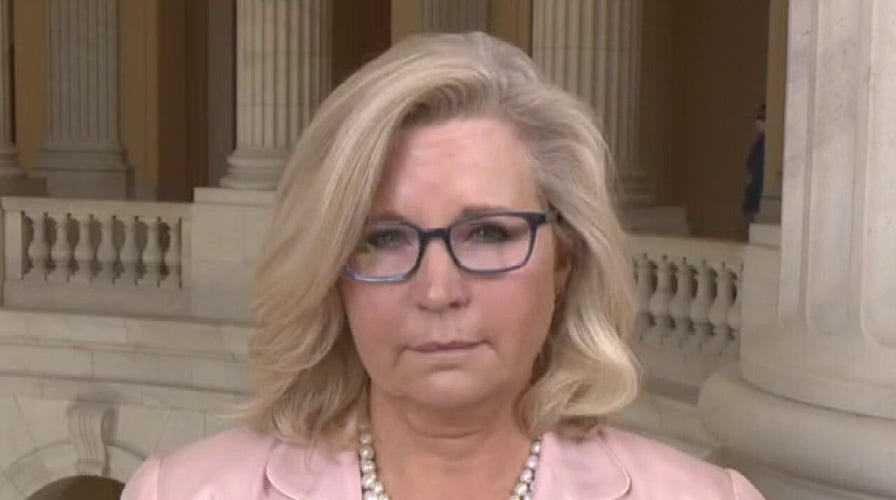
Liz Cheney slams 'indefensible' situation in Afghanistan
Wyoming Republican weighs in on the Biden maintaining August 31 deadline to get Americans out of Afghanistan on 'Your World'
This is a rush transcript from "Your World with Neil Cavuto," August 24, 2021. This copy may not be in its final form and may be updated.
NEIL CAVUTO, FOX NEWS ANCHOR: We are continuing to monitor Jen Psaki at the White House here.
Just to bring you up to speed on what's going on, the president's committed himself to getting all our personnel -- that includes the 6,000 troops right now in and around Kabul -- out by a week from now, the end of the day on the 31st of August.
All of this occurs at the same time the administration has reminded us that they can get a lot of people out every day, each day. At the pace we're running right now, in the last 24 hour period, some 21, 700 people have left Kabul in that period. They include Americans and Afghan nationals.
We're also learning that, since August 14, they have put a number to the total who have left in that period at close to 60,000, 58,000, a little north of that.
Welcome, everybody. I'm Neil Cavuto. And this is "Your World."
A couple of startling developments here. We're waiting to hear from the president of the United States in about 20 minutes from now.
Apparently as part of a conference, a virtual conference, with G7 leaders, he was explaining his mission to get everyone out -- and that includes our troops -- by next week at this time, because of the feared terror threat to our troops who are there, that Al Qaeda or other elements could do something to disrupt that. And he didn't want to risk that.
But he's run into a whole blitzkrieg of criticism from European leaders, who said that he's leaving many, many people stranded.
To that end, there has been a warning put out by the Taliban that says you can go ahead and evacuate Americans, but some of these other players, that's a whole 'nother matter.
Quoting here: "We are asking the Americans, please change your policy and don't encourage Afghans to leave." Similarly, the policy address is to the point that, if you try to do that will not be looked at favorably.
Now, another -- a number of European leaders, including Boris Johnson, had been pushing the president to extend that deadline. But, again, he is refusing to do so and thinks that enough people can come out of there that, if you want out of there, you will get out of there.
But what is not clear is who exactly is getting out of there and how many are Americans or how many are Afghan nationals who've helped Americans and helped our cause there in the past 20 years.
The real read here -- and this is where it got a little confusing with Jen Psaki -- is that we will do this based on the achievement of an objective. If that objective is to get Americans only out, their goal is to make sure it's complete by next week, as well as the number of troops.
But it is now meant to extend to Afghan nationals or those holed up in their homes afraid to leave, because they're thinking that, if they were to leave and they were to get to the perimeter around the airport, harm would come to them, no such clarity there.
Let's go to Jacqui Heinrich at the White House on the balance that the president is trying to push in this much-delayed remarked to the nation.
What are we learning on a little this, Jacqui?
JACQUI HEINRICH, FOX NEWS CORRESPONDENT: Well, Neil, one thing I want to point out that I was just listening to in that press conference with White House Press Secretary Jen Psaki, she was asked, if we have to maintain this August 31 withdrawal deadline, does that mean the evacuation flights need to end sooner, enable -- to be able to give our military time to get their own people and weaponry and machinery out of there?
And she said yes. That being said, she was pressed on that for a little bit more detail. The obvious question is, well, when do you stop those flights? She did not want to go into any more operational detail with that.
So we're looking to what the president has to say later on this afternoon. His remarks have been delayed a few times today. But the White House did released that statement outlining what he told the G7 allies in his virtual meeting this morning.
It appears he's keeping the door open somewhat to extending the August 31 deadline. And I really want to put air quotes around that somewhat, because this is what the statement said.
"The president conveyed that our mission and Kabul will end based on the achievement of our objectives." It later goes on to say: "We're on pace to finish by August 31."
The statement also makes clear that each day of continued operations in Afghanistan, our troops are facing an increased threat from ISIS, and it notably states that completion of the mission by August 31 depends on the continued cooperation with the Taliban, including continued access for evacuees to the airport.
The White House also says the president and -- or asked the State Department of Pentagon for contingency plans to adjust this August 31 timeline if necessary. But what those contingency plans look like is a really big question mark.
Officials at the Pentagon have told our reporters, to adhere to that August 31 withdrawal, the military would need to start pulling out at least beginning on Friday. This morning, the Taliban drilled down on their so called red line, saying that no extensions would be allowed.
They also said the U.S. should not encourage -- quote -- "Afghan elites" to leave the country, people like doctors and engineers and educated folks, the spokesperson for the Taliban saying, we need them here. They also announced that Afghans currently at the airport should return to their homes.
So it is very unclear just how much access the Taliban is going to allow at the gates. Meantime, it's also unclear how many Americans are left in the country. The State Department and Pentagon have not given clear numbers on how many are left.
There was a leaked cable that was first reported by Politico out this morning. It placed that estimate around 4, 300 Americans. Of course, we're still waiting on like the official update from that. But that is very far below the roughly 11,000 Americans believed to be in Afghanistan as of last week, when we heard from the White House.
So, looking for a lot more detail on exactly who's left and what we're going to do to bring them home, because this just seems to be evolving. And there are a lot of different answers at the same time, seeming to conflict with each other, Neil.
CAVUTO: Yes, to put it mildly.
Jacqui, then does it mean that if there were Americans still there and still hoping to get out, but here you are at the witching hour on the 31st, and they can't get out, that the administration is open to extending that deadline, or does that look like an immovable date?
HEINRICH: Well, a lot could happen.
CAVUTO: Yes.
HEINRICH: I mean, remember, we have the CIA director talking to the Taliban. I mean, maybe they strike a deal. And who knows what that entails to allow that to happen. But maybe they strike a deal and they're allowed to push that a little bit.
Maybe there's some event between now and then that really throws all this off-course. We have been talking so much about a potential -- a very real ISIS threat, a mass casualty event, potentially.
So, looking -- a lot of different things could shake this up. Hope, day by day, you get updated answers and hope for the best, but to say that it's a tenuous situation is putting it lightly.
CAVUTO: That is exactly right there.
Jacqui, thank you so much for that.
I want to go to Jennifer Griffin at the Pentagon.
Apparently, the impetus behind this was this serious terror threat or, at least as the president viewed it, Jennifer to our troops already there. Do we know much more about this and what made it coalesce around the 31st?
JENNIFER GRIFFIN, FOX NEWS NATIONAL SECURITY CORRESPONDENT: Well, Neil, there has been a threat to our troops from the moment that they landed at the Kabul Airport and returned to Afghanistan after pulling out.
That, we know. We know there are intelligence reports that ISIS would like to strike at the airport. But that is not what caused the August 31 deadline. That deadline was announced by President Biden previously.
And the reason that the White House is tiptoeing around whether they can get all Americans out by August 31 is that the military is going to have to start drawing down soon. We have just learned from the Pentagon that, as of now -- as of now, approximately 4,000 American passport holders have been evacuated from Afghanistan.
That means that thousands more could still be left. And they have less than a week to get those Americans out. Now, FOX News has learned that the withdrawal of U.S. forces from the Kabul Airport has already begun and that the number of U.S. troops at the airport has already been reduced.
Pentagon officials won't tell us what they told the president about staying beyond August 31. But, as you heard Jacqui say, the White House asked for contingencies if Americans need to be rescued after August 31.
It was clear at the Pentagon briefing this morning the decision to leave by the deadline has already been taken.
(BEGIN VIDEO CLIP)
GRIFFIN: Sounds like you're still working on an August 31 deadline.
JOHN KIRBY, PENTAGON PRESS SECRETARY: We're absolutely still aiming towards the end of the month.
(END VIDEO CLIP)
GRIFFIN: Now in a race against the clock, 37 U.S. military planes took off in the past 24 hours, 32 C-17s and five C-130s; 21, 600 people were evacuated, among them, nearly 9,000 people on civilian aircraft.
But that pace is going to be difficult to sustain. The reality of the massive heroic -- historic -- excuse me -- airlift with military planes now landing and taking off every 45 minutes is bumping up to the reality that time is running out on the ground.
The Taliban announced publicly after a secret meeting with CIA Director William Burns in Kabul Monday that it would not extend the deadline. Already, the Taliban has begun tightening the noose around the airport, stopping Afghans and even those with American passports from getting to the airport.
(BEGIN VIDEO CLIP)
GRIFFIN: When does the U.S. military have to begin making those preps? When does that decision have to be made?
KIRBY: Roughly speaking, you need at least several days to get the amount of forces and equipment that we have at the airport, to get that safely and effectively retrograded.
(END VIDEO CLIP)
GRIFFIN: Press Secretary John Kirby was asked about U.S. Marines guarding the U.S. Embassy.
But officials told us those forces have already withdrawn.
(BEGIN VIDEO CLIP)
QUESTION: We're talking about pulling all the troops, where you go to zero at the embassy. Is that correct?
KIRBY: That is correct.
No, I followed the question. That's correct.
(END VIDEO CLIP)
GRIFFIN: So, right now, there are no U.S. troops guarding that $800 million embassy.
Chairman of the House Armed Services Committee Congressman Adam Smith was briefed by Defense Secretary Lloyd Austin and General Mark Milley during a classified briefing on Capitol Hill today.
(BEGIN VIDEO CLIP)
REP. ADAM SMITH (D-WA): I'm very confident that we will get as many as it is possible to get out. All, that's going to be very, very difficult. And I did ask about the 31st deadline. That is still the goal.
And I was very specific. You need to have a plan to go past the 31st. And they assured me that they do.
(END VIDEO CLIP)
GRIFFIN: But, as we have reported, there remains a very serious security threat from ISIS inside Afghanistan. That means, if the U.S. wants to operate in Afghanistan after August 31, they will need the permission of the Taliban -- Neil.
CAVUTO: So, Jennifer, if I can get this straight, when they say they get all Americans out, they are saying all Americans, right?
When they say all out, are they talking about Americans, or is the preference right now, because we're told that some of the -- getting the troops out, the 6,000-plus troops who are there, that could start as soon as the next 48 hours.
So, which is it?
GRIFFIN: Well, we're reporting that the troop withdrawal has already started.
So you had a high of 5, 800, about 6,000 U.S. troops. That's already starting to be retrograded. They have to do that in order to keep on a timeline to be out within a week.
CAVUTO: Understood.
GRIFFIN: But what they are promising and what the president has promised that any American citizen who has a passport, any American citizen will be -- they will get them out.
But how they're going to do that before August 31, they don't even know how many are in the country. So that's why the president has asked for contingencies from the Pentagon for what they would do after August 31 to get those American out -- Americans out. And that's going to require coordinating with the Taliban.
CAVUTO: But, again, it's -- the focus is on getting Americans out, not these Afghan nationals or those who worked with Americans, right, that seems to be more of the focus? Am I reading that correctly?
GRIFFIN: Absolutely. It's gone down to right now the State Department has basically said that Americans with passports, green cards or SIV documents in hand, visas in hand, they should make their way to the airport, but anyone else should not -- should not come to the airport at this time.
CAVUTO: So, if you don't have paperwork, you don't have these visas, you don't have anything special in writing that warrants you being at that perimeter or trying to get through that gate, perimeter, or whatever they're calling it to get to the airport, you're not going to?
GRIFFIN: Well, the Taliban have said they won't let Afghans leave the country. They want -- they don't want the brain drain.
And so they have agreed to let Americans with passports and visas come through their checkpoints. But even that, we're hearing reports that they're turning people back.
So, it -- again, it is all dependent on the Taliban.
CAVUTO: All right, so, just to be clear -- I'm sorry to keep badgering on this, but it's a numbers point to me now.
I'm curious, because we would seem to have, even with the drawdown of troops already, more troops than we do have Americans left who are seeking flight from Afghanistan.
GRIFFIN: It's a very fluid number.
But I would say, based on -- if you take the Pentagon and State Department at their word that there were about 11,000 Americans at the start of this process, and they have gotten about 4,000 out, that still leaves several thousand Americans left.
CAVUTO: Yes.
GRIFFIN: Not all of them may want to leave. The State Department can't force them to.
But if you're American, if you have a passport, if you want to leave, the U.S. military is committed to getting you out.
CAVUTO: Got it.
Jennifer, thank you very much for all of that great reporting, as usual.
To Lieutenant General Richard Newton, a former U.S. Air Force assistant vice chief of staff.
General, the 31st, and getting every American wants out by then, and leaving it open as to any friend of America who wants to get out by then, how is all this going to go down?
LT. GEN. RICHARD NEWTON (RET.), U.S. AIR FORCE: Well, good afternoon, Neil, again.
Boy, lots to unpack here, and great reporting by Jennifer. Again, the Taliban own all the cards. They own all the cards pertaining to the ground. They own all the cards pertaining to their strategic messaging and their information operations campaign, if you will.
They also now appear to own all the cards regarding this deadline of 31 August that president of the United States, again, instituted, if not some weeks or so ago, but has now put the United States in a position where we're backing -- we're within a week now, Neil, of that 31 August date.
And so this is an extraordinary situation. And if I may, let me segue also to a point. As Jennifer said, if the number was 11,000, yes, my numbers are between 11,000 and 15,000, but let's say we still have 7,000 to 10,000, Americans still waiting to be evacuated.
We also have tens of thousands of Afghan partners who have stood by us, those Special Immigrant Visa holders. But, also, don't forget our allied partners who have been with us since the beginning of Operation Enduring Freedom back in October 7 of 2001.
So not only is it the United States. Not only is it our Afghan partners, but it's also our allies who've been standing by us and also been spending blood and treasure alongside us. So very, very difficult, extraordinary situation. I have never seen this in my 34 years on active duty, certainly.
CAVUTO: Is it your sense, then, General, that the Americans who want to get out, they might have a shot of getting out, but anyone who is not American is simply not getting out?
NEWTON: Yes.
CAVUTO: Forget about how many of the next wave might be non-Americans, but that it doesn't matter; at this point, it's not happening?
NEWTON: My sense is, we're getting dangerous close of closing that chapter.
And my hope is -- and, by the way, hope is not a strategy. My hope is that we do not leave any American behind. But I believe we should also be just as fervent of not leaving behind any of those Afghan partners who stood by us, by the way, and who have done incredible work supporting the United States.
And this withdrawal, again, is -- again, it boggles my mind in terms of why this is even unfolding. This has all been really induced by the administration, and now leading up to this deadline doesn't make any sense.
And if the president and the administration is trying to be risk-averse and more risk-averse, by creating this false deadline, in my view, is actually creating more risk. Jennifer mentioned the airlift operations.
This is the second most busiest consequential airlift we have had in our U.S. history, other than the Berlin airlift, C-17s and C-130s and other aircraft taking off every 45 minutes. That is a daunting task, in and of itself, that the United States Air Force and our military, military men and women there are making look easy.
I don't want to say that it is easy. But that is a tremendous strain that has been put on the shoulders, again, of our military, that our policy- makers now with this 31 August date has really created -- we have really painted ourselves into a corner.
CAVUTO: Yes, a very, very tight corner, at that.
General, thank you very, very much, and more, sir, for your incredible service to this country, as I always like to remind people, even though you never do.
But, General, thank you again.
I want to go to Congresswoman Liz Cheney right now, sits on the House Armed Services Committee.
Congresswoman, thank you very much for joining us.
Apparently, we're told that the August 31 deadline grew to be something the president could not wiggle from because of the concern of a terror threat against our troops. Al Qaeda comes to mind.
What do you think of that?
REP. LIZ CHENEY (R-WY): I think that it is an inexplicable and indefensible situation that President Biden has put us in.
There's one message that the Taliban should be hearing from the United States of America. And that is, if you do not allow us right now to withdraw every person we need to get out, every American, every Afghan who helped us, you will face consequences that will be more severe than you can imagine.
That's the message the Taliban should be hearing. Instead, we are in a situation where we have watched over the last week. You have had prisoner releases that include, for example, external operations teams that have been released. These are Al Qaeda teams that are specifically focused on attacking the United States of America.
So, across the board, this decision that President Biden has made to withdraw from Afghanistan, and the way that it's been implemented, has really increased the threat to the United States and has put us at risk in ways that are hard to calculate, frankly, right now, Neil.
CAVUTO: Now, the drawdown in troops occurs already, as you know, Congresswoman, when we are trying to effort people out of the country, and it complicates things and maybe slows that down.
But in the rush to get out, are you concerned that many Americans could still be left behind, and that there's no plan B to get them? The administration seems to be hinting that they could push that deadline back, even though they're not saying it as much.
But it appears very unlikely.
CHENEY: I am -- I'm deeply concerned about that, Neil.
We have got, it seems to be, thousands of Americans still left in Afghanistan. And they're not all in Kabul. They're all over the country. And the fact that the administration right now is rushing to get out and is counting on the Taliban -- and the other thing that Congress is going to need to investigate is the extent to which we have been making concessions to the Taliban over the course of the last several weeks.
The treaty that was negotiated, the agreement that was negotiated last year, in my view, was a surrender agreement under the Trump administration by Secretary Pompeo. It set this in action. It set this in motion.
But President Biden bears direct responsibility for what is really a catastrophic decision that is going to put us at risk and in ways that we have not been since before 9/11.
CAVUTO: Now, the Taliban has made it very clear, Congresswoman, as you know, that they don't want any more Afghan nationals leaving or even thinking of leaving, conveying that we are not going to allow Afghans to leave and we will not extend the deadline for them to leave, indicating again and again this is about Americans leaving, and no one else.
What do you make of that?
CHENEY: Look, first of all, I do not believe that we will be able to get all of the Americans out by August 31. I think it's very clear that we are not on a path to do that, despite what the White House is saying.
Secondly, this -- none of this had to happen, Neil. We had 2, 500 forces on the ground maintaining a counterintelligence presence, maintaining a counter-terrorism presence. The Afghan forces were bearing the brunt of the fight. We were working with them.
And we were preventing the Taliban from gaining an entire country as a sanctuary from which their allies, Al Qaeda, the other terrorist organizations like ISIS-K, the Haqqani Network, which now seems to be responsible for security in Kabul. All of those terrorist organizations which want to attack the United States now have an entire country as a sanctuary, thanks to this withdrawal that we have seen President Biden order.
CAVUTO: Now, we don't know what transpired, Congresswoman, with the head of the CIA talking to the Taliban leader here.
But we're left to leap to possibilities, like whether the Taliban had conveyed, we can't control what Al Qaeda does and some of these other elements within the country. It's best that you leave, and leave by the 31st.
What do you think happened in that meeting, so where we're at the point we are, where we're leaving on the 31st, end of story?
CHENEY: Look, we have now for many years had people in our government in - - across many administrations now think that the Taliban are somehow a partner for peace, think that we can negotiate with the Taliban, try to convince the American people that the Taliban is separate from Al Qaeda.
We heard that from the Trump administration. We heard that from the Obama administration. We're hearing it now from the Biden administration. It's simply not true.
The head of the Taliban has pledged allegiance to the head of Al Qaeda. They absolutely fight hand in hand. You're watching this Badri 313 organization, the special forces for the Haqqani Network, now seems to be in control of security in Kabul.
The idea that we have gotten ourselves into a position where we are actually pleading with the Taliban to provide American security is catastrophic. And we're seeing the consequences and the damage to U.S. power and strength around the world, the damage that it's doing to our military, the damage that it's doing to our relationships with NATO, not to mention the Afghans who have been fighting with us who we are now leaving behind, is immeasurable.
And we will be working for many, many years to undo the damage that's been done now in the last several weeks.
CAVUTO: Congresswoman, what did you make of the president's claim that this was something that he inherited, that had President Trump had things his way, we would have been out of there in May, and we were dealing with a different numbers, different situation?
Here, now, we're talking about the end of August, later than the former president would have envisioned. What did you make of all that?
CHENEY: Look, I was clear at the time I think that President Trump, Secretary Pompeo's determination to negotiate with the Taliban -- Secretary Pompeo was the first secretary of state to meet with the Taliban -- that was a huge mistake.
The document they signed was a surrender agreement. That document required concessions, including the release of 5,000 prisoners. It completely eliminated, set aside the Afghan government, didn't allow them to participate. That was a huge mistake, and one that emboldened the very terrorists that we now find threatening our people on the ground.
But President Biden did not have to go along with it. President Biden reversed many decisions that he disagreed with that President Trump made. And, ultimately, he's the commander in chief, and he made the decision to withdraw our forces, to do it in the way that it's being done now that is just absolutely shameful and will certainly heighten the terrorist threat to the homeland, will certainly make it much more difficult for us to defend ourselves, and for us to get our allies to trust us and our adversaries to fear us.
CAVUTO: Congresswoman, I'm sure you're aware that President Trump in a number of interviews has said that this would not have happened if he were in charge.
What do you think?
CHENEY: Well, look, he set this in motion.
He began the process of negotiating with the Taliban. He said many times the Taliban was going to kill terrorists on our behalf. He praised the Taliban. He apparently wanted to invite them to Camp David. So, he fundamentally misunderstood the situation the ground, and did real damage to our partners, the Afghan government, by excluding them from those negotiations.
So the idea that you could sit at a table and negotiate with the Taliban, count on them to defend our security is wrong. And we heard a lot of things from President Trump and Secretary Pompeo that were wrong.
But, again, President Biden is the commander in chief right now. And he's the one who made the decision to withdraw now and to do it the way he's done it. And he bears certainly the brunt of the responsibility for what's unfolding on the ground.
CAVUTO: I'm sure -- if you will indulge one more question, Congresswoman - - the Taliban seems to be sending a signal, we're a different Taliban, we're not the same Taliban from 20 years back.
Do you believe that?
CHENEY: Well, they're stronger.
They aren't the same Taliban. They're stronger. They now have significant sources of U.S. military equipment, including potentially military equipment that's got classified information that could now end up in the hands of adversaries like the Chinese. And they now control an entire country.
So, they are stronger. They have learned. And they now also are able to say that they have defeated the United States. So, we have deployed forces in Afghanistan for two decades. The men and women who deployed there kept us safe. They prevented future mass casualty terrorist attacks from Afghan soil.
But now, on the verge of the anniversary of 9/11, the Taliban are basically calling all the shots in terms of whether we can even get Americans safely out of Afghanistan.
President Biden needs to say very clearly and very directly that they will suffer severe consequences if we are not able to get every single American out of Afghanistan. That's the message they have got to hear. And, so far, he's been delivering a message that is exactly the opposite of that one.
CAVUTO: You mentioned that we have not been attacked since 9/11, maybe because of our presence in Afghanistan.
Now that the Taliban rules the show, and soon we will be gone, do you think the prospect of an attack on the United States is real?
CHENEY: It is. Unfortunately, Neil, it's real. The possibility is heightened. We have heard many of our military leaders say that.
One of the things that we knew after 9/11 was we had to prevent terrorists from having safe havens. We had to prevent them from having sanctuary. And that's why it was so important for us to have forces on the ground working with the Afghans, so that we could, in fact, help to prevent the Taliban from taking over the country.
We have now -- the Biden administration has handed the Taliban an entire country. They're going to declare a caliphate. They may already have declared a caliphate. They're going to be welcoming other terrorists into Afghanistan to train.
They have released terrorists from their prisons who will populate terrorist movements around the world. This step has made us significantly less safe and has increased the cost both in lives and treasure that we are going to have to pay in order to keep us safe into the future.
So, it is -- it's really -- it's really a calamity all around.
CAVUTO: Liz Cheney, thank you for joining us. I appreciate it.
CHENEY: Thank you, Neil. Good to be with you.
CAVUTO: Same here.
All right, let's go to Representative Susan Wild, the Democrat of Pennsylvania, sits on the House Foreign Affairs Committee.
She led a bipartisan letter to President Biden calling on him to extend that deadline, start discussions with NATO about how we deal with the goings-on at the Kabul Airport. Kind enough to join us.
Congresswoman, what reaction did you get from the president?
REP. SUSAN WILD (D-PA): I haven't received an immediate reaction.
But I will tell you that I think the president has probably been deluged with requests that we stay beyond August 31. I think it's really important to note that our letter, which went out yesterday -- it had been in the works for several days -- is a bipartisan letter.
It was signed on to by Representative Don Bacon, a former Air Force general. And he obviously knows firsthand the importance of keeping our promises to our allies.
So, with that said, I think that the president has certainly received these messages from many of us who have asked that the presence remain beyond August 31. We had a classified briefing earlier, which you have referred to earlier in your show.
And it was clear that the consensus of Congress on both sides of the aisle was that we should stay in Afghanistan as long as it's necessary to get the job done. I think the real question is, how do you define getting the job done?
And if you will indulge me for just a moment, I want to clarify the number of Americans who are believed to still be in Afghanistan. We know from the briefing we received and from what we have heard before that Americans are asked to register with their embassy when they go into a foreign country and to unregister, so to speak, as they leave a country.
That often does not happen. And so it's very -- it's almost impossible for the U.S. to keep track of how many American citizens are in every country, unless those citizens voluntarily comply with this request.
And we know that a large number have not complied. We also know that the you that the -- that administration has sent 13 communications to Americans known to be in Afghanistan since March, 13 communications, urging them to leave the country.
And so it's very hard to know who has left, who remains, and who desires to get out. So, that complicates matters tremendously.
CAVUTO: Do you think it's in the many thousands, though, Congresswoman? Do you think it's in the many thousands?
And the ones who stayed behind and ignored those overtures, if that is the case, they probably didn't suspect that the government would collapse so quickly. It's pretty clear that neither did the president. So, is that on them, or is that on the president?
WILD: It's not on anybody in my view.
This has been a tragic situation that has occurred. We have to remember that this has been in the planning for much more than a year. The former administration announced plans to leave Afghanistan. The former secretary of state met with and negotiated with the now leader of the Taliban.
And so this -- I don't think that you can place all of the blame on any one person. I think it's really important...
CAVUTO: No, no, and I don't want to do that.
But, Congresswoman, I do want to get your take, then, on this extending the deadline that you want to do. And that seems to have been a bipartisan push, and even among some of the European leaders, who let the president know they weren't very happy with this decision.
Is it your sense that every American who wants out will be able to get out by the 31st? But the message we seem to be sending Afghan nationals who are there, that it won't be the same for them, that we won't hold the same bar for them, that the priority now is Americans, and Americans only.
WILD: Let me say that I'm really encouraged by how this has accelerated, the evacuation I mean; 60,000 people have been evacuated since -- in the last 10 days, that we were advised during the briefing that the airport will hold eight planes at a time.
It's always full. And they are constantly rotating in and out. So I don't - - I can't speak to whether we will get every American out by August 31.
I am concerned about our Afghan allies. I'm very concerned. As the general before Representative Cheney said, it's really, really important that we treat these people who stood alongside our troops and helped them and, in many cases, saved them from danger, that we do everything we can to help those people get out of the country.
So, who knows what can happen by August 31, certainly greater minds than mine. But I feel reassured somewhat after the briefing that we had earlier today that our military is very -- and our top brass are very much on top of the situation.
The one thing that they -- the alarm that was sounded, however, is that the situation is growing increasingly dangerous hour by hour. And so I am deeply concerned about the welfare of our troops who have just been sent over there and feel very strongly that we cannot subject them to unnecessary risk.
And I don't -- that may be an understatement, from what we understood from the briefing.
CAVUTO: That's apparently the tradeoff the president might have made, Congresswoman, this notion that, if there was a terror threat or a real terror possibility against our troops, it reinforced the notion that we should stick to that deadline, even, even if some people, maybe a lot of people, are left behind.
What do you make of that?
WILD: Well, I am sure that -- there's no doubt in my mind, knowing how this president feels about our troops, that the safety of our troops is foremost in his mind.
I think that he is weighing all of the options. I think that he is considering the many times that Americans and others have been -- have been advised to leave the country. I think that he is doing everything possible to streamline.
And we absolutely -- and one of the things my bipartisan letter called for was that we streamline the visa process for these Afghan allies, which of course, has been substantially halted over the last year.
So, it's -- unfortunately, as much as I hate to say it, it is a balancing act. At some point, you cannot subject our troops to unnecessary risks. And I -- and when I say risks, I mean devastating risks that we are all very, very concerned about.
CAVUTO: Congresswoman, thank you very, very much. And we do appreciate it.
WILD: And I suspect that that -- I...
CAVUTO: Go ahead.
WILD: Thank you.
CAVUTO: All right, thank you.
Again, and the congresswoman touched on it, Liz Cheney touched on it, some of the motivations behind the decision of the part of the president not to go beyond this August 31 deadline to keep our personnel in the country.
We are expected to hear from the president, but we were expected to hear from him almost three hours ago, weren't we? So we don't know what's behind the delay, maybe fine-tuning this, addressing some other matters.
But we did hear that part of the thinking was that our troops were in danger, and that Al Qaeda, ISIS, other elements could have been planning something in the very near future or something that would disrupt that departure.
Lucas Tomlinson has been looking into this issue. He joins us from the Pentagon -- Lucas.
LUCAS TOMLINSON, FOX NEWS PENTAGON PRODUCER: Well, Neil, late last week, the president said that Al Qaeda was gone from Afghanistan.
Today, for the second time, the Pentagon said Al Qaeda maintains a presence.
(BEGIN VIDEO CLIP)
KIRBY: I think we're all sighted on the fact that there's still an Al Qaeda threat in Afghanistan, and as well as Al Qaeda affiliates that we know are there. And nobody is -- I have -- we have said that consistently.
There's no gap in understanding here.
(END VIDEO CLIP)
TOMLINSON: As we reported earlier, Neil, some of the nearly 6,000 U.S. troops have started pulling out of Afghanistan, this ahead of the -- President Biden's August 31 deadline.
Today, the president refused to budge. The Taliban said earlier there would be consequences if the U.S. did not withdraw from the airport, and the clock strikes midnight on September one. Twenty years ago, Neil, U.S. forces, some on horseback, defeated the Taliban.
As the 20th anniversary of the 9/11 attacks approaches, the Taliban now control not only billions of weapons, but the capital city of Kabul, home to 4.5 million people. The first Green Beret in Congress in multiple combat deployments to Afghanistan spoke on FOX earlier today.
(BEGIN VIDEO CLIP)
REP. MICHAEL WALTZ (R-FL): We are less safe now. Al Qaeda 3.0 will come roaring back in the wake of this Taliban advance.
They will hit the United States again. And what has me so upset is that future American soldiers are going to have to go back to deal with this, but with no bases, no allies, and fighting their own equipment.
(END VIDEO CLIP)
TOMLINSON: Over 60,000 people have been evacuated from Afghanistan since late July.
But I'm told those evacuations will slow as U.S. forces depart the country -- Neil.
CAVUTO: And, Lucas, to be clear, there's no plan right now that we're going to change the policy of not breaching that perimeter that the Taliban has set up at the airport to look for Americans or those friends of Americans in Afghanistan beyond that perimeter?
And other countries like Germany and France have done so, but we are not changing that posture?
TOMLINSON: Well, Neil, John Kirby said that, on occasion, that U.S. forces do leave the airport.
And, remember, just late last week, three Chinook helicopters rescued 169 Americans.
CAVUTO: Right.
TOMLINSON: We heard earlier this week that another helicopter rescue mission took place and actually flew a couple hours outside Kabul for rescue, smaller amount of over a dozen Americans.
So some of these rescues are happening. The Pentagon is not being very vocal about it, for obvious reasons. But you're right. The majority of the nearly 6,000 U.S. troops are not leaving the airport. They're not leaving the wire, Neil.
CAVUTO: All right. And they are confident, Lucas, that any American who is there and wants to leave can leave and will leave by the 31st?
TOMLINSON: Well, that's what the Pentagon is saying, is that the Taliban, the -- what the U.S. has -- the deal has been that they have been making with the Taliban is that Americans will be able to get to the airport.
But, of course, we have seen a lot of stories, we have read a lot of reports of Americans who have a lot of trouble getting to the airport.
(CROSSTALK)
TOMLINSON: They have been beaten. They haven't been -- actually turned back. And they're calling news outlets from their apartment saying they can't get to the airport.
So it's still a very serious situation, Neil.
CAVUTO: Got it. Lucas, thank you very much, Lucas Tomlinson on that.
As Lucas was wrapping up there, we are getting word now out of the House that it's passed a measure approving that $3.5 trillion budget blueprint, what some people are calling the human infrastructure package, and locking in a late September vote on the trillion-dollar infrastructure-only measure.
You might recall there was a battle between some 10 moderate Democratic congress men and women who had said, look, we're not going to hold a bipartisan agreement that has widespread support to deal with infrastructure hostage to something like this that could be delayed substantially.
Apparently, the middle ground has been found to go ahead, try to get a vote going on the infrastructure-only package, and then do the $3.5 trillion one, or at least the motion of that, in September.
Now, it could go a variety of ways. You get to vote on that. The easier vote would be and likely approved for the infrastructure-only measure, marking up and then dealing with the time and delays and the limited calendar to get the other thing done before the end of the year. That's anyone's guess.
So, whatever your view on government spending, if you're for it, it's delayed. But in the eyes of the financial markets, they see similarly delayed are all the tax increases that would pay for that.
We will have more after this.
(COMMERCIAL BREAK)
CAVUTO: All right, we're told it was a pretty feisty virtual call the president had with other G7 leaders in the White House today, Angela Merkel, among others, questioning the timing, of limiting the timing to our staying in Kabul.
As you might have heard by now, the president has indicated that, by the 31st, we will indeed be out. There were reports of concern of a terrorist act against our troops still remaining there. No way of knowing. Maybe the president will detail that when he speaks to the nation, when he speaks to the nation, if he speaks to the nation.
About three hours ago, he was supposed to.
Let's go to Claudia Rosett, the Independent Women's Forum senior policy fellow.
We are getting out a week from today. What do you think?
CLAUDIA ROSETT, FOREIGN POLICY FELLOW, INDEPENDENT WOMEN'S FORUM: I think this is a complete disaster. It just keeps getting worse.
Effectively, you have just seen Joe Biden, president of the United States, complying with the Taliban red line that was originally his deadline, first September 11, then August 31.
But once the Taliban say it's a red line, you have to be out. And especially given that we probably can't get out of all the people who want to get out and need to get out by that time, this is -- basically, America should be saying to the Taliban, we're done when we're done. We will tell you.
Instead, they're telling him. That's a terrible message to send to our allies in the G7 and to the world.
CAVUTO: You might be right about the confusion it's getting a from our allies, including British Prime Minister Boris Johnson, who we're told -- this is a Reuters report, Claudia -- that the number one condition for our staying with the deadline or beyond was that militants would have to allow safe passage of Afghans wanting to leave the country even after that deadline.
Apparently, the message from the Taliban is, forget about the deadline about that. They are not part of this. And they won't be either.
ROSETT: That's already gone. There's no safe passage at this point.
And what you're seeing, what is now happening, look at the world stage. This is the United States. Our position used to be, we don't negotiate with terrorists, et cetera. We don't -- backing down in the face of the Taliban, in the face of now that the terrorist threats around the airport, if the reports are correct that the Biden administration is worried about ISIS-K and Al Qaeda, which wasn't supposed to be there at all, according to Biden, but there they are, attacking the airport, which is incredibly vulnerable.
We have left ourselves with a one-runway commercial airport for the exit from Afghanistan, having given up a huge Bagram Air Base. And what we're showing is, yes, we will back down.
And, honestly, Neil, one of the things I'm wondering, especially as we wait, it's now almost five hours that the president speech to the American public and the world has been delayed, is, what happens when we have a real showdown with an enemy that has intercontinental ballistic missiles?
Because they're out there. And what we're seeing is, there's no leadership, no competence, just endless messaging, and, frankly, lies coming out of this White House. That is so dangerous.
I mean, who believes right now when the U.S. says, we have got this, we have got your back, we can deal with this? And that invites the kind of attacks -- President Biden is trying to fend off potential terrorist attacks on the Kabul Airport right now.
The way he's dealing with this, deferring to the Taliban, backing down in front of reported threats from ISIS and Al Qaeda, is going to invite worse attacks on the United States, worse threats, because what he's showing is he won't stand up to it.
CAVUTO: Well, Boris Johnson is apparently worried about just what you said there, Claudia, that what we're saying is Afghanistan can't lurch back into becoming a breeding ground of terror, Afghanistan can't become a narco state, girls have got to be educated up to the age of 18.
I think it's safe to say, under the Taliban, whether you buy the fact that it's a new Taliban or not, none of that is likely to happen.
ROSETT: Yes, Taliban 2.0 or whatever they are now has the same character that they had. That hasn't changed.
You look at the horrible stories already of the beheadings, the rapes, the fourth marriages. Look at what they're doing around the airport. The difference is, they now have an enormous arsenal of the weapons we left behind and far more sophistication and experience. They're much more dangerous.
And, Neil, the world is much better connected than it was when they first rose to power. The shock we had that Al Qaeda could reach out from Afghanistan, of all places, and take down the Twin Towers and hit the Pentagon, these days, they can -- the capacities of hostile foreign actors are huge.
Look at cyber. Look at biological, as well as nuclear, airplanes. It's -- there's really a huge range of threats. What America has to do is show enough strength to deter those. And that's exactly what's being just squandered sort of in torrents right now. It's not on show at all.
I'd say that with great respect to our military, who are working like mad...
CAVUTO: No, I understand.
ROSETT: ... at the Kabul Airport.
But they have the raw -- they have -- what orders do they have? It's a rout.
CAVUTO: Claudia, thank you very much.
I do want to go to Dave Sears, retired Navy SEAL, commander.
Dave, you might have heard a little bit of what Claudia was saying and concern about what Afghanistan will look like a little over a week from now. What do you think?
DAVE SEARS, FORMER U.S. NAVY SEAL COMMANDER: Yes, I think it's going to be in terrible shape. It's actually going to look worse than it did pre-9/11.
You had -- now you have 90 percent of the world's opium trade coming through Afghanistan, when before it was down to extremely low levels. You're going to have an armed Taliban that is -- really has some serious capability.
So you're going to have problems with the Northern Alliance or any other groups that try to resist that. They're going to going to up against a pretty heavily armed adversary. It's going to be really, really ugly.
CAVUTO: So, this threat from Al Qaeda, ISIS, other elements, and with the Taliban there, is it all like a disparate, warring group of terrorists, or is there something there to the argument that this is beyond, forget about our controlling it, but even maybe the Taliban controlling it?
Who do you believe?
SEARS: I do believe they are disparate groups.
But the -- Afghanistan has never been able to have some kind of centralized government, no matter who it is, whether it's the Taliban, whether it was the Afghan military that we put in charge -- or the Afghan government that we put in charge. It's not able to be centrally governed.
So, you're going to have various warlords. You're going to have ISIS groups. You're going to have A.Q. groups. And the U.S. helped kind of stabilize that peace and give us some semblance of order. The Taliban will be doing -- trying to do the same thing. But you're going to have a lot of warring factions for power.
That's the history of Afghanistan and that region.
CAVUTO: Do you think this raises the threat level in this country, in other words, that because of what's gone down there, that we could be attacked again?
SEARS: Yes, I do.
I think the response to this, the response to the Taliban's deadline, the fact that we're -- Claudia was talking about it -- the way that you use deterrence is through strength. You have to have something to back up the idea of deterrence.
And if we're showing weakness, which we are here, and we're allowing the Taliban to dictate to us, that just emboldens enemies, and it emboldens terrorists.
CAVUTO: All right.
SEARS: Because if you're willing to back down, they will go forward.
CAVUTO: Dave Sears, retired Navy SEAL commander.
Thank you, Dave, for your service as well.
We wait to hear from the commander in chief about what was behind this decision and what will happen after the decision, when our troops are gone, when our people hopefully are gone, but many more Afghans.
Content and Programming Copyright 2021 Fox News Network, LLC. ALL RIGHTS RESERVED. Copyright 2021 VIQ Media Transcription, Inc. All materials herein are protected by United States copyright law and may not be reproduced, distributed, transmitted, displayed, published or broadcast without the prior written permission of VIQ Media Transcription, Inc. You may not alter or remove any trademark, copyright or other notice from copies of the content.
