



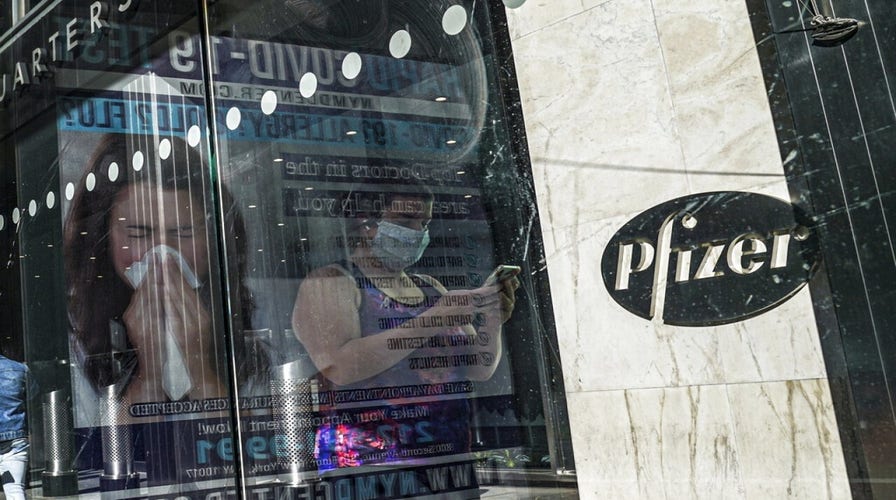
What's the economic fallout of potential Pfizer COVID-19 vaccine?
Real Clear Politics reporter Philip Wegmann reacts on 'Your World'
This is a rush transcript from “Your World With Cavuto” November 9, 2020. This copy may not be in its final form and may be updated.
NEIL CAVUTO, FOX NEWS ANCHOR: Welcome, everybody. I'm Neil Cavuto, and this is YOUR WORLD.
And what in the world to make of changed dynamics? A week ago, it's a
nation all focused on election eve, now delighting in the prospect of a
potential cure or a remedy for the pandemic that has gripped the world.
The latest on the fallout from all of this for the markets and why they
acted the way they did with Susan Li
Hey, Susan.
SUSAN LI, FOX NEWS CORRESPONDENT: Neil, best day on Wall Street in seven
months, brand-new record highs.
And, as you mentioned Pfizer's announcement A vaccine could be approved
before year-end with 90 percent efficacy means the U.S. economy could
reopen sooner than expected, and we could get back to traveling like we
used to, airlines recovering on the optimism. U.S. airlines laid off more
than 30,000 last month, while losing billions of dollars.
Same for cruise lines. Norwegian warning earlier this year that it may
struggle to survive. Hotels and casinos getting some relief as well. 2020
is set to be the worst year on record for hotel occupancy. COVID is roughly
nine times worse than 9/11 for the travel industry, according to one
analysis.
So, as money goes back into travel names, money is coming out of lockdown
winners, those that did well as people worked in schools from home. So,
think of Peloton, Zoom, which is now in our everyday language, DocuSign,
Netflix, and Shopify.
Stock markets coming off the best election week since 1932. And Wall Street
believe that a lightly divided government will mean less regulation and
lower taxes.
Now, in nearly a century, divided and unified governments have resulted in
similar gains for the S&P 500. But what is the best type of divided
government for Wall Street? Well, history tells us that a Democrat in the
White House, with a Democrat Senate and Republican-controlled House has
actually outperformed in nearly a century.
Second best is the GOP controlling both the White House and the Senate,
with a Democratic-led House. So, interesting that this year, Neil, that
we're likely looking at a Democrat in the White House and control of the
House, while Republicans will likely have control the Senate.
And that's the first time in nearly a century that that scenario is playing
out. Isn't that interesting, Neil?
CAVUTO: Yes. Combine that with the vaccine news, and it was a nice one-two
punch up.
LI: Yes.
CAVUTO: Thank you very much, Susan, as always, Susan Li of FOX Business
Network fame, which, if you don't get, you should demand.
Of course, you do get it, and so you don't have to demand it.
Blake Burman with us right now and the president about what he made of his
coronavirus news here and the vaccine potential, because, in the middle of
that, someone lost their job today -- Blake.
(LAUGHTER)
BLAKE BURMAN, FOX NEWS CORRESPONDENT: A busy Monday we got over here,
Neil.
Actually, there was a Coronavirus Task Force meeting in the White House
within the past hour or so. Of course, that comes on the heels of this
great news from Pfizer today about its COVID-19 vaccine candidate, by and
large, effective, potentially close to the finish line here of the clinical
trial.
This was how President Trump reacted as he took to Twitter earlier this
morning, writing the following, at one point saying -- quote -- "Stock
market up big. Vaccine coming soon. Report 90 percent effective. Such great
news."
Here was the health and human services secretary, Alex Azar, on what could
potentially come next.
(BEGIN VIDEO CLIP)
ALEX AZAR, U.S. HEALTH AND HUMAN SERVICES SECRETARY: Yes, so Pfizer will
have to now pull together their data and submit it to the FDA, where it
will undergo an independent review process there. And so it, of course, has
to be authorized by the FDA.
So you should be thinking in the several-week-time period both for the
submission and then review by FDA of the data.
(END VIDEO CLIP)
BURMAN: Azar is one of the leaders of Operation Warp Speed. So too was the
now former head of the Pentagon, Mark Esper.
President Trump announcing today that he has fired the former defense
secretary. This had been widely speculated that it could happen after the
election. In what essentially amounted to an exit interview with "The
Military Times," Esper said late last week that he was not going to resign.
And he pushed back on the idea that he might have been a yes-man to the
president. This, of course, Neil, begs the question of who might be next.
By the way, also in the president's Cabinet, we continue to monitor the
health now of the housing and urban development secretary, Dr. Ben Carson,
as his office today confirmed that the doctor has COVID-19, a spokesperson
for Dr. Carson saying that he is in -- quote, unquote -- "good spirits."
Just 4:05 here on the East Coast on a Monday afternoon, Neil.
(LAUGHTER)
BURMAN: We will see where the rest of the week takes us over here at the
White House -- back to you.
CAVUTO: When it rains, it pours.
BURMAN: Yes.
CAVUTO: Blake, has the administration responded to the timing of this
Pfizer-BioNTech announcement on this potential vaccine?
I'm just imagining, if it had come out last week at this time, would have
had a very different impact. But you never know.
BURMAN: Right.
CAVUTO: But, I mean, have they talked about that? The company's CEO,
Pfizer's CEO, said, no, it's not anything to do with the politics or the
timing of the election or any of that.
BURMAN: Right.
CAVUTO: But their thoughts?
BURMAN: I mean, I can tell you, Neil, this morning, I personally reached
out to the White House to ask for any sort of reaction to what we learned
from Pfizer.
That was first thing this morning. I have not heard back from the White
House on this. The Pfizer CEO said, of course, that they may know or, on
the flip side, may not know whether this thing -- whether the COVID-19
vaccine candidate was safe by October.
Of course, then there -- or effective by October. Then, of course, there's
the safety issue of it, which is the next part of it.
CAVUTO: Right.
BURMAN: But, no, we haven't exactly heard from the White House.
But the Pfizer did -- CEO did say they may know or they may not know --
Neil.
CAVUTO: Yes, that's another line like, it is what it is.
(LAUGHTER)
CAVUTO: All right, Blake Burman, thank you very much, my friend.
BURMAN: You got it.
CAVUTO: Busy day for Blake on this Monday after the election.
Ted Weisberg is with us right now of Seaport Securities, Kathryn Rooney
Vera of Bulltick Capital Markets.
Welcome to both of you, guys.
You know, Kathryn, we could go back and forth on when -- the timing of this
vaccine news, but, obviously, it was deemed to be very promising news for
the markets. I noticed airline stocks were soaring today on the notion that
maybe this will get people flying sooner than thought.
Was it an overreaction? By day's end, I mean, many of those gains,
impressive though they were, were halved. What do you make of that?
KATHRYN ROONEY VERA, BULLTICK CAPITAL MARKETS HOLDINGS: Well, the much-
anticipated, Neil, rotation into value stocks and small cap value certainly
came to the fore today. Technology underperformed and those value stocks
really outperformed.
So, the market, I think, got ahead of itself. The fact is that we have a
promising vaccine, but it's not widely distributed. And, Neil, I think the
biggest push to the upside for the markets is that the assumption that the
Senate will remain in Republican hands, serving as a speed bump, if not a
full stop sign, to corporate tax hikes.
And I think that is also potentially a mistake. We have the Georgia run-off
January 25. And can you imagine, Neil, the amount of cash that's going to
be thrown into this race, the repercussions of which -- the repercussions
of which are enormous.
I mean, if the Republicans lose those two Georgia seats, then it's de facto
Democratic controls. And we're back to the drawing board, Neil, talking --
us analysts and economists talking about the negative impact that a 7
percentage point increase in the corporate tax rate would have on corporate
earnings and the S&P 500.
CAVUTO: All right, just to elaborate on that, Joe Biden has proposed to
hike corporate taxes from 21 percent to 28 percent, splitting the
difference from where they were last time, when the president lowered it
from 35 percent to 21 percent.
Having said that, Ted Weisberg, though, I am curious. The markets breathe a
sigh of relief that the Senate would still be in Republican hands. As you
know, Kathryn pointed out there's a possibility that these twin Senate
elections, run-offs that are scheduled for January 5 could tip Democrat.
They both have to tip Democrat for that to happen.
But your thoughts if they do, if that happens. What then?
TED WEISBERG, PRESIDENT, SEAPORT SECURITIES CORPORATION: Well, I think, in
fact, if that does happen, it's going to be a big negative for the market.
I mean, we have discussed that possible scenario prior to the presidential
election, if, in fact, the Democrats were able to sweep the Senate and, of
course, maintain the House. So I would agree that that potentially is a
game-changer, at least as far as the markets are concerned.
But the good news, Neil, is that we have another two months to live before
we have to worry about that.
(LAUGHTER)
WEISBERG: And we will know the answer to that soon enough.
Meanwhile, today obviously was a fabulous day. And it was great news from
Pfizer, but the president and his administration has been telegraphing the
prospect of a vaccine, not for weeks, but for months. It's a timing issue.
But, clearly, today's news was good news.
And you saw, as your previous guests pointed out, a complete reversal in
sentiment, I mean, a strong market. It's unfortunate that we had to give
back a lot of the gains. But we still had a very healthy -- a healthy,
positive day.
And it's all those sectors that were out of favor, all of a sudden, they're
in favor. And the sectors that had been in favor are out of favor. Just
look at the Nasdaq being down today. What a difference a day makes.
It's too bad we can't trade with the benefit of 20/20 hindsight.
CAVUTO: I thought that's what you did. I thought that's all you did. You
had that.
(LAUGHTER)
CAVUTO: I thank you, Ted. I thank you, Kathryn, very, very much.
So, let's get a doctor's read of all of this of the significance of this
vaccine news, if it ultimately pans out.
Dr. Bob Lahita back with us, St. Joseph University Hospital, the chairman
of medicine, New York Medical College professor of medicine, much, much
more.
Doctor, let's say this pans out, and hope matches the reality, and the
reality matches the hope. How quickly would that be able to get into folks'
hands?
DR. BOB LAHITA, ST. JOSEPH UNIVERSITY HOSPITAL: It'll be able -- hi, Neil.
First of all, good to see you again.
CAVUTO: Same here.
LAHITA: It's going to get into people's hands.
Remember, this is -- this is warp speed, as the previous administration, or
the current administration, said. Ten months to get a vaccine like this is
absolutely amazing, really amazing. And right now, we're looking at an
authorization, an emergency use authorization, which will be available, I
presume, by next week.
They're saying the third week of November. And that's really very exciting
news. By the end of 2020, we're going to hear Pfizer -- Pfizer having 50
million doses, 50 million doses. And, by 2021, when it's going to be
available to everybody, the public, there's going to be 1.3 billion doses
in 2021.
They're already ramping up to produce these, Neil. Now, this has...
CAVUTO: So, Doctor, what -- how does it go? How does it go in terms of
distributing this to the people?
There's a certain order. Could you explain how that would go, likely?
LAHITA: Yes.
Likely, I'm told it will go to those vulnerable people first, which are the
elderly and those with comorbidities who are at extreme risk of dying from
the disease. After that, it's going to go to health care workers, nurses,
doctors, EMTs, paramedics, police officers, firemen, after that,
conductors, bus operators, et cetera, people who are vital to the workings
of our society.
And that's the way it's going to go. And it's extremely exciting, because I
can now see more than the light at the end of the tunnel. I can see the end
of the tunnel with bright lights. Very, very exciting.
And, Neil, this is the...
CAVUTO: So, people get cavalier with this sort of stuff, though, Doctor,
right?
LAHITA: Yes.
CAVUTO: I mean, a lot of them are going to say, well, I guess I can
dispense with the whole mask thing. I guess I can...
LAHITA: No.
CAVUTO: ... eat to my heart's content as late as I want, if my restaurants
or bars are open in my state. And in states like New Jersey and
Connecticut, that was just pulled back.
So, people can get a little cocky prematurely. What do you tell them?
LAHITA: Yes, I tell them to keep mitigating, keep wearing the mask, and
keep the social distancing, and wash your hands. Behave as though
everything is radioactive that you come into contact with. Don't let your
guard down.
Remember, this is an emergency use authorization. And this is after two
injections. These injections are one and then 21 days later, another one.
And then the measured data right now, seven days after, and now they're
going to do 14 days after, and it's 90 percent effective.
But we don't want to let people's guards down, because we're still going to
have 100,000 people a day infected from now until the vaccine is released,
which could be March or April. So, let's not get cocky, let's not get crazy
and start dropping our masks and socializing and screaming and yelling and
going to bars and having -- sharing beers with all of our friends.
That, we don't want to see -- Neil.
CAVUTO: All right, very good advice.
Dr. Bob Lahita, always good catching up with you, my friend, and stepping
back and looking at the big calm picture...
LAHITA: Thanks.
CAVUTO: ... which you do very, very well.
Well, speaking of the virus, I should say that Joe Biden announced his
Coronavirus Task Force today. Some of the members were what you would
expect, a former surgeon general under Barack Obama, a former FDA
commissioner, also under the former administration, and then a fellow who
was a whistle-blower on Donald Trump, who resigned after he said that
warnings of the pandemic were not heeded by the administration.
We're going to look into that and the fallout from who Joe Biden is talking
to -- after this.
(COMMERCIAL BREAK)
CAVUTO: Well, he said he would do it, and now president-elect Joe Biden
has, announcing his own COVID-19 task force. And it's a rather eclectic
bunch.
Jacqui Heinrich has more from Wilmington.
Hey, Jacqui.
JACQUI HEINRICH, FOX NEWS CORRESPONDENT: Hey, Neil.
The president-elect has cheered on that good news coming from -- coming
about the Pfizer vaccine, but also today, during that briefing, urged
people to take seriously mask wearing and social distancing, saying that we
have got a long winter ahead of us.
He's trying to strike the everybody's president tone, saying that these
actions shouldn't be seen through a political lens or as an effort to
restrict people, but it's steps that people need to take to bring cases
down because widespread vaccine distribution is still far off.
(BEGIN VIDEO CLIP)
JOE BIDEN (D), PRESIDENT-ELECT: The expectation is the FDA will run a
process of rigorous reviews and approvals. And the process results must
also be grounded in science and fully transparent.
At the same time, it's clear that this vaccine, even if approved, will not
be widely available for many months yet to come.
(END VIDEO CLIP)
HEINRICH: But the General Services Administration certifies Biden's win.
And there's little he can do to put plans in motion until that happens,
meaning the more than $9 million in federal funding set aside to aid his
transition is off-limits until then.
Part of that money goes toward training and doing background checks for
Cabinet appointees and also physical space at federal agencies. Yesterday,
the Biden transition team urged the GSA to get on it, telling us:
"America's national security and economic interests depend on the federal
government signaling clearly and swiftly that the United States government
will respect the will of the American people and engage in a smooth and
peaceful transition of power."
Now, with the possibility that the Republicans continue to control the
Senate, many of those positions he plans to appoint won't take -- might
take a long time. And so there's work to be done, because a lot of those
health care agency heads that he would have to appoint can't wait too long
past January 20 to get those people in place.
So, there's work behind the scenes getting all of that rolling now, Neil.
CAVUTO: Yes, to put it mildly.
Jacqui, thank you very, very much, Jacqui on all of that.
When we were exploring a little bit of who's on this august panel right now
to help the president-elect, Vivek Murthy, you might remember that name,
the top doctor in the country, the former surgeon general under Barack
Obama, then David Kessler, the former FDA commissioner.
But one that stuck out, at least in our minds, when we saw it was Rick
Bright. You might not remember him, per se, but he was the Trump whistle-
blower who had resigned after he said that his consistent warnings about
the pandemic were being ignored by the administration, all part of this
panel of advisers helping the president-elect deal and get organized for
taking over how we deal with this virus in January.
Let's get to read from Phil Wegmann, the RealClearPolitics maestro.
You know, Phil, looking at that, and who's on this panel, particularly Rick
Bright, what did you make of it and the signal that Biden might be sending
here?
PHILIP WEGMANN, REALCLEARPOLITICS: It's telling that this is one of the
first actions from president-elect Biden.
He made tackling the coronavirus a top priority. He talked about it every
day on the campaign trail and argued that he was going to be listening to
the science and the best people on this.
So, he moved quickly to put together a group of folks who certainly have
the academic pedigree and certainly bring a little bit of political
controversy with them.
The message that he's telegraphing right here is that he is focused on
getting the correct personnel, even if it is going in a different direction
than his predecessor.
CAVUTO: I'm just wondering, because both candidates, particularly Kamala
Harris, in her debate with Mike Pence, had talked about, if this was a
vaccine being touted by Donald Trump, she wouldn't take it, if it was a
vaccine being touted maybe by Anthony Fauci, she would, or notable medical
experts.
Now, this was one that was announced by the heads of Pfizer and BioNTech,
just saying that it looks promising, but without getting ahead of their
skis.
So, no criticism of the source of this, but this could become a political
football, can it not?
WEGMANN: Yes, everything in 2020 is political.
And Senator Harris certainly caught some criticism because of her concern
that maybe politics would encourage some pharmaceutical companies to cut
corners. We can have that debate, and maybe it will become a topic of
conversation very soon.
But I think that something that we can't miss here is that, while this
pandemic started in China, and certainly was exacerbated by the communist
government there, it's encouraging that it was an American company and
American allies who brought about the vaccine that hopefully will begin to
be the end of this.
I think that, love him or hate him, Joe Biden is correct when he says that
there's nothing that the American people can't do when they work together.
And, again, love him or hate him, President Trump hopefully put together
the infrastructure that's going to be able to push this vaccine out to the
entire country.
CAVUTO: Yes, Operation Warp Speed had a lot to do that. That was a
president from creation. But we leave the political back-and-forth aside
for the time being, until I ask you this question.
If we had gotten this news a week ago, what impact would it have had?
(LAUGHTER)
WEGMANN: That's the counterfactual question on the mind of everyone at the
White House.
Everyone there is seeing this as bittersweet news.
CAVUTO: I just want to stick you in a corner here on this one, yes.
WEGMANN: And they appreciate it. And they hope that it comes to the
American public soon, from the conversations I'm having with them.
CAVUTO: Obviously, it would have -- to hear many people say, it would have
been a game-changer, at least would have eased a lot of people's concerns,
had they heard it.
It's interesting, when we look at markets and what they do, and I know
you're too sophisticated to get caught up in them.
But I am wondering whether the markets were saying this is the cure for the
stymied sort of American spirit, that what -- left unshackled now by the
fears of the virus, the economy under this new president, if he -- if all
these legal efforts on the part of the Trump administration fail, is going
to be good, that whether you want to credit or -- the president for
Operation Warp Speed, which may be sped up the timetable for a potential
cure for this thing, or at least a vaccine, it could unleash a lot of good
things, a good economy, company earnings that could soar, airlines that
have been floundering that now could see more filled seats.
What do you think of the fallout from this, if everything goes clocked
according to hopes? What do you think it's going to be?
WEGMANN: Well, I think that what we're seeing in the market is obviously
optimism about this vaccine.
I mean, come on, how could that not be the message that we're seeing in
these tea leaves? People want to be done with lockdowns and the pandemic.
CAVUTO: Right.
WEGMANN: At the same time, I think the market might be reacting to the
possibility of divided government, where Republicans control the Senate and
Democrats have the White House, the idea being that if there is a bit of
gridlock, things remain the same, and there are not big, sudden changes
that would disrupt things.
That's good for planning if you're in business.
CAVUTO: All right, don't start raiding my market turf, young man.
(LAUGHTER)
CAVUTO: I mean, but you're exactly right. That's exactly the sentiment
that's building, Phil Wegmann of RealClearPolitics fame.
And he's right about that.
The other thing that Phil was right about, talking about the idea of the
Republicans hanging onto the Senate, but it does really depend on these
twin run-off elections that happen in Georgia on January 5.
Republicans can only afford to lose one. They lose both, well, you have got
Democrats running the Senate. What happens?
After this.
(COMMERCIAL BREAK)
CAVUTO: All right, a big day for news, and waiting to hear from RNC
officials about that count every single vote, the focus certainly on
Pennsylvania, but a few other states could come up as well.
When they start speaking, we will be taking you there.
Stay with us.
(COMMERCIAL BREAK)
CAVUTO: All right, Georgia has two Senate races. And they're going to go
to two run-offs on January 5.
They're crucial to seeing whether Republicans can hang on to the Republican
control they enjoy right now. Split government, of course, we mentioned was
good for Wall Street. We will see if it helps the Peach State one way or
the other. Republicans can only afford to lose one of these races. They're
optimistic they can avoid that altogether and win them both.
Jonathan Serrie right now with more on how things are going in Atlanta.
Hey, Jonathan.
JONATHAN SERRIE, FOX NEWS CORRESPONDENT: Hi there, Neil.
Well, a lot of news coming out this afternoon of the Georgia secretary of
state's office. I will break it down for you.
First item is, they held a news conference this afternoon, said that, so
far, they have found no major issues with voting irregularity. But they do
understand why Republicans are challenging some of the vote counts.
Take a listen.
(BEGIN VIDEO CLIP)
GABRIEL STERLING, GEORGIA VOTING SYSTEM IMPLEMENTATION MANAGER: And when
you're this close, and the emotions run this high, it's understandable.
And the president, to a strong degree, has a responsibility to those 70
million people or so who voted for him to say, I'm going to go through all
the legal means to make sure your vote is defended. We understand that.
(END VIDEO CLIP)
SERRIE: In addition to the presidential race, both of Georgia's U.S.
senate seats are in play.
Democrat Raphael Warnock is challenging Republican Senator Kelly Loeffler,
who was appointed to fill the seat of Senator Johnny Isakson when he
retired for health reasons last year. And Democrat Jon Ossoff is
challenging Republican incumbent David Perdue.
These Georgia races could affect the balance of power in Washington.
(BEGIN VIDEO CLIP)
SEN. CHARLES SCHUMER (D-NY): Now we take Georgia, and then we can change
the world.
(CHEERING AND APPLAUSE)
UNIDENTIFIED MALE: I'm sorry. Can you repeat that, Mr. Schumer?
SCHUMER: Now we take Georgia, and then we can change America.
(END VIDEO CLIP)
SERRIE: And, this afternoon, Senators Perdue and Loeffler, both of them
Republicans, issued a joint statement calling for the resignation of
Georgia Secretary of State Brad Raffensperger.
Raffensperger is a fellow Republican and a fellow Trump supporter. But both
of Georgia's Republican senators are alleging that there are failures in
the election process and that the buck should stop with the Republican
secretary of state.
Well, minutes ago, Raffensperger issued a response, saying -- quote -- "If
I was Senator Perdue, I'd be irritated I was in a run-off. And both
senators and I are all unhappy with the potential outcome of our president.
But I am the duly elected secretary of state. One of my duties involves
helping to run elections for all Georgia voters."
And he goes on in that statement to say that he is not resigning and that
he will continue on in his duties as Georgia's top elections official --
Neil.
CAVUTO: How could it be the secretary of state's fault that it was a close
election in Georgia? How would that fall on him?
SERRIE: And that's what he's arguing, that the senators and the Republican
base may not like the outcome of this election, may not like that Georgia
may be turning blue, at least in this election cycle, but, as the person in
charge of monitoring elections of managing elections for the state, that he
has to be fair to all Georgia voters.
The Republican base may not like the outcome, but he doesn't have the
ability to control the outcome. He's basically saying, don't blame the
messenger. I only report -- if I'm doing my job correctly, I'm only
reporting the results.
CAVUTO: So, if he monitored a landslide, that's OK for the president or
for these senators. But if he is monitoring a close race, it's all on him.
That just seems a little specious. But we shall see.
All right, Jonathan Serrie.
SERRIE: He's in a tough position because there are...
CAVUTO: Yes.
SERRIE: Yes.
Yes, I was just going to say...
CAVUTO: No, I see what you mean. I just want them to be clear.
Go ahead.
SERRIE: ... there are so many conspiracy theories out there, and there's
political pressure to legitimize those theories. But he has to follow the
facts.
CAVUTO: Yes.
All right, thank you very much, my friend, Jonathan Serrie, on all of those
developments here.
In the meantime, one of the things we're following about what might happen
under a President Biden is how quickly he can move, whether it's a
Republican Senate or not.
There are these things called executive orders. It is rather routine, as it
was for this president, to issue them to undo what his predecessor was
doing, who also issued a lot of executive orders to undo what his
predecessor was doing.
But exactly what executive orders and what would they overturn?
After this.
(COMMERCIAL BREAK)
CAVUTO: All right, Joe Biden leaving a meeting with transition team
members in Wilmington, Delaware, this ahead of news that Republicans are
planning to outline their legal strategy to protest what was going on in
states like Pennsylvania. It's only a couple of minutes away.
Want to sneak it, if I can, my buddy Charlie Gasparino with some signals he
is hearing from team Biden how they might go in, I guess with a lot of
executive orders, huh?
CHARLIE GASPARINO, FOX NEWS SENIOR CORRESPONDENT: Right
And I think you're going to see them mostly on trade. And that's where the
president has a lot of power on executive orders. As you know, you can't
cut taxes by executive order. But on trade, and particularly some
regulations involving fracking -- that came up during the campaign -- you
can -- you can send some edicts out on environmental issues and on trade
policy that could be pretty substantial.
The trade policy, I think, could be a net benefit for the American worker,
in this sense, that we would stop the trade wars with our European allies.
It would be less of a tit-for-tat tariffs with the European Union.
It'll be -- it's unclear how far Biden will go in stopping those tariffs --
that tariff war with China. We should point out that China -- engaging
China in a tariff war or in at least being sort of antagonistic with them
on trade, given their poor record in the past of stealing intellectual
property and creating a one-sided trade system, is a bipartisan issue.
So, it's -- I wonder if he's going totally reverse what President Trump
did.
CAVUTO: So, in an executive order -- I don't mean to rush you buddy.
But an executive order on that, an executive order to reverse the climate
change thing, right?
GASPARINO: That's what it seems.
That's where he's got his power, Neil. He doesn't have his power on taxes.
And that's where...
CAVUTO: All right.
GASPARINO: And, as you know, if the Republicans pick up one of those
Georgia seats -- a lot of hedge fund guys I know that are studying it say
they will get at least one and maybe two -- then the broader Biden economic
agenda is just not going to happen.
CAVUTO: All right, thank you, Charlie, very much. Sorry to interrupt you
here.
All it would take is one seat right now to just keep it still Republican.
They lose both seats, it goes Democrat.
Kayleigh McEnany right now spelling out the Republican National Committee's
plan to fight what's been going on in some states, notably Pennsylvania
with the vote count.
Let's listen in.
(JOINED IN PROGRESS)
KAYLEIGH MCENANY, WHITE HOUSE PRESS SECRETARY: ... one a party in America
that opposes verifying signatures, citizenship, residency, eligibility.
There is only one party in America trying to keep observers out of the
count room. And that party, my friends, is the Democrat Party.
You don't take these positions because you want an honest election. You
don't oppose an audit of the vote because you want an accurate count. You
don't oppose our efforts at sunlight and transparency because you have
nothing to hide.
You take these positions, because you are welcoming fraud, and you are
welcoming illegal voting. Our position is clear. We want to protect the
franchise of the American people. We want an honest, accurate, lawful
count.
We want maximum sunlight. We want maximum transparency. We want every legal
vote to be counted. And we want every illegal vote...
CAVUTO: Whoa, whoa, whoa.
I just think we have to be very clear. She's charging that the other side
is welcoming fraud and welcoming illegal voting. Unless she has more
details to back that up, I can't in good countenance continue showing you
this.
I want to make sure that maybe they do have something to back that up. But
that's an explosive charge to make, that the other side is effectively
rigging and cheating.
If she does bring proof of that, of course, we will take you back. So far,
she has started saying right at the outset welcoming fraud, welcoming
illegal voting.
Not so fast.
We will have more after this.
(COMMERCIAL BREAK)
CAVUTO: All right, team Trump still supporting its case that the facts
don't back up what's going on right now in the recount or the count of
votes, that this is something that Democrats were deliberately strategizing
to fix the election in their favor.
Even Republicans such as Chris Christie and Roy Blunt among those saying,
be careful, let's not make that leap.
Nevertheless, Grady Trimble on how the RNC and others within the Trump
campaign now are pushing this case going forward -- Grady.
GRADY TRIMBLE, FOX NEWS CORRESPONDENT: Well, Neil, I think it's important
to start coming out of that press conference there to note that the
Republican commissioner with the Philadelphia commission, who's in charge
of this vote count, he has said that there is no cheating going on here.
And he even received death threats, He told "60 Minutes," because he's
involved in this election. So, we're waiting for this lawsuit from the
Trump campaign to be filed in Pennsylvania. And we do want to see the
details of that, because we're hoping that there might be some evidence
about these claims that they're making.
Over the weekend, though, they did lay out some of their claims, primarily
here in Philadelphia and in Pittsburgh. In Philly, they say poll watchers
weren't allowed close enough to observe votes being counted.
But officials here again say, nobody was denied access. And I have talked
to Republican poll watchers, two of them who tell me they were given the
same access everybody else in the room was.
Also want to talk about Allegheny County, where the claim there is that
Republican observers specifically were barred from watching the count for a
full 24 hours, and they alleged that a deceased woman there voted by mail.
(BEGIN VIDEO CLIP)
COREY LEWANDOWSKI, TRUMP 2020 CAMPAIGN SENIOR ADVISER: And when you go to
the secretary of state's Web site today, it says that she voted in this
election, effective November 2, 2020, a full nine days after Ms. Ondick of
Allegheny County passed away.
(END VIDEO CLIP)
TRIMBLE: Important to note that, if you go to the secretary of state's Web
site, which we did, and put that woman's name in, it says that her vote or
her ballot was recorded. It doesn't say whether it ended up in the final
tally.
We asked Allegheny election officials about that. And we also asked the
secretary of state about that, but we did not get a response.
In response to the poll workers, specifically Republican poll workers being
barred from the counting room, here's what Allegheny elections officials
had to say about that: "At no point were canvassing operations conducted
without observers having the opportunity to see the process and the
counting."
And, finally today, 11 attorneys general, Republicans in various states,
are asking the Supreme Court not to count the mail-in votes in Pennsylvania
that were received after Election Day. As you know, as of right now, votes
received on the 4th, the 5th, and the 6th of November, as long as they were
in by 8:00 p.m. and postmarked before the election or on Election Day, they
would be counted, attorneys general for 11 states asking for those to be
thrown out.
So, again, Neil, we await that lawsuit. We look forward to examining that
evidence that they say they have -- Neil.
CAVUTO: All right, Grady.
And, as you pointed out, and as Roy Blunt and other Republicans have
pointed out here, the president's lawyers must present facts, and then it's
time for the facts to speak for themselves.
If dead people did indeed vote in this election, it would not be the first
time that's happened. For the Trump folks, you apparently are going to need
tens of thousands of corpses having done so. So far, we haven't heard.
We will have more after this.
(COMMERCIAL BREAK)
CAVUTO: It seems like 20 years all over again.
Welcome back, everybody. I'm Neil Cavuto.
And taking a look at Republicans vs. Democrats' view of letting the count
go on, if you are hearing Republicans correctly. And Democrats know it's
just forestalling the inevitable. Their roles were reversed in the Bush-
Gore hanging chad controversies then that dragged on for the better part of
a month.
See if you notice a pattern that has now completely reversed itself now vs.
then. Take a look.
(BEGIN VIDEO CLIP)
FMR. SEN. JOE LIEBERMAN (I-CT): If the votes were accurately counted in
Florida, we will win Florida and therefore the election.
MATT SCHLAPP, CHAIRMAN, AMERICAN CONSERVATIVE UNION: The way we resolve
division, even when you don't get your way in an election, is to count
every legal ballot.
FMR. TOM DASCHLE (D-SD): And there is overwhelming support for your effort
to ensure that we have a fair and full count.
There's a recognition, of course, that we have got a lot of work to do to
obtain that count.
REP. KEVIN MCCARTHY (R-CA): What we need in the presidential race is to
make sure every legal vote is counted, every recount is completed, and
every legal challenge should be heard.
DAVID BOIES, ATTORNEY, AMERICAN FEDERATION FOR EQUAL RIGHTS: The rules of
the game have been first that the people elect the electors, and they do so
by a majority of their votes.
SEN. TED CRUZ (R-TX): The media does not get to select our president. The
American people get to elect our president.
GEORGE W. BUSH, FORMER PRESIDENT OF THE UNITED STATES: I have won three
counts. And I think it's time to get some finality to the process.
BIDEN: The people of this nation have spoken.
(CHEERING AND APPLAUSE)
BIDEN: They have delivered us a clear victory, a convincing victory.
JAMES BAKER, FORMER U.S. SECRETARY OF STATE: This is what happens when,
for the first time in modern history, a candidate resorts to lawsuits to
try to overturn the outcome of an election for president.
It is very sad.
SCHUMER: So, I say to Donald Trump, you lost. No more games. Go home. Go
home to Florida. Stop delaying. Stop making up lies about the election.
FMR. SEN. ARLEN SPECTER (D-PA): Enough is enough. And with the people of
Florida having spoken, Governor Bush having retained this lead, it seems
that this is a time that America ought to be able to move forward.
JIM KENNEY (D), MAYOR OF PHILADELPHIA: I think what the president needs to
do is, frankly, put his big boy pants on. He needs to acknowledge the fact
that he lost, and he needs to congratulate the winner.
(END VIDEO CLIP)
CAVUTO: All right, each side convinced that it is right.
We just wait for the proof that indicates the charges they're making are
fair, the rush on the part of Democrats to go ahead and acknowledge that
Joe Biden is the president of the United States, which, technically, he is,
and the Trump folks have a case to argue that the count is so close in some
of these states, it should proceed uninterrupted.
Let's get the read on all of this from Steven Mulroy, election law
attorney, University of Memphis School of Law professor, and author of
"Rethinking U.S. Election Law: Unskewing the System."
Steven, very good to have you.
You can see this through the prism of your party and your politics, I get
that. But, invariably, you do need to have proof either someone fixing an
election or rigging it or making it fraudulent. What do you think then and
now the arguments that are being made?
STEVEN MULROY, UNIVERSITY OF MEMPHIS: Well, there is one similarity
between Bush v. Gore and 2020, is that one particular legal theory that the
Republicans advanced in 2020, and only three justices signed on to back
then, is now potentially being revived by opinions from Justice Alito and
Justice Kavanaugh.
And that has to do with the extension of the absentee ballot receipt
deadline by the state Supreme Court in Pennsylvania.
CAVUTO: Right.
MULROY: The argument is that that usurps the power of the state
legislature under the Constitution and is invalid.
Of course, the issue is that even if the court were to accept that theory,
how many votes are affected, and would it be enough to change Biden's
36,000-vote lead in Pennsylvania? And, even if it did, what about the other
states that are also separately bringing Biden up above 270 Electoral
College votes?
CAVUTO: All right.
Now, obviously, you have made an important distinction here that, back 20
years ago, it was involving one state a couple of key counties. Here, it's
up to half-a-dozen states, and that they'd all have to go complete reversal
for the Trump forces to have any chance.
But it's the fraudulent part that kind of worries me, because I need -- and
I think most people, rational people would say, well, if you have got proof
of that, let's show it up front.
I have no doubt that dead people voted in this election, as they have in
every election, at least that I can remember, but in the numbers that would
change or swap the results, what do you think of that?
MULROY: Well, right
So, I think you make an important distinction. The American people are
probably less concerned about some obscure constitutional theory about
whether the deadline was properly extended because of the pandemic or not.
But if there was actual indications of straight-up fraud, then I think
that's the kind of thing that people would be concerned about. But you, I
think, Neil, correctly point out that you need to show a number of
fraudulent votes that are large enough to undo the lead that Biden has, not
only in Pennsylvania, but in a couple of other states as well.
And that seems like it would be a tall order.
CAVUTO: Do you think, Steve, that, in the few seconds we have, that this
could disrupt the system or make people who did not vote for Joe Biden
question its authenticity, and that it could do maybe more harm than good?
MULROY: I think the more you hear that kind of loose talk, the more it
undermines public confidence in the integrity of our electoral system, and
that could have potentially bad consequences down the road.
CAVUTO: All right, Steven, I'd love to get you back. I apologize for the
truncated time, with all these developments.
Steven Mulroy, the election law attorney.
We're not judging one's claims over the other. We're just asking for proof.
If you have something to prove an outlandish charge, or something that, on
the surface, seems outlandish, by all means, share it with us, and we will
share it with the world.
We're waiting.
Content and Programming Copyright 2020 Fox News Network, LLC. ALL
RIGHTS RESERVED. Copyright 2020 ASC Services II Media, LLC. All materials
herein are protected by United States copyright law and may not be
reproduced, distributed, transmitted, displayed, published or broadcast
without the prior written permission of ASC Services II Media, LLC. You may
not alter or remove any trademark, copyright or other notice from copies of
the content.
