









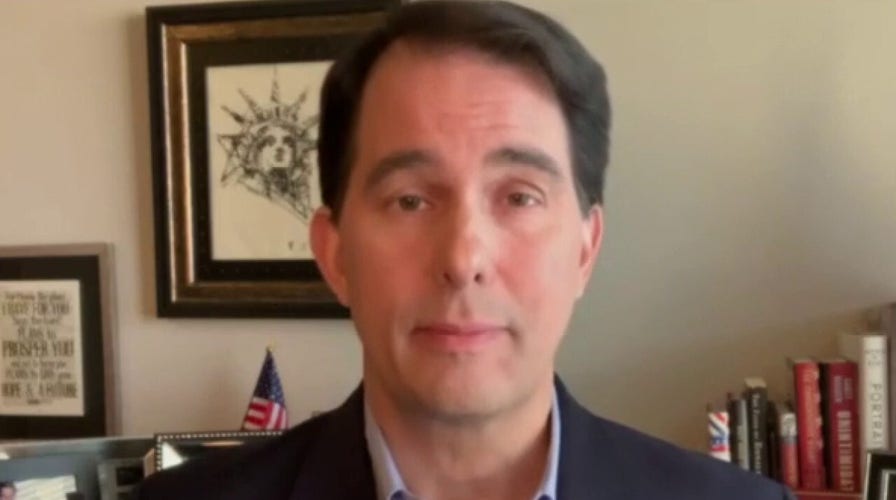
Walker: There needs to be a game plan for reopening local economies
Former Wisconsin Gov. Scott Walker reacts to protests over lockdown measures amid coronavirus pandemic.
This is a rush transcript from "Your World with Neil Cavuto," April 16, 2020. This copy may not be in its final form and may be updated.
(BEGIN VIDEO CLIP)
GOV. ANDREW CUOMO (D-NY): The New York pause policies, the close-down policies, will be extended, in coordination with other states, to May 15.
I don't want to project beyond that period. That's about one month. One month is a long time.
(END VIDEO CLIP)
NEIL CAVUTO, FOX NEWS ANCHOR: Stay at home. Just stay a little longer. How about two weeks longer?
Welcome, everybody. I'm Neil Cavuto, and this is "YOUR WORLD."
The governor of New York leading a half-dozen other Northeastern states, saying, we're not ready to go back to everything as normal at the end of this month. Try the middle of next month, and we will get back to you on that.
This as the president has been talking about with governors all across the country, all 50 of them, what is a right time to start unwinding the process that has got roughly nine out of 10 of us sort of locked at home, or not venturing too far from home?
What happens right now, especially as states differ on who's ready and who's ready for what? In the case of New York City, the mayor raising with Bill Hemmer not too long ago the possibility that the city's pools and beaches could be closed for the summer. We're talking the summer.
So, where are we going with all of this?
John Roberts at the White House following how the president is sort of ironing all of this out and finding some compatibility with the nation's governors -- John.
JOHN ROBERTS, FOX NEWS CHIEF WHITE HOUSE CORRESPONDENT: Well, let's hope he's finding some compatibility, Neil.
He's been on the phone with them for the past hour. It started about 3:00. Last time we checked, the president was still on the phone with them going over his new opening up America again guidelines that will be released at 6:00 tonight.
This is real specific medically-based data that he's providing to the governors, so that they can formulate a plan to open up the country. From the 30,000-foot level, here's what we know about the plan. It will be governor-led. It will be data-driven and layered on a -- basically, a -- don't know what that number is there for.
It'll be data-driven and layered, specifically tailored state by state and -- really, we can get rid of that. I'm not talking about that.
It'll be data-driven and layered, not a cookie-cutter, one-size-fits-all type of policy. Some governors will continue their shelter-in-place policies, others will open sooner.
We are told that the -- there we go.
We are told that the president's chief medical advisers, Dr. Robert Redfield of the CDC, Dr. Tony Fauci, and Dr. Deborah Birx, have all signed off on these guidelines, all three agreeing that this is the way forward.
At a briefing last night, the president indicated that this will be a rolling opening. Listen here.
(BEGIN VIDEO CLIP)
DONALD TRUMP, PRESIDENT OF THE UNITED STATES: You already know we will be opening up states, some states much sooner than others. And we think some of the states can actually open up before the deadline of May 1.
And I think that that will be a very exciting time, indeed. Governors are looking forward. They're champing at the bit to get going. Again, not all states are the same.
(END VIDEO CLIP)
ROBERTS: So what do governors think of the plan?
Ned Lamont of Connecticut speaking to this before he got on the call with the president. Listen here.
(BEGIN VIDEO CLIP)
GOV. NED LAMONT (D-CT): As you said, these are guidelines. Of course we will listen, see what he has to say, see what Dr. Fauci, Dr. Birx recommend. What's a testing protocol that makes sense? How do we share data?
Then, at the end of the day, though, every state is a little different, and every governor will make up their own mind how to proceed.
(END VIDEO CLIP)
ROBERTS: Now, in announcing the guidelines tonight, President Trump will also salute those who have been on the front lines helping the United States make its way through this crisis, the doctors, the nurses, the first responders, the politicians on a state and local level, the businesses that have stepped up to the plate to really keep things moving, treat these patients.
The president just a little while ago on the South Lawn paying tribute to the nation's truckers who have kept the wheels rolling all through this, bringing in much-needed medical supplies, food and other items. Listen to what the president said.
(BEGIN VIDEO CLIP)
TRUMP: To every trucker listening over the radio or behind the wheel, I know I speak for the 330 million-plus Americans that we say, thank God for truckers. That will be our theme, thank God for truckers.
(END VIDEO CLIP)
ROBERTS: The president also had teleconferences with members of his new Opening Up America Again congressional group, 32 members of the House, 65 members of the Senate.
The big topic of conversation in those teleconferences, Neil, was the fact that the small business association $350 (sic) pool for paycheck protection has run out, and Congress still has not passed anything to replenish it.
There is a bill in Congress for $250 billion for more paycheck protection funds, but that's stuck. And the president is trying to get that push through -- Neil.
CAVUTO: You know, John, I'm curious.
Has the president commented to anyone about the timing of the governors' announcement, at least the Northeastern ones, led by Governor Cuomo, to push this back to the middle of May, so close to this phone call?
ROBERTS: Yes.
And the one thing I got from the White House this afternoon when I was read in, again, on the 30,000-foot level on this plan is that this is going to be data-driven, not date-driven.
So while there are probably some states in the nation that could open up tomorrow, and, if not tomorrow, certainly before the April 30 guidelines expire, but, for other places like New York City in particular, probably like Detroit, like New Orleans, it may be some time before they can begin to get back to normal.
But that's the way that the president is looking at this. It is not going to be like flipping a switch. It'll be slowly turning up a dimmer, if you will, on the country, and it will take some time before everything is back to normal.
CAVUTO: All right, John Roberts at the White House.
All of this occurs at a time we got news today that jobless claims soared in the latest week, more than 5.2 million Americans applying for first-time jobless benefits here, but all of this at a time in the last four weeks we have seen about 22.5 million Americans file for these claims.
So a delay of any sort and getting back to business as usual or de- sheltering some of these plans obviously risks those numbers getting still higher.
But that will be the rule right now in the New York area, along with the states of New Jersey, Connecticut, Delaware, Rhode Island, Pennsylvania, Massachusetts, all right now pushing back any talk of easing up on sheltering at home until at least May 15, in other words, another month of that.
Let's get the read from David Lee Miller in New York with the very latest - - David Lee.
DAVID LEE MILLER, FOX NEWS CORRESPONDENT: That's right, Neil.
We heard from Governor Andrew Cuomo today, saying that he is going to extend until May 15 now the shutdown of these nonessential businesses in New York state, citing the fact that the social distancing and other measures that have been put in place are working to slow the virus.
The governor said he's making this decision in coordination with seven other Northeastern states. But, interestingly, those states do have varying policies about how they want to restart the economy. In the last 24 hours, here in New York, 606 fatalities were reported. That is down significantly from the 752 the day before.
The governor said, we have to continue what we're doing. And he made his case, citing statistics on the rate of infection.
(BEGIN VIDEO CLIP)
CUOMO: No political decisions, no emotional decisions. Data and science. We're talking about human lives here.
(END VIDEO CLIP) MILLER: The governor also urged New Yorkers to abide by his executive order requiring anyone who was in a situation where social distancing cannot be practiced to use a face covering.
And at a nursing home in Andover Township, New Jersey, authorities say, acting on a tip, they found 17 bodies in a small morgue. Some of the remains were relocated to a refrigeration truck that had been set up nearby.
The mayor says he has heard unconfirmed reports of as many as 76 deaths at this 700-bed facility. It is not clear how many people at that home died from the virus, but the governor is now asking his attorney general to investigate.
(BEGIN VIDEO CLIP)
GOV. PHIL MURPHY (D-NJ): I am heartbroken by the tragic news that several individuals have lost their lives in a coronavirus outbreak at the Andover Subacute and Rehabilitation Center I & II, and pray for the health and recovery of the other residents.
(END VIDEO CLIP)
MILLER: And in New Jersey, at least 3,156 people have lost their lives in total to the coronavirus. The curve there is on the rise.
Governor Cuomo said today that he is going to help out a neighbor, and New York will be sending 100 ventilators across the Hudson to New Jersey -- Neil.
CAVUTO: David Lee Miller, thank you very much, my friend.
So, you know what those states are battling and how they're trying to balance the need to economically get back on track with some of the real medical issues that David Lee just spelled out.
How do you go about that?
Let's ask Nicole Saphier that.
Doctor, I mean, obviously, they're wrestling with a number of issues. Many of these states have already imposed statewide, you have to wear a mask, a medical mask, a face mask.
So they're already knee-deep in that. So it does make a little sense, why would they suddenly reverse that, go back to business as normal in just a couple of weeks? But by pushing it to May 15, what did you think of that?
DR. NICOLE SAPHIER, FOX NEWS CONTRIBUTOR: Well, Neil, that's a great question.
And to be honest, I have mixed feelings about it. On one hand, I -- I want to get things open again. I think that there are long-term consequences to mental and physical health by keeping things shut down.
I think we're seeing an increase in depression and anxiety. It's really unfortunate. Also, I want to be -- on the other side, I want to make sure I'm keeping everybody safe from this novel coronavirus.
I hate hearing stories that you have 17 people, 17 bodies piled up in a nursing home in New Jersey. I mean, it is shocking and very tragic.
But here's the thing, Neil. We need to have a very smart and balanced plan of how we're going to open things back up. Saying everyone's going to be at a stay-at-home order in this area until mid-May, that's really disconcerting to me.
I was really hoping that we could take this on a day-by-day, week-by-week basis. Right now, we just saw the first single-day drop in deaths in New York. And that is extremely encouraging. That doesn't mean that we should open up everything tomorrow. But to push it off now for a month from today, essentially, to me, that seems a little hasty.
I understand that they're executing extreme caution here. But I do think that there's a smart way to begin slowly opening things up. And I really hope that is not so discouraging to people to hear that mid-May date, because I think that that potential bad news that was given today could really have an effect on people's mental health.
And I don't like that. I really would prefer to take this a little bit slower, and maybe look at things on a week-by-week basis, and not be pushing things out. You keep seeing these titles on media articles saying that New York beaches may be closed throughout the entire summer.
I mean, that's something people look forward to all year round. We can't be doing that right now. We have to continue to encourage people, telling them that the social distancing measures are working, we're having fewer new cases, fewer hospitalizations, and fewer ICUs.
And now we just saw the single first day drop in deaths. I mean, those are all great things to talk about. We have to focus on that. And I would -- I would much prefer that we looked at this more on a day-by-day or week-by- week basis, and not be putting out these long-term estimates.
CAVUTO: All right, we will watch what happens.
Right now, these states are the only ones that have extended it to the degree they have. But we will be keeping a close eye on others, and if they follow, Doctor.
Thank you very, very much, Dr. Saphier.
Again, you hear about this rolling recovery, this rolling getting back to work, the sort of staggered schedule to sort of push you out of your home and see if it's -- it's time to go back to work.
For many people, that's going to be confusing, very confusing.
Stay with us.
(COMMERCIAL BREAK) CAVUTO: You know, pushing back these stay-at-home provisions for another couple of weeks now, one more month of this, for a lot of folks, well, that's got pretty exasperating written all over it, particularly in places like Michigan that might feel the same way. We don't know yet.
But you might recall that the governor there, Whitmer, had imposed even stricter stay-at-home provisions yesterday that triggered protests and traffic jams, that extending to at least three other states where there are pretty tough stay-at-home provisions.
A lot of folks in these states are saying: Enough already. This is getting out of control. We want to go back to work. We want to protect those who are in danger. We want to protect to make sure that this doesn't get worse, but come on already.
Scott Walker is the former governor of Wisconsin. He joins us right now.
Governor, what do you make of these provisions, particularly -- and I should lead off first with what is going on in Michigan, where the governor there took what were pretty stern measures and made them even tougher. In other words, you can't buy a motorboat. You can buy a canoe.
SCOTT WALKER (R), FORMER WISCONSIN GOVERNOR: Yes.
CAVUTO: If you have a vacation home in the state, you can't see it, and on and on. And they just said, enough.
What do you make of this?
WALKER: Well, for all the people talking about you need to look at the data and the facts, they're just ignoring that in a big power grab.
And I think this is what has made people increasingly frustrated with what's going on all across the country, Michigan probably being the tip of the spear.
I mean, the fact that you're going to go fishing, you're going to be in a canoe, to me, actually being out in the water is the ultimate social distancing. You wave to your neighbors when they're on the boat, but you don't have to be up close to them.
Why would you take away these opportunities that don't put anyone at risk? But this is what happens when people get power-hungry, and they're taking actions that far exceed their constitutional rights.
CAVUTO: You know, it's always a balance between protecting the public health and protecting the public economy. And I get that, Governor.
But do you fear that Republicans leading this charge to go back -- I'm not saying it's monolithically Republicans, by the way -- that if something happens...
WALKER: Right.
CAVUTO: ... if there's a sudden spike in cases, they're going to look like they were too, too busy, to rushed to get business going, and not looking after the public welfare? What do you think?
WALKER: No, I think you have got to balance both. And that's where the balance comes in.
We have got to fight the war against the coronavirus and win. If we engage too quickly, we're only going to hurt ourselves later with the economy, if we got to go back and repeat some of these measures over and over again. That would be an absolute catastrophe both for the health of our fellow citizens and the health of the American economy.
But we have got to have a plan to do both. We can be, first and foremost, looking out for fighting the coronavirus, providing all the assets we need to deal with this health and medical issue. At the same time, we have got to be able to walk and chew gum and start planning for how we restore the health of the American economy.
To me -- I have written about this for weeks in The Washington Times, that you can't just wake up the day after and say, oh, by the way, now we're going to reopen the economy. There's got to be a plan, including things like fixing the unemployment system, which, unfortunately, they broke at the federal level when they provided disincentives for people to go back to work once it is safe.
CAVUTO: What I wonder about is -- we will eventually get to the point, Governor, that this will end, hopefully, prayerfully, without any spike in cases, et cetera, but it will be slow, right?
I mean, a lot of these states are going to maintain distancing measures and the like. But you're familiar, in Wisconsin, a lot of buildings and workplaces that are very, very crowded. People are packed close together.
And I'm wondering if as many people come back to work, even when they're allowed to come back to work, because they're going to have to be spread out.
WALKER: Well, a couple of things.
Again, you got to have a game plan. Today, unfortunately, the new governor here extended the stay-at-home order to almost the end of May, so almost a month-and-a-half from now. To me, we should look at the next two weeks.
Our peak in Wisconsin was weeks ago, at the beginning of April. It was 198 new cases that day. The average this week has been about 127, according to data from the Wisconsin Hospital Association.
We're not out of the woods yet, but we need to look at the data. My hope is that we will continue to get better over the next few weeks and then have a game plan. I don't think you just open it up all at once.
Maybe some of the viewers don't remember this, but I remember years ago, when I was a kid playing sports, if the lights went off at the stadium, then you turned them on, and it took a while to come back on.
That's what the economy is going to be like. There's going to have to be a phase-in. I think we start with manufacturing and the trades. Those are areas where you physically have to be there and where you can spread people out.
You can close down break rooms and lunchrooms and keep people at their -- at their actual machinery at their site. You can do other things to make sure people aren't huddled together, and keep those offices where there are cubicles and administrative duties going on. Keep them at home longer.
There's a logical way to do this. But we have got to have a game plan. Most leaders, most governors and mayors, aren't talking about that around the country. We need to have a game plan And we need to be doing it now, not waiting until whatever day is the artificial endpoint, and then waking up and wondering why the economy doesn't come back.
And, as I mentioned, we also got to do it. Lindsey Graham and Tim Scott laid this out weeks ago. We have got to fix unemployment. I think there's a way that you can encourage people to go back to work, keep them whole for the higher amount they're getting.
A guy making $10 an hour right now under the new system here in Wisconsin, he would be making $400 a week if he was working. He's going to make about $800, a little bit over $800, with this new federal enhancement.
But I say, let him go back to work when it's safe, but do so in a way that puts an incentive on going back to work and doesn't provide a disincentive for work along the way.
We have got to handle those things now...
CAVUTO: All right.
WALKER: ... and not wake up weeks from now and try and fix it.
CAVUTO: We shall see.
Governor, thank you very much for taking the time.
By the way, to the governor's point here, this is a global issue, folks. The United Kingdom, they're going to keep their very strict measures in effect for at least another few weeks.
Germany, that has had a big improvement and a swing in things, back to business as usual, or close to it come, next week. Kids go back to school the week after that.
It's different strokes for different folks, no matter where you live on Mother Earth.
Stay with us.
(COMMERCIAL BREAK)
CAVUTO: All right, this is a staggering number to look at; 22-plus million Americans who have lost their jobs over the last four weeks, filed unemployment claims, better than 5.25 million in the latest period.
And it's a trend that has not been, well, the working man and woman's friend.
Steve Moore, former economic adviser to the president of the United States, very close confidant to him, widely respected writer on all things financial.
Steve, the longer this goes on, whether it's medically necessary or not, I mean, the economic pain is palpable and real. So, with states, a number of them, now delaying these changing or revising these at-home rules, do you worry numbers like that, claims like that get worse?
STEPHEN MOORE, FORMER DONALD TRUMP CAMPAIGN ADVISER: Yes, I do.
I told the president exactly that in our first meeting of the new economic task force that he's appointed. And I think he, more than anybody in the White House, wants to get this economy up and running.
And that was before we saw these horrific numbers today that show 22 million people unemployed. Neil, that's not -- that's something I never thought I'd see in my lifetime.
And so I think that has maybe created a little bit of a tipping point here. I think Americans are starting to see the kind of carnage that is created when you shut down a $20 trillion economy.
I think you're going to start to see some states as early as next week, Neil, starting to open, states like Arizona, states like Nebraska, that are going to say, hey, we can do this in a smart way and keep our citizens safe, and not put them all on unemployment lines.
CAVUTO: Do you worry, though, that this pretty much kicks in the can the notion of a V-shaped recovery, though, that with so many states on staggered schedules, likely, to your point, that we're not all going to ride like a rocket on this back?
MOORE: No, it's going to be a slow-rolling kind of wave, where you're going to start to see these -- these red states, frankly, the more Republican states -- I just listened to your discussion with Governor Walker.
Wisconsin may be a lagging state, and Michigan. By the way, your mayor there in New York is now saying, what, that New York City might not open up until after the Fourth of July. I mean, that's crazy.
By the way, you do that, New York City is no longer to be the financial center of the country. It's going to -- it's going to move somewhere else, and Times Square May as well.
So you're going to see a -- but there's probably no way around that, Neil, because we do believe in federalism. The president said that yesterday, that this has to be led by the states. I think he will reiterate that later today, when he has his press conference.
The White House is going to provide the guidance. The states are going to make the decisions.
But I'm with you. I think, if these states across the country, like California and New York and Illinois, which are big, important states economically, if they don't open up, it's going to really slow down the rapid kind of expansion, that V-shaped recovery that we all want to see.
CAVUTO: But what about if there's a spike in cases?
No matter how you stagger this or try to get back, I mean, there's probably going to be a spike of some sort in cases, right? How do you balance that?
MOORE: That's the -- that's the decision that the president has to make.
It's got to be one of the hardest decisions any president has made in modern times. You want to keep the American people as safe as possible. As the vice president and the president have said, saving lives comes first.
But when you see 22 million people in unemployment lines, and you see those pictures of what's happening in Pittsburgh, with people standing in line a mile-long to get to the food banks, people are really suffering out there.
And the left tries to make this as lives vs. the economy, but you have to do both. We don't have a society if we don't have an economy that is producing things and good -- like goods and services.
And I do think that, finally, the American people are starting to say, wait a minute, yes, we want to remain safe, yes, we want to remain healthy, but there's got to be a way to do this, keeping people safe and healthy, but getting people back on the job and these businesses up and running, because, if we don't, this goes back to your initial question to me, Neil.
What happens if we don't open up the economy soon? And if we don't open the economy until the middle of June, as sort of the governor of Virginia is saying, you can pretty much wipe out the entire year of 2020.
And it's going to be a brutal recovery. I think a lot of Americans think, oh, as soon as this is over, we will just go outside, and we will go back to our jobs and everything will be back to normal.
No, it's going to take a number of months to get back anywhere near normalcy.
CAVUTO: We shall see.
Steve Moore, thank you very, very much.
Then there's the issue of China and what it knew and when it knew it and how closely it was working with the World Health Organization, or not working.
Enter Jeff Sessions. You remember him. He weighs in -- after this.
(COMMERCIAL BREAK)
CAVUTO: All right, you're looking to live in Connecticut right now, Hartford, Connecticut.
Governor Ned Lamont is going to outline and will outline exactly why he and six other governors in the Northeast have decided, we're going to be doing this at-home thing another month -- after this.
(COMMERCIAL BREAK) CAVUTO: Forget about what China knew and when. Where did this whole COVID- 19 thing start, and how?
A lot of folks are confused.
Jennifer Griffin, our Pentagon correspondent, with more -- Jennifer.
JENNIFER GRIFFIN, FOX NEWS NATIONAL SECURITY CORRESPONDENT: Neil, for the past three days, the defense secretary and chairman of the Joint Chiefs have been asked about the origins of COVID-19.
They have said repeatedly, the intelligence picture is not complete.
(BEGIN VIDEO CLIP)
MARK ESPER, U.S. DEFENSE SECRETARY: The results are inconclusive, if you will.
We do know one thing. If the Chinese government, the party had been more transparent earlier, it would have helped us. A majority of the views right now is that it is natural, that it was organic.
(END VIDEO CLIP)
GRIFFIN: The choice of the word natural is by design, meaning the current intelligence suggests it either occurred naturally in a Wuhan market, the seafood market there, transferred from a bad or a pangolin, a type of anteater, to human beings, or it may have been part of legitimate research the Chinese have been doing in their Wuhan labs on how coronaviruses naturally spread from bats to people, research the U.S. at times has even funded.
If it originated in a lab, it is believed it left the lab accidentally, perhaps a researcher unwittingly who was contaminated and spread the virus into the community.
U.S. national security officials have been clear, this was not a manmade bioweapon. The U.S. has done genomic testing on the virus and ruled out that possibility.
Last week, the Pentagon's top doctor ruled out China unleashed the bioweapon on the world.
(BEGIN VIDEO CLIP)
GRIFFIN: Do you have any new information or any suspicion that this COVID- 19 may have been the result of a bioweapon.
BRIG. GEN. PAUL FRIEDRICHS, JOINT STAFF SURGEON: I'm not worried about this as a bioweapon.
(END VIDEO CLIP)
GRIFFIN: Bottom line is, it's still too early to say where this virus came from. It did begin in Wuhan, China. And the Chinese have not been forthcoming about what they know or when they knew it -- Neil.
CAVUTO: All right, Jennifer, thank you very, very much.
So, forget about what the Chinese knew.
What did the World Health Organization know about any of this? Already, the president has promised to cut our funding to the World Health Organization to get to the bottom of this and cozy ties that he deems are too cozy.
Jeff Sessions joins us right now, the president's former attorney general, now a candidate to retake his old Senate seat in Alabama.
General, Senator, I don't know which to call you, but I will -- very happy to have you.
What do you make of the World Health Organization and this investigation into what they knew and how close they were to China? Effectively, we're saying that they -- the Chinese were lying and that the World Health Organization knew it. What do you think?
JEFF SESSIONS, FORMER U.S. ATTORNEY GENERAL: Well, I think we absolutely need to inquire into that. We spend a tremendous amount of money that the president is suspending that go to the World Health Organization.
Did they know? Well, what did they know? We know that, in mid-January, they announced that it was not transmittable from person to person. That was one of the greatest errors in the history, I guess, of modern medicine.
It was absolutely false. It lulled the world into a false sense of security. And I'd like to know, did the Chinese tell them that? Did they ask questions about that? Did they get it in writing? How was it that they told the world, falsely, that it was not transmittable?
And they need to answer that. It's important for the entire world, no doubt about it.
We know this, that doctors in China on January 1 were warning of the transmissibility of this, wear -- encouraging people to wear protective clothing, and were shut down by the Communist Party, were told not to tell the truth about it, had to sign a statement recanting their testimony, were even jailed.
CAVUTO: All right, so they -- they -- if you're right -- if you're right, Senator, then they did -- they did -- they did hoodwink people.
But it appears they hoodwinked your old boss, the president, because, back in January, he had said specifically of the Chinese: "The United States greatly appreciates their efforts and their transparency. It will all work out well. I want to thank President Xi."
So, was President Trump duped?
SESSIONS: Well, I don't think duped is the word for it.
He had no way to study what went on in China. He apparently took the word of what they were telling him.
CAVUTO: Well, apparently, he got -- he did get a heads-up. He did get a heads-up, Senator, from Peter Navarro, right? He did get a heads-up that this could be a worry, this virus could be a big worry, right?
SESSIONS: Well, he did get a heads-up.
Peter Navarro argued the case. But you're saying, at that point, I'm not sure that he had any basis to conclude China was flatly lying. And he -- so, he had to make a decision about how to respond to the Chinese leader. And he did.
But he did quickly recover, and was attacked by the World Health Organization for actually stopping travel from China to the United States. That was a colossal error by Dr. Tedros and the World Health Organization.
They clearly took China's side, improperly, and attacked, improperly, the president of the United States.
CAVUTO: But do you think we're so focused on whether the World Health Organization was cozying up to China?
And, by the way, it did have a long history of unusually close ties with China, even ignoring advances that the Taiwanese were giving them and warnings they were giving them, but that there's a lot of blame to go around here.
I mean, I get the impression sometimes, Senator, that the administration points fingers at these organizations and other organizations, and just doesn't say, hey, we all botch things, we all miss things. It's only human. It's not a sin.
But there's enough blame to go around. And, right now, the focus should be on beating this thing. There's plenty of time for investigations and taking people's budgets away. But is now the time to do that?
SESSIONS: Well, it's a suspending of the budget and a call for a form -- and transparency, which is absolutely important.
I do not believe China needs to get away with this again. In the past, consistently, when caught in wrongdoing, they just denied it. And when you challenge it, they deny it again, they deny it again, and deny it again until people give up and go away.
CAVUTO: Right.
SESSIONS: In this deal, I think the world needs to know, with conclusive proof, what did they tell the WHO, what did they tell the world, and was it true or not?
Didn't they know at least is as early as January 1 that this was a transmissible disease? And now the world has suffered incalculable loss.
CAVUTO: So, you think there was -- yes, I understand. You think there was plenty -- you think there was plenty out there.
Real quick -- I'd like to leave you on this note -- have you and the president talked? I know you left -- last time we talked, it was a little tense, to put it mildly. He even disputed the way you're using his name in political ads and the rest. He is supporting your primary opponent, the former Auburn University football coach.
But have you talked to each other? Have you made amends? Or is it just still chilly?
SESSIONS: We have not made a conversation and talked about it.
I would just say this. I remain very supportive of him and his agenda. I have defended him because he's been faithful to what he promised, and he's been highly effective in achieving things for America.
Would love to be a part of the United States Senate. And we can continue to battle with him for the great principles that I think are important for the future of the republic.
I do believe that we need to stand up on this China matter. I think we need to straighten up the World Health Organization. I have no doubt about that.
CAVUTO: All right.
SESSIONS: And he's a strong person. He's willing to do it.
And I don't think that we need to say we can't walk and chew gum at the same time. I think we can active -- investigate this problem, at the same time we respond to the pandemic. I don't think it's the wrong thing to do. I think we need to get busy about it right now.
FOX has really produced some new evidence that...
CAVUTO: All right.
SESSIONS: And more proof that it came out of the lab, maybe, instead of the wet market. That's a dramatic development. That's what I have thought the facts were before.
CAVUTO: We shall see. We shall see.
(CROSSTALK)
SESSIONS: ... confirmed.
CAVUTO: All right.
All right, Jeff Sessions, thank you very much for joining us.
By the way, we did reach out to the senator's primary opponent and the incumbent Alabama senator. We have not heard back. But hope springs eternal.
Stay with us.
(COMMERCIAL BREAK)
CAVUTO: All right, the well has run dry.
The $360 billion set aside in the Paycheck Protection Program to help businesses get back on track, it's already tapped out. And the extra $250 billion that Republicans are leading a charge to add on to that, well, that's kind of in limbo.
Mike Emanuel with the latest from Capitol Hill.
Hey, Mike.
MIKE EMANUEL, FOX NEWS SENIOR POLITICAL CORRESPONDENT: Neil, good afternoon.
The Small Business Administration says it essentially handed out 14 years worth of loans in less than 14 days. Check out the numbers, $350 billion exhausted, more than 1.6 million approved loans, nearly 5,000 lenders participating.
This afternoon, Senate Majority Leader Mitch McConnell tried to bring up a $250 billion extension of the program once again, and it was blocked.
(BEGIN VIDEO CLIP)
SEN. MITCH MCCONNELL (R-KY): It's absolutely surreal to see Democratic leaders treat support for workers and small businesses as something they need to be goaded, goaded into supporting.
This really should be above politics.
(END VIDEO CLIP)
EMANUEL: Staff members of the top Democrats in Congress, Speaker Nancy Pelosi and Senate Minority Leader Chuck Schumer, have been negotiating with Treasury Secretary Steve Mnuchin, trying to get some other priorities included with small business funding.
(BEGIN AUDIO CLIP)
REP. NANCY PELOSI (D-CA): They need the money. We understand that. And we're willing to give them that money. But we also need the other money.
And why -- the question is not, why are we not just saying, let's just do that and forget about hospitals, state and local? The question is, of the Republicans, why are you ignoring your state?
(END AUDIO CLIP)
EMANUEL: Leader McConnell notes he has been telling his lawmaker colleagues this program for small businesses has been running out of cash, and now it has -- Neil.
CAVUTO: All right, Mike, thank you very much, Mike Emanuel on Capitol Hill.
Well, you have heard about these $1,200 checks and all the rest. Maybe you got yours. Maybe you didn't. Hang in there.
How about a $2,000 check, and not just a one-time event? How about every month?
The congressman who wants to do that and get that going -- after this.
(COMMERCIAL BREAK) CAVUTO: All right, maybe you have gotten your $1,200 stimulus or coronavirus relief check, maybe a little bit more. Maybe you're still waiting.
But now a gentleman, he was a presidential candidate, a congressman from Ohio, who is saying, you know what, we can do a lot better than that, and we can provide a lot more help than that -- his proposal, a $2,000 check every month for virtually every American.
I don't know about every American, but I want to get the details from him, Congressman Tim Ryan with us right now.
Congressman, good to have you.
Is it every American, or could you detail who gets those checks?
REP. TIM RYAN (D-OH): If you make $130,000 or less as an individual, you will get it, $260,000 per couple, you will get it. Everybody over the age of 16 will get it.
And so this is going to hit every American that needs it right now. The anxiety is deep. We need the wage continuity, Neil, that's going to be able to help these families. They didn't do anything wrong, but the bottom fell out.
And I just think a one-time $1,200 shot, which is -- is welcome, and people are thankful for it, isn't nearly enough to help people.
CAVUTO: All right, but that sounds like a lot of money. I haven't even added it all up. How much would that be?
(LAUGHTER)
RYAN: Well, it's going to be, you know, into the trillions of dollars.
But when you look at the hole in the economy, the tens of trillions of dollars that we're missing now, 70 percent of our economy is consumer- driven. And so we have to get money in the consumer's hands.
Now, this is not just for the short term, Neil, where we're saying, look, we want to help you with your mortgage and all of these other issues that people are having now, because they're not working. And they didn't do anything wrong.
But if we want to go from an L-shaped recovery to a V-shaped recovery, we have got to make sure that people aren't behind on their mortgage, behind on their car payments, behind on their bills. And, that way, they will be solid. And then, if we want to -- as we unravel this thing, that we will be able to have consumers out there with money in their pocket that can start going to the restaurants and spending the money.
So, if we want a V-shaped recovery, we're going to need to make sure that people are stable and have some dough in their pockets. And that's exactly what this does. And it gets rid of all of these -- the conversations about the bureaucracy and the this and the that, and how do you -- how do you shove $2 trillion through a garden hose?
Direct cash payments to the American people to stabilize their lives, I don't think that's too much to ask.
CAVUTO: Well, it's a lot of money.
But, having said that, I understand where you're coming from, Congressman. But how long would it last? How long would these checks keep coming?
RYAN: Well, I mean, first of all, Neil, I mean, when we did the tax cuts a few years ago, that was $2.3 trillion in money that was all borrowed.
And so no one was talking about, where are we going to get the money for these tax cuts?
CAVUTO: Well, this will be borrowed, too. This will be borrowed, too.
RYAN: Well, it's -- well, everything is going to...
(CROSSTALK)
CAVUTO: I guess what I want to know is how long it would go on, is what I'm saying.
RYAN: Well, in Congressman Ro Khanna and our -- and my legislation, this will go until we get the unemployment rate back to pre-coronavirus levels.
And, again, this is an aspiration. I think this is something that needs to happen, until we can get the economy moving.
But, Neil, we get calls all the time. I mean, people are struggling out there. This is very, very difficult. The mental health issues are going up. The physical health issues obviously are going up. People are working longer hours. The grocery worker, the truck driver, these people need some help.
And it's always OK -- if the big dogs need some help, they always seem to get it. And when are we going to help the person on the ground that's making the country move right now that are in very risky situations?
It's time for us to help the cop, the firefighter, the retail worker that's out at the local grocery store. It's their turn.
CAVUTO: No, I -- I can see, Congressman, where you're coming from.
But many in your party have blocked this additional $250 billion in aid to help the Paycheck Protection Program, which seems to have met huge demand, essentially capped out today.
RYAN: Yes.
CAVUTO: Wouldn't the immediate need right now be, replenish that, because a lot of folks are depending on it?
RYAN: I am 1000 percent supportive of us getting these small businesses their money.
I'm getting calls every day from friends of mine who own restaurants and different facilities that they need help. And I'm supportive of it.
But, at the same time, I'm also getting a lot of calls from my mayors, city council people, township trustees. Their general revenues are bottoming out. So we can't just help the small business people, and then tell the public sector that their revenues are down, and they won't have enough money to hire police and fire.
Who's going to go tell the police officers and the firefighters that, we got to lay you off now, in the middle of a global pandemic, and we can't pick up trash and do the basic services that are needed?
Those people need help, too. And there's really -- we're borrowing money like crazy here. Why would we not want to help these locals, who certainly can't get it themselves? I don't know what the holdup is here.
CAVUTO: All right.
RYAN: We got to get both parties together to agree on that. That's -- this is simple. This is not complicated.
CAVUTO: We shall see.
Congressman, thank you very much. Good seeing you again. Be well. Be healthy.
We will have much more after this.
(COMMERCIAL BREAK) CAVUTO: All right, the president says, ultimately, it's up to the governors.
But we're hearing among his ideas is a three-phase approach that would start with reopening theaters and restaurants and large venue settings, again, with social distancing in effect, and then get to the schools and maybe nonessential travel.
That tips it off. Much more to come.
Here comes "The Five."
Content and Programming Copyright 2020 Fox News Network, LLC. ALL RIGHTS RESERVED. Copyright 2020 ASC Services II Media, LLC. All materials herein are protected by United States copyright law and may not be reproduced, distributed, transmitted, displayed, published or broadcast without the prior written permission of ASC Services II Media, LLC. You may not alter or remove any trademark, copyright or other notice from copies of the content.
