


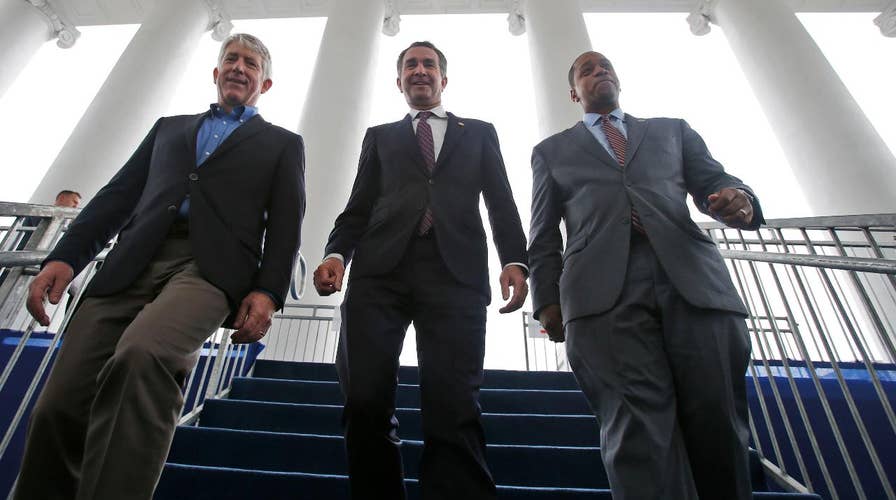
Virginia leadership crisis: Top 3 state Democrats embroiled in controversy
Blackface scandals and sex assault allegation rock Virginia politics; reaction and analysis from the 'Special Report' All-Star panel.
This is a rush transcript from "Special Report," February 6, 2019. This copy may not be in its final form and may be updated.
(BEGIN VIDEO CLIP)
SEN. MARK WARNER, D-VA: I'm shocked and incredibly disappointed. This has been an awful week for Virginia. But I'm just getting the original report.
SEN. TIM SCOTT, R-S.C.: I think it's interesting that for a long time people have tried to pose this or prop this up as a Republican issue. And we are finding out today it's a human issue. And it's unfortunate that we are finding this out so late in the game, but it's obviously a very important issue and I hope people figure out how to do the right thing as soon as possible.
(END VIDEO CLIP)
CHRIS WALLACE, HOST: That's Democratic Senator Mark Warner and Republican Senator Tim Scott reacting to the latest revelations from Virginia, and they keep on coming. While Governor Ralph Northam ponders whether to step down, the woman who alleges Lieutenant Governor Justin Fairfax, Northam's potentially successor, sexually assaulted her, has now come forward. And the next in line to become governor, Attorney General Mark Herring admits he wore blackface in college.
Time to bring in our panel to sort this all out, Jason Riley, from "The Wall Street Journal" and the Manhattan Institute, Mara Liasson of National Public Radio, and national security analyst Morgan Ortagus. Jason, what on earth is going on in Virginia?
(LAUGHTER)
JASON RILEY, "WALL STREET JOURNAL" COLUMNIST: Well, I think what surprised a lot of people, Chris, is not only how commonplace this sort of behavior seems to have been.
WALLACE: You are talking about the blackface?
RILEY: Yes, but how recently it was still so commonplace, at least in certain parts of the country and in certain social circles. But I would like to reiterate something Senator Scott said here. What we also see playing out is a cautionary tale in politicizing racism. This is not a partisan issue. Neither party is unblemished here. But you have had Democrats in recent years try and pretend that Republicans have a monopoly on racial prejudice. The reality is that Congressman Steve King's views on race are no more representative of all Republicans than the Virginia governor's views are of all Democrats, and we should acknowledge that.
WALLACE: Let's take a look at the line of succession in Virginia because this gets really interesting, and, again, you need a program to follow all of this. If Ralph Northam were to resign because of wearing blackface back in the 80s, his successor would be Lieutenant Governor Fairfax. If he resigns because of allegations of sexual assault, his successor is Attorney General Herring. But if he resigns because of wearing blackface, the new governor will be House Speaker Kirk Cox, all those top three as you can see are Democrats. Cox is a Republican.
Mara, what makes this even more interesting is the reason that Cox is the speaker in the first place is because in the 2017 election, there was one, the last district was decided -- it was a flat-footed tie, equal number of votes. So they picked a name of one of the two candidates out of a bowl. It turned out to be the Republican rather than the Democrat. That gave the majority to the Republicans, so potentially the next governor of Virginia, Cox.
MARA LIASSON, NATIONAL POLITICAL CORRESPONDENT, NATIONAL PUBLIC RADIO: Would be a Republican.
WALLACE: Would be a Republican, and by the benefit of picking a name out of a bowl.
LIASSON: Yes, out of a bowl, and with the benefit of having three Democrats ahead of him fall like dominoes. If you took this storyline to a publisher, they would say this is ridiculous. Why don't you write it again? I think it's just extraordinary. And that's why there is now talk of Ralph Northam becoming an independent and keeping job that way because the entire Democratic Party in Virginia of course wants him to step down. He might keep his job because of all of this mishigas.
(LAUGHTER)
LIASSON: I don't know what else you would call it.
WALLACE: That's a technical political phrase. Morgan, let me pick up on that, because it was easy enough for Democrats to kick out, or push out a Democrat because another Democrat was going to inherit the role. But this potentially could be kicking out a Democrat so a Republican ends up taking control of a very key state in what could be a big state in the 2020 election. Could you see that making some Democrats maybe backtrack on wanting to force Northam out?
MORGAN ORTAGUS, NATIONAL SECURITY ANALYST: It shouldn't, right? This shouldn't be a political decision at this point. I know all of it is politics. But the problem here is that we are in the middle of a very nasty and contentious national discussion still on race, but also on the Me Too movement. I mean you are looking at what the lieutenant governor is accused of. If we applied the standards that the Democratic Party set out for Kavanaugh and for others -- look at the senator who had to step down from it last year. If we apply that standard, then just merely the accusation means that you must remove yourself from the office.
I don't apply that standard. But I think as we look at what we are doing, this conversation that we are having on race and that we are having on the Me Too movement, we haven't really solidified this as a nation because it got political and because people started to using it to the gain of their political party instead of figuring out where we are.
WALLACE: Let me stir up the pot a little bit more in all of this, Jason, because it isn't just race. It isn't even just the Me Too movement. Remember, this all started with Ralph Northam and his comments on late term abortion. And the question I have is, is this just a problem for the Democratic Party in Virginia, or could this become or is it already a problem now for the national Democratic Party?
RILEY: It could be if we start setting new standards. It could go well beyond Virginia. If we are going to retroactively condemn these behaviors, these poor taste attempts at humor from 30 years ago or more, we could be heading down a very slippery slope, and I don't know that we want to do that.
If the governor believes he has lost the confidence of the people of Virginia, he can no longer do his job effectively, then, yes, resign. But to start -- we all know humor doesn't age well. That's no big secret. But to start, again, retroactively setting some zero tolerance policy, you're going to be roping in not only just public figures --
WALLACE: Wait, are you suggesting that the governor wearing blackface back in 1984 shouldn't be grounds for him to be removed?
RILEY: In and of itself, no. He has apologized. I think people are very forgiving, and I think tolerance is part of forgiving people. And he said he was sorry for what he did. But I think, again, if we start applying this standard to everyone, you are not -- every public figure who has ever engaged in this, you're going to be roping in entertainers, comedians, singers, all types of people in public life. And I just don't know that we want to go down that road.
LIASSON: The Democrats have to decide what their standards are. Is it zero tolerance without any due process? Do they want to form a circular firing squad every time one of these things happens? I think the late term abortion problem is separate. That's something that Republicans can use to paint the Democratic Party as the party of abortion up until the moment of birth. That's separate. But these other problems about race and Me Too, these are internal Democratic troubles.
WALLACE: Real quickly, hard for Democrats to say well, now, let's take the long view of this when they were going after Republicans tooth and nail.
ORTAGUS: We also saw in Florida, we saw the secretary of state, a Republican had to resign over this. Another state legislator in Florida, also a Republican, is dealing with this. So it goes -- as Tim Scott said, it goes beyond party. We have a human issue, we need to have a national conversation on this. And this is why you don't politicize these very sensitive conversations. When you do, it comes back to bite you.
WALLACE: All right, panel, we have to step aside for a moment. Up next, a new crop of possible Democratic candidates, and an old controversy Elizabeth Warren can't seem to end. We are talking 2020 next.
(BEGIN VIDEO CLIP)
PETER DOOCY, CORRESPONDENT: Anything that you could tell us about the big announcement?
SEN. AMY KLOBUCHAR, D-MINN.: Just that we would love to have FOX there covering it.
OPRAH WINFREY: Have you given yourself a deadline?
REP. BETO O'ROURKE, D-TX, FORMER SENATE CANDIDATE: Before the end of this month.
SEN. KAMALA HARRIS, D-CALIF., PRESIDENTIAL CANDIDATE: We should be united in service of a common purpose.
SEN. ELIZABETH WARREN, D-MASS.: I am not a member of a tribe, and I have apologized.
(END VIDEO CLIP)
WALLACE: A lot of action in the Democratic race for president today. Senator Amy Klobuchar looking to get in, Beto O'Rourke still thinking about it, and Elizabeth Warren trying to put out still another fire. And we're back now with the panel. Let's start with Elizabeth Warren, who, it turns out, and take a look at this, registered for the Texas Bar in 1986, and there you can see she listed her race as American Indian, appears to be in her handwriting. Mara, how much does this add to the problem we have known that Elizabeth Warren has had for some time claiming that she was a Native American?
LIASSON: I think the problem is she just can't get rid of this. She took the DNA test in hopes of getting rid of it. Didn't work.
WALLACE: It didn't work because it turned out to be point-zero-whatever.
LIASSON: But also, it didn't work in terms of getting the issue out of --
WALLACE: It might have worked if she had a little bit bigger percentage, maybe one percent.
LIASSON: A lot bigger. I don't think one would have done it.
Then she apologized to the Cherokee Nation. Now there is this registration card where she identifies herself as American Indian, which, by the way, she always said that she did, or she never used it to get advancement. So I think it is a problem for her. In general, the Democratic field is going to get bigger and bigger, and it's going to get more diverse. Right now we have had a lot of, quote, progressive candidates. It's going to start getting more diverse when you get Amy Klobuchar and some other people in there.
WALLACE: All right, Morgan, I'm going to give you a two-for. Beto O'Rourke told Oprah yesterday, and there's no bigger person to tell, that he will decide by the end of this month whether or not he is going to run. And then there was this. Let's put it up on the screen. Democratic Senator Kirsten Gillibrand sent out this gif, and you will see it keeps repeating itself, giving a look of extreme exasperation with the president's speech. Sent this out as a tweet to raise money. Thoughts? You can go with either one.
ORTAGUS: I think Hillary Clinton tried that exasperated, rolling her eyes out throughout the 2016 campaign, and it didn't work well for her. So I don't know what Kirsten Gillibrand is trying to get out of that.
For Beto, it's interesting because he still captures so much of the young millennial, now Gen Z vote, Gen Z, many of them are old enough to vote in this next election. So we'll see if that's able to continue. I think you could see a lot of people waiting it out. I agree with her on the diversity. But what still remains to be seen for me is, if you are a white man, can you get through this primary? Because there is a lot of Democrat activists that are saying it needs to be a woman, it needs to be a person of color. And what's your argument if you are Biden or Beto or another white man to take the nomination from someone like Kamala Harris?
LIASSON: Like Ohio is an argument. That's one argument.
(LAUGHTER)
WALLACE: Yes, that is an argument.
Jason, Let's go back, and it seems like a year ago already, to the president's State of the Union last night. A lot of commentary about it. Do you think that the president paved the way for some real legislating this year, some real compromise, or do you think he made Democrats an offer they can all too easily refuse?
RILEY: I think that the doubling down on the border wall is getting diminishing returns for him. The shutdown, the run-up to the shutdown, the midterm elections, none of this has really swayed public opinion his way as he thought it would. So I don't think that's working for him. He laid out some --
WALLACE: What about the argument if he doesn't keep pushing for that, that key 35 percent, his base --
RILEY: He honestly believes that, but I think there are other issues he could be using, and last night he mentioned some of them. I think doubling down on partial birth abortion I think will be very popular. Most Americans do not like partial birth abortion, including most women and most millennials, as you were talking about.
I also think the socialism that he is talking about that's so popular with many younger people on the left is popular. When it comes to things like Medicaid for all, most people get their insurance through their employer. They like the insurance they are getting. And when they are told that a single payer system means they have to give that up plan, it becomes very unpopular. I think the president has some issues here that he touched on last night that he can continue to talk about.
WALLACE: Mara, I've got less than a minute left. Do you think that this speech in the end was more designed as an opening salvo for 2020 or to actually make some legislative progress in 2019?
LIASSON: The first one. If he wants to make progress on infrastructure, drug pricing, paid family leave, all of the potentially bipartisan compromises, he needs to flesh those out, he needs to lay down some principles, he needs to show that he is really serious about getting deals on that. So I would say right now it was a 2020 --
WALLACE: The fact is he talked for 15 minutes about the wall and for about 15 seconds about infrastructure.
LIASSON: That's what I mean. If he is serious about making bipartisan compromises on those issues, he needs to prove that he is. His speech didn't do that.
WALLACE: Real quickly.
ORTAGUS: The prescription drug that he talked about, that goes farther, I think, in the minds of most voters than talking about healthcare comprehensively. People are worried about the cost of their prescription drugs. And if he can get a win on that, I think he chips away at the problem that the Republicans had in the 18 midterm as it relates to healthcare.
WALLACE: I will say, I met with Nancy Pelosi yesterday, and she said, we agree on drug pricing. We completely disagree about how to accomplish it. Thank you, panel.
When we come back, the town of Golden, Colorado, goes to the dogs.
(COMMERCIAL BREAK)
WALLACE: Finally tonight, last Sunday was National Golden Retriever Day. And the town of Golden, Colorado, decided to celebrate in a big way. They invited the owners of goldens to bring their dogs to have a good time and just maybe break the world record for the most golden retrievers ever gathered in one place. The dogs clearly loved it, and more than 900 showed up. And they swamped the old record of 361 that assembled in Scotland last July. So congratulations to all those dogs and owners who decided to, yes, go for the gold.
And that's "Special Report" for tonight.
Content and Programming Copyright 2019 Fox News Network, LLC. ALL RIGHTS RESERVED. Copyright 2019 ASC Services II Media, LLC. All materials herein are protected by United States copyright law and may not be reproduced, distributed, transmitted, displayed, published or broadcast without the prior written permission of ASC Services II Media, LLC. You may not alter or remove any trademark, copyright or other notice from copies of the content.
