


Trump signals openness to deal to reopen government with 'down payment' for border wall
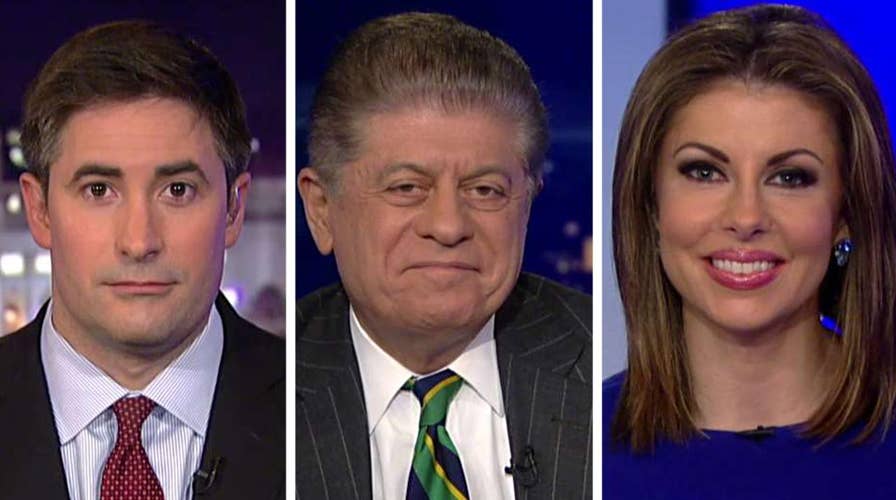
Furloughed federal workers to miss second paycheck as Senate rejects two proposals to end partial government shutdown; reaction and analysis from the 'Special Report' All-Stars.
This is a rush transcript from "Special Report," January 24, 2019. This copy may not be in its final form and may be updated.
(BEGIN VIDEO CLIP)
PRESIDENT DONALD TRUMP: One of the ideas suggested is they open it, they pay a prorated down payment for the wall, which I think people agree that you need. You need the wall. In fact I see a lot of Democrats, almost all of them are breaking saying, look, walls are good, walls are good.
REP. NANCY PELOSI, D-CALIF., SPEAKER OF THE HOUSE: How is a wall more important than families? This shutdown is not a glitch. It is a crisis that the president alone created and that the president alone can end.
(END VIDEO CLIP)
JOHN ROBERTS, ANCHOR: Let's bring in our panel now, Fox News senior judicial analyst Judge Andrew Napolitano, national security analyst Morgan Ortagus, and Jonathan Swan, national politics reporter for "Axios." The president there asking for a prorated down payment on his wall in a continuing resolution which would fund government for three weeks or so. I did the math really quickly, $5.7 billion divided by 365 times 21 -- $327 million he wants. Can he get that out of the Congress?
MORGAN ORTAGUS, NATIONAL SECURITY ANALYST: I may have an MBA, but I cannot do math in my head the way you just did.
ROBERTS: I did it on the computer. It was faster.
ORTAGUS: I think when the American people are looking at this, this has devolved into a cafeteria food fight with the Democrats in Congress saying, but he started it. And I think that's why people are so frustrated. I think whatever moral argument that Nancy Pelosi and the Democrats felt that they had around Christmas or even two weeks ago, for me that has really evaporated in all of this, because there is no point. We have this many resolutions come to the table that you are not seeing Democrats negotiate with the president.
And this standoff is hurting real people. There are real people that I in the Navy Reserve that I drill with that are federal agents that work at the U.N. in New York, these are friends of mine that have children that are living paycheck to paycheck because they may have a wife or husband at home. And so I think that it's time for both sides of the aisle to get over themselves and to get a real solution here. And this moral imperative that the Democrats think they have I think has been washed away. It's time. It's time to come to the table.
ROBERTS: Is it telling, Judge, that the Democratic measure just to open the government with no money for the wall got two more votes in the Senate than the president's plan did?
JUDGE ANDREW NAPOLITANO, JUDICIAL ANALYST: Yes, it is very telling. I was surprised to see the six Republicans in the Senate go for it.
But I want to pick up on what Morgan was saying and not address the politics and not address morality but just address the Constitution. According to Congressman Will Hurd, former CIA agent and a conservative Republican through whose district most of the wall would pass, the vast majority of that property is not owned by the federal government. The president cannot condemn property on his own, he can't take property on his own. He can only do that with the express authorization from Congress. And Congressman Hurd says most of my constituents are saying not in my backyard. What does that mean? That means litigation over the value of each parcel of property. The president can get $7 billion tomorrow. He won't be able to spend it for years until the litigation is over with.
ROBERTS: And here's one of the other things about the wall, too, in Texas, because you have to build it out of the Rio Grande floodplain. These illegal migrants coming up from Honduras who want to get apprehended by the Border Patrol will simply have to cross the river, put feet on American soil, and it would be like there was no barrier there.
NAPOLITANO: Once their feet on American soil, they are protected by due process.
ROBERTS: So Jonathan, Morgan was saying that tomorrow federal workers will miss their second pay period, and for a lot of people this really is going to begin to bite. So how do you read political pressure and how it's growing, and who is it really putting pressure on, Congress or the president?
JONATHAN SWAN, NATIONAL POLITICS REPORTER, "AXIOS": It's really hard to say because the president is seeing the Coast Guard, for example, not getting paid, and they've tried to hotline a bill to pay them through the Senate that the military is certainly, Trump sees that as his constituency. He said this publicly that a lot of these federal workers are Democrats, so he does distinguish in some ways about that.
And obviously the Democrats, they say these are their constituents, and particularly members from states with lots of federal workers. Maryland, Virginia, others. So there is pressure on both sides. But the leadership is so dug in. Nancy Pelosi has said that walls themselves are immoral. So for her to then give money for something called a wall is then off the table, or even steel slats or whatever.
ROBERTS: But so is off the table taking down the amoral wall that already exists along the border.
SWAN: Sure.
ROBERTS: She's trying to have it both ways.
SWAN: So you now have this situation. I was talking to someone in the White House today about this, and Democrats are now saying maybe we'll give you $5.7 billion for things along the border but not barriers and wall. That's not going to cut it. That's everything except for what Trump really wants.
ORTAGUS: If you're the president's reelection campaign members and you're watching these past two weeks, I think you're elated, because any thought that you had that the Democrats might moderate and nominate someone like Biden and try to be responsible, if this is the behavior that we've seen over the last two weeks going into 2020, the president's reelection campaign must feel great.
ROBERTS: However, there seems to be a little bit of a disconnect here. I want to jump ahead and replay something that Wilbur Ross said this morning that even the president said he could have said better, and the way Wilbur Ross walked it back this afternoon. Listen here.
(BEGIN VIDEO CLIP)
WILBUR ROSS, COMMERCE SECRETARY: The banks and the credit unions should be making credit available to them. These are basically government guaranteed loans.
We are painfully aware that there are hardships inflicted on the individual workers. All I was trying to do is make sure that they are aware that there are possible other things that could help somewhat mitigate their problems.
(END VIDEO CLIP)
ROBERTS: So Judge, the administration is trying to take the moral high ground here to say we know that workers are hurting but it's important that we get border security, and then Wilbur Ross comes out and says I don't know why they can't get a loan.
NAPOLITANO: I think he really cut the ground out from under the president there. In the world in which he lives he can call up his banker and get a loan for almost anything that he wants. But the federal government workers cannot do that. It's one thing to say, well, you work for the federal government, it's bankrupt, what do you expect, there are times when it can't pay their bills. It's another thing to say, what's wrong with you? Go borrow the money. Nobody accepts that is a reasonable response.
ROBERTS: Right now, State of the Union, the president had his heels dug in, he sent the note back to Nancy Pelosi yesterday, I'll see you on the 29th, his schedule. She wrote him back, no, you won't. And then we heard that there was going to be a plan b.
Late last night the president tweeted, "As the shutdown was going on, Nancy Pelosi asked me to give the State of the Union Address. I agreed. She then changed her mind because of the shutdown, suggesting a later date. This is her prerogative. I will do the address when the shutdown is over. I'm not looking for an alternative venue for the State of the Union Address." He got the political capital, Jonathan, of making her disinvited him, but then does he lose by saying, you know what, she's right?
SWAN: I don't know. It was sort of out of character for Trump. And I was texted this a few hours ago. It was quite surprising to see him do that. Is there some backstory here, is it political? The two things I've learned is, one, there are real logistical issues with a lot of these other options, but also more than that, and I heard this from people who discussed this with Trump, is he likes the tradition. He really likes the House.
ROBERTS: What bigger venue could you get?
SWAN: And he didn't want to give up the pomp and circumstance of the House. So I think that was really the --
ROBERTS: He's got to wait a little while, he's got to wait. All right, hang right there, panel. Next up, friendly talks with North Korea and harsh words with Venezuela. We'll be right back.
(COMMERCIAL BREAK)
(BEGIN VIDEO CLIP)
MIKE POMPEO, SECRETARY OF STATE: The regime of former president Nicolas Maduro is illegitimate. We call on Venezuelan security forces to ensure the protection of interim president Guaido's physical integrity and his safety.
VLADIMIR PADRINO LOPEZ, VENEZUELAN DEFENSE MINISTER (through translator): We categorically reject the illegal actions in which a parallel government is attempted to be installed in our country. We recognize as a legitimate president of the Venezuelan-Bolivarian Republic, our commander in chief, Citizen Nicolas Maduro.
(END VIDEO CLIP)
ROBERTS: Dueling views there from our secretary of state and the Venezuelan defense minister. And we are back with our panel. Morgan Ortagus, you are the national security expert here. Where is this heading?
ORTAGUS: This is a tough one. I think what's really important is the number of countries in the western hemisphere that are supporting the opposition as well. But I really think if you look at the larger picture, this is the first real geopolitical power struggle between us and the Chinese, and of course the Russians, in our hemisphere and this new sort of cold war redo that we are entering.
And so I think what's really tough is that the Chinese are holding their debt. They are clearly not going to be interested in a new pro-democracy, pro-American regime there. And so this is really about which side blinks. The longer that the military supports Maduro, the more time that he has on his side. And unless the U.S. and the Columbia and any other countries have a strategy to get to the military away from Maduro, I have a hard time seeing him falling, as much as we would like that to happen.
ROBERTS: The United States thought this was going to be over quickly, Judge. It looks like they may have misjudged.
NAPOLITANO: I agree with you. And I was surprised at the strength and the clarity of the statement we heard from the Venezuelan military. I think that basically says, he's our guy and we are going to defend him, and the other guys illegitimate.
My view is Maduro is a monster, Venezuela is a disaster, but it is not our job -- I'm quoting John Adams now -- to go around the world, he said roam the world, looking for monsters to slay, because if it is, there are monsters far worse than Maduro, and where will this end?
ROBERTS: But he was pretty bad.
NAPOLITANO: Yes.
ROBERTS: So far, Jonathan, the Venezuelan military has held off most action. They've been out in the streets, but they are still backing Maduro. They don't want to get involved in a firefight with the Venezuelan people it would seem, at least not now. But if these crowds continue to come out on the streets and Maduro continues to be in charge of the military, could we see the beginnings of a civil war here, or some sort of massive violence in the streets?
SWAN: We could, but I would say, yes, the military made that statement, but they also haven't arrested -- and touch wood, obviously -- they haven't arrested Guaido, and that is not being lost on U.S. officials. Ye, but here's the calculation. Maduro is sitting there hoping that the military stays loyal to him, and there's every chance that if he doesn't -- he's worried about giving them an order that they might refuse. If they refuse an order from him, that changes the dynamics pretty substantially.
As for what to watch, we are expecting obviously oil is the big leverage point for the U.S., and they are looking, as they've said publicly, diverting, trying to divert all this money that the U.S. is sending over there to the new regime.
NAPOLITANO: I don't want to contradict what I just said, but there's a constitutional argument to be made under the Venezuelan Constitution that when the General Assembly declares the presidency vacant, the head of the legislature, this 36-year-old fellow we're talking about, is the interim --
SWAN: And that's exactly the argument.
NAPOLITANO: So you could actually make that argument under Venezuelan law.
ROBERTS: I think they are trying to make that argument. And Maduro is saying, well, you're nuts, because I don't buy that argument.
ORTAGUS: But it's important to note that this is not an American-led effort, this is not American-led regime change. This is America standing up by the people of Venezuela who have been literally starving in the streets. This is plenty of countries, I think over 21 in the region at this point, that are supporting them. So this is the president actually standing by the people of Venezuela in a way I think he should get a lot of credit for. We saw this happen in 2009 in Iran with the Green Revolution. President Obama did not stand by those dissidents, and we see what happened there.
ROBERTS: Up against some powerful opposition, as you pointed out, China, Russia, and one of our supposed to be allies, Turkey, as well.
Let's jump ahead to North Korea because Chairman Kim is said to have great satisfaction about a letter the President Trump sent to him in response to a letter that Kim sent to the president. Apparently the White House is not at least at the moment going to release the text of this. But the president says "The fake news media loves to say so little happen at my first summit with Kim Jong-un. Wrong! After 40 years of doing nothing with North Korea but being taken to the cleaners and with major war ready to start, in a short 15 months, relationships built, hostages and remains back home where they belong, no more rockets r missiles being fired over Japan or anywhere else, and most importantly, no nuclear testing."
But Jonathan, at the same time, the president getting some criticism from people saying he should not meet with Kim because North Korea has not taken step one toward denuclearization.
SWAN: Right. And the big fear among hawks on this issue has been for Trump to fall into incremental -- you give us one thing, we'll give you another. The hawks want total denuclearization before we make any concessions to North Korea. But to Trump's point, the only concession he has given them has gone and met with him. He actually given him anything beyond that.
ROBERTS: And he's going to meet with them again. That's all the time we've got. Panel, thanks for being with us tonight, appreciate it.
When we come back, why General Colin Powell is thankful tonight.
(COMMERCIAL BREAK)
ROBERTS: Finally tonight, a good Samaritan, former Joint Chiefs Chairman, also former Secretary of State General Colin Powell, a familiar face around these parts, is thanking a man who helped him change a tire after a blowout. Anthony Maggert had lost a leg in Afghanistan working as a civilian employee. Powell took to Facebook to say the man's help reminded him what this country is all about. The general left us with this quote, "Let's stop screaming at each other. Let's just take care of each other." Isn't that true. I once ran into the general at the Subway in our town.
Content and Programming Copyright 2019 Fox News Network, LLC. ALL RIGHTS RESERVED. Copyright 2019 ASC Services II Media, LLC. All materials herein are protected by United States copyright law and may not be reproduced, distributed, transmitted, displayed, published or broadcast without the prior written permission of ASC Services II Media, LLC. You may not alter or remove any trademark, copyright or other notice from copies of the content.
