










Trump sends scathing letter to Pelosi on eve of impeachment vote
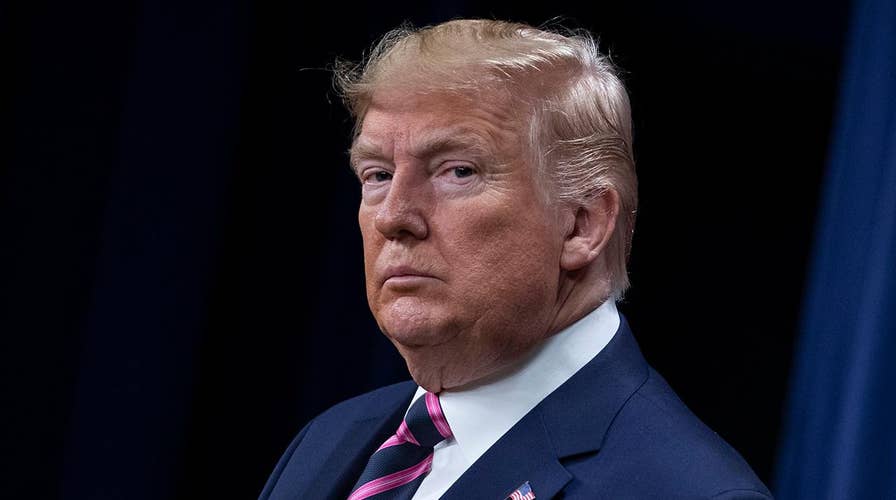
President Trump, in a blistering, no-holds-barred six-page letter to House Speaker Nancy Pelosi, lambasted the Democrats’ impeachment inquiry; Rep. Eric Swalwell reacts.
This is a rush transcript from "The Story," December 17, 2019. This copy may not be in its final form and may be updated.
Martha MacCallum, host: Thank you, everybody. And breaking tonight, take a look, there's a live shot. This is the House Rules Committee that is still at it tonight. That vote could approve the guidelines, and it could come at any moment now, so we're watching that. The House is readying to impeach President Trump. He sent Speaker Pelosi, late today, a blistering letter expressing his "strongest and most powerful protest against this move," says it's unlawful and that it's a partisan crusade by Democrats. Also, another big story breaking tonight, the FISA court slapping back at the FBI. Good evening, everybody. From New York, I'm Martha MacCallum, and this is “The Story.” The country remains divided tonight on the issue of impeachment. Take a look at this CNN poll which actually shows a five-point move against this idea in just the last month. And this pressure being felt in swing districts and beyond as Democrats come face to face with some constituents who are not onboard.
[begin video clip]
Male Speaker: The facts of history are the --
Female Speaker: Liar.
Male Speaker: -- are the facts of history. They will not be denied.
Male Speaker: You're a liar.
Male Speaker: You're a liar.
Female Speaker: Liar.
Male Speaker: Liar! Liar!
Male Speaker: You should be in jail. You're dead. You are a disgrace to the House of Representatives! You will be going to jail for treason!
Male Speaker: [unintelligible] the allegations of -- [bleep]
Male Speaker: It's crap.
[end video clip]
Martha MacCallum: Those are some unhappy folks. Both sides of the story here tonight; Democratic Congressman Eric Swalwell and Republican Congressman Devin Nunes. Plus, Trey Gowdy here tonight on the big picture in all of this. Also, some new polling spells trouble for Democrats in 2020. And Donna Brazil responds to the new polls about the head-to-heads from President Trump and those who are running. And an exclusive interview this evening, in New York, U.S. ambassador to Germany, Rick Cornell, is joining me as well. But we start tonight with the big story, impeachment. Democratic Congressman Eric Swalwell, a member of both the House Intel and Judiciary committees joins me this evening. Congressman, thank you very much. Good to have you with us today.
Rep. Eric Swalwell, D-Calif.: Of course. Good evening, Martha.
Martha MacCallum: What do you make of those, you know, heated interactions that you're seeing in some of these 31 swing districts. And then also Adam Schiff got some backlash in his district as well.
Eric Swalwell: Well, it shows the courage that my colleagues have brought to this decision-making process. I've heard Republicans accuse Democrats, in fact, ranking member Doug Collins, for hours today in the Rules Committee, said all the Democrats are doing are playing to their base. Well, if you look at Elissa Slotkin and others standing before their town halls and their constituents, and you see people disagreeing with their decision to move forward on impeachment, that's actually not playing to your base at all. That is standing up for what you believe in.
Martha MacCallum: No, they're making tough decisions. There's no doubt about it.
Eric Swalwell: Yeah.
Martha MacCallum: How many of those 31 do you think can survive the elections in 2020?
Eric Swalwell: I think the voters will reward them for their conviction. I really believe that people understand that this is about our national security, our election integrity, and our oath to the Constitution. It's not about politics. And whether you agree with what we're going to do tomorrow or not, that is why every person who will vote for impeachment tonight is doing it.
Martha MacCallum: You know, does it concern you -- when I looked at, today, some very interesting -- in the Quinnipiac polls, when you looked at some of the numbers underneath the top line numbers, independents, 58 percent of independents in that Quinnipiac poll said that they're against impeachment. So, you know, I just wonder if you're right about those swing districts. And obviously, the tough votes --
Eric Swalwell: Yeah.
Martha MacCallum: -- that those people are going -- are going to have to take.
Eric Swalwell: I don't know about the Quinnipiac poll, but I know about another organization called Fox, and they have their own poll. And I looked at the independent polling there, and a majority of the people polled thought that what the president had done was wrong.
Martha MacCallum: Yeah.
Eric Swalwell: And more people than --
Martha MacCallum: Yeah, that's a different --
Eric Swalwell: -- not thought that the president --
Martha MacCallum: -- poll.
Eric Swalwell: -- committed bribery.
Martha MacCallum: That's a poll that we covered last night as well.
Eric Swalwell: Yeah. 50 percent said he should be removed in the Fox poll.
Martha MacCallum: 54 -- 50 percent said he should be removed. 54 -- 4 percent, rather, said impeach but do not remove. That's the Fox follow which we showed everybody last night.
Eric Swalwell: And Fox is more credible than Quinnipiac, right?
Martha MacCallum: I think they're all credible. Those are all good, solid polls that I think that people rely on across the spectrum. So, we -- that's why we bring them all to everybody. We've got a CNN poll, we've got a Quinnipiac poll, we've got a Fox poll. All those numbers are going out there tonight, so...
Eric Swalwell: And they're all higher than the higher than the Clinton impeachment approval numbers, by the way.
Martha MacCallum: Okay. So, let me ask you this: It was very interesting to me when I watched Senator Schumer come out today and say that they needed more witnesses on the Senate side. And it looked as though he was kind of pointing the finger back at his colleagues in the House and suggesting that you all have left business unfinished. What do you -- how do you feel about that?
Eric Swalwell: He's right about the four witnesses he says that we need to hear from.
Martha MacCallum: Yeah.
Eric Swalwell: And remember, the president has told those witnesses not to come forward. The difference between the House --
Martha MacCallum: Why don't you subpoena all of them, and why don't they push for them all to come --
Eric Swalwell: So --
Martha MacCallum: -- and put it through the court system and wait?
Eric Swalwell: And so, they have been subpoenaed.
Martha MacCallum: One of them was recalled, one of those subpoenas.
Eric Swalwell: 12 out of 14 of them --
Martha MacCallum: Yeah.
Eric Swalwell: -- have been subpoenaed. But, Martha, the difference between the House proceeding and the Senate proceeding, and this is what Senator Schumer knows, is that the chief justice of the Supreme Court will be presiding over the Senate proceedings. So, if the Senators want to hear from those witnesses and the chief justice says that they're relevant, you can conclude probably that that's how the Supreme Court would rule. And the senators would then have to vote against the ruling of the chief justice. So, we don't have a chief justice of the Supreme Court here in the House. And so that's why senator Schumer is making that argument that I think is right.
Martha MacCallum: Well, you heard what Mitch McConnell said. He said, "Our job is to be the jury, and it's the House's job to run the investigation." So, he's essentially saying, you know, you had your chance. You could have waited. You pushed it through, and that was your, you know, political decision, reality decision, whatever it is. But that's -- that's where it stands right now.
Eric Swalwell: I think the American people expect a fair trial. And trials have witnesses, and there are still relevant witnesses. And then the point is, if -- what the House has proved is not enough. And I think we've shown abuse of power that's jeopardized national security and election integrity. If that's not enough, and you still have lingering questions, well, these four individuals have information that would be relevant. I also think it's relevant that the president's telling them not to go forward because innocent men do not conceal or hide evidence. They are forthcoming and cooperative. And they do that because they have nothing to hide.
Martha MacCallum: All right. Well, you know, they also protect executive privilege, which presidents have done up and down the line in the course of all of these impeachments processes that we have seen. So, I mean I don't think that's all that --
Eric Swalwell: But do you think they're more -- if the president had exonerating evidence, he would say, "You know what? I'm just going to sit back, and I'm going to make these executive privilege arguments even though I know that I'm innocent, I really care about executive privilege."
Martha MacCallum: I -- I --
Eric Swalwell: I don't buy it. I just --
Martha MacCallum: I get that.
Eric Swalwell: -- not with this president.
Martha MacCallum: You know, I have no idea what the president feels.
Eric Swalwell: Yeah.
Martha MacCallum: But just looking at it as -- as an observer of both sides of this process, I think there's reason to believe, on both -- you know, that there's not a whole lot of fairness and open-mindedness in this process. And, you know, that he probably feels like he's not going to get a fair shot if they do put people out there.
Eric Swalwell: And if he released --
Martha MacCallum: I don't know.
Eric Swalwell: You know, he released --
Martha MacCallum: I don't know.
Eric Swalwell: -- that call -- he released the call record because he thought it was a perfect call --
Martha MacCallum: Right.
Eric Swalwell: -- and that made him look isn't. So why wouldn't he release the witnesses, and why wouldn't he release the documents? I think that's a fair question.
Martha MacCallum: Well, you know what? I think if those witnesses would exonerate him, he should get them out there. Why not? Why not?
Eric Swalwell: Yeah.
Martha MacCallum: Eric Swalwell, thank you very much.
Eric Swalwell: Of course. My pleasure.
Martha MacCallum: Good to see you tonight. Also, here tonight --
Eric Swalwell: You too, Martha. Thanks.
Martha MacCallum: -- Republican -- thank you -- Congressman Devin Nunes, ranking member of the House Intelligence Committee. Congressman, good to have you with us tonight --
Rep. Devin Nunes, D-Calif.: Great. Great as always.
Martha MacCallum: -- as well. What do you think about those -- those swing districts and how that's going to go in 2020?
Devin Nunes: Well, I think all those members are in a lot of trouble. The key is, is do Republicans have good candidates? And in many of those districts, we do. So, for example, in California, we have a former member, David Valadao; four polls, he's up by double digits, and that was before impeachment. So, I think we've got a lot of great districts that we can win in 2020. And, you know, the problem that they have with this impeachment is that they did not run a fair process. So, whenever they say they're running a fair process, it actually means the opposite. We had so many witnesses -- and we didn't ask for very many. We asked for about 10 witnesses. They called exactly zero of our witnesses in, okay? So how do you have a fair trial? How do you run a real investigation? You know, for all the nonsense that we've heard with these guys that, where they moved from the Russia hoax to the Ukraine hoax that then turned into the impeachment hoax, remember, we gave them dozens and dozens and dozens of witnesses when we were in control to try to prove their Russia hoax. And now what do we know? All they did was lie to the American people.
Martha MacCallum: Well, let's talk about -- let's talk about some of that. Very interesting report tonight coming out from the FISA court, pushing back against the FBI, essentially saying, you know, don't try this again with us because by the time it gets to us, we're assuming that what you're putting in front of us is real and is accurate and is substantiated. And now they know that that was not the case at all, that they were given things that had huge holes in them and asked to sign off on them.
Devin Nunes: Yeah. I'm glad to see the FIS court come out and make a statement. But your viewers need to know that the FIS court is also culpable in this madness also.
Martha MacCallum: How so?
Devin Nunes: And I say that because we sent them two letters, very specific letters, so this is probably people are hearing this for the first time. We sent one, I believe in February of 2018, warning them of very serious matters that it was based on the memo that we had put forward at that time. They did absolutely nothing about it. Then again, when we found out that source two, the only additional information, okay, that was there, it was essentially the -- it was the dossier --
Martha MacCallum: Right.
Devin Nunes: -- the dirt. It was the fake news stories that they used, and then it was this source two. Well, we assumed the whole time -- we assumed when we wrote the original memo that source two was legitimate. But later, Trey Gowdy, who you're going to have on in a little bit, and myself, and John Ratcliffe, and our investigative team, we began to look at source two, and we discovered, number one, that they had actually begun spying before they even got the -- the warrant.
Martha MacCallum: Yeah.
Devin Nunes: But number two, they left all of this exculpatory evidence. This is evidence that they should've put forward on both Page and Papadopoulos and I think Papadopoulos is really key because he's the reason that they started the entire investigation and he denied it clearly. So, at that point when you have a full-blown CIA investigation going on you should do something but the point here, Martha, is is that the court knew about all this. So, I'm not saying that I'm glad they've acted. I'm glad they said something, but I think the court needs to be –
Martha MacCallum: Well, let me ask you this.
Devin Nunes: The court has to be ended. I mean, this is –
Martha MacCallum: Okay. Well, that’s what I was just going to ask you because tomorrow I'm going to interview the attorney general, William Barr, and we're going to talk about this. Do you believe that the -- this court should be eliminated as Andrew Napolitano has also -- the judge has also advised on this show?
Devin Nunes: Yeah. We need a process, okay. So, I'm not going to speak in absolutes, but I will say that the way that they -- the courts conducted themselves is totally inappropriate. They ignored clear evidence that we presented to them that remember, they had this. The American people didn't have it. We had seen it. They had it. They did absolutely nothing about it. So, they've left really Congress no choice but to have to step in and fix this process.
Martha MacCallum: Let me ask you this. Were there particular judges on the fifth court that you feel did not treat this properly?
Devin Nunes: Well, I mean, look, when you have the evidence that we present to them and they do nothing about it and now they come out and I have to look closely at the letter that they sent out today, the statement that they sent out because I'm not so sure that they're being entirely truthful because I've read what we sent them. I just read it a few hours ago back in the summer of 2018 they had a lot of this information that they claimed they just found out about. So, I have to look closely at the wording.
Martha MacCallum: Very interesting. All right. Well, yeah, we'd love for you to come back and talk about that some more, you know, when you make that comparison between what they're saying and what you told them and made clear to them back then. I want to ask you one last question with regard to Ukraine because you talked about, you know, the Russia situation and then Ukraine. Rudy Giuliani, the president's attorney, is -- you know, has been back in Ukraine. He says that he has a lot of information that will prove that there was indeed a Ukraine element to meddling in the election. In fact, he's arguing I believe that it was Ukraine and not Russia. He says that he needed to get Yovanovitch out of the way because she was standing in the way of improving the situation there. Do you agree with that? What do you think about that?
Devin Nunes: Well, I want to -- I don't think -- I have not seen Rudy Giuliani say that Russia didn't meddle in the election. It is clear that Russia meddle in this last election and it's clear that Russia has always meddled in our elections and Russia will continue to try to meddle in our elections as will other countries. The key point here is that about Ukraine there was no question that the Democrats were -- had paid operatives that were getting information out of Ukraine. I mean, you only have to look at Paul Manafort. I mean, Paul Manafort was dirtied up by what was likely disinformation. Now look, he ended up doing other things wrong but that initial dirt, that came from Ukraine. We also know that the dossier sources, some of those sources were in Ukraine. So, there's no question I'm not saying that the Ukrainian government had some not like Putin was doing, but look, they clearly sided on behalf of the Clinton campaign and they helped to dirty up Trump. I mean, you had the ambassador in Ukraine in the United States in Washington, D.C., saying negative things about a presidential candidate, which is almost unheard of. So, as it relates to Yovanovitch the issue there is that there are people there that -- in Ukraine that want visas to come to the United States so they can present evidence to the appropriate authorities, whether it be Congress or the Department of Justice and that's the problem and that's what Rudy Giuliani is saying that there are people that want to give us information that cannot do it.
Martha MacCallum: Okay. We’ll see where it goes. Devin Nunes, thank you very much. Congressman, good to see you tonight.
Devin Nunes: Thank you.
Martha MacCallum: Thank you.
Devin Nunes: Absolutely.
Martha MacCallum: Coming up next, this independent voter confronted her democratic congresswoman and she joins us to tell us why, what she's thinking, what's on her mind tonight.
[begin video clip]
Susan Jaslow: I think you're in a lot of trouble if you vote for this impeachment.
[commercial break]
Martha MacCallum: Congresswoman Kendra Horn is considered one of the vulnerable Democrats. She represents a district in red state Oklahoma that went for President Trump in 2016. She came face-to-face with voters, including my next guest who have deep concerns over impeachment.
[begin video clip]
Susan Jaslow, independent voter: He's a duly elected president and I feel it is not your responsibility to take somebody that was duly elected out of office. Let me do that. So, as an independent voter I think you're in a lot of trouble if you vote for this impeachment.
[end video clip]
Martha MacCallum: Today, Congresswoman Horn announced her intention to vote in favor of impeachment. Joining me now is Susan Jaslow, an independent voter who you heard there in an Oklahoma residence. Susan, thanks for being here tonight. Good to speak with you.
Susan Jaslow: Thank you for having me.
Martha MacCallum: Tell me what -- thank you for being here. What prompted you to speak up in there?
Susan Jaslow: Well, I'm not a political person by any means and I was watching the television and Speaker Pelosi looked at me and said, "Constitution is at stake if we don't impeach the president.” And then she went on to tell me that this is not a political matter. And I was just highly insulted. She’s insulting my intelligence. I mean, that’s absolutely ludicrous. And I figured I needed to tell somebody that the country is tired of all this. And --
Martha MacCallum: Why did you feel that she was insulting your intelligence by saying that?
Susan Jaslow: Because the constitution is not at stake. And it is political. And I just felt that she was not being truthful with me. And so, I decided to, you know, tell somebody how I felt. I’ve never done this in my life. I’m just a normal person and a normal wife, mother, grandmother --
Martha MacCallum: Yeah.
Susan Jaslow: -- and I’ve never done anything like this. But I think that --
Martha MacCallum: So, why --
Susan Jaslow: -- we’re all tired of it.
Martha MacCallum: So, why now? You know, like, what -- given that, and I think a lot of people out there feel exactly the way you do. Why were you so moved to, you know, get up and leave your house and go speak out?
Susan Jaslow: Because we’ve just come to the end. I’m tired of all the bickering, the bipartisan bickering. And this country needs to get back to what it’s supposed to be doing. The representatives need to legislate. Let the president do his job. And if we feel at the end of the term he’s not doing a good job, let me --
Martha MacCallum: You want the voters to decide?
Susan Jaslow: -- vote him in or out. Right.
Martha MacCallum: So, let me read you what your representative Horn said. She said, “It’s with a heavy heart, but with clarity of conviction that I’ve made my decision. The oath I took to protect and defend the constitution requires a vote for impeachment. I must do my part to ensure that our democracy remains strong.” Do you think that she will survive in this district given that eight Republicans have now said they’re going to run for her seat against her?
Susan Jaslow: No. I don’t think that she was being honest. I felt that she nullified my vote. And why is her vote more important than my vote? And a lot of people I’ve spoken to feel the same way that I do. A lot of people are out there that are silent and are feeling the exact same way. So, I felt she had no right to do that. Let the voters, the 63 million people that voted for Trump leave him in office or take him out. And she had no right to do that.
Martha MacCallum: So, do you feel that there are a lot of others? What did it feel like in that room? Was there support in the room when you spoke up? How did you feel?
Susan Jaslow: Well, there was support. I was very surprised that after I had spoken, I got an applause. And then I went home and I -- I got all the emails and the texts. And everybody I met, mostly everybody I met, said, “Sue, you know, I felt the same way you do. I just didn’t have enough nerve to say it.” So, there are a lot of people out there that feel the same way I do.
Martha MacCallum: Do you think -- when you read -- President Trump always says, “Read the transcript.” When you look at the transcript, do you see anything wrong with that, with the phone call, with what he asked the president of Ukraine?
Susan Jaslow: I -- there wasn’t any -- there weren’t any facts to -- impeachable facts. So, let him finish out his term, let him do his job, and I will decide if I thought he did a good job or not. Let me -- let me vote him in or out. I don’t feel that Miss -- the Congresswoman [sic] Horn had the right to do what she did and take away my vote. And a lot of people feel the same way I do. We’re very mad. We’re very angry. We just want our country back. We want everybody to play nice, like schoolchildren, and play nice, and let’s just get back to running the country.
Martha MacCallum: Susan Jaslow --
Susan Jaslow: That’s all we want.
Martha MacCallum: Thank you. Thank you for speaking out and thank you for coming here to tell us how you feel about it. We appreciate it. Thank you very much, ma’am.
Susan Jaslow: Thank you.
Martha MacCallum: Good to see you.
Susan Jaslow: Thank you. Thank you.
Martha MacCallum: Coming up next, Trey Gowdy has some thoughts on that and where all of this is heading.
[commercial break]
Martha MacCallum: So, ahead of tomorrow’s expected full House vote on impeachment, estimates show that they have the necessary numbers to impeach, 216, 218, and all, really, that’s looked like that was going to happen from the beginning on the House side. And tonight, the count is that 28 of the 31 Democrats that we’ve been talking about in the Trump districts are going to vote, “Yes.” And they are still tallying up to that final 31. Let’s bring in Trey Gowdy, former House Oversight Committee chairman and Fox News contributor. Trey, good evening. Good to have you here.
Trey Gowdy, Fox News contributor: Good evening. How are you?
Martha MacCallum: What’d you think of Susan Jaslow?
Trey Gowdy: I thought that she was fantastic. I wish everybody in public office could hear how normal, average --
Martha MacCallum: Yep.
Trey Gowdy: -- reasonable people think and feel. I thought she was great.
Martha MacCallum: You know, she said, “People need to play nice and they need to let voters decide who the president is going to be.” Do you think that that idea resonates at all on Capitol Hill on the House side?
Trey Gowdy: Oh, I think they have a lot more of a base analysis than that. Here’s the analysis. If I vote not to impeach Donald Trump, I’m going to get a primary opponent and I’m guaranteed to lose.
Martha MacCallum: [affirmative]
Trey Gowdy: If I vote with my party, I’m going to get a really strong general election opponent, but I might win. So, for Democrats in Trump districts, their dilemma is do I lose in the spring for sure, or do I maybe lose in the fall when it’s pretty and there’s college football, and other things to mitigate my greed?
Martha MacCallum: [laughs]
Trey Gowdy: But they’re guaranteed to lose if they break --
Martha MacCallum: Oh, man.
Trey Gowdy: If they break with their party, they’re guaranteed to lose in their primary.
Martha MacCallum: Wow. We’ll -- yeah. We’ll see where all of this -- do you think politically, overall, I mean, you know, look ahead for a bit to 2020 based on what you see right now. How do you think this sorts out? Do Democrats hold the House after this?
Trey Gowdy: Yeah, well Kevin McCarthy is a -- is a prolific fundraiser. He -- I'm biased. I like him a lot. I think he's recruiting good candidates. So is Elise Stefanik. But I think it's an uphill -- it's an uphill battle to flip that many seats. I think we do hold the Senate. And as you and I have discussed in the past, I think all of this is about flipping the Senate. I think it's about Chuck Schumer and Nancy Pelosi trying to neuter a second Donald Trump term, because there's not a chance in hell he's going to be removed from office. So why are we going through this exercise if we know he's going to be on the ballot in 2020?
Martha MacCallum: Well, let me ask you about what Chuck Schumer said today. He said that he was appalled that Mitch McConnell said that he was impartial in this process. Mitch McConnell said it's a political process. This is not a court of law, and he -- you know, he's on one side. Schumer said that's unbelievable. He said we have to be able to bring in witnesses. We want Mulvaney, we want Bolton, and the two other men who were associated with them. What do you say?
Trey Gowdy: That's what you do during the investigation. And Adam Schiff and Jerry Nadler, if they really felt strongly about Bolton and Mulvaney, and they could have gone to court. But what they felt most strongly about was hurrying through this because they're being governed by calendar. I mean, the Judiciary Committee, Martha, called more impeachment witnesses for the Nixon impeachment than they did the Trump impeachment. They called John Dean, and then they called, what, a couple law professors?
Martha MacCallum: All of the men that -- oh, yeah.
Trey Gowdy: That's it. No fact witnesses. Yeah, no fact witnesses.
Martha MacCallum: All right. I want to get your thoughts on this Jim Comey interview that Chris Wallace conducted with him on Sunday. And with regard to the FISA process and with regard to whether or not these were errors, mistakes, or something more, watch this.
[begin video clip]
Chris Wallace, anchor, ‘Fox News Sunday’: Given the repeated errors, some would say abuses of the FISA process, does Attorney General Barr have a point?
James Comey, FBI director: No. He does not have a factual basis as the attorney general of the United States to be speculating that agents acted in bad faith. The facts just aren't there. Full stop. That doesn't make it any less consequential, any less important. But that's an irresponsible statement.
Martha MacCallum: So, he says that was an irresponsible statement. What do you say?
Trey Gowdy: He's lost his mind. How many of these close calls went in favor of President Trump? I mean, what --
Martha MacCallum: None.
Trey Gowdy: When they changed the email, was it to help Trump or hurt him? When they put the dossier material in, was it to help Trump or hurt him? When they put the -- the DNC-funded Fusion GPS research material, was that to help Trump or to hurt him? Everything that happened was done to hurt Donald Trump. So, I'm -- look, this is the same Jim Comey who thought it was nonsense that we were looking into it. Now he's had a mea culpa moment. It's two years too late. We really could have used him doing some objectivity when he was at the FBI and not two years too late.
Martha MacCallum: Yeah. I mean, how -- how do you describe, you know, that -- what you just said, you know, how could it be that all of those errors went in one direction, and there isn't anything -- and why isn't he curious as to whether or not there was a possible motive behind it?
Trey Gowdy: Because he's morally superior to me and you, because he's always right, because he's the same Jim Comey who couldn't admit he messed up the Clinton investigation. This is the same Jim Comey who said the FBI didn't give a whip about -- it's the same Jim Comey who said he didn't leak or do weasel things in a very document that he leaked. So, that's the Jim Comey we're talking about.
Martha MacCallum: Trey Gowdy, thank you, sir. Always good to see you.
Trey Gowdy: Yes, ma'am.
Martha MacCallum: We'll see you soon.
Trey Gowdy: You too. Yes, ma'am.
Martha MacCallum: Up next, a 2020 Democratic campaign admits that they are worried when they look ahead at the dynamics for 2020. They believe President Trump has a pretty good chance of winning. Donna Brazil on the new polls and whether that fear for her party is real. Coming up next.
[commercial break]
Martha MacCallum: One of the 2020 Democratic campaigns is openly admitting that they are nervous about President Trump's position to win in 2020. Listen to Bloomberg campaign manager Kevin Sheekey in The Washington Post's latest Cape Up podcast.
[begin video clip]
Kevin Sheekey: As we've seen the polls in the swing states, I'm incredibly nervous. You know, I am nervous that Donald Trump is poised to win again.
[end video clip]
Martha MacCallum: President Trump beats each of the 2020 Democrats in a head-to-head matchup by three to 10 percentage points according to a brand-new USA Today Suffolk University national poll taken as House Democrats prepare for impeachment tomorrow. Here now, Donna Brazile, former DNC chair and Fox News contributor. Donna, good to see you tonight. Thank you for being here.
Donna Brazile, Fox News contributor: Thank you.
Martha MacCallum: What's your response to Kevin Sheekey as he looks at those swing states?
Donna Brazile: Well, I understand his concern. After all, President Trump really doesn't have competition in -- in his primary. We do know that the Democrats are in a very competitive primary. Right now, the Trump campaign is able to focus on many of the general election battleground states, Florida, Wisconsin, Michigan, Pennsylvania. The president's made repeated visits to those states. So what he is saying is something that we should all worry about. Look, if you look through the history of our country, only five presidents have lost re-election; Taft, Hoover, Ford, Carter, and George Herbert Walker Bush. So, it's tough to beat an incumbent. That said, I do believe in that same poll, there are a lot of good points. One, Democrats are still doing very well with women. They're doing well with people under 35. But there are -- there are still holes in the coalition that Democrats must pull together in order to win next year.
Martha MacCallum: So, you know, you look at those polls, he beats Michael Bloomberg by nine. And I should point out these are national polls, which, you know, are never as good --
Donna Brazile: Right.
Martha MacCallum: -- as state-to-state polls. Joe Biden by three points. Do you think overall that when you look back at this that the impeachment is going to have been a negative or a positive in terms of the way people view these Democrat presidential candidates?
Donna Brazile: Well, I may not be like most Democrats, or even most Americans. I think this is a solemn duty that the House must undertake in order to protect our country and protect the Constitution. And so, whether they win or lose next year what should remain is the rule of law and I think that's important. So, I understand the political calculus that goes into every vote that members take, and tomorrow will be another vote that members take that might produce a primary challenge or someone that challenges them from the other side.
Martha MacCallum: What did you think -- I'm curious what you thought of Susan Jaslow was a voter who was on earlier in the show. I'm not sure if you saw her, independent voter. She said, "Don't take away my vote." That's what she said to her representative. Your vote tomorrow is not more important than my vote, she said, when I voted in 2016 and I want to vote again in 2020 for the person who I want to be president.
Donna Brazile: And Kendra Horn, who was elected in Oklahoma, the third woman elected in Oklahoma in the history of that state, she won by 1 percentage point. So, she understands what's at stake. Sixty-six million people voted against Donald Trump or voted for Hillary Clinton. Sixty-three million voted for Donald Trump against Hillary Clinton. And so whether you are for Hillary Clinton, for Donald Trump, or against either one of them, it's important that tomorrow's deliberations, what we're going to hear on the House floor, it is a statement about who we are as a country and I know there are people tonight who are looking at me saying well, she's just another Democrat. No, I'm just another American who cares very deeply about the future of our country.
Martha MacCallum: Donna Brazile. Thank you, Donna. Good to see you tonight. Thanks for being here.
Donna Brazile: Always.
Martha MacCallum: You bet. So, coming up, a Story exclusive with Ambassador Richard Grenell next.
[commercial break]
[begin video clip]
President Trump: My administration is working with other nations to stop criminalizing of homosexuality and we stand in solidarity with LGBTQ people who live in countries that punish jail or execute individuals based upon sexual orientation.
[end video clip]
Martha MacCallum: Trump administration taking steps to decriminalize homosexuality around the world following the president's U.N. address back in September. Tomorrow U.S. Ambassadors Richard Grenell and Kelly Craft host a U.N. security council event on the issue where they will plan to shine a light on the 70 U.N. member nations that still consider it to be illegal to be homosexual. Joining me now exclusively Richard Grenell, U.S. ambassador to Germany. Rick, good to see you. Thank you for being here.
Richard Grenell, U.S. ambassador to Germany: Good to see you. Thanks for doing this story.
Martha MacCallum: You say -- you know what? It's important and, you know, the president has spoken out about it. You say this is the first time that this has been a stand-alone effort by the United States on this. Tell me about that.
Richard Grenell: Yes. For the United States to sponsor a stand-alone effort. Look, you go to the U.N. and there are 70 countries there in that room that criminalize homosexuality. Ten of them will kill you for being gay. So, what Trump has done, what President Trump has done to really launch –
Martha MacCallum: Including what are some of those countries that will kill people? We've seen horrific images of people being blindfolded, pushed off of the top of buildings, stoned.
Richard Grenell: Right. Iran, Saudi Arabia. Look, we have a problem in the Caribbean. We have a problem in our own kind of neighborhood, if you will. So, this is not just a Middle East problem. This is Africa. This is the Caribbean. And what we have to do is we have to solve this problem. We give a lot of money. Let's just take the example of Zambia where they just convicted and jailed two people for being gay. They did it and they said we're doing this because you're gay. Okay? The United States gives Zambia $500 million a year in aid. What did Zambia do when our U.S. ambassador said you cannot do this? This is not right. You cannot jail someone for being gay. The government of Zambia has called for our ambassador to be removed, sent home. Now, what President Trump is doing is he's trying to say look, this is something that we can all agree on. The religious community, the right, center, left, everyone can agree you shouldn't be criminalizing homosexuality.
Martha MacCallum: Fascinating. I mean, is it going to get anywhere?
Richard Grenell: Look, I think we are making progress. We're doing a lot already. We're talking to -- I personally have talked to a lot of countries, ambassadors, and foreign ministers who criminalize it. So, I think it's going to take 70 different plans. It's going to take a while, but we had to start, and we've started.
Martha MacCallum: Good for you and we wish you very good luck in that effort. I want to talk to you about one other issue before I let you go because I know you have, you know, sort of been -- you -- some people in Germany are not happy with some of the things that you're pushing in terms of the Nordstrom [spelled phonetically] pipeline, Nord Stream pipeline that's going to go from Russia to Germany. It's going to bypass Poland. It's going to bypass Ukraine. Why does this matter? And now there's legislation in the Senate that's going to pass the Senate I believe. The president will sign that's going to sanction some of the companies involved.
Richard Grenell: Yeah. So, this is good. We've had a longstanding U.S. policy that Europe should diversify. It shouldn't get all of its gas from Russia. It's important to note that the Russian Nord Stream One pipeline we are good with. It's the Nord Stream Two, the one that's going to come on and give even more power to the Russians. This is something that we are supported by 17, 18 other countries in Europe who are saying to Germany you shouldn't do this. So, the Senate and the House have come together. It's now going to be on the president's desk to try to sanction this pipeline. We think that it's a longstanding policy of the United States government to push for diversification and we stand with those 18 other countries in Europe that also agree with us.
Martha MacCallum: Well, good luck on that and good luck to you and our new U.N. ambassador Kelly Craft in your efforts to change these rules in these 70 countries. We hope you get somewhere. Keep us posted. And it's good to see you in New York. Back in New York.
Richard Grenell: Nice to see you again. Nice to see you.
Martha MacCallum: Thank you, Rick. So, on the eve of a historic House vote that could make President Trump just the third in history to be impeached, some are calling the past few weeks the best of his presidency. Find out why next. Rick says nobody’s talking about it in Europe.
[commercial break]
Martha MacCallum: Well, it is the eve of this big vote that is expected to happen tomorrow in the House toward the impeachment of a sitting president, just the third time in American history. You’ve heard this a lot over the course of this coverage. But my next guest argues that the past few weeks have actually been the best of Trump’s presidency, not despite impeachment, but because of it, to some extent. Marc Thiessen writes in The Washington Post, “The economy is humming, Trump’s accomplishments are accumulating, and impeachment is backfiring. And that makes these the best weeks of Trump’s presidency so far.” Marc Thiessen joins me now. He is the cohost of the American Enterprise Institute’s “What The Hell is Going On?” podcast and a Fox News contributor. Marc, always good to see you.
Marc Thiessen, Fox News contributor: Good to be with you, Martha.
Martha McCallum: I’m sure there’s, you know, a lot of folks in the country who will look at your headline --
Marc Thiessen: [laughs]
Martha MacCallum: -- and say, “How -- what the hell is going on? How could you think that?”
Marc Thiessen: Well, here’s what the hell is going on. Look, let’s just look at the legislative accomplishments. So, for the past 12 months, Nancy Pelosi and the House Democrats have basically been stonewalling President Trump’s legislative priorities. Then all of a sudden in the last week or so, the legislative dam has broken. They agreed to pass the USMCA trade deal with Mexico and Canada, which he’s been pushing for them to do for months. They agreed to do a spending bill to avert a government shutdown. They agreed to pass a defense bill that creates his Space Force, that has federal parental leave, that has -- and doesn’t put any restrictions on the border wall. Remember the big fight about the border wall?
Martha MacCallum: Yeah.
Marc Thiessen: And they also -- they also passed a tax bill. They agreed to a tax bill. It hasn’t passed. It’s passing in the Senate, not yet in the House. But they’ve agreed to a tax bill that repeals three Obamacare taxes, further dismantling the Affordable Care Act. How did that suddenly happen? What’s the difference between the past week and the past 12 months? And the answer is impeachment. Impeachment’s the difference. These Democrats are -- see the polls showing that Americans think that they’re focused on impeachment at the expense of getting things done for the American people, and especially the voters like -- the voter you had on just a few minutes ago who thinks that the Democrats are trying to take away their vote and are not doing the things that they sent them to Washington to do. And so, these Democrats, these vulnerable Democrats are desperate to show that they’re working with the president.
Martha MacCallum: Well, let me ask you this. So, if that’s true, if what you say is true, I mean --
Marc Thiessen: [affirmative]
Martha MacCallum: -- a lot of those are facts, obviously.
Marc Thiessen: Yeah.
Martha MacCallum: But do you think Nancy Pelosi sits back, hurt instincts were, right, that she --
Marc Thiessen: [affirmative]
Martha MacCallum: -- shouldn’t do this. That it would be divisive for --
Marc Thiessen: Yeah.
Martha MacCallum: -- the country. Then she got sort of put into, you know, sort of jammed into a position where she kind of had to move forward and then she kept saying, you know, “It’s a Republic only if you can keep it.” And, you know, it was just this somber, serious, sad moment. And she didn’t have any choice. Do you think she regrets it now?
Marc Thiessen: Well, I think she was right the first time when --
Martha MacCallum: Yeah.
Marc Thiessen: -- she said that the -- you know, she was right a few months ago and the Democrats should have just listened to her when she said that unless you have something that’s so unanimous and bipartisan --
Martha MacCallum: Right.
Marc Thiessen: -- that it can be passed with a bipartisan majority, you shouldn’t pursue impeachment. I mean, look, the impeachment has backfired on the Democrats horribly.
Martha MacCallum: You know --
Marc Thiessen: If you just look at the polls, the support for impeachment has dropped. And the polls are showing that Trump’s -- before impeachment, Trump was losing to most of the Democrats in national polls --
Martha MacCallum: Yeah.
Marc Thiessen: -- possible Democrat -- now he’s beating most of them.
Martha MacCallum: Now he’s beating them. And now his approval numbers are sort of matching their highs. They’re never --
Marc Thiessen: Absolutely.
Martha MacCallum: -- they’re, I think, at 43 percent. You know, I wonder if it would have been, you know, just purely politically, right, for them, would it have been better for them to have dragged this thing out as long as possible, to have gone to the courts, to have said, “We want John Bolton. We want Mick Mulvaney.” And just sort of keep it in the blood stream while they pass some of these other things, and while they let it go? You know, jamming it sort of through in the House side --
Marc Thiessen: Yeah.
Martha MacCallum: -- put them in this, you know, very difficult position where a lot of folks look at it and they go, “Well, I don’t even know what’s going on. And I’m not sure why we’re doing this.”
Marc Thiessen: Well, they’re in the worst of both worlds because they’re taking on an issue, which is probably the most serious constitutional process you can take, which is impeachment, and they’re doing it in a way that shows that they’re not serious, that it’s political. They’re impeaching -- one of the two articles of impeachment is impeaching the president for obstruction of Congress. You know, their article one of the Constitution. He’s article two. Article one is not superior to article two. And he’s appealed to article three, the Judiciary. How can you -- how can you impeach the president for going to the courts --
Martha MacCallum: Well --
Marc Thiessen: -- to adjudicate whether executive privilege is valid or not?
Martha MacCallum: Yeah. I mean -- let me --
Marc Thiessen: It’s just ridiculous.
Martha MacCallum: Let me ask you this. Because, you know, looking back at Clinton and looking back at Nixon, there was some feeling in the country that I think sort of matched the sentiment that --
Marc Thiessen: Sure.
Martha MacCallum: -- Nancy Pelosi talks about. It was dramatic. It was upsetting. It was unnerving.
Marc Thiessen: Yeah.
Martha MacCallum: People were, you know, it was just, you know, it just left everyone feeling sick, I think. This, you know, I just talked to Rich Grenell. He’s like, “Can I tell you something? Nobody ever asks me one thing about the impeachment that’s going on in America.” And I hear all the time people say, “No, no one’s talking about it when they go out campaigning. No one’s talking about it out there.” I mean, that’s weird, Marc.
Marc Thiessen: This is a story in the liberal coastal elite bubble. In the rest of the country, they want to know, what are we doing on prescription drugs? What are we doing on trade? What are we doing on all these different things? And so, when, you know, we do this wall-to-wall coverage of the impeachment hearings because it’s news, and it’s history and it has to be covered --
Martha MacCallum: You have to.
Marc Thiessen: -- right?
Martha MacCallum: Absolutely.
Marc Thiessen: But when Americans look at that, we all sit around and debate, did they just score a point against the president. Did the president -- how did the president come out?
Martha MacCallum: Yeah.
Marc Thiessen: They look at that and say, “You’re not focused on the right thing. You’re spending all your time impeaching the president over something we don’t --“
Martha MacCallum: Yeah.
Marc Thiessen: “ -- think is impeachable instead of getting things done for the American people.” This week, Trump, because they went --
Martha MacCallum: Yeah. Well --
Marc Thiessen: -- down this path is getting things done.
Martha MacCallum: -- I think it changes impeachment forever. I think it just becomes a political weapon. We’re going to see it all the time. Marc --
Marc Thiessen: I hope not.
Martha MacCallum: -- I got to go. Thank you very much.
Marc Thiessen: Thanks, Martha.
Martha MacCallum: That’s the story of December 17, 2019. But as always, the story goes on. So, we’ll see you right back here tomorrow. And I will have an exclusive interview in Detroit with Attorney General Bill Barr. Tucker Carlson coming up right after this in Washington, D.C. So, stay tuned for that. Goodnight.
Content and Programming Copyright 2019 Fox News Network, LLC. ALL RIGHTS RESERVED. All materials herein are protected by United States copyright law and may not be reproduced, distributed, transmitted, displayed, published or broadcast without the prior written permission of CQ-Roll Call. You may not alter or remove any trademark, copyright or other notice from copies of the content.
