




Trump on US-China trade negotiations: We want to make a deal we can be proud of for many years
Fox Business correspondent Charlie Gasparino, contributor Deneen Borelli and Democratic strategist Scott Levenson weigh in on the future of trade negotiations between the U.S. and China.
This is a rush transcript from "Your World," January 31, 2019. This copy may not be in its final form and may be updated.
NEIL CAVUTO, HOST: The freeze is on. And chances are, you're feeling it if you're one out of the seven in 10 Americans in the bone- chilling path of it and just trying to deal with it.
Forget about the businesses and all those schools shut. At least 10 people are dead because of all this brutal cold. And guess what? That brutal cold is not over.
Welcome, everybody. I'm Neil Cavuto, and this is "Your World."
And the records falling faster than the temperatures across much of the country today. Try these on for size, minus-30 degrees in Rockford, Illinois, minus-32 in Grand Forks, North Dakota. Try minus-45 in International Falls, Minnesota.
It is so cold that 18 auto plants and facilities in Southeast Michigan are limiting operations or shutting down completely today because there's not enough natural gas to go around.
Michigan's governor issuing an appeal directly to residents to reduce their energy consumption too.
(BEGIN VIDEO CLIP)
GOV. GRETCHEN WHITMER, D-MICH.: Turn our thermostats down to 65 degrees or less from now until Friday at noon.
(END VIDEO CLIP)
CAVUTO: Snow squalls and icy roads leading to pile-ups. This truck driver swerving to avoid a multi-vehicle accident on a highway in Michigan.
(BEGIN VIDEO CLIP)
UNIDENTIFIED MALE: I about just got caught in a giant wreck. Holy (EXPLETIVE DELETED). Cars are into other pickups. There's people hurt. I got to let you go.
(END VIDEO CLIP)
CAVUTO: Banged up, but we're told that everyone is going to be OK.
And, meanwhile, in Detroit, more than two dozen water mains freezing up as the mercury plummeted to 13 degrees below zero. In New York City, temperatures were into the low single digits. This fountain in Bryant Park looking more like a giant ice sculpture.
We have got you covered with all of this with Jacqui Heinrich in New York City on how folks are dealing with it, and FOX News and meteorologist Rick Reichmuth on when we could see some relief from it.
We begin with Jacqui in New York.
Hey, Jacqui.
JACQUI HEINRICH, CORRESPONDENT: Hey there.
It is 16 degrees out here. With the windchill, it feels like negative 2. The key is just to dress for it. You have got to wear layers and you got to be prepared. I even have these goggles out here with me for in case the wind kicks up. You can see the fountain behind me is just ice.
And we talked to some New Yorkers and some visitors about how they were faring in these chilly temperatures. Take a listen.
(BEGIN VIDEO CLIP)
GOV. ANDREW CUOMO, D-N.Y.: I know the Western New York attitude that they can handle anything. And I believe that and I respect that, but there's no need to test that premise over these past couple of days and these next couple of days.
UNIDENTIFIED MALE: Yes, back home, our toilet is plugged. The bathtub doesn't work. So I left my wife and four kids with a disaster.
UNIDENTIFIED FEMALE: But I had to buy my new jacket because of the cold.
HEINRICH: You weren't prepared?
UNIDENTIFIED FEMALE: I wasn't, but actually my old jacket, we're going to give it to some homeless person. So we're just carrying it with us now to find somebody.
(END VIDEO CLIP)
HEINRICH: Warms your heart, if nothing else.
Western New York got two feet of snow yesterday in some places. And lake- effect snow is bringing another two to three feet today. That's compounded by extreme cold from the polar vortex, wind gusts up to 45 miles an hour, windchills at minus-25.
Governor Cuomo told people, really, don't test your limits. Don't go out there. So, emergencies in these kinds of situations can be extremely dangerous. The governor's warning people not to go outside. Take the massive fire that actually happened just across the state border in New Jersey yesterday.
Hundreds of firefighters were bracing windchills at negative 16 degrees. Winds sent embers flying for miles; 200 workers who were inside the plant at the time of the fire got out safely. But nearby homes were evacuated. School was canceled today because of all that smoke.
Now the rubble is encased in ice. So, for your safety and the safety of others, state authorities warning people not to go outside. And we just confirmed in the last few moments up in Buffalo, Erie County, three deaths, all men who died because of the cold. One person perished in a bus shelter. Another person died while snowblowing, and the other one died while shoveling outside.
So take these cold temperatures seriously -- Neil.
CAVUTO: Jacqui, thank you very, very much.
So now what? What are we looking at in the next 24 hours?
Let's go to Rick Reichmuth -- Rick.
RICK REICHMUTH, CHIEF METEOROLOGIST: We're almost done. We -- but you're right. We got about 24 hours to get through, and then we start to see a really dramatic improvement.
These were last night's low temperatures. You see that minus-45 in International Falls. That's the actual air temperature, and it's colder than you were the night before, minus-21 in Chicago. You were 23 -- minus- 23 the night before. Minus-27 is your all-time record. Didn't hit that for your coldest ever.
Last night got to 10 in D.C., 2 in New York, 5 in Boston, minus-13 back in Elkins, West Virginia, obviously the cold air. And current temperatures, still very cold. Actual air temperature in Chicago is minus-6 still. That's a lot better than you were yesterday. And we are going to see big improvements.
Factor in the wind, feels very cold obviously for everybody. That said, windchill advisories are getting whittled down to far less territory now, kind of interior parts of New England.
All right, now, when you look at this, the blue line is zero. So anything in blue at least is zero. Not in blue is above zero. Watch what happens on the forecast windchill as we go through tonight towards tomorrow morning. It's still there, and then throughout the day on Friday, this really whittles away, and by the time we get towards Saturday morning, pretty much gone for everybody, except for parts of Maine, but you will notice we will be up to around 26 in Chicago.
You were talking about snow squalls. Yesterday, we had this line of snow that came through everywhere pretty much in the Northeast. That was the actual cold front that brought the really frigid air in behind it, a very quick batch of a lot of wind and a lot of snow, just a very short time. So you couldn't get more than, maybe a half-an-inch of accumulation.
Not the case. This is one of the lake-effect snow bands that's been pummeling the Tug Hill Plateau around Watertown. That's why we're seeing such incredible snow, but it's a really isolated area. And that's your- lake effect snow. You see it across every one of the Great Lakes right now bringing those lake-effect snow bands on the opposite side of the lakes.
That said, here you go, minus-2 for a high today in Chicago. Neil, look at this, 42 two days from now, Saturday, 51 for Monday as a high in Chicago, so a huge swing in temperature about to hit everybody, and it's going to feel really nice.
CAVUTO: Yes, but people are going to get really sick.
REICHMUTH: Yes, and there's that too. Yes.
CAVUTO: Thank you very, very much, my friend.
Well, here's something that might want your heart a little bit if you're into making money in the stock market. You made it handsomely over the past month. Stocks are hotter than hot. For the S&P 500, the last time we saw a month this impressive was back in January 1987.
Ronald Reagan was president at the time. The New York Giants had beaten the Denver Broncos in Super Bowl 21. Whitney Houston and Lionel Richie were winning big at the American Music Awards. And -- and the Dow Jones industrials had crossed 2000 for the first time. Keep in mind we're at around 25000 now.
That was the same year, by the way, that Wall Street and greed is good came to the scene.
All right, all of these people are too young to remember any of this.
We have got Susan Li with us. We have got Kathryn Rooney Vera and John Tamny.
John, an impressive start to the year for the S&P 500, the best start since January 1987. We know what happened at the end of that year, but I'm curious, what do you make of this start and what it portends for the rest of the year?
JOHN TAMNY, EDITOR, REALCLEARMARKETS: Well, I will point out that I actually attended that Super Bowl in person.
But in terms of what's going to happen...
CAVUTO: Showoff. What a showoff.
(LAUGHTER)
TAMNY: What's going to happen for the rest of the year, I'm a little bit more bearish.
I think people underestimate the import of the U.S. harassment of Huawei. That would be the equivalent of Chinese officials telling Apple, you can no longer sell in our country. Imagine the market impact of that.
I think we're underestimating this. It's not getting better. We keep going after even more. So I feel like there's going to be some substantial bumps in the road coming ahead.
CAVUTO: All right.
Well, Susan Li, we just got numbers out of Amazon, the big online retailer, that blew away estimates.
SUSAN LI, CORRESPONDENT: Yes.
CAVUTO: I know, in after-hours trading, it's hopping.
So a lot of these same issues that were getting just shellacked in December particularly are storming back. What do you make of that?
LI: Yes, I would say Amazon just crushed it in their earnings reports. Amazon being Amazon once again. They beat the Street by 40 cents.
And, as you know, in the markets, that's huge. And they're also reporting some growth in the Amazon Web services as well, jumping more than analyst expectations. So, yes, people had some bearish thoughts and I guess the bearish stance in December with that rout, but heading into January, I think that over and over again, with Apple, with Facebook, companies are proving they're still making a lot of money.
And Amazon just did that a few minutes ago.
CAVUTO: You know what's interesting, Kathryn? I was looking at the particulars of this rally, and then -- and some of the big outstanding contributors, Boeing in the month up an excess of 21 percent, Goldman 22 percent, IBM close to 19 percent.
What happened? What was going on?
KATHRYN ROONEY VERA, BULLTICK CAPITAL MARKETS HOLDINGS: Can I raise my hand and say I was the bull when everyone was a bear?
A month ago, we were talking about recession, if you remember, Neil. That was breathless almost anticipation in the media, recession is coming, near- term recession, U.S. is slipping into recession.
How much do we hear that now? We never hear it. One of my conviction views has long been no U.S. recession. And the two things that took down the markets last year, Neil, one was fears on the Fed hiking rates and two was trade fears.
So what I think is going on here is the market is returning to fundamentals, looking at the fact that the U.S. economy is strong, earnings growth is up 13 percent year over year, with almost half of the S&P reporting.
And the fact is, is that we're very quickly approaching March 1 and some form of trade deal, which has been my long-held contention. On top of that, Neil, we have the Fed, that was very dovish yesterday. The Fed is very unlikely to move, if anything, once this year. All good for markets.
CAVUTO: Interesting too, John, because obviously we're waiting to hear from the president. He's meeting with vice premier of China on this two- day series of trade talks here.
We don't know how much progress has been made, but the president has been very optimistic. How much does that factor into your view of the markets?
ROONEY VERA: Oh, huge.
(CROSSTALK)
CAVUTO: First to John. First to John. I apologize.
TAMNY: Well, I think -- I think it's a massive factor.
You just brought up Boeing. Boeing gets one-quarter of its sales from China. Apple gets the third most of its sales from China. Starbucks has 3,400 stores. They're on the way to 7,000. McDonald's, its second largest market is China.
If you make it difficult for the Chinese to sell in the U.S., you are putting a bullseye on the most successful U.S. corporations in the world. And that will have a market impact.
CAVUTO: And if you don't, Susan, then it could be off to the races. Right? What do you think?
LI: Yes.
Well, we were having a discussion here on the floor of the New York Stock Exchange, and hopes of a U.S.-China deal really rallied the Dow into the close. We were down triple digits. At the close, we were down maybe eight points at the end of it.
And there are expectations here amongst traders that there's going to be some sort of a deal. What does a deal look like? Well, to us and to the traders here in this discussion, it's if the president says it's a deal, first of all, we don't go up to 25 percent on tariffs.
(CROSSTALK)
CAVUTO: We will watch closely.
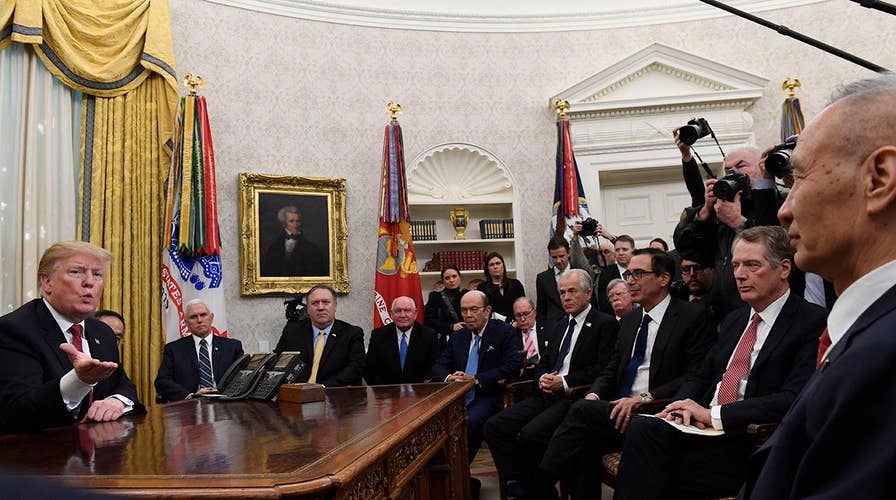
Speaking of trade, the president with the vice premier of China.
(JOINED IN PROGRESS)
PRESIDENT DONALD TRUMP: ... and also the vice minister of trade of China. We have had long discussions. This has been going on for quite some time. It will be, by far, if it happens, the biggest deal ever made -- not only the biggest trade deal ever made. It will be the biggest trade deal by far, but it'll also be the biggest deal ever made. The two largest countries doing a trade deal. There won't be anything that will match that. And we'll see what happens.
We've done very well. We've had a very, very strong relationship, as my relationship is with President Xi.
I think we'll start by reading the letter that President Xi sent to me and to us. It puts us off to a good foot. And then we'll also repeat a couple of the remarks that the vice premier stated. And then we are going to have Mr. Lighthizer speak for a couple of seconds. And we're then going to get back to business, and you can go and have fun and write your stories.
So thank you very much for being here. We appreciate it.
And if you could start by reading the letter from President Xi, and maybe you could speak louder.
UNIDENTIFIED FEMALE: Message from President Xi to President Trump:
"Mr. President, I send you my best wishes as a new round of high-level consultations is being held between our two countries on economic and trade issues. I ask Mr. Liu He to bring to you sincere greetings and best wishes from me.
"Right now, China-U.S. relations are at a critically important stage. Last month, we had a successful meeting in Argentina, in which we agreed to work together to build a bilateral relationship based on coordination, cooperation, and stability. That was followed by the good conversation we had through a phone call and the letters of congratulations we sent each other on the 40th anniversary of our diplomatic relations.
"Guided by the agreement we reached, our economic teams have engaged in intensive consultations and made good progress. I hope our two sides will continue to act in a spirit of mutual respect and win-win cooperation, and step up consultations by meeting each other halfway in order to reach an early agreement that works for the interests of both sides.
"Such an agreement will send a positive signal to our two peoples and the broader international community. It will serve to ensure healthy development of China-U.S. relations and contribute to steady growth of the world economy.
"Mr. President, in our last phone call, you said you wanted for China to buy more agricultural products. I have made some arrangements about which, I believe, you might have been briefed.
"As I often say, I feel we have known each other for a long time, ever since we first met. I cherish the good working relations and personal friendship with you. I enjoy our meetings and phone calls in which we could talk about anything. It falls to us to work together and accomplish things meaningful for the people of our two countries and the world at large.
"Mr. President, if there is anything, you could always approach me through various means. I hope we'll keep close contact in various ways. As the Chinese Lunar New Year draws near, my wife and I wish to send our New Year greetings to you, to Melania, and to your family. May you enjoy a happy and prosperous New Year."
TRUMP: That's a beautiful letter and we appreciate it. You may go with the vice premier's statements, and then I'm going to ask for you to say a few words, Bob, if you don't mind.
Please.
UNIDENTIFIED FEMALE: The vice premier said that President Xi attaches tremendous importance to the personal friendship with you, and he hopes to you -- to see your continued success. And over the past two years, since you took office, you have made tremendous accomplishment on both the domestic and diplomatic front.
Thanks to your policies of tax reduction and deregulation, your U.S. economy, as I heard from my American colleagues over there, has now been enjoying high growth and low employment with unprecedented prosperity. And it is because of your decisive decision that has directly facilitated the major breakthrough -- the relationship between the U.S. and the DPRK.
And under the strategic guidance of you and of President Xi and you, Mr. President, it is possible that China and the U.S. will have the possibility of striking a successful deal on trade.
And my trip to the U.S. this time is to follow through on the important agreement reached between you and President Xi to accelerate the 90-day consultation between China and the United States in the hope of striking a comprehensive deal.
And we've been working conscientiously with Ambassador Lighthizer and Secretary Mnuchin over the past couple of days, and our discussions are going well. We have achieved a lot of important consensus towards the direction of striking a comprehensive deal, which is to be ultimately reached between you and President Xi.
TRUMP: Well, thank you very much.
Bob, maybe you could say just a few words as to where we are, how we're doing, what we're discussing. And then maybe I will ask the vice premier to say a few words, and we'll get on with our negotiations.
ROBERT LIGHTHIZER, U.S. TRADE REPRESENTATIVE: Great. Thank you, Mr. President.
TRUMP: Perhaps, go ahead, if you want to say that.
UNIDENTIFIED MALE: (SPEAKING CHINESE)
TRUMP: Got it? He speaks very good English.
LIGHTHIZER: Based on many months of negotiations, we had two very intense, very long days of discussions. Your team was -- all of your team was involved.
I think we've made progress. We have much work to do if we're going to have an agreement, but we made substantial progress. We focused on the most important issues, which are the structural issues and the protection of U.S. intellectual property, stopping forced technology transfer, intellectual property protection, agriculture and services issues, and enforcement, enforcement, enforcement.
Both sides agree this agreement is worth nothing -- if we can get an agreement, it's worth nothing without enforcement. That's been your instruction from the beginning. So we're focusing -- we have a lot more issues to cover, but we focused on the structural issues -- the ones that you've been so focused on -- and we talked about enforcement, enforcement, enforcement.
TRUMP: And you'll be going in early February, with your group, to China to continue negotiations.
LIGHTHIZER: We are more or less -- Mr. President, we are more or less in continuous negotiations. There will be a brief pause for the Chinese New Year -- briefer than the Chinese want -- but our people will be in contact.
We're going back and forth with papers and with discussions. The Secretary and I will be going over there shortly, and then we'll see where we are.
At this point, it's impossible for me to predict success, but we are in a place that, if things work, it could happen.
TRUMP: OK. Thank you very much. I appreciate it. And we look forward to that, and we look forward to the results of your trip. But you're really discussing it anyway, whether you're in China or here. We have a thing called the telephone and other means of talking. So I know you're spending a lot of time, and it's moving along well.
So I just want to say the vice premier is a friend of mine. He has become -- he is truly one of the most respected men in Asia, one of the most respected men in all of China, and, frankly, one of the most respected men anywhere in the world. And it's a great honor to have you with us.
LIU HE, CHINESE VICE PREMIER: Thank you.
TRUMP: And if you'd like to say a few words -- please, Liu.
LIU: It's an honor to meet you, Mr. President.
I don't think you can hear me.
And I fully agree with the report said by Ambassador, Mr. Lighthizer, and we actually have to establish three key themes, first about (OFF-MIKE) and, secondly, about drugs coming through and, thirdly, about enforcement or implementation.
But, at the same time, we'll also discuss something from China: the need to do something where (OFF-MIKE) U.S. some problem with (OFF-MIKE).
So I thank you so much to be with you, and I'm waiting for (OFF-MIKE) in Beijing (OFF-MIKE), and I hope we will make a deal.
TRUMP: We'll be going. And we look forward to that. And then a little back-and-forth, and ultimately, I know that I will be meeting with President Xi, maybe once and maybe twice, and it'll all seem -- it seems to be coming together.
And I do appreciate the fact that you said so much about our farmers and that you'll be doing purchases quickly about the farmers. That's really wonderful.
LIU: Five -- five million.
TRUMP: Five million...
UNIDENTIFIED FEMALE: Five million tons of soybeans.
TRUMP: Five million tons of soybeans. Wow.
LIU: Per day.
TRUMP: Per day. That's going to make our farmers very happy. That's a lot of soybeans. That's really nice.
And I know they said some other things, and we'll put out a release for the press.
But the relationship is very, very good between China and the United States. And the personal relationships are very good, with the vice premier, with myself and President Xi, and with our representatives. It's been very, very good.
And, you know, you read a lot of things. Sometimes you hear good, sometimes you don't hear good. But I will say that I think that the relationship that we have right now with China has never been so advanced. I don't think it's ever been better. But I can you tell you for a fact, it's never been so advanced.
And certainly a deal has never been so advanced. Because, essentially, we don't have a deal. We never had a trade deal. We're going to have a great trade deal. But we never really had a trade deal with China, and now we're going to have a great trade deal with China, if it all works out.
And we look forward to it. It's going to be great for both countries -- not just us, not just them. This is going to be great for both countries.
And I know you've already done a lot of opening up China to the financial services industry. It's been happening very much, very rapidly. And hopefully we can get that done for our farmers, our manufacturers, and likewise, the United States.
So it's just an honor to be with you. And I will see you today, but I will see you a lot over the next month, that I can tell you. OK?
Thank you very much. It's a great honor. Thank you.
QUESTION: Mr. President, when do you want to meet with President Xi?
TRUMP: We haven't set up a meeting yet.
I think we're working on seeing where everybody is, and then we'll meet to discuss some final issues. It may be a lot, it may be a small amount. But I have a feeling it will be agreed to pretty quickly by both countries. Both countries would like to see a positive result.
QUESTION: And have you seen enough progress, based on what you've heard from your team so far, on I.P. and technology transfers?
TRUMP: Yeah. Yeah, very much. Technology transfer, I.T. I think that we have made tremendous progress. That doesn't mean you're going to have a deal, but I can say that there is a tremendous relationship and warm feeling, and we've made tremendous progress.
QUESTION: Mr. President, did you talk to your intelligence chiefs today about the displeasure you had with their testimony to Congress?
TRUMP: I did. And they said that they were totally misquoted and they were totally -- it was taken out of context. So what I'd do is I'd suggest that you call them. They said it was fake news, so -- which, frankly, didn't surprise me.
QUESTION: We just ran exactly what they said to Congress.
TRUMP: Excuse me. Excuse me. It didn't surprise me at all. But we're here to talk right now about China.
QUESTION: Did the fact they didn't bring up the border as the world threat assessment, did that undermine or undercut what you have said -- that there's a crisis at the border?
TRUMP: It didn't undermine anything. We need a wall. And if we don't have a wall, we're never going to have security for our country.
QUESTION: But they didn't bring it up as part of the national security assessment.
TRUMP: Next.
QUESTION: Does that undercut...
TRUMP: Please.
QUESTION: Is there any more detail about the soybean offer and deal?
TRUMP: Well, I think it's so nice that -- you said soybeans?
QUESTION: Yes, sir.
TRUMP: That's a tremendous purchase, which will take place now. And our farmers are going to be very happy.
QUESTION: When does that start?
TRUMP: When is the soybean taking place?
LIU: They have already (OFF-MIKE)
TRUMP: They've already started.
LIU: And they will start another (OFF-MIKE)
TRUMP: So they've started on a smaller scale, and today they're starting very big. And I very much appreciate that. Please tell President Xi. And on behalf of the agricultural industry, and on behalf of our farmers, frankly, we appreciate it very much. It's a very big order.
LIU: Chinese people like U.S. farmers very much.
TRUMP: They like the U.S. farmers. Well, we have good product. And you can use it, and it's...
LIU: (OFF-MIKE)
TRUMP: No, but I really appreciated that. That was really fantastic to say. And that's before we make a deal. It's a fantastic sign of faith.
QUESTION: Mr. President, was the Huawei case discussed during negotiations?
TRUMP: No, we haven't discussed that yet. It will be, but it hasn't been discussed yet.
QUESTION: In what aspect? How will it be discussed?
TRUMP: Well, it will be discussed. I'm sure at some point that'll be -- that, actually, as big as it might seem, is very small compared to the overall deal, but that will be discussed.
Anything else?
QUESTION: Mr. President, is the plan to sort of combo the trips to see Xi and to meet Chairman Kim again?
TRUMP: Excuse me?
QUESTION: Would you combine the trips to see Chairman Kim for your meeting again?
TRUMP: It's possible. We'll see how it is. We haven't discussed it yet.
When President Xi and I meet, we want to have it down so that we have certain points that we can discuss and, I would say, agree to. But we're not quite at that stage yet.
But all of these representatives and these representatives are coming to a conclusion, except for certain very important points. And we want to make it comprehensive. We want to make a deal that we can look at and be proud of for many years -- not where we have to go back and renegotiate, or we left things out.
So whether it's intellectual property or whether it's any of the other things that we discuss all the time, we want to try -- would you say? -- have everything included. We want to have it very comprehensive.
QUESTION: What are the specific points that you feel like you need to negotiate one on one with him personally?
TRUMP: Well, we really -- we really have discussed many of those points today.
But I would say, probably more than any other thing, every single point that you discuss in the newspapers and on television. Those are the points that we're discussing.
I don't think I've ever heard of any point that was discussed by the folks that really represent you, and represent you well. It's every single one of those points have been discussed in our transactions and our trade deal -- in this trade deal.
QUESTION: Mr. President, you said earlier you would be willing to postpone this. What did you mean by that? Do you want to extend the deadline? Or what did you mean by that?
TRUMP: We haven't talked about extending the deadline. The deadline is March 1.
That deadline has stayed, and we really haven't talked about it. Maybe we don't -- I don't think we have to extend. Now, at a certain point, you're going to have -- this is a very complex, and a very large -- it's the largest transaction ever made, to be perfectly straight.
We have to get this put on paper at some point if we agree. There are some points that we don't agree to yet, but I think we will agree. I think, when President Xi and myself meet, every point will be agreed to.
One of the things that we discussed in Argentina was fentanyl. This is not a trade deal, this is a fact that President Xi was extremely good when he said that they would criminalize fentanyl, because fentanyl is killing a lot of our great American people.
And if they did what they are going to do, it would very much halt or at least -- I think it would stop fentanyl from coming into this country, which would be a tremendous thing. And so that's a separate than a trade deal, but it's a very important thing.
QUESTION: Mr. Lighthizer mentioned enforcement. How do you envision an enforcement mechanism working?
TRUMP: Well, I think we're going to have strong enforcement language both ways. They want enforcement, too. And I think we're going to have it both ways, and we'll have strong enforcement language. This is a serious deal that we're doing. This could be done very quickly, very easily, but it wouldn't be comprehensive; it would be small.
And I just want to end by saying it really is a sign of good faith for China to buy that much of our soybeans and other product that they've just committed to us prior to the signing of the deal -- is something that makes us very proud to be dealing with them.
I think that the farmers who have already been notified of this by me and my representatives -- and by Sonny. Sonny Perdue is here, the Secretary of Agriculture. I think that was music to your ears, Sonny.
SONNY PERDUE, U.S. AGRICULTURE SECRETARY: Absolutely. Good news.
TRUMP: And that's a big number. That's a big number even for you to hear. Right?
PERDUE: Good news. Our folks will be happy.
TRUMP: Will you let the farmers know right away?
PERDUE: They'll know before I (OFF-MIKE).
(LAUGHTER)
TRUMP: And that was more than even soybeans -- that was the other things that we discussed before the press came in. They discussed other things that they are buying also. So, Sonny, if you let everybody know, that would be great.
PERDUE: We'd be happy to do that.
TRUMP: Were you surprised to hear that?
PERDUE: Pleased to hear that.
TRUMP: That's going to keep the farmers busy. That's going to keep them busy. That's a big order.
So let's keep going. Let's start our discussions and we'll ask the media to leave. Thank you all very much. We appreciate it. Thank you. Thank you very much, everybody. Thank you.
QUESTION: Is Secretary Mnuchin going over with Ambassador Lighthizer?
TRUMP: I think so. Steve, you're going?
STEVEN MNUCHIN, U.S. TREASURY SECRETARY: Yes, I will go with Ambassador Lighthizer.
TRUMP: Are you going? Are you going, too? Ask Mnuchin. She wanted to know about Mnuchin.
QUESTION: Is there a date for that?
MNUCHIN: We have a tentative date we need to confirm in the next couple of days.
QUESTION: What about the summit with North Korean leaders?
TRUMP: It's moving along well. The end of the month, the end of February.
QUESTION: Any other details you can provide?
TRUMP: Early next week, probably State of the Union, OK?
(CROSSTALK)
QUESTION: (OFF-MIKE) President Xi?
TRUMP: It could be. Could be. One way or the other.
CAVUTO: All right, you never know.
You're probably wondering, why were you on that wall to wall? Just the same reason why our business network, Fox Business Network, was on it wall to wall.
I don't know, maybe because it hints of a major trade deal between the two biggest economic powers on Earth.
No matter how you feel about the president, no matter how you feel about China, what was discussed in that room will affect each and every one of us, and $200 billion worth of Chinese goods that come into this country that could be facing some very big tariffs, the president United States hinting, with the vice premier of China in the Oval Office, something you do not see every day, that the two biggest economic powers on the planet are on the cusp of something that could be huge, that could change the complexion of how trade deals are scored, not only between this country and the Chinese, but you can imagine the Europeans watching closely.
That's why this is a very significant event. I stress again the significance of what was going on.
Liu He, Chinese vice premier, has already said the Chinese have agreed to buy more soybeans from the United States. That was known for quite some time. What wasn't is this number attached to it, better than five million tons, more than twice what had been rumored and talked about before.
The president indicating here that he wants to see this continue and will continue in discussions with Xi Jinping, the Chinese president.
But what this means in this back and forth -- and it has been a rough ride here -- is that the Chinese economy, which has been back and forth, this is the first sign of the Chinese cracking, the first sign of them conceding that they'd rather a deal sooner than later, and that this gets to be a lot broader than buying soybeans from the United States or wheat from the United States.
Now, we went wall the wall on this to indicate that this isn't about politics. This is about money. How often do I say we're not about the red or the blue? We're about green. We're about staying away from the drama, and looking at the money and the dollars and the yuan attached to the two biggest players on Earth doing business together in a fair and more amicable way.
If the president can pull this off, if the Chinese can make good on their commitment, this, my friends, will be unprecedented. Leave your politics aside, and look at the significance of these two powers coming to potential agreement on thorny trade issues that have bedeviled administrations, Republican and Democrat, for decades.
We are not there yet, but we are closer.
Blake Burman at the White House -- Blake.
BLAKE BURMAN, CORRESPONDENT: Neil, the last time Liu He, he vice premier of China, was here at the White House, at the beginning stages of the summer of last year, I believe, this wasn't played out before the cameras.
It gives you just a little bit of a sign. You and I were joking yesterday about, what is progress? I think you just watched there exactly what progress is.
The treasury secretary, Steve Mnuchin, told us going into this that they expected significant progress. And we saw some of it there between President Trump and the top negotiator with China, China saying that they will indeed start -- that it will begin a massive soybean purchase.
But, as you and I discussed earlier today on the FOX Business Network, and as you just hit on, this is not just about soybeans. The U.S. is going into this trying to get major structural changes out of China, namely, China to stop engaging in intellectual property theft, for them -- for them to stop engaging in the forced technology of transfer -- forced technology of transfer -- transfer of technology, rather.
Sorry. It is cold out here.
And as well to open up their markets. The president said that these issues were addressed. He said that they have made -- quote -- "tremendous progress," but that they haven't made a deal just yet. And that is kind of the next phase in all of this, is to get those systemic changes on board with China.
The president's top negotiator, the U.S. trade representative, Robert Lighthizer, said that they discussed these issues, that they made progress, but that both sides agreed that enforcement is key, something that the U.S. has been talking about for a while.
And if indeed the Chinese are agreeing to some sort of enforcement measures, that would be a significant step here. But the bottom line with all of this, Neil, the folks here who are involved in all of this were telling us for the last several weeks, this is the meeting that matters. Don't worry about all the other noise. This is the meeting that matters.
And now, in this meeting, we also hear that President Trump and President Xi of China probably going to meet once, if not twice, in the upcoming months.
In the grand scheme of all of this -- and you heard it from the president - - that is the meeting that will really matter. But, indeed, between now and then, and from over the last couple months until now, it seems as if the U.S. is making progress with this one -- Neil.
CAVUTO: It is remarkable.
Blake Burman, thank you very, very much.
So, just to review here, you have the vice premier, essentially the number two in China, in the Oval Office with the president of the United States, greasing the skids for a meeting between the two world leaders themselves at the end of February.
The president making it clear that he's not stopping at the Chinese commitment and promise to buy more soybeans from American farmers and, we are told, a number of other agricultural items.
He could have cut it at that and left it at that, but we are getting indications now that Robert Lighthizer, the trade negotiator here, who's been playing very tough back and forth with the Chinese, want to see more, more about patent infringement, more about technology transfer, more about why American companies when they do business in China have to give away their heart and soul and spreadsheets in order to do so.
That is significant, my friends, I cannot stress enough to you, though it might be boring economics to a lot of people, it might not have the tawdry appeal of scandals and rumored scandals and collusion and all of that. This is huge, the potential for a trade deal that could change the lives of not only a couple of billion people in China, but millions in the United States of America.
As I stress, we are nowhere near a finished deal, but we are getting the first signs that the Chinese want one, and the sooner, the better.
That's why we were wall to wall with it, because it affects you.
We will have more after this.
(COMMERCIAL BREAK)
(BEGIN VIDEO CLIP)
TRUMP: Thank you very much.
It's a great honor to have the vice premier of China with us, and also the vice minister of trade of China.
We have had long discussions. This has been going on for quite some time. And it will be by far, if it happens, the biggest deal ever made, not only the biggest trade deal ever made. It will be the biggest trade deal by far, but it will also be the biggest deal ever made, the two largest...
(END VIDEO CLIP)
CAVUTO: Well, that's what the president wants to see, the biggest deal.
We're a long way from that, but we did get a commitment today. And it was spelled out in numbers, that if the Chinese stick to them, it will be record-breakers, agreeing to buy more than five million tons of soybeans from U.S. farmers who have been badly beaten by these trade back and forths between our two countries.
The president setting the stage for what he hopes will be a completed trade deal with his Chinese counterpart, Xi Jinping, when they meet at the latter part of next month.
Let's get the read on all of this and these fast moving developments with Charlie Gasparino of FOX Business Network, also FOX contributor Deneen Borelli, Democratic strategist Scott Levenson.
Deneen, the first thing you seize on here is what we always say. It's not about being red or blue. It's about green. This is about potentially a lot of green between the two largest economies on the Earth inching closer to something, a long way from anything that we can firmly -- we have been led on before. But what do you think?
DENEEN BORELLI, CONTRIBUTOR: I think this is a beautiful thing.
I mean, this has been going on for many, many years in terms of China really taking advantage of America, Americans and our economy, when you look at the counterfeit products that they do, the intellectual property theft.
This has been going on, and it should have been taken care of before now. But thank goodness the president has not only informed Americans of the severity of this, but he is also moving forward and getting China to come to the table to make things happen.
CAVUTO: We don't know what the final deal will look like.
BORELLI: No, we don't, right.
CAVUTO: And we do know -- one of the things that's been brought up, Charlie, on the business network is this idea that there's a sense who needs the other more, and the growing sense was, because of the China slowdown, this has prompted them to come to the table and literally go into the Oval Office and the Resolute Desk to hammer out something.
CHARLIE GASPARINO, SENIOR CORRESPONDENT: Yes.
I mean, listen, there's something -- what's fascinating about China is you got to give Trump and Peter Navarro, who's -- a lot of it's behind -- he's behind a lot of the anti-China stuff -- credit for at least enlightening people on what -- how pernicious China is as a global trading partner, how they steal our stuff, how they attack.
They're on the warpath against us. They have -- they have basically created a cold -- a hot war in terms of trade and stealing and theft of intellectual property.
Where you have to criticize the Trump administration is how they deal with it. Yes, this is a good deal. The fact is, when you go narrowly, when you go at China, when you go out all our trading partners, when you go at the - - at the world, instead of isolating China, it makes the -- it makes the business of doing a trade deal like this much more difficult.
CAVUTO: Well, we don't know -- we could see what happens.
But, Scott, I mean, I am wondering, Democratic and Republican presidents in the past have been hoodwinked and fooled by the Chinese, who make a commitment -- sort of like my diet commitments -- and never stick to them.
(LAUGHTER)
CAVUTO: So how do we make sure that this one works?
SCOTT LEVENSON, DEMOCRATIC STRATEGIST: Well...
CAVUTO: And, again, there's no deal here.
LEVENSON: No.
Again, timing is everything for the president. He needed to change the subject over the last couple of weeks. And he successfully did that today.
People are going to be looking to see whether this deal actually comes through. And the details matter.
CAVUTO: What do you follow more closely, whether they can avoid a government shutdown in two weeks, or whether we could score a trade deal in four weeks?
LEVENSON: Well, when 800,000 Americans are suffering every day, obviously, that gets all our attention.
But this is a great way...
(CROSSTALK)
CAVUTO: They're not suffering anymore. They're back to work.
LEVENSON: And that's a great thing.
(CROSSTALK)
GASPARINO: What is the economic consequences if they buy all these soybeans from us?
CAVUTO: Well, that's one part of it.
So, Deneen, the one thing I wanted to get from you is, if the president can work something out with his Chinese counterpart -- and we're told that's a very strong personal relationship -- how he will he avoid what his predecessors were unable to avoid, in other words, just getting hoodwinked?
BORELLI: Well, look at the time it has taken for us to get the situation that we're in now, in terms of President Trump getting China to come to the table.
So he's the negotiator. He is willing to stand by and let China really basically continue to implode, because they need us more than we need them.
CAVUTO: But to Scott's point...
(CROSSTALK)
CAVUTO: ... the perception that the president might have failed in the shutdown.
LEVENSON: It's not over yet.
CAVUTO: That the Chinese read into that he was vulnerable?
BORELLI: I don't think so.
(CROSSTALK)
BORELLI: No, I don't. I don't think so.
(CROSSTALK)
CAVUTO: What do you think of that, Charlie?
GASPARINO: I agree with you.
I think -- I think -- listen, I think they want to do a deal. They have an economy that is problematic. We're holding...
(CROSSTALK)
LEVENSON: The timing for them wasn't better than this week, though, to make a deal.
(CROSSTALK)
LEVENSON: So they had ultimate leverage, because he needed to change the subject.
(CROSSTALK)
GASPARINO: But they have leverage on -- they have leverage...
(CROSSTALK)
CAVUTO: Well, this meeting was scheduled long before, to be fair.
LEVENSON: A meeting scheduled and a deal announcement are two different things.
(CROSSTALK)
CAVUTO: We're not at the latter yet.
(CROSSTALK)
GASPARINO: Let's be real clear.
The minute Trump pulled out of TPP, they had leverage.
CAVUTO: Trans-Pacific Partnership between the major Asian countries.
GASPARINO: That was it. And we have -- we could have -- we could have squeezed them that way. And he chose to pull out.
CAVUTO: All right, now one of the things I just want to get your take on too, guys -- not to get too wonky here -- is that the economy and the markets seemed to have a big turnaround in January, or the perception was one of the best performances of the S&P since 1987, before all of you were born, obviously.
(LAUGHTER)
CAVUTO: But I'm wondering whether that signals things are going to change, not only here, but for the globe.
Or are we getting ahead of ourselves?
BORELLI: Well, I think the economy has been doing really, really well under President Trump.
So, with the lower taxes Americans are getting, the wages are going up. More people are hired.
(CROSSTALK)
CAVUTO: And all of Scott's buddies want to tax people.
(CROSSTALK)
LEVENSON: The truth of the matter is, you have had a very erratic -- a very erratic stock market over the last six months.
(CROSSTALK)
CAVUTO: So, you wouldn't hang your hat on it?
(CROSSTALK)
LEVENSON: Well, the fact that we have had a good three weeks shouldn't negate the fact that we have tremendous downswings right before that.
(CROSSTALK)
GASPARINO: The stock market is down actually over the past six months because of the trade stuff.
So, I mean, it was at...
CAVUTO: Well, there are a lot...
(CROSSTALK)
GASPARINO: It was at 26000.
Listen, why is the stock market up in January? You know why?
CAVUTO: You're a half-empty kind of a guy.
GASPARINO: You know why?
Think about the rMDNM_Fed. The Fed is not going to raise rates.
CAVUTO: There you go.
GASPARINO: We are going into a global slowdown. It's going to impact us.
CAVUTO: All right.
GASPARINO: But I don't think this is a thing that we should be celebrating, the Trump economy is growing at 3.5 percent for the rest of time.
LEVENSON: No.
CAVUTO: No, God forbid.
All right, so we have we a lot coming up here.
Kidding, kidding, kidding.
Did you ever wonder, in retrospect, what was the deal with that Roger Stone predawn raid? And what did they get in that raid?
After this.
(COMMERCIAL BREAK)
(BEGIN VIDEO CLIP)
ROGER STONE, FORMER TRUMP CAMPAIGN ADVISER: I am heartened that Senator Graham and also some Republican members of the House are looking into the manner in which I was arrested.
(END VIDEO CLIP)
CAVUTO: That was Roger Stone commenting about Senator Lindsey Graham's curiosity to find out why on the methods used to go after Roger Stone and to get his house essentially ransacked, looking for a lot of stuff, and then ultimately arrested and charged on seven counts of everything from obstruction of justice to witness tampering.
Former Whitewater independent counsel Robert Ray on all of this.
Robert, you and I were speaking in the break about it, that this was unusual, but it wasn't unprecedented. What did you make of it?
ROBERT RAY, FORMER INDEPENDENT COUNSEL: I think that's exactly right. If there's a situation involving an obstruction case, you could understand, just generally speaking now, without talking specifically about this, why the FBI investigators might be interested in raiding a home in order to execute a search warrant to find out any additional evidence that they might be able to glean that they wouldn't otherwise have access to, for example, if they had issued a subpoena.
CAVUTO: Did you ever use methods like that?
RAY: Well, sure, when you say methods.
Now, look, are there always the question about legitimate claims about FBI overreaching? Sure. I mean, I have been familiar with those. They were - - I had those issues when I was a prosecutor. I have had them as a defense lawyer.
All I will say to that is just be careful, Neil, and think about -- there's another side of the coin. And that is, ordinarily, we leave it to the sound judgment of law enforcement officials on the ground, and provide them with a wide berth about appropriate exercise of force in order to effect or effectuate an arrest.
CAVUTO: All right, so...
RAY: That doesn't mean that I'm saying that doesn't -- it's not appropriate subject of congressional oversight.
But everybody, the public included, should just be careful about trying to rein the FBI in, because you think -- second-guessing them.
(CROSSTALK)
CAVUTO: So, there are no questionable methods that you could see being used here, right?
RAY: Right.
And are you really going to get into the business of saying, well, if the FBI sent 10 people, that would be enough, but if they sent 15 people or 25 people...
CAVUTO: Well, apparently, they sent more people than we did to get Usama bin Laden.
RAY: Well, sure. OK, fine. So you're going to criticize that?
CAVUTO: Right.
RAY: You got to be careful.
CAVUTO: Understood.
RAY: I mean, my view of this, it's the same thing as like a military commander on the ground. You don't second-guess the judgment.
CAVUTO: But where do you think and what do you think they were looking for?
Roger Stone does not become top of mind to get this kind of treatment. Maybe -- obviously, they're aware of things I'm not, but what do you think?
RAY: Well, it may not be anything more complicated than going to get access to whatever the latest communications were on his computer, for example, that are otherwise not privileged.
I mean, if he had...
CAVUTO: And they did get a warrant for that.
RAY: And they got a warrant for that.
So if they got those things, and you wouldn't otherwise be able to capture that if you issued a subpoena, because you're essentially telling the target of the investigation, oh, and, by the way, I'm looking for these things. And there's always -- there's already evidence in the case that he obstructed justice.
You might understand why the FBI would take those precautions.
(CROSSTALK)
CAVUTO: But you were reminding me the trial of something like this could be a ways off, maybe a year off.
RAY: Sure.
CAVUTO: And yet you have the acting attorney general saying he is under the belief that this is wrapping up soon. Who's right on that?
RAY: Well, it depends what happens to conclude an investigation.
I would imagine that Bob Mueller stays as long as necessary to conclude the major prosecutorial decisions in the case.
CAVUTO: Could it go another year, another year?
RAY: Well, sure, but that doesn't mean that he has to remain all during that time. That could be returned to the ordinary processes of the Department of Justice, once he's made the major prosecutorial decisions.
That doesn't mean that there might not be trials in the future or appeals or a whole bunch of things that would happen that the Department of Justice is well-equipped to handle.
CAVUTO: Robert Ray, thank you very, very much.
Meanwhile, so many talks going on today, including on what to do about a wall. It works fine in Southern California, but that's about the only place they want it -- or do they?
After this.
(COMMERCIAL BREAK)
(BEGIN VIDEO CLIP)
TRUMP: If you go to Tijuana and you take down that wall, you will have so many people coming into our country, that Nancy Pelosi will be begging for a wall. She will be begging for a wall. She will say, Mr. President, please, please give us a wall.
(END VIDEO CLIP)
CAVUTO: Well, I suspect that Henry Cuellar, the Democrat of Texas who serves on this committee, this conference committee, that's trying to hammer out an agreement in the next two weeks, I suspect he might slightly disagree with that.
But, anyway, he joins us.
Congressman, very good to have you.
(CROSSTALK)
CAVUTO: What do you think of what the president was saying, that there is a need for a wall, it works, and eventually, given some of the issues we have on the border, you and Nancy Pelosi and others will be begging for that?
(LAUGHTER)
REP. HENRY CUELLAR, D-TX: Well, first of all, I think the president has also said that every part of the border is different.
In Texas, for example, there are cliffs that are about 200-to-300-feet- tall. The local people call them, they're God's wall. So you have got those cliffs, and then you have got rivers. So every place is different.
And I think the president knows that.
CAVUTO: Well, he's acknowledged that. He's acknowledged that, right?
But do you look at a wall, where Nancy Pelosi has said it's not up for debate, she doesn't want to do that, and doesn't think it's necessary, and won't provide the funds, do you agree with that?
CUELLAR: Well, I think that what we ought to look at is, what are we trying to accomplish?
(CROSSTALK)
CAVUTO: No, do you agree with that? Do you with her that it's not necessary?
(CROSSTALK)
CUELLAR: I'm trying to answer your question.
What are we trying to accomplish? If you want to stop drugs, listen to the latest drug case in New York, or let -- look at the latest DEA reports or CBP. Most drugs will come through ports of entry.
So we need to put canines, the latest X-ray machines there, men and women in blue, which is CBP officers, there.
CAVUTO: No, I agree with all of that. You want smarter technology, smarter issues, drones. I understand. And I get all of that.
But do you rule out a wall, even though, in her state, along the Tijuana- San Diego border, it seems to be working just fine?
CUELLAR: Again, if you want to stop drugs, if you want to stop people from coming in, you got to look at, where are most people coming in?
In 2000, we had -- Border Patrol detained 1.6 million individuals. Last year, they stopped on the southern border 303...
(CROSSTALK)
CAVUTO: I'm sorry. We're talking past each other.
Do you have a problem with a wall, yes or no?
CUELLAR: Yes, I do. It's a 14th century solution.
Have you seen...
(CROSSTALK)
CAVUTO: But Democrats voted for wall funding when Barack Obama was president.
CUELLAR: Let me -- let me let me -- let me finish -- let me finish. You asked me a question. Let me answer your question.
If you put billions of dollars, and take away private property rights, which I know, Neil, you're a big believer in private property rights -- there are ranchers that have owned land there for a long time. Sometimes, they have to put a fence up a mile or two away.
(CROSSTALK)
CAVUTO: Understood. But it's not a problem with the wall itself, right?
I just want to be clear on the semantics here.
CUELLAR: There is -- I get it. It's a 14th century solution to a 21st century problem.
(CROSSTALK)
CAVUTO: Well, many in your party voted for that 14th century solution.
CUELLAR: I want to see, how we do stop -- how do we stop drugs and people from coming in?
CAVUTO: All right, many in your party voted for that 14th century solution.
I guess what I'm asking is, are you open to that, in any way, shape or form, as part of a security package?
CUELLAR: I will look at, what are the threat assessments, so we can address that issue.
CAVUTO: All right.
CUELLAR: I have not voted -- I really think the wall is a 14th century solution.
You know, the bad guys are creative. What they will do is, keep in mind, if you put a barrier, they are going to go around, or they're going to use a catapult, or they're going to use a ladder to climb over it.
(CROSSTALK)
CAVUTO: You're open. You're open, right? Anything could happen. We will see, right? OK.
CUELLAR: Thank you.
CAVUTO: Have a nice day.
Congressman, seriously, I appreciate it.
So much we don't know. This much, we do. It's going to be an interesting day tomorrow.
Here comes "The Five."
Content and Programming Copyright 2019 Fox News Network, LLC. ALL RIGHTS RESERVED. Copyright 2019 ASC Services II Media, LLC. All materials herein are protected by United States copyright law and may not be reproduced, distributed, transmitted, displayed, published or broadcast without the prior written permission of ASC Services II Media, LLC. You may not alter or remove any trademark, copyright or other notice from copies of the content.
