


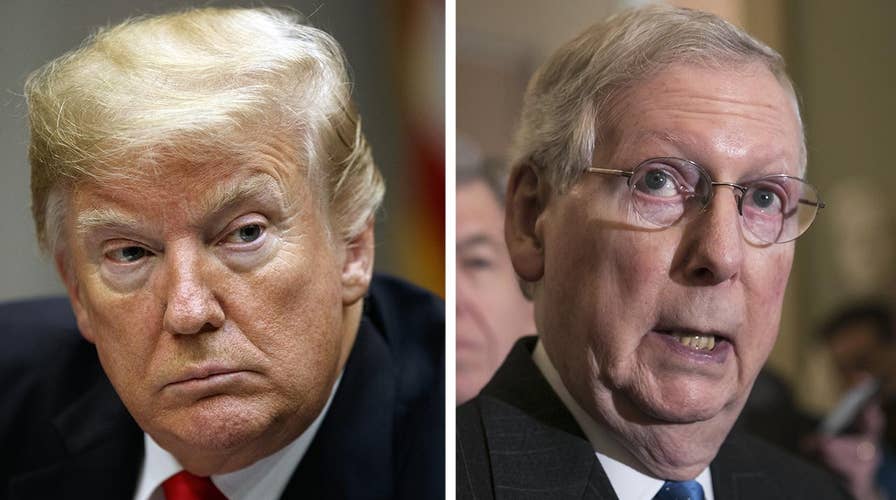
Trump drops demands to fund wall to avoid shutdown, Sen. McConnell makes deal to fund government through February
Democrat incoming House Majority Leader Rep. Steny Hoyer says that a border wall will not pass through the House once democrats take office, but will still work to secure the border.
This is a rush transcript from "Your World," December 19, 2018. This copy may not be in its final form and may be updated.
NEIL CAVUTO, HOST: All right, Shepard, thank you very much.
Well, at least it's over. The Fed hikes, the Dow dives, as the Federal Reserve signals, guess what, more rate hikes to come.
Welcome, everybody. I'm Neil Cavuto. And this is "Your World."
And the Dow nearly 300-point surge evaporating as the news first hit the tape, as expected, the Fed hiking interest rates, not expected, some of the details after that announcement, which trigger more to come, and not as few as people thought.
It plans that we're building on the sell side, with the Fed chief talking and talking and talking, and that got investors worrying and worrying and worrying. And it got us thinking of this as a bear approaches a Florida home. Take a look.
(BEGIN VIDEO CLIP)
UNIDENTIFIED MALE: Hey, bear. Go. Bear, go away. Bear, go away. He's looking at me. Bear, go away.
(END VIDEO CLIP)
CAVUTO: Bear, go away, indeed. See, that's a metaphor for the markets. You see what we did there?
Anyway, it's easier said than done to chase a bear goodbye or to tell a market bear not to come visit at all. We're all over the bear implications of this, because it wasn't the reaction most expected, with Kristina Partsinevelos on what has got Wall Street worrying, Deirdre Bolton on if consumers should be fretting, and last but not least, Blake Burman on how the White House is responding.
We begin with Kristina.
KRISTINA PARTSINEVELOS, CORRESPONDENT: Oh, Neil, that was a perfect segue with the bears.
But like you said, you had the Fed that did allude to a cautious approach, but not cautious enough for investors, because you did see some drastic swings today, more than 600 points just on the Dow alone, seeing it close down 1.5 percent, like you mentioned, the Nasdaq also down over 2 percent, and the S&P 500 over a percentage-and-a-half.
So you have these swings that constantly seem to be happening. But if you look at the intraday -- and we're going to bring that up again because I know you already discussed it -- you had the Fed already -- pretty much investors bake in the fact that there was going to be an interest rate hike. That was in the markets, why we saw some positive territory in the morning.
Then you hit 2:00 p.m., the fact that there's two more hikes in 2019, a further hike proposed for 2020, and that's where you started to see the downward trend. Investors are parsing through the details. Then the Q&A with Jay Powell happened. So that was why the uptick went up.
And then later on, you saw it close down. Which sectors are we seeing some weakness across the board? You're seeing technology being hit the hardest, energy, followed by financials. The stocks that you're seeing on your screen now, biggest losers on the Dow, that would be intel, Nike, Apple. Look at that.
You can see Boeing down 2.6 percent, Amex down 2 percent.
Want to talk about some of the winners, though, on the New York Stock Exchange. This would be GE, 5.1 percent. Reason being, there was a variable positive analyst report coming from Vertical Research, well- respected analyst. And he said that although the company's a little bit risky, there is some near-term liquidity. Therefore, he is rating GE as a buy.
You're also seeing a slight uptick with Verizon, just some green, when we're seeing so much red right now.
I want to turn to Micron. Micron shares, let's -- oh, down 7.8 percent for the day. Reason being disappointing guidance coming from the company. And then let's look at the 10-year and the two-year spreads over here. We have been talking about this quite some time, the flattening of the yield curve. You can see it at 2.78 percent.
Part of the reason why we saw the financial sector get hit, because you're not gaining as much in the future when you're holding a 10-year bond, so down 4.3 basis points.
And then I want to end on oil, because this came up in the Q&A with Jay Powell, the fact that these inflationary concerns usually are triggered by an increase in oil. And look at that. We have oil at less than $50 a barrel. Yes, it's up a almost a buck today, but it's definitely off the highs that we saw in September, when it was above $75 U.S. a barrel -- Neil.
CAVUTO: Amazing.
Kristina, thank you very, very much.
PARTSINEVELOS: Thanks.
CAVUTO: So, as Kristina pointed out here, everything was hunky-dory. The markets had expected this quarter-point hike in interest rates. What they didn't expect were some of the things that Jerome Powell said, the chairman of the Federal Reserve, afterwards, in which he oftentimes pooh-poohed whatever's going on in the markets and said, by and large -- not exactly word for word -- that he doesn't stress about the markets.
Gary Kaltbaum was saying maybe he should. Quoting from Gary, a very, very good market read over the many decades I have known him, looking at trends that he thinks the Fed should pay attention to, because the markets are telling a story.
Quoting Gary here: "Transports in a bear market are not telegraphing anything. Russell 2000, a collection of largely small stocks in a bear market, not telegraphing anything. Regional banks in a bear market not telegraphing anything. Oil prices crashing not telegraphing everything. Three-quarters of the S&P 500 in a bear market not telegraphing anything. Restaurants in a bear market, 10-year yield down to 2.77 percent not telegraphing anything."
You can see the trend that he's showing here, that the markets are doing all of this in an environment that the Fed chief, according to Gary, chooses to ignore.
"We have no problem with the raising of rates," Kaltbaum writes. "We really don't have a problem with him saying they are looking to raise some more. The market will have a problem knowing that the Fed has absolutely no clue what the market's own action is telegraphing as of this second. And that is a worry."
To FBN's Deirdre Bolton on the fallout from this on a host of various things that you buy.
DEIRDRE BOLTON, CORRESPONDENT: Yes, Neil, I'm going to go back to that image that you brought in with the bear, because when the Fed raises rates, as it did, the prime rate goes higher.
And, as we know, banks set their lending rates on prime. It's a domino effect.
Let's go over the types of loans that are affected, so anything variable, basically, so credit cards. That's one way. Auto loans. Sometimes, auto dealers will make up for it. But brass tacks, it goes higher. Adjustable- rate mortgages also go higher.
And then also if you're doing any work on your home, home equity lines of credit, they go higher. So borrowing becomes more expensive for all of us as individuals. Also gets more expensive for any kind of company that wants to borrow for any reason.
So President Trump has spoken out, as we know, against rising rates. So love him or hate him, it's in part because of that dynamic. The Fed's interest rate increases do act to slow the economy.
I want to bring you back to that credit card example because this affects so many Americans. Average credit card rates right now, 17.6 percent. That's why, if you're a millennial, your parents just tell you to pay this off right away. But according to Bankrate, for a $10,000 credit card balance, a quarter-of-a-point hike, as we saw today, is likely to add $2 a month to the minimum monthly payments.
And that doesn't seem like a lot, but over 12 months, you keep carrying, it does add up.
Now, on the flip side, with higher rates, savers are rewarded, because bank customers do see noticeably higher savings rates. The only trick about that is, it takes a little time to make its way through the system.
So this is, of course, what we have been talking about, what we have been seeing, the Federal Reserve's activity. And I think, Neil, the point today was that the Fed, while it said it was perhaps not going to be as aggressive as previously thought, it wasn't really as dovish as a lot of investors had thought.
CAVUTO: Right. Right.
BOLTON: And then the other thing that you know very well, I mean, since 1960, I think there's been one Fed chairman who has engineered a soft landing. That was Greenspan in the '90s. It's just tough to get this balancing act exactly right.
CAVUTO: Yes.
And then this compounded by saying the markets really -- don't really bother me one way or the other. Maybe they are signaling something.
BOLTON: Especially since October.
CAVUTO: It doesn't hurt to at least give them a look now and then.
BOLTON: Just have a look.
CAVUTO: All right, thank you very much, Deirdre.
Let's go to the president of the United States right now. He has been oddly silent on all these developments here.
To Blake Burman at the White House with the very latest -- Blake.
BLAKE BURMAN, FOX NEWS CORRESPONDENT: Neil, the seventh rate increase from the Federal Reserve during the tenure of President Trump, so far, no reaction from the president, who has very publicly in the past vented his frustrations against the Federal Reserve.
Traditionally, you wouldn't expect a reaction from the president or from the White House. But, as we know, the president has broken with this tradition.
For example, in just the last days, weeks and months leading into this, the president at one point said the Federal Reserve had gone crazy. He said that Jay Powell, that he wasn't happy with the job that the Fed chair was doing.
Ahead of this interest rate increase just yesterday, the president also warned the Fed in a tweet that they shouldn't make another mistake, as he put it.
At his news conference just a little while ago, Powell was asked about all of this, about many of the president's comments, and he brushed aside the president's criticisms.
(BEGIN VIDEO CLIP)
JEROME POWELL, FEDERAL RESERVE CHAIRMAN NOMINEE: Political considerations have -- play no role whatsoever in our discussions or decisions about monetary policy.
We have the independence, which we think is essential to be able to do our jobs in a nonpolitical way. And we are -- we at the Fed are absolutely committed to that mission, and nothing will deter us from doing what we think is the right thing to do.
(END VIDEO CLIP)
BURMAN: President Trump has said in the past that he is a low interest rate person. This is now the fourth interest rate that Powell has overseen as the Fed chair.
And Neil, as you know, it was President Trump 13 months ago who nominated Jay Powell to lead the Federal Reserve.
CAVUTO: I wonder, if things as they are now, whether he would do that again. We will see.
All right, Blake, thank you very much.
BURMAN: Sure.
CAVUTO: Again, no word from the White House. If we hear anything from the president, tweet or otherwise, we will certainly go back to Blake and, of course, the president.
Did the Fed get it right this time? Or did the president? Remember, the president was highly critical of a move right now, as Blake pointed out, that inflation was very low, the dollar was very strong, no need to move. The Fed did move. The markets were OK with that move.
It was the words that the Fed chairman was speaking that telegraph that there's only a slight change in forward policy.
Market watcher Larry Shover says that the Fed is on the right track. Scott Martin disagrees.
Scott, what do you not like here?
SCOTT MARTIN, KINGSVIEW ASSET MANAGEMENT: I don't like market's reaction, Neil.
I mean, front and center is the reaction today. I mean, we saw one of the biggest slides in the S&P 500 today that we have seen in this whole sell- off that started back in October.
And here's what I don't get. Late in November, Fed Chairman Powell was talking at the New York Economic Club about being close to neutral, about having much more of, say, a dovish outlook with respect to what the Fed was going to do, as they, say, deliberate data that's come in since then, right?
So, going forward in November, he said, we're going to watch the data, we're going to be careful. Since then, as Gary Kaltbaum noted, as you wrote, as you read there that he wrote, which is, sentiment has fallen off. Business sentiment is falling off. Homebuilder sentiment is falling off. The market is falling off.
Interest rates, by the way, have gone down over that period, telling the Fed that they need to back off. Yet they hike another interest rate hike today.
So, to me, it doesn't make sense that Chairman Powell said he was going to get more dovish, and didn't. And it doesn't seem like they're watching the market or the data at all.
CAVUTO: All right, now, Larry, if I read or tried to read between the lines -- you guys are much better at that than I am -- from the Federal Reserve chairman, it's that: I'm going to still be hiking next year, just maybe one less hike than was out there.
And I think people who respond to that say, really? Or what do you think?
LARRY SHOVER, SOLUTIONS FUNDS GROUP: Yes.
Well, I think they responded a couple of ways. And one is that the market responded that implied rate hikes for next year is less than half, meaning less than one. And he reduced it down from three to two. So he's still out of touch with reality. I think that shook up the markets.
But, on the other hand, I think he gave a fair assessment, in that he's going to continue to hike. It's hard -- it's hard to say policy is tight right now, when you have sure rates still accommodative, below the neutral rate, and you have less than 4 percent unemployment.
I mean, why in the world would you not continue to raise rates? I mean, understand people worried about yield curve inversion. But the Fed looks at the three-month, 10-year. They don't really care as much about the 5- 30, the 2-10, et cetera. And that's still holding up.
I mean, we're far -- we're far away from like a real inversion. And inversions with real rates where they are today is much different than before.
CAVUTO: All right.
All right, gentlemen, I'm very sorry for truncating this.
We are following this and other news developments, including progress on a government shutdown that looks like it won't happen for the time being.
But, again, you heard Larry refer to this yield curve inversion, the tightening between short-term rates going all the way up to 10-year note. They're almost even now. What worries them is when it switches around and the short-term rates get higher than the longer-term rates, all but presaging a recession almost 100 percent of the time.
So that was fueling a lot of this as well.
In the meantime, I told you how we might be avoiding a government shutdown. I stress might, because everyone has to go along. No word from the president whether he will.
The Democratic incoming House majority leader, Steny Hoyer, who is all but here to say he has no choice, he's next.
(COMMERCIAL BREAK)
CAVUTO: All right, it looks -- and I stress looks -- like we might avoid a government shutdown come Friday night. And that is because the president dropped his demands to make that $5 billion funding for a wall or another down payment on it a deal-breaker.
If Democrats said no, he was going to shut down the government. That doesn't look like the case right now. It's not that simple. It's a quick extension that decides this issue sometime in February, or punts it to that long.
Let's get the read from House Majority Leader Democrat Steny Hoyer.
Congressman, very good to have you.
Do you think this agreement will pass with the White House? Have you heard that the president will accept it?
REP. STENY HOYER, D-MD., MINORITY WHIP: I don't know whether the president will accept it.
But my assumption is he will, or McConnell would not have offered it.
CAVUTO: Right.
HOYER: And McConnell has offered it. As you just said, we're just punting the ball down the road a little bit. Nothing is solved. We're just delaying the decision.
The fact is, Neil, as you know, we have agreement on 95, 96 percent of the seven remaining appropriation bills. We ought to pass that agreement and just leave for later, if necessary, the big disagreement we have over the wall.
I think McCain (sic) knows that he's not going to be able to pass the wall through the Senate, and he's certainly not going to be able to pass the wall through the House next year.
We're for border security. We want to strengthen border security. We have done that in the -- in the homeland security bill. But it's not the wall, from the president's standpoint. So we're just kicking the ball down the road. And we're going to have a fight, a disagreement and more doubt about whether or not we're going to keep government operating in an effective, efficient manner on February.
So that's -- that's unfortunate, from my standpoint, but like you pointed out...
CAVUTO: But it is, to your point, a February item.
And I think you were quoting Mitch McConnell, who is going to take this to the president, presumably, I would think, has.
But having said that, though, I mean, this will be a February development, of course.
HOYER: Yes.
CAVUTO: Your party will be in control of the House at that time. And the question now becomes, what will happen on this wall issue?
Is it your sense that you or your colleagues are dead-set against -- against that it on its own, that without a joint effort for comprehensive immigration reform, which has been a goal for, what, almost two decades now, we're not going to get there?
HOYER: Two decades.
Well, I think that's right. And I think that delaying it six weeks or thereabouts is not going to have the problem go away. And I think it's unfortunate that we didn't do what we have overwhelmingly agreed to do over the last year in terms of agreement on the seven bills that are outstanding, except for the wall.
We ought to leave that, if we can't decide that. That's what compromise is about. You figure out, what can we agree on. Well, we have agreed upon 95, 96 percent. We ought to pass that. And that which we can't agree on, we will have to argue about and see if we can reach agreement later on.
But what we have done is simply kick the whole can down the road, and without a solution, and we're just delaying the fight until February, and the doubt, I might say, until February. That's unfortunate.
CAVUTO: I know you don't like to comment on the Federal Reserve and what it's up to, but there was a crazy market reaction to their move to, as expected, high interest rates, but still, still to indicate the economy is still strong enough to keep hiking rates, maybe not quite at the pace they have been, but still at a pretty good pace.
HOYER: Well... CAVUTO: Does that concern you, that they see a strong economy that many, that maybe yourself, Congressman, and some of your colleagues have said isn't so strong? The Federal Reserve seems to beg to differ.
HOYER: Well, I think, first of all, I'm a big supporter of the independence of the Federal Reserve.
They are Democrats and Republicans over the years that I have been here who have tried to influence the Fed to do what they thought was best. The strength, I think, of our system is that the Federal Reserve is independent, can make independent judgments, some of which are sometimes not politically popular, which is why the politicians weigh in and say, don't do it.
CAVUTO: Or right. Or right. Sometimes, they could be botching it.
HOYER: Yes.
CAVUTO: Very few have orchestrated, like, safe landings or trying to contain a safe recovery, right?
HOYER: Exactly.
Now, as it relates to the economy, very frankly, the economy has been a growing economy now for some 90-plus months, as you know, which is phenomenal in many respects, both under Obama. And then it has continued under President Trump.
But notwithstanding that it was growing very rapidly and well, we did a $1.5 trillion stimulus, which I thought was very ironic in a growing economy. And we didn't pay for that stimulus, so that I think that it has the possibility of providing for an economy that is not going to be as steady as you might think.
CAVUTO: Well, why is that stimulus, the tax cuts, the problem, and not the trillions more in spending?
HOYER: Well, the trillions more in spending is mostly in defense, as you know, and the Republicans have been very strong supporters of that spending. That's where we have really increased spending on this...
(CROSSTALK)
CAVUTO: Well, but not exclusively there, right?
HOYER: No, not exclusively.
CAVUTO: I mean, over the next 10 years, it's going to add more, as things are standing now, than under Barack Obama.
So, obviously, I'm not having -- casting aspersions on Democrats or Republicans.
HOYER: Right.
CAVUTO: But the problem is the spending. It's not really the money coming in, right?
HOYER: No. We have -- we have a spending problem, but we have a much greater paying-for problem, Neil.
CAVUTO: But isn't the paying-for problem because we're spending too much?
HOYER: But if we would pay for what we buy, that would be a constraint on spending.
If we can borrow and spend, as we have been doing -- and that's what the tax bill did. It wasn't paid for -- $1.5 trillion, some say $2 trillion dollars, was not paid for. And so there was no constraint, no discipline in the system.
And that goes for tax cuts, and it goes for spending. You're correct on that.
CAVUTO: Steny Hoyer, thank you very much. Hope you have a merry Christmas. Very good seeing you again.
HOYER: Thanks a lot. Good to see you.
CAVUTO: Steny Hoyer.
CAVUTO: All right, the read from the Republican National Committee boss, Ronna McDaniel, on that after this.
(COMMERCIAL BREAK)
CAVUTO: All right, we have still not heard from the president of the United States, by the way, on the rate hike move by the chairman of the Federal Reserve and the chairman, the reaction he got when the market tanked on that. So we hope to hear from him on that.
We also hope to get an idea from the president if he will intimate whether he would go along with this latest plan to avoid a shutdown I was mentioning with Steny Hoyer Friday night that would extend this, keep the government lights on, so to speak, through the first week of February.
Republican National Committee Chairwoman Ronna McDaniel with us right now.
We did reach out to Tom Perez, her Democratic counterpart. Haven't heard back, but hope springs eternal.
Ronna is here.
On the government shutdown, do you know, Ronna, whether the president will sign -- sign off on this?
RONNA MCDANIEL, CHAIR, REPUBLICAN NATIONAL COMMITTEE: I don't. I haven't spoken with the president.
I think Congressman Hoyer is correct that Mitch McConnell wouldn't be bringing it to the floor if he didn't have some confidence that this is going to pass. And I do know the president does not want to shut the government down, but he also doesn't want to keep continually pushing forward this immigration problem that we have.
You know, asylum claims are up 1700 percent in the past 18 years -- in the past eight years. You have 90 percent more people trying to cross illegally over the border right now than you did a year ago. You have 12,000 kids that have come unaccompanied that are under the care of HHS.
I mean, this is a crisis. Democrats were very reasonable in 2013, when they all agreed to pass reasonable immigration reform. And now they won't come to the table. And the president is saying, enough is enough.
CAVUTO: Well, he seemed to make it clear last week with Nancy Pelosi and Chuck Schumer that this would be his battleground, and if it meant a government shutdown, he would take the heat and the blame, and he was happy to do that.
What changed?
MCDANIEL: Well, I think he recognizes that we're -- the Democrats aren't willing to work with them, that they will push it forward to February, when we have a new majority in the House.
And let's let the Democrats really explain to the American people why they are not willing to deal with comprehensive -- comprehensive immigration reform. When they take the leadership, they're going to have to address this with their constituents.
Everybody is seeing these caravans continuing to grow. We know this is a crisis. You know, Neil, the other thing is, there are 800,000 cases pending right now on the courts for asylum claims. We just do not have the judicial bandwidth, we do not have the agent bandwidth with our ICE agents to continue to have this influx of people coming into our country. It has to be solved.
Why won't Democrats work on this? You know why? Because President Trump wants it. And that is just not good governance. And we will see in February if they're willing to work with him if this continuing resolution passes.
CAVUTO: Do you worry, though, to the president's base, this has been a very core popular issue the president campaigned on, and he said he would deliver on it.
And, obviously, you can't do that all alone. I understand that, but that there is a risk here, in abandoning this for now, to keep the government on, with a worthy goal, but that it's going to tick off people who feel let down again that this opportunity to do this wall, or whatever you're calling it, ain't going to happen?
MCDANIEL: Well, I think the base recognizes that the president is adamant about this. You saw Sarah Sanders yesterday say they have gone to other agencies to see if they have room within their budgets to help build the wall.
I think he's looking at other options besides getting this through Congress. And the president recognizes that the areas where we do have walls, where we actually do have physical borders, like Yuma, like El Paso, like San Diego, crossings are down 90 percent. It works.
CAVUTO: Right.
MCDANIEL: This is something the president is pushing forward because we have a border problem. Democrats recognize this.
Why won't they come to the table? Just because they don't like President Trump. That is not what constituents want.
CAVUTO: All right.
MCDANIEL: This is a country that wants to see unity right now, like we just saw with the prison reform bill that the president's passing. This is something that Americans wants, some bipartisanship.
CAVUTO: And that did have bipartisan support.
MCDANIEL: Yes.
CAVUTO: So, let me switch gears a little bit, if you don't mind, on the president's decision to pull troops, our troops out of Syria.
A lot of people are wondering why. Some of his closest, you know, confidants, Marco Rubio and others, who are saying, whoa, whoa, whoa, whoa, what's going on here? Are we bequeathing this to the Russians here?
And you say?
MCDANIEL: Well, I obviously have not talked to the president about his decision to pull troops out of Syria.
But, as he stated, ISIS is -- is on the run. It's no longer an issue. And so it's not...
CAVUTO: Are you that sure ISIS is no longer an issue?
MCDANIEL: Well, I don't get the briefings.
CAVUTO: Right.
MCDANIEL: So I don't -- I'm not getting the military briefings.
But the president does. And he is saying this isn't a time and a place to be putting our human capital.
CAVUTO: Because other military advisers I have talked to say that it is still enough of a concern that we shouldn't be pulling out right now.
Obviously, you're not involved in these national security issues.
MCDANIEL: No.
CAVUTO: I understand that, but that this sent mixed messages.
And I know Senator Corker and others were there at the White House trying to get a sense of where this decision or what was the genesis of this decision. But it's worrying a lot of folks.
MCDANIEL: Well, what I do know is, this is a president that supports our military. And our president was decisive in his action with Syria when they used chemical weapons on women and children and they crossed that red line that Obama set that he ignored.
And President Trump acted. So this isn't a president who backs down. If he feels like there's a need to be there, he will be there.
CAVUTO: All right.
Then, finally, he hasn't commented yet on the Federal Reserve's move to hike interest rates today. And I know he has been very critical of Jerome Powell and the Fed constantly raining on an economic party that's thriving by doing this sort of thing.
And the markets seem to agree. Stanley Druckenmiller and some other big investors agree with the president on this. Do you think or do -- should he speak out again on this? He's been very quiet today. And I'm just curious.
MCDANIEL: Well, I'm not going to advise the president on what he should be saying to the Fed.
CAVUTO: Go ahead. He doesn't watch this show. It's OK. Trust me, he doesn't watch.
(CROSSTALK)
MCDANIEL: I know he watches your show.
CAVUTO: No, no, he doesn't. It's fine. It's fine. I don't take umbrage.
MCDANIEL: Of course he does, Neil. You're must-watch. You're must-see TV.
(CROSSTALK)
CAVUTO: Do you think that he should respond? Does your base want him to response to this today?
MCDANIEL: Well, we don't want to slow down the economy.
CAVUTO: All right.
MCDANIEL: So, we will see what happens. I think it's concerning.
I will tell you what. I was looking at maybe buying a new home, my husband and I. When I see interest rates go up, that makes me a little unincented to go buy a new home, just personally.
CAVUTO: Interesting.
MCDANIEL: And I think that you're going to see some -- something in the housing market with that. It's concerning.
Listen, our economy's growing. Wages are up 3 percent over the past two months. That's the highest it has been in a long time.
CAVUTO: OK.
MCDANIEL: Obama didn't have that in six years of his presidency. We don't want to slow this -- this -- this economic recovery down.
CAVUTO: OK.
MCDANIEL: The president will be concerned about that, I'm sure.
CAVUTO: Ronna, thank you very, very much, Ronna McDaniel, the RNC chairwoman.
I misstated our call to Tom Perez, the DNC chairman. We did call him, and he refused. But that's OK.
I seem vulnerable, but that's OK.
We will have more after this.
(COMMERCIAL BREAK) CAVUTO: All right, so you don't like interest rates now in this country overnight around 2.5 percent.
We're lucky. In some parts of the world, look at how high those rates are, 7.75 percent and Russia and Mexico. Let's just say it could be worse -- after this.
(COMMERCIAL BREAK)
CAVUTO: Did Mark Zuckerberg perjure himself when he was in Congress not too long ago?
The Facebook CEO saying that there was no sharing of personal data without users' own permission. And now we get revelations in a New York Times study, an investigation -- excuse me -- that says that is exactly what is going on. And it might have involved a lot of other players getting their hands on that information, including Amazon and Netflix, a host of others.
Let's get the read from attorney Emily Compagno.
How big a deal is this, Emily?
EMILY COMPAGNO, ATTORNEY: It's a tremendous deal, Neil.
And I want to point out as well the timing of the fact that the D.C.'s Circuit attorney general just filed lawsuit against Facebook. And here's why that's so important and relevant to the revelations that came from The New York Times yesterday.
Specifically, the lawsuit approaches and touches on the fact that not only did Facebook fail to protect users, but they also engaged in active deception, both with accessing the data, as well as what they did with the data. And that goes to the testimony before Congress that the 2011 agreement with the FTC was complied with.
Furthermore, the A.G. is asking for not only an injunction, so to increase that policy of protecting data, but restitution costs and penalties. And it can be amended. So, in light of this regulatory information about Amazon and Bing and basically the fact that no one's data was protected outside of their permission, including with hardware companies like BlackBerry, Facebook is facing such a dark hole.
And know too that this lawsuit is the first effort by U.S. regulators to actually penalize them. So this is where it becomes real.
CAVUTO: All right. So when Zuckerberg was up on the Hill, testifying about this, and a number of congressmen raised this back and forth, are you doing this, no, no, no, no, and I know Netflix and Spotify and Amazon and Microsoft in variant ways, Emily, said that we were not part of this or whatever.
So, I don't know their full statements of deniability. I do remember Zuckerberg denying that this kind of thing was happening at the time.
Could he have been ignorant about it, or was he holding something back?
COMPAGNO: He can certainly argue an ignorance.
But I will point out that there's a whole host of charges and allegations that can surface that aren't necessarily criminal when we talk about perjury and the like. And that has to do with investor fraud. That has to do with mismanagement. That has to do with faith in terms of a director in an operation of a business.
So he could be facing, if he was ignorant, then an argument that he should have known, right? And that's letting investors and obviously users and consumers down as well. So, honestly, either way that he tries to defend it, he's not in a good position, especially as well that additional argument that, well, these second parties were extensions of Facebook, because we're hearing different comments and explanations by Facebook as to how it circumnavigated the policies that they put in place after the 2011 agreement.
CAVUTO: I'm just wondering. Obviously, we're not seeing a mass affection from Facebook by users, better than a billion worldwide, but it is giving those in Congress pause. And it's the one thing that's uniting both Republicans and Democrats, not only to initiate hearings, but to really watch this company closely.
It's having a chilling effect as well on others with whom Facebook does business. Is all of this justified?
COMPAGNO: Well, I think, in the interest of protecting consumers, it's certainly justified, because we have seen what happened when Facebook didn't comply with a policy set forth.
And as a lawmaker said today, look, we don't want to have to regulate you, but we will, if we are finding out, which we did, that tens of millions of users' data was breached and accessed without consent, and then disseminated for profit, essentially.
That's something that's inexcusable, and that's why there's three different U.S. agencies investigating them right now, FTC, SEC and the DOJ, and, again, in addition to this lawsuit, which other agencies can join.
So, going forward, I think it behooves us. If Facebook doesn't comply voluntarily, then over-regulation is probably needed.
CAVUTO: You know, Emily, I remember we talked about this many months ago, and you told me then, Neil, this isn't over. And I thought you were crazy. But it's not over. It's not over.
(LAUGHTER)
CAVUTO: All right, Emily, thank you very, very much.
COMPAGNO: I'm not crazy, I promise.
CAVUTO: No, no, you are not.
COMPAGNO: Thank you, Neil.
CAVUTO: All right, maybe me, but not you.
All right, Emily Compagno on this.
Well, you want proof that we're still spending, that the consumer, despite all the worries and back and forths and government shutdown, will it happen, will it not, what's going on with all these probes, investigations?
I want you to take a look at those boxes whipping by Jeff Flock.
(COMMERCIAL BREAK)
CAVUTO: By the way, don't tell our Jeff Flock that consumers have stopped shopping.
He's right now at a Lands' End distribution center in Dodgeville, Wisconsin, to prove his point.
Hey, buddy.
JEFF FLOCK, CORRESPONDENT: Lots of boxes in this place, Neil.
I don't know. I think they have got -- I don't know -- what's it, hundreds of millions or -- I don't know how many boxes here, but as you can see perhaps in the background, things are moving so fast, our signal even is getting a little funky.
They're even letting me throw boxes on.
I have got Jerome Griffith, the CEO of Lands' End.
This is going to be a good Christmas, yes?
JEROME GRIFFITH, CEO, LANDS' END: Well, out of quarter three, we had a great quarter three. And the trends have continued so far.
FLOCK: What are you seeing so far with the orders that you have out here? Any indication?
GRIFFITH: We were very key item-oriented this year. The certain things that we thought were going to sell well have performed well. And we have got good stock levels in them.
FLOCK: Before I get away, Fed raising interest rates again, is that good news or bad news for your business?
GRIFFITH: I don't think it's bad news for our business. But I can tell you, we're here concentrating on the business fundamentals.
And what happens in areas that I can't control, I don't worry about too much.
FLOCK: Ah, OK, one of the most-laid back CEOs, and perhaps best-dressed CEOs in the retail world.
Jerome Griffith doesn't talk to too many people, but he talked to us, Neil, here on the FOX News Channel.
CAVUTO: Who would not talk to you, Jeff?
Thank you very, very much, Jeff Flock.
All right, the retiring House Speaker Paul Ryan wanted to sort of just settle some issues before leaving Capitol Hill. It's what he said and what he acknowledged that had people saying profound for a 48-year-old guy.
(COMMERCIAL BREAK)
(BEGIN VIDEO CLIP)
REP. PAUL RYAN, R-WIS., SPEAKER OF THE HOUSE: What continues to plagued us is a mandatory spending system that is deeply out of balance and unsustainable.
Ultimately, solving this problem will require a greater degree of political will than exists today. And I regret that. But when the time comes to do this, and it will because it must, the path ahead will be based upon the framework that we have laid out to solve this problem.
(END VIDEO CLIP)
CAVUTO: All right, Paul Ryan in his final words as speaker before he steps down and goes into private life.
He's been in Congress. He's all of 48 now, one of the youngest speakers we have ever had in American history, certainly the youngest to call it quits on his own and retire from Congress. So he's been there since he was 28 years old.
So what does the future hold for him? It says something about the times we live in when, right after we were covering that on FOX Business live, a lot of people were saying, well, good riddance.
(LAUGHTER)
CAVUTO: It's a cruel world out there.
Fox News contributor Kat Timpf. We have got Catalina magazine publisher Cathy Areu, Natural Taxpayers Union senior fellow Mattie Duppler.
Mattie, he knew when he took this job a few years ago the heat would he get, and he acknowledged that. And he acknowledged that the most crucial issue of our time, dealing with our debt and spending that is out of control, a pox on both parties, a pox on himself.
MATTIE DUPPLER, REPUBLICAN STRATEGIST: Well, I think that this criticism of Speaker Ryan is fully undue, for a couple reasons.
One, if you recall, when Speaker Ryan became speaker, he did so as an act of public service. He didn't want the job.
CAVUTO: He didn't want the job. He did not, yes.
(CROSSTALK)
DUPPLER: It's a thankless job, as you mentioned before. You get no credit for what you do try to accomplish while you're there.
And he was the head of a conference that was extremely diverse and wanted a lot of different things from him. Now, the conversation about entitlements, spending and debt would be absolutely different without Speaker Ryan, without Chairman Ryan, as chairman of both the Budget and the Ways and Means Committee.
He was able to offer leadership on those issues. We wouldn't even have the lexicon to talk about tackling these problems if we didn't have his leadership on these issues.
I think for too often, we look at full-scale, big-picture reforms, without looking at what we need to get things done. And that's getting the inertia started in the right direction to begin with. And Speaker Ryan is responsible for that.
CAVUTO: And he started that.
Now, to give him credit, a young guy and all, but I remember distinctly when he was just trying to rein in, Cathy, the growth of Medicare. Forget about cutting it, just the growth.
CATHY AREU, PUBLISHER, CATALINA: Right, right.
CAVUTO: And those famous ads that were playing out that he was trying to push granny off a cliff, who I thought at the time was a guy dressed up as an older woman, but the guy pushing her off the cliff was, in fact, supposed to be Paul Ryan.
And that's what you get trying to control the growth of something.
AREU: Right. Right.
But I think his legacy is going to be the tax bill. It was the biggest tax legislation in 20 years. So, we have to give him credit for that.
CAVUTO: Do you give him credit for that?
AREU: I give him credit for unifying his party and having that pass, yes. He was able to do something that maybe someone else couldn't have pulled off. So he did unify the party.
And, actually, from what I heard on the ground, everyone likes him in Congress. I mean, the Democrats might not admit it, but he's a likable guy. And they will say he's talented.
CAVUTO: Yes. He's a good human being, a good human being.
(CROSSTALK)
AREU: Original ideas.
CAVUTO: But he was -- some of the stuff he's talking about, as much as you hope the two parties can get together on something, maybe saw a hint of that on this criminal justice legislation, maybe saw a hint of that to avoid the government shutting down on Friday.
Maybe there are hints of it. What do you think, Kat?
KATHERINE TIMPF, CONTRIBUTOR: I suppose there are hints of it, but you have to really want to look.
He's talked a lot about -- I have appreciated the way he's talked a lot about civility and he's talked about tribal identity politics, and how politics nowadays seems to be about hating something or hating the enemy, rather than...
CAVUTO: What do you mean by that? Right.
TIMPF: Rather than uniting around common values that we all share as Americans, which would be a great thing to get around.
The criminal justice reform bill was an example of that. But those examples really are few and far between. There seems to be a lot more venom going all over the place in politics.
CAVUTO: Way too much venom.
And I think back on a core -- and we have all been down there. And you go to Washington, and you realize these guys who scream and yell at each other right at the microphones are slapping each other's backs and joking with each other, and they don't loathe each other.
And I think it goes back to that notion a lot of this is just for theater and effect.
DUPPLER: Well, and, Kat, I think you raise such a good point, which is that Paul Ryan has always been for something. He's not been the guy that you point to when you're looking for someone to be against something. He is always for something.
He is for building a future that lasts. And that is why he took on entitlement spending as really his issue he wanted to try and tackle.
CAVUTO: But even his Republicans abandoned him on that.
DUPPLER: I would argue that Republicans are politicians, as are Democrats.
CAVUTO: Sure.
DUPPLER: And they are -- both parties are victims to the difficulties of the bias against reform in Washington.
I think, to Cathy's point, the fact that tax reform got done, the first transformational piece of tax reform in 31 years, that's generational. But that was a one-party effort. The health care thing was a one-party effort, right?
I mean, we're going to be doing legislation by one party from now on?
AREU: What's so interesting is, with the legacy, is -- you just read about it and some people are saying, oh, this is great, the tax bill, it's wonderful, this is his legacy.
But at the same time, then you have the Democrats saying, it's awful, it's not going to work, and this is the worst piece of legislation we have seen in so long, that he did nothing.
CAVUTO: Yes. It needn't be that way.
You think we can ever get our act together?
TIMPF: I don't think so, not anytime soon, unfortunately.
(CROSSTALK)
TIMPF: He really tried. He was someone who came in and started talking about the deficit, talking about the debt.
And then during his time as speaker, the deficit actually went up almost $350 billion. So he, I think, will be remembered as someone who really tried, but he couldn't actually pull it off.
CAVUTO: All right.
A general on what the president is thinking about doing in Syria, or not doing -- right after this.
(COMMERCIAL BREAK)
CAVUTO: All right, FOX News can confirm that the president is seriously considering withdrawing all our troops from Syria. The Wall Street Journal the first to report the administration was even thinking about the move.
Retired Three-Star General Jerry Boykin joins the right now, a former Green Beret commander as well. You do not mess with the general, so I will not.
(LAUGHTER)
CAVUTO: General, you don't think this is a good idea. Now, the president says ISIS is gone, defeated, this is a good time to do it.
You say?
LT. GEN. JERRY BOYKIN, RET., U.S. ARMY: I would say I ask two questions.
Number one, what does your intelligence community say? Do they agree that ISIS is decimated and now would be the proper time to pull out? The second question I would ask, is what are you planning for the Kurds? What are you planning for the Christians up in that area and the Yazidis?
You cannot leave them vulnerable. And I am afraid the president may be on dangerous ground here. I want him to succeed, because he's been so good with our military, allowing them to fight to win. But I don't want to see it blown now.
CAVUTO: You know, a lot of people read into this that the Russians would be delighted by this, the Iranians would be delighted by this, Assad would be delighted by this.
BOYKIN: Yes.
CAVUTO: So those are a lot of nefarious elements that would be happy. And we're concerned.
BOYKIN: Yes, I'm absolutely concerned about leaving Russia there to essentially control Syria, along with their allies the Iranians.
But the other thing is, you still have a lot of other terrorist groups that are not ISIS. But there are still Iranian -- I mean, Syrian terrorist groups in there. And what are they going to do once they don't have the U.S. presence there? Who are they going to go after?
It's not just Bashar al-Assad and his government. In fact, some of them are going to go after the Kurds and the Christians, just like the Turks will.
CAVUTO: In other words, they morph into something else, right?
I mean, when we thought we had Al Qaeda on the run and Boko Haram on the run, and they morph into other entities or combinations therein. Do you think ISIS is destroyed?
BOYKIN: ISIS is in at least 34 other countries. This -- it's misleading to say they're destroyed.
What the president said was that they -- they have been destroyed in Syria. That may be true. I sort of doubt that they're destroyed. I think there are still remnants of ISIS there.
But they are still in 34 other countries. And their ideology is very much alive. We have to be very careful here. I think this is dangerous ground, Neil.
CAVUTO: All right, General, thank you very much.
Regardless, I hope you have a merry Christmas, sir. Thank you as well for your service to this country.
BOYKIN: And you too.
CAVUTO: General Boykin.
All right, a quick final peek at the Dow here, down 351 points.
We had a better-than-800-point swing in the markets here, at first happy that the Federal Reserve was going to only hike interest rates a quarter- point, not happy that it is still, by and large, going to stick to its plan to keep hiking rates next year, maybe one less hike, but still hikes, and the Federal Reserve chairman, who has essentially ignored the markets telling him, you know what? We're panicking.
Will they still panic tomorrow? We will see.
"The Five" is now.
Content and Programming Copyright 2018 Fox News Network, LLC. ALL RIGHTS RESERVED. Copyright 2018 ASC Services II Media, LLC. All materials herein are protected by United States copyright law and may not be reproduced, distributed, transmitted, displayed, published or broadcast without the prior written permission of ASC Services II Media, LLC. You may not alter or remove any trademark, copyright or other notice from copies of the content
