





Trump confident US will reach 'great' trade deal with China
President Trump meets with Vice Premier Liu He at the White House; reaction and analysis from the 'Special Report' All-Stars.
This is a rush transcript from "Special Report," January 31, 2019. This copy may not be in its final form and may be updated.
(BEGIN VIDEO CLIP)
PRESIDENT DONALD TRUMP: We are going to have a great trade deal. It's going to be great for both countries, not just us, not just them.
UNIDENTIFIED FEMALE: It is hopeful that China and the U.S. all have the possibility of setting a historical deal on trade. And my trip to the U.S. this time is to follow through on the importance of the agreement reached between you and President Xi. We have achieved an important consensus towards the direction of striking a comprehensive deal.
TRUMP: Five million tons of soybeans per day. That's going to make our farmers very happy. That's a lot of soybeans. This isn't going to be a small deal with China. This is either going to be a very big deal, or it's going to be a deal that will just postpone for a little while. I think that probably the final deal will be made, if it's made, will be made between myself and President Xi.
(END VIDEO CLIP)
BRET BAIER, HOST: President Trump meeting today in the Oval Office with the vice premier of China who carried a letter from President Xi. And we have been reporting that there were positive indications, positive messaging coming from the administration about these deals as they progress, about the talks. Today, tangible movement in that direction. The president tweeting "China's representatives and I are trying to do a complete deal leaving nothing unresolved on the table. All of the many problems are being discussed and will hopefully be resolved. Tariffs on China increased to 25 percent on March 1st, so all working hard to complete by that date. Looking for China to open their markets not only to financial services, which they are now doing, but also to our manufacturing farmers, and other U.S. businesses and industries. Without this, a deal would be unacceptable." And again, the president pointing out 5 million tons of soybeans, that's a bigger number than they thought.
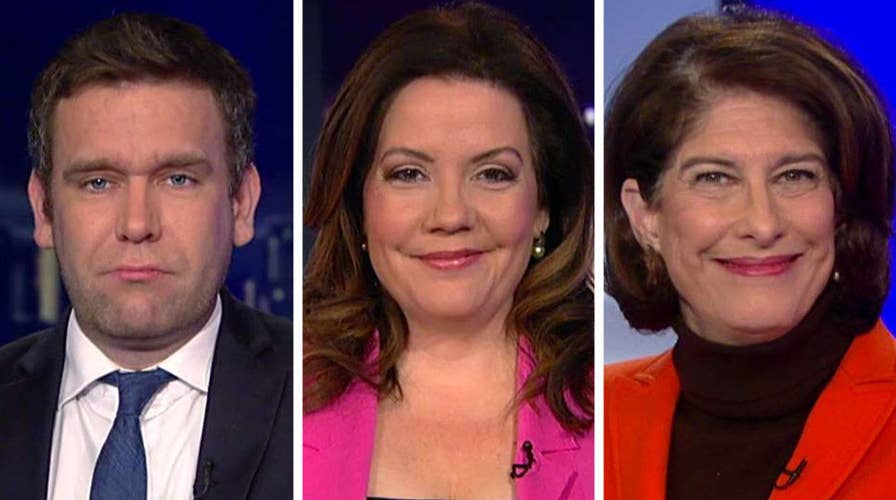
Let's bring in our panel, Tom Rogan, commentary writer for the "Washington Examiner," Mara Liasson, national political correspondent for National Public Radio, and Mollie Hemingway, senior editor at "The Federalist." Mara, this seemed like a big moment today, and a big move towards a meeting with Xi that could have a deal.
MARA LIASSON, NATIONAL POLITICAL CORRESPONDENT, NATIONAL PUBLIC RADIO: Yes, they could have a deal. One thing, the White House was looking into clarifying those remarks about 5 million tons. It might be bushels, but the point is they're going to buy a lot of soybeans.
But I think the big question is, there are two parts to this deal. One, China buys more of our stuff, like soy beans. The other part, which is much harder, is China changes its business model, stops stealing intellectual property, forcing technology transfer, et cetera. And the question hanging over these talks, would Donald Trump settle for just reducing the trade deficit, in other words, just settle for them buying more stuff but not really push for structural changes? Today he said several times that he wanted everything resolved. And what I've been told is he used to have an obsession with the trade deficit, but over time he has come to understand why these structural issues are really important. And those are hard ones to resolve and verify, but it's sounds like that's what they're pushing for.
BAIER: Tom, there are experts here in this town as well as finance experts in New York who are skeptical about dealing with China on this level and that they could just pat his back and say here's something for now, and continue their practices down the road. But the president has managed to get them to this point.
TOM ROGAN, COMMENTARY WRITER, "WASHINGTON EXAMINER": And I think he will get the agricultural stuff. We will get a deal, I'm 95 percent certain of that, because the Chinese need a deal. Their economic downturn debilitates President Xi's ability to reform the economy and do the other things in geopolitics he wants to do. And President Trump wants a strong economy and consolidation. So we will get something.
I think President Trump will also get in terms of machinery access, in terms of selling medium value goods, those American companies, Caterpillar type companies, for example. What he won't get is the intellectual property protection, because President Xi cannot give him that. The Chinese will commit to that and they will gradually break it down and keep stealing it because they need to do that to do what their ultimate ambition is, which is to usurp the United States as the guarantor of international economic order.
BAIER: I thought you were going to say take over the world, but you were heading down the road.
ROGAN: Broadly.
LIASSON: Something like that.
BAIER: Something like that. OK, Mollie?
MOLLIE HEMINGWAY, SENIOR EDITOR, "THE FEDERALIST": It is interesting to reflect on where we were when we started this trade war. We were told this would be disastrous for the United States and that China would handle it just fine. It turns out that the U.S. actually imposed tariffs pretty smartly. This has hurt China far more than it has hurt the U.S., which is having to absorb short-term costs in hopes of a long term deal.
China had a very foolish approach to it. They decided to target their tariffs in Democratic districts or in districts they thought might be able to turn Democratic in the 2018 midterms. It was a very shortsighted strategy on their part. They are the ones suffering, and that meddling in U.S. elections is not look kindly upon by everybody as well, as we heard in the intel briefing earlier this week.
But this whole thing was brought up not just about the trade deficit but really to deal with those decades-long problems, the way the Chinese dump and steal intellectual property. And so I think people will be eager to see major gains made on all of these fronts.
BAIER: Are there people, do you think, on either side of the aisle who are second-guessing their criticism of the president going in on how he was handling the China talks?
LIASSON: Well, I think they might do that if he gets a deal. I think it's a little early. You don't think that the Chinese are going to give up on those structural issues, but that is the top priority for Bob Lighthizer, and supposedly now for the president.
ROGAN: But the president's defense, though, in terms of it's the best deal we can get, because they won't give that up. But what we are doing, the administration very effectively limiting Huawei's access to both our allied markets, shutting them down, just closing doors on them. And that's how you deal with it, and you hit them with the cyber stuff as well. So if you have those two, dual track approach, that's pretty good.
BAIER: I want to talk quickly about Venezuela. Here's the secretary of state, the now disputed president Maduro, and of the opposition leader Guaido.
(BEGIN VIDEO CLIP)
MIKE POMPEO, SECRETARY OF STATE: The United States is prepared to support the Venezuelan people to achieve their freedom and democracy. This is a catastrophe, a man-made catastrophe by the Maduro regime.
NICOLAS MADURO, DISPUTED VENEZUELAN PRESIDENT (through translator): This campaign has been prepared to justify a coup d'etat in Venezuela that has been set, financed, and actively supported by the Donald Trump administration. If the government of the United States intends to intervene, they will have a much worse Vietnam then you can imagine.
JUAN GUAIDO, VENEZUELAN OPPOSITION LEADER (through translator): The pressure and the support of the United States is important, and all the other countries in the world that support us. We are sure that we are starting the change.
(END VIDEO CLIP)
BAIER: We're not doing a blockade, Mara. We're not surrounding them. Maduro is still there. He's getting support from Russia, China, Cuba. How long do we think this standoff can last?
LIASSON: We don't know. Despite what was written on John Bolton's notepad, we're also not sending troops there it doesn't seem like. So the point is that even though he has Cuba, Russia, there are a lot of other countries lining up to support the opposition president, and that matters in Latin America and elsewhere.
HEMINGWAY: And we are doing a good job of applying pressure without getting fully involved. When we intervene in another country's affairs it doesn't always work out the way we want. What we are doing in terms of imposing sanctions, working with other global leaders to encourage resolution to this humanitarian crisis is great. But stepping it up too much, we should make sure that's in our national interest as well.
ROGAN: I think Afghanistan, we first went in there, suitcases full of money was the big weapon, buying off the generals, buying allegiance. I think that is what is happening behind the scenes. I think four weeks were from now, I think Maduro will be gone. And I think the tipping point is reached. The implosion there is obvious. The E.U. next week is coming in with sanctions, and the Russians do not have the money to be able to contest with us this far abroad.
BAIER: You think a month. All right, next up, 2020 and the abortion debate.
(COMMERCIAL BREAK)
(BEGIN VIDEO CLIP)
ERICA SACKIN, PLANNED PARENTHOOD: Governor Northam has clarified that in that conversation he wasn't talking about abortion. He was talking about circumstances where a woman may have a wanted pregnancy and then finds out later in the pregnancy that it won't be viable and won't survive the womb.
SEN. BEN SASSE, R-NEB.: What he was actually talking about was a little baby girl being born alive, and him saying, well, let's try to comfort the baby a little bit while the mom and the doctors have a debate and whether a whole bunch of doctors get together and say, yes, we think infanticide is OK.
I think the 2020 Democratic presidential candidates should have to answer for this. This isn't the old Democratic Party argument 15 or 20 years ago that abortion should be safe, legal, and rare. This is about whether or not Democrats and these aggressive pro-abortion Democrats are going to continue to duck talking about whether or not they stand with that little baby girl.
(END VIDEO CLIP)
BAIER: Well, it was tough to get Democratic senators on Capitol Hill to comment at all about this. Some said they didn't hear about it, hard to believe that, but they did. And as far as the Planned Parenthood spokesperson, the governor of Virginia started the sentence with when we talk about third trimester abortions. So clearly he was talking about abortion in that whole dynamic.
"National Review" has a piece talking about "Democrats running for president in 2020 haven't commented on the Virginia abortion bill, but most of them have effectively already told us where they stand because they have cosponsored the Women's Health Protection Act, federal legislation that would override state restrictions on third trimester abortions." To that point, the bill's cosponsors, who are already 2020 candidates, there you have them there, and possible 2020 contenders, there's a whole list of those as well who have not officially gotten into this race. But it's interesting to see and it is definitely an issue that's getting attention. We're back with the panel. Mollie?
HEMINGWAY: This has been a very frustrating thing, as a Virginian, we are talking about this, because Virginia was contemplating this late term abortion bill. That is what Governor Northam was talking about. although it is also true that people who have his radical views on abortion also oppose bills that would protect children who survive abortion. That is another issue that they are very much out of the mainstream and out of touch with even people who identify as pro-choice. It is very sad, actually, to hear some of these conversations that we are having. We are in a rare group of countries that even permit abortions at these latest stages of pregnancy when children can feel pain. We are with China and North Korea, countries that you don't want to be identified with in permitting this barbaric and evil practice.
It is also disappointing -- I'm glad that you were trying to get senators on the record, because many people in the media do not ask people who have these radical views to explain themselves, to talk about what actually happens in these late term abortion procedures or when a child survives abortion.
BAIER: It's clearly something they don't want to talk about as you get into the details of this, Mara, but it's clearly also going to be an issue.
LIASSON: It's going to be an issue. I think politically this is called a self-own, or an own-goal, where you just really step in it. And the Democrats were on very safe political ground when safe, legal, and rare was the criteria, but this was a huge opening for Republicans, and you can see how aggressively they pounced on this because it sounded like he was defending infanticide. The president even was gloating about it, saying this is going to pump up the pro-life movement like nothing else has ever done that before. I don't know if that's true or not. I think it depends on how well Northam and others explain what they meant, but this was a huge political opening.
BAIER: But it can't be like a Planned Parenthood person, because he was talking about abortion, and he was very detailed. And this bill is pretty detailed, the Women's Health Protection Act of 2017. Restrictions on the performance of abortion are unlawful and shall not be imposed or applied by any government. A prohibition on abortion after fetal liability when, in the good faith medical judgment of the treating physician, continuation of the pregnancy would pose a risk to the pregnant woman's life or health," is how that part reads. Tom?
ROGAN: This policy approach from Democrats make much of social democratic Europe look like a citadel of old school, firebrand, American social conservatism, the distance in legal portfolio in terms of what is being suggested here.
And I do think politically you can understand why President Trump is hitting this, because one of the critiques against the president is that he is someone who has a flexible moral code. If he is standing up on the platform and saying you know me for what I am. I've been here for four years. But Democrats are saying that you could essentially kill something that I think most Americans would say was alive at that point, not only does that consolidate him as certainly the lesser of two evils in I think a lot of people's minds, but it suggests that there is a callousness to Democratic policies that does not fit with the moral narrative that they have so carefully sculpted with people like Alexandria Ocasio-Cortez. That disconnect I think is their greatest challenge in a political sense.
BAIER: Yes. And obviously there's the pro-choice argument and the people who say politicians should not be making decisions, but there always seemed, Mara and Mollie, to be this line at which even those folks who were advocating that, didn't get to that point.
HEMINGWAY: That's why it's important to even think about this in terms of people who are pro-choice would say that this type of legislation is extremely radical. Even people who identify as pro-choice tend to see is something that should be done only in the first three months of the child's life. These bills are essentially Gosnell protection acts. Kermit Gosnell was the abortion doctor and serial murderer who is in prison in Pennsylvania --
BAIER: By the way, we only that covered that story, and it didn't get it covered for a lot of the time before he ended up going to trial.
HEMINGWAY: And these are the type of practices that I think everyone regardless of whether they're pro-life and support the sanctity of human life for children or they're not think this is extreme.
BAIER: All right, panel, not done talking about this or the health care issue broadly.
When we come back, giving is better than receiving. We'll explain.
(COMMERCIAL BREAK)
BAIER: Finally tonight, the National Champion Clemson Tigers had a special surprise for one very important member of their football team.
(BEGIN VIDEO CLIP)
UNIDENTIFIED MALE: I don't know if you're interested, I know you are busy. But, the NFL, they have presented you with two Super Bowl tickets to the Super Bowl this year.
(APPLAUSE)
(END VIDEO CLIP)
BAIER: David Saville is the team's equipment manager and what many describe is really the heart of the Clemson football team. Saville also has Down syndrome, came to Clemson as part of a college program. And he was pretty psyched today. It looks like he might be a little late to classes on Monday. He is heading to the Super Bowl in Atlanta, and he phoned his father. That's good news.
Thanks for inviting us into your home tonight. That's it for this "Special Report" - fair, balanced and unafraid.
"The Story,” hosted by New England Patriots fan, Martha MacCallum starts right now.
Content and Programming Copyright 2019 Fox News Network, LLC. ALL RIGHTS RESERVED. Copyright 2019 ASC Services II Media, LLC. All materials herein are protected by United States copyright law and may not be reproduced, distributed, transmitted, displayed, published or broadcast without the prior written permission of ASC Services II Media, LLC. You may not alter or remove any trademark, copyright or other notice from copies of the content.
