


Trump administration to expand expedited deportations
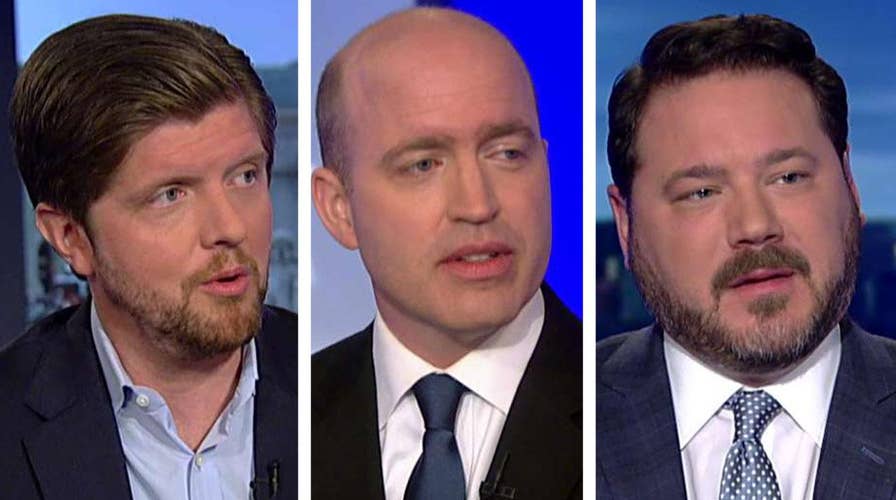
The 'Special Report' all-star panel on the impact of the border crisis, Trump's immigration agenda on the 2020 election.
This is a rush transcript from "Special Report," July 23, 2019. This copy may not be in its final form and may be updated.
(BEGIN VIDEO CLIP)
REP. ERIC SWALWELL, D-CALIF.: We can't just assume that most Americans know what happened. We have to, I would say, frame this in a way that they are learning for the first time from someone who had a front row seat to all of these witnesses.
KELLYANNE CONWAY, COUNSELOR TO PRESIDENT TRUMP: They also think you're stupid, America, that you can't read the report for yourself.
REP. JIM HIMES, D-CONN.: There's a difference between reading the book and seeing the movie, and part of the objective here is that Bob Mueller bring this thing to life.
SEN. MITCH MCCONNELL, R-KY, SENATE MAJORITY LEADER: I don't know how many times we want to see this movie again, but I think the American people have moved on past this.
(END VIDEO CLIP)
BRET BAIER, HOST: We are going to see it tomorrow, two big hearings on Capitol Hill. We'll have coverage here on Fox. A bit of a surprise today as we learned that there will be a plus one for Special Counsel Robert Mueller. That is Aaron Zebley. He is the Special Counsel's attorney, also a longtime associate. He was the senior attorney on the case handling some of the sensitive issues, and he will be at the table, we're told, at the House Judiciary Committee, at least, and that has thrown Republicans into a tizzy, and questions about how this is all going to go.
Let's bring in our panel, Ben Domenech, publisher of "The Federalist," Jeff Mason, White House correspondent for "Reuters," and former CIA analyst and nationally syndicated radio host Buck Sexton. OK, Ben, thoughts on this late addition and kind of laying out the blueprint here?
BEN DOMENECH, "THE FEDERALIST": I think that to have a late addition like this is consistent with everything that we seem along the process of the way this report has been handled publicly, which is that it has increased, I think, no one's faith in the institutions involved of an approach that is going to be responsible and that's going to stay away from being a real circus.
The fact is that Mueller is going to come before the Congress and say -- stick to I think most of the report, but I can't see any situation where this is not going to end up being shaded in ways that are trying to damage the president further to get him to try to go further than what the report said. Democrats are going to try to do that over and over again. It's just going to be a circus-like atmosphere, and it's not going to be the kind of thing that the American people deserve.
BAIER: Jeff, the DOJ wrote this letter saying that he should -- Mueller should stick to the report and kind of what's in the report. There was a back and forth with Jerry Nadler, and then the attorney general weighed in on it. Take a listen.
(BEGIN VIDEO CLIP)
REP. JERROLD NADLER, D-N.Y., HOUSE JUDICIARY COMMITTEE CHAIRMAN: I think it's incredibly arrogant of the department to try to instruct him as to what to say. It's part of the ongoing cover-up by the administration to keep information away from the American people.
WILLIAM BARR, U.S. ATTORNEY GENERAL: Bob had said that he intended to stick with the public report and not go beyond that, and in conversations with the department, his staff was reiterating that that was their position. And they asked us for guidance in writing to explain, or to tell them what our position was. So we responded in writing. The department sent the guidance they had requested.
UNIDENTIFIED MALE: So Mueller actually requested it?
BARR: Yes.
(END VIDEO CLIP)
BAIER: So the cover by the administration was actually requested by Mueller. But either way, this looks like it's kind of going to stick to the guidelines.
JEFF MASON, WHITE HOUSE CORRESPONDENT, REUTERS: The truth is Mr. Mueller said early on before he even agreed to do any testimony that if he were to speak to Congress, he would stick within the confines of his report. And he said that the report contained his essential testimony. It contained the statement that he and his investigators had to make and the evidence that they had to show from the two-year investigation. So there's some back-and-forth about that right now, but it's completely in line with what he has said before if he stays pretty closely to that report.
BAIER: Democrats just want to soundbites, right? They want the report, and yes, no, is this true, is this not, down the line?
BUCK SEXTON, FORMER CIA ANALYST: The likelihood of a major revelation here is I think really low. That would be the consensus going into this. But I think as much of what is not said is going to what's focused on here. I think that there will be moments where questions are asked and Mueller stays within the boundaries of the report and doesn't give an answer. People try to make that into a shouldn't he give us more information of this. And there will be arguments as to what the boundaries of the reports are.
This is all just a way of saying, yes, people are looking for soundbites for their specific narratives here. I think it will be easy for him to deflect on what Republicans really want to know, which is likely to come out in the inspector general report in September. Democrats really just want the reiteration of all of this to the point that was made by the congressman before, one of the congressmen before. They just want this brought to life once again. But I think they may find that this doesn't have quite the impact that they were hoping.
Also, by the way, the last time around when Mueller appeared on T.V., it was not a great performance. A lot of people started to think how involved was he really at the very top level of the biggest decisions day-to-day, and does he really act as the messenger for the Democrats here that they'd like them to be? I think the answer is no.
BAIER: There's some serious stuff obviously in these 400-plus pages, and a lot of it deals with what Russia did, what they tried to do, and the reaction to it. Republicans are hoping it backfires. Here's Rush Limbaugh today.
(BEGIN VIDEO CLIP)
RUSH LIMBAUGH, RADIO TALK SHOW HOST: This is a recipe for one of the biggest backfires. Mueller can't go outside the report. He has testified to it. He has put his name on it. It is what it is. It can't be changed, and it's explicit.
Charging decisions are made by the attorney general, not the special prosecutor. It was Comey's firing that got everybody all hot and bothered on obstruction, and that's what Mueller began investing. The point is, Mueller knew there was no collusion on May 17th.
(END VIDEO CLIP)
BAIER: And that's one of the questions Republicans will ask, when did you know?
DOMENECH: I think this is a situation where Mueller could have approached this in a number of different ways. He could have said, look, my report speaks for itself. You've all read it, you've all had the ability to go and check out the background information about this. I'm just going to let it stand.
He also could have come to the Congress with no preconditions and said, look, I will take any question, I will approach this in a way that will allow every little radical to be going down. Instead we have this situation where nobody's going to be happy with the result. Democrats will wish that he was stronger against the president in all likelihood. Republicans will wish he would've been more open about various potential FISA abuse and other aspects of this investigation that they would like to hear him talk about, and everybody's going to walk away mad at each other.
BAIER: OK, thanks for that. We will have coverage tomorrow either way.
I want to turn to this story that we led the show with, and that is the DOJ putting out this letter saying the department's review will consider the widespread concerns that consumers, businesses, entrepreneurs have expressed about search, social media, and some retail services online. An antitrust investigation that seems, Jeff, pretty wide in scope. We don't really have the confines of where this is going.
MASON: Absolutely, very wide, and it didn't specifically name any companies, but the companies that one can assume are involved are alphabets Google, potentially Apple, Facebook, the companies that Americans, people around the world use and rely on for social media, for communicating with each other. They are massive, massive technology companies in this country.
BAIER: This tracks with congressional efforts to look into these companies. I was anchoring "FOX News Sunday" for Chris last month, and I asked one of the Democrats in charge of one of these committees about it.
(BEGIN VIDEO CLIP)
REP. DAVID CICILLINE, D-R.I.: One of the things I think we are very concerned about is the impact on consumers. When you say they're free, the true is the data that is collected, and their attention is then used to generate revenue. So it's not really free. There have been significant reductions in privacy. There has been substantial evidence of misuse of data.
(END VIDEO CLIP)
BAIER: Point being, Buck, that this is the black hat now for Washington, Republicans and Democrats.
SEXTON: This is also politics driving the way people are going to see the economics of this or the specific definitions about monopoly and antitrust. The major companies that are at issue here had the opportunity to operate more as utilities. They did get their hand stuck in the door here doing stuff that's obviously political. They initially said this isn't really happening. I think now that case is too hard for them to make, and so that's pushing a lot of people to say, well, communications are regulated across the board. I work in radio, there's all kinds of regulations there. They look at murders, they look at what you can say. Why should these companies, especially Google, Facebook, the major ones we're talking about, be able to operate in this space where they are able to get away with a lot of stuff that other companies wouldn't. And I think that's where you're going to see the regulation come in. And I do think that conservatives feel like this is an issue of what's right now. And this is finally -- accountability is needed.
BAIER: Quickly, this seems like the beginning of the beginning.
DOMENECH: Yes, it does. And there is a wait right here between the pro- business attitudes that a lot of conservatives have and a lot of their skepticism about this comprehensive digital wokeness that we see driving Silicon Valley's activity in recent months.
BAIER: We'll follow it. Next up, fast tracking immigration enforcement.
(COMMERCIAL BREAK)
(BEGIN VIDEO CLIP)
MATTHEW ALBENCE, ACTING ICE DIRECTOR: Of the 899 that we arrested because May 13th and July 11th, 605 were convicted criminals and 93 had pending criminal charges. What we're looking with these charges are a whole host of individuals crimes ranging from domestic violence to all other sorts of violent offenses.
KEN CUCCINELLI, USCIS ACTING DIRECTOR: This regulation really just takes us back to the original statute, will help them do their jobs more smoothly, more easily, and safer for the officers as well.
(END VIDEO CLIP)
BAIER: Expediting of getting illegal immigrants out of the country, the acting DHS secretary saying if you have no legal right to be here we will remove you. We're back with the panel. Buck, what about this move and what it means?
SEXTON: The president is right that they need to up the deportations, and they also need to start exacting a political price abroad for countries like Mexico, like Guatemala, northern triangle countries that are not doing enough to help with this issue.
BAIER: You just got back from there.
SEXTON: Just traveling with the Secretary Pompeo to Mexico City and El Salvador. El Salvador sounds like there are very on board to try to stop the migrant flow. They take responsibility for it as a problem that they are creating, at least within their own borders. Mexico is obviously taking a slightly different approach. They've sent some troops, but they are not doing the third safe country agreement.
The problem with the Trump administration right now is they keep saying we're going to have these ICE raids and these deportations, and they don't materialize. And people are starting to wonder is that from lack of will or capability, or what is going on here. If you're going to say this is going to happen, and you are negotiating with people on the premise that they better act or else, you need to actually do the things you're going to say, and this administration needs to step up and get those deportations going.
BAIER: Gallup, the most important problem in the U.S., July 2019, 27 percent say it's immigration is the most important problem. That surpasses any other problem last month. And if you look at the years, basically immigration is taking over as the issue.
MASON: Yes. And that's something that the president is clearly very aware of because he's talking so much about it. He did in 2016, he will continue to going into 2020. But there might be some vulnerability there if some people from his base or others who are concerned that he's not actually fulfilling the promises that he's made. The big sign at all of his rallies has to do with promises made, promises kept. But he's showing some sensitivity to the fact that there's some criticism that maybe he hasn't been able to make the wall happen in the way that he promised in 2016. Certainly, Mexico is not paying for it. And some of these deportations are not leading to the numbers that he suggested would come.
BAIER: "The Washington Examiner" had a headline, "Trump is not built a single mile of new border fence after 30 months in office." And the president tweeted out, "When an old wall at the southern border that's crumbling and falling over built in an important section to keep out problems is replaced with brand-new, 30-foot high steel concrete wall, the media says no new wall has been built. Fake news! Building lots of wall!" Trying to say he's replacing lots of wall with new wall.
DOMENECH: The problem that we're facing here is much bigger than just a question of a wall. You mentioned Guatemala. Guatemala is a country of about 17 million people. In the last nine months the Border Patrol has acquired and had to process more than 235,000 Guatemalans. That's 1.4 percent of the country all showing up at our southern border. This is a problem that's going to require a lot more than just wall building. It's going to require policies on the part of these Central American countries that are fundamentally different from the ones they are currently advocating for that are pushing people into the arms of human traffickers.
BAIER: And yet as we get ready for another round of Democratic debates, it seems like there's not a unified message on immigration from the Democrats. In fact, the hand raising that illegal immigrants should get health care, essentially Medicare.
SEXTON: It's pretty close to open borders, Bret. Every time the administration takes any enforcement measure or even says they're going to take enforcement measures, you can count on all the Democrats on stage, all the Democrats across the party to oppose those enforcement measures. So it's really a de facto open border status. Certainly, if you show up with a child at the southern border you are effectively going to get into the country.
It has been disheartening to watch the Democrats able to focus on treatment of people at the border specifically as the only issue here, as though we weren't in the midst of hundreds of thousands of people, as Ben points out, getting into this country who plan to stay here illegally, and by the way, are breaking the law in the process coming into the country in the first place.
BAIER: We will see how it goes down in Detroit at those debates. Panel, thank you.
A Marine veterans long journey leads to an emotional reunion. We'll bring you that next.
(COMMERCIAL BREAK)
BAIER: Breaking tonight, you are looking live at the Rayburn House Office Building. These are environmental protesters who have super glued themselves to the door to prevent lawmakers from getting to the capital for votes. You see there's two guys here. Apparently, there's a couple other guys at other doorways. Police are trying to move them out. They've super-glued themselves there. Not sure what chemicals are going to be used to get them unstuck. Maybe not environmentally friendly, but they are doing it, live. We'd thought we'd bring that to you. You can't make this up in Washington.
Thanks for inviting us into your home tonight.
Content and Programming Copyright 2019 Fox News Network, LLC. ALL RIGHTS RESERVED. Copyright 2019 ASC Services II Media, LLC. All materials herein are protected by United States copyright law and may not be reproduced, distributed, transmitted, displayed, published or broadcast without the prior written permission of ASC Services II Media, LLC. You may not alter or remove any trademark, copyright or other notice from copies of the content.
