







Tom Homan on the border crisis: We've got to throw everything at it we can before something devastating happens
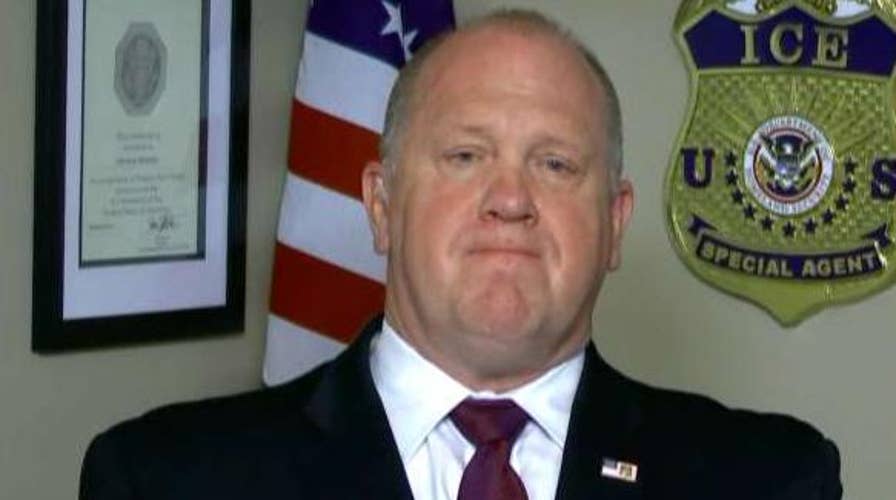
Former acting ICE director Tom Homan says Democratic leadership has not done one thing to fix the crisis at the U.S.-Mexico border.
This is a rush transcript from "Your World," April 24, 2019. This copy may not be in its final form and may be updated.
NEIL CAVUTO, HOST: Thank you, Shepard.
I want to show you something that's going on in Mexico as we speak. In fact, it's been happening all this week. These are some of the late images we have gotten, new video we have gotten from yesterday that shows how Mexican authorities crack down on a migrant wave going on in their country.
They round them up on a big old train, several such trains. And they're successful at rounding them up. Here's the problem for us. They're on their way here. And we don't know how to deal with them. We just know that there are quite a few of them.
So Mexico cracking down, and we're at a loss as to figure what the heck is up.
Jonathan Hunt in Los Angeles with the very latest on that -- Jonathan.
JONATHAN HUNT, CORRESPONDENT: Neil, we're getting some new and disturbing video today via Customs and Border Protection.
What they're not sure about is whether what we're about to see is a one-off or a growing trend. Let's show you that video first given to us by CBP. Officials say it was recorded on the Arizona-Mexico border Saturday night. A group of men, at least two of whom are armed, with what appear to be automatic or semiautomatic weapons, pull up in a truck, a woman and a young boy with them.
Carrying their weapons, they walk right up to the border. The armed men then stop on the Mexican side, while another man who appears to be unarmed escorts the mother and child through the fence, points the way to them, and then hops back through.
CBP, by the way, moved in quickly to detain the woman and her son, who are Guatemalan. The armed men slipped away into the night in Northern Mexico. Now, given the ongoing drug smuggling activity along the border, weapons are nothing new, but officials say it is disturbing to see them in the hands of apparent human smugglers right on the border.
Meantime, as you were mentioning, several thousand Central American migrants are currently in Southern Mexico heading toward the U.S. border, by train by bus and on foot, but they are still around 1,000 miles from the border itself.
It's difficult to get an accurate estimate of the numbers, but Associated Press reporters who are actually traveling with the migrants put the number at around 3,000. Yesterday, Mexican police detained more than 350 of those migrants in what appeared to be a well-planned operation to disrupt the caravan. That may have reduced the numbers.
And again, Neil, we cannot emphasize enough those numbers are frequently inaccurate. But President Trump's Twitter claim today that the caravan is 20,000-strong, according to all the information we can find, Neil, seems to be very much inflated -- Neil.
CAVUTO: So, Jonathan, there are disputed reports as well that the Mexicans aren't doing enough to either stop the train or stop these folks from getting on the train, or that they're just looking the other way. We just don't know. Right?
HUNT: Well, we don't know.
The evidence we have from the video we saw coming in yesterday was that they appeared to carry out this pretty well-coordinated operation to round up some of those migrants. But they got in the end the total figure we hear was 367.
Now, there are at least several thousand, 3,000, according to the AP, in the current caravan. So that, in essence, is a very small number of them. Obviously, President Trump has called on the Mexican government to do more. Remains to be seen if they will follow what are essentially presidential orders -- Neil.
CAVUTO: All right, Jonathan Hunt, thank you very, very much.
It does show the renewed dangerous for our border agents there and how to deal with it, looking how a lot of these armed men, for example, are helping in one case, as Jonathan pointed out, escort a woman and a child to the U.S. border.
Former acting ICE Director Thomas Homan.
Thomas, good to have you back with us.
You can understand obviously the president then talking or discussing the possibility of sending armed soldiers to the border to counter this, but it just seems to escalate by the minute.
THOMAS HOMAN, CONTRIBUTOR: Look, it's very concerning.
As I have said on your show many times, Neil, none of this is happening on the northern border without the coordination and the approval of the Mexican drug cartels. They control everything on the northern border, I mean, from the incursion the other day with the military, who I'm certain was probably working on behalf of the drug cartels, because that happens, to what we just saw.
This is -- this should be very concerning to the administration, to the men and women of the Border Patrol, because this is going to end up in a shooting situation. It's going to happen. It's a matter of time.
So, look, this emergency on the border, this crisis on the border, we got to -- we got to throw everything at it we can, before something devastating happens.
CAVUTO: You know, this also occurs as a judge is pondering what to do about remain in Mexico, the Trump administration policy that, if you're apprehended, and you're going through the whole adjudication of this, that you're -- the Mexican authorities will be responsible for those in Mexico.
They will not be able to wait it out in the United States. Now, assuming, as they have in the past, courts don't go along with that, now what are we looking at?
HOMAN: The same thing I have been pushing.
Look, the courts have not helped the president. He's the only one actually throwing ideas out there, trying to think out of the box on what to do. And every time he does something, the courts hold him up.
Congress hasn't done anything. The Democratic leadership hasn't offered up one proposal, one fix. So, as I have said many times, we need to do operationally what Congress is failing to do legislative. ICE needs to do a national operation.
Look for these family groups and single adults who had their day in court and a federal judge said they got to go home. We got to execute those orders, because I ran an operation like that three-and-half-years ago.
And the result were, the border numbers went down significantly, because we show consequence deterrence. I think HSI portion of ICE needs to go down to Mexico, work with our vetted units, the federal police that we vetted, and identify these criminal cartels, dismantle them, take their money, and imprison them.
Look, any smuggling Mexico is also illegal. And right now these criminal cartels are operating with impunity. Mexico needs to step up. We can show them how to do it and show them a way.
So I think HSI needs to take a bigger role down there. I appreciate what Mexico's doing right now. But my concern is this. Is it a dog and pony show to just appease the president for a short time? Or are they actually going to sustain an operation that's going to result in the arrest and removal of Central Americans back to their home country.
CAVUTO: The irony would be then -- I'm going to accept what you're saying at face value -- is the Mexicans -- accepting at face value that they're trying to deal with this problem themselves, have actually made it easier for these migrants from all points south to get here.
HOMAN: Bingo, because it's illegal in the -- in Mexico to transit through Mexico without a transit visa.
So if they're not applying to Mexican immigration for a transit visa, then they're operating illegal in Mexico. So Mexico needs to step up and enforce their own laws. If they do that, it would have a significant effect on the people coming north.
And, plus, it's just not about law enforcement and border security. It's about saving lives. As we know, 31 percent of women are sexually assaulted during this trip. Children have died. More children will die. This isn't just about enforcing the law. This is about saving lives and saving women's health and children's health.
Even if you don't like ICE, even if you don't like this president and border enforcement, would you please do something to save lives? I mean, that needs to be the message.
CAVUTO: Thomas Homan, thank you very, very much.
And the world has gone increasingly toward Mr. Homan's direction here. You have already heard from presidential candidates, Democratic presidential candidates like Cory Booker, who acknowledge we have a crisis at that border. Jeh Johnson, former Barack Obama homeland security secretary, saying we have an emergency at the border.
And now Tom Friedman, a somewhat left-of-center columnist, saying that what we have there is something that both parties need addressing and need to do so right now, talking about the need for something that is dramatic on both parties' part.
Let's go to Republican strategist Noelle Nikpour, Democratic start Danielle McLaughlin, and The Wall Street Journal's Bill McGurn.
Bill, end it with you.
This notion that it's escalating fast, and everyone increasingly seems to acknowledge that, but no one's doing anything.
BILL MCGURN, THE WALL STREET JOURNAL: Right.
What we what we see is what you get after decades of Congress not acting. I was in the Bush White House when we tried a bipartisan immigration reform. And then Senator Obama was one of the people that helped deep-six that, despite having Senator Kennedy on there.
I think there are reasonable trade-offs that can be made. Each side has to give a little. But, right now, I don't think there's any mood for that.
NOELLE NIKPOUR, REPUBLICAN FUND-RAISER: I agree with you.
I think that the price that some of the Democrats may pay for working or being seen to work with anything with Trump, especially on that golden issue of immigration, which build the wall, that's how he got elected, with that one message.
MCGURN: Right.
NIKPOUR: So I think the price they fear they're going to pay is at the polls.
CAVUTO: Well, you know, Danielle, it's interesting.
When I was reading Tom Friedman's column, he was at the San Diego border with Tijuana, and looking at the fact that's a very high wall. He seemed to embrace a high wall, that he noticed a lot of the chicanery and the problems started when you left that area. And either it was a lower wall or no wall at all, but advocating that, while a wall exclusively wouldn't be the answer, his view, the president saying there's an urgent situation and was right.
DANIELLE MCLAUGHLIN, POLITICAL COMMENTATOR: It's all about the rhetoric at this point, the wall, the election.
CAVUTO: Do you call it urgent? Do you call it an emergency?
MCLAUGHLIN: Yes. Yes, I do. And I think Democrats absolutely need to step up, because I think they will pay a political price if they don't do something about the women and the children who are coalescing around the border, who are coming up from these countries that are basically failed nation states.
It has to be comprehensive, but I think they do need to get on board with...
(CROSSTALK)
NIKPOUR: But don't you think that the reason that -- you're acknowledging they need to get on board. A lot of people are acknowledging that it's a crisis, Democrats.
But they're not making a move towards it, because then it looks like they are extending an olive branch of Trump. And I feel like that they -- they risk what the public perception is going to be.
(CROSSTALK)
CAVUTO: Well, they're crafty enough to read polls, though, right? And that is the number one issue for a lot of Americans right now.
It's usurped health care. And I'm wondering, the longer this goes unaddressed, savvy candidates like Cory Booker are realizing, I don't want to be on the wrong end of this issue. Right?
MCGURN: Well, except I think the dominant mode is, they would rather deny Donald Trump a victory, what he would present as a victory, than even get some victories of their own.
Look, I was in support of the...
(CROSSTALK)
CAVUTO: But they certainly wouldn't be for a defeat for themselves, right, to look like they're behind the eight ball here?
MCGURN: Well, I'm not sure about that.
Look, they didn't make the trade earlier this year wall for DACA, right?
NIKPOUR: Right.
MCGURN: Regularizing these who are people here under DACA and kind of in a legal limbo. That would have been a straight off trade that was good, but they just couldn't...
(CROSSTALK)
CAVUTO: But now we're beyond that. Right?
MCGURN: So they couldn't -- we're beyond that.
But I think -- I don't think we're going to get comprehensive immigration reform any time before 2020. I would like to see them pick one piece of this, whether it's our asylum laws, trying -- the administration trying to rationalize the system, making people go through certain checkpoints for asylum claims.
So we just have...
(CROSSTALK)
CAVUTO: Or while they're waiting that process out, do it in Mexico.
And that is seen somehow to have been a heinous decision. I don't know what the big deal is. But what do you think?
MCLAUGHLIN: Well, there are also other ways of dealing with asylum seekers.
There was a pilot program under the Obama administration which was a community-based system. And the number of folks who went to their asylum hearings, who went to check-ins with ICE offices was in the 90th percentile. It was a very, very effective way of making sure that people made their day in court.
I think there's other things that Democrats want. They do want a DACA fix. They want -- probably they want citizenship for dreamers, but I'm not sure they're going to get that.
MCGURN: They could have had it. They could have had it.
(CROSSTALK)
MCGURN: That's the point. They chose not to have it.
CAVUTO: They're talking right past each other.
MCLAUGHLIN: They are.
CAVUTO: And to your point, there's broad agreement on some of the areas where they can address it, but we're past that.
And then we have incidents involving U.S. detainees or those who are dealing with those trying to cross the border who are second-guessed by Mexican officials and held at gunpoint, until they can resolve which side of the border they're on. Turns out that those U.S. guards were on the side of the U.S. border, beyond just the fence, which obviously leaves some wiggle room here.
But this is how crazy it's getting. That could end violently.
NIKPOUR: Of course it could end violently.
But I think that the worst problem is we have a crisis at hand. Both parties have acknowledged it's a crisis. But because the -- Donald Trump has done everything he said he's going to do. He's fulfilled every promise, but the biggest one, the biggest piece of the puzzle is immigration.
And I think the Democrats, if they play a hand, they all know that Donald Trump will tweet out, look what I did. He will claim victory for it. And then there's reelection.
(CROSSTALK)
MCGURN: They won't do it after 2020, if they do it at all, to come together, because the -- if I were President Trump...
(CROSSTALK)
CAVUTO: Well, if you just follow the math, then we will be up to 200,000 incursions, you know?
MCGURN: Right.
But I think, if I were President Trump, I would propose a compromise. Now, they can reject it. But then so it's clear who's doing the rejecting and who's doing the proposing. And it could be something that's revived.
CAVUTO: All right, we will watch it very, very closely.
But it is a mess the border, because no side really knows for sure what the other is doing. And they get a little trigger-happy and nervous in the process. So we're monitoring that.
Also monitoring the president responding to Democrats who want to subpoena White House officials, past, present, and everyone in between, to speak on Capitol Hill. The president is saying, I don't have to do that -- after this.
(COMMERCIAL BREAK)
(BEGIN VIDEO CLIP)
DONALD TRUMP, PRESIDENT: The subpoena is ridiculous.
JOHN DELANEY, D-PRESIDENTIAL CANDIDATE: Congress has subpoena power. They're going to use it. They're going to get the information they believe they need to do as part of their oversight responsibilities.
KELLYANNE CONWAY, TRUMP SENIOR ADVISER: There's really no reason to comply with all these requests when we have the Mueller investigation.
SEN. KIRSTEN GILLIBRAND, D-N.Y., PRESIDENTIAL CANDIDATE: If we have to see the administration and take them to court, we will.
(END VIDEO CLIP)
CAVUTO: This is why folks are confused, House Democrats slapping President Trump's aides with subpoenas, testify, or else.
The White House slapping back, asking why it is they seem to need more, considering how thorough the Mueller report already was. And a lot of these same folks have talked ad nauseum to the Mueller folks.
House Judiciary Republican Greg Steube joins me right now. He says, enough is enough.
We did reach out to the Democratic chairman, Jerry Nadler, have not heard back. Hope springs eternal, though.
Congressman, your point is that they shouldn't testify, or that you can't force the issue?
REP. GREG STEUBE, R-FLA: Well, when is enough enough?
You have had 22 months to investigate. You have had $25 million that was spent, with 18 lawyers, 2,800 subpoenas, 500 search warrants and 500 witness interviews. At what point do you say, OK, we have done enough investigation?
And with all of that investigation, it comes with no collusion. And the attorney general decides not to have any obstruction charges. So I think, as a country, we need to be focused on moving forward and trying to improve the lives of Floridians and Americans.
CAVUTO: So you would be against any of these hearings, period?
STEUBE: I just don't think -- what are we going to learn from these hearings from the people that are part of this report that we haven't learned already?
CAVUTO: OK.
So the fact that maybe they could elaborate a little bit on this, it's very different when someone's in writing, and you hear the exchange, like a Don McGahn, of course, who was the White House counsel, who we're told the president had wanted him to fire Bob Mueller.
Wouldn't you, just out of curiosity, want to get to the bottom of that, what really happened, or what?
STEUBE: Well, I think the -- Trump -- I think President Trump and the administration was very transparent in the investigation. They didn't claim executive privilege.
And I think they will claim executive privilege when their general -- former general counsel testifies. And he has every right to do that.
CAVUTO: All right, so -- the reason why I'm saying it is -- and you're quite right. There could be a lot of politics involved. Many argued that Republicans were playing some of these same games looking into a lot of Clinton-related scandals and during the Obama years, what have you.
But the fact of the matter is, though, this obviously isn't going away. To your colleagues who are saying, we need to get to the bottom of this to see whether it's an impeachable offense, something that they say Bob Mueller and his folks left out there for them to decide, that he wouldn't rule, for example, one way the other on obstruction and dropped it in their lap, do you agree with their characterization like that?
STEUBE: Well, I think it was in the beginning.
The last four months that I have been in Congress, you have heard them say, let's wait for the Mueller report, let's wait for the Mueller report. And then the Mueller report comes out, and no collusion. And I think that disappointed a lot of Democrats, because I think they thought that there was going to be something that they could find that would be impeachable.
And now, because they don't have that, they're going to try to do everything they can to try to find something that they can move forward. There's been a number of different of their members where they have said that they want to move forward with impeachment.
There were some of the freshman members that I came into Congress with that were talking about impeachment soon after getting sworn in. So certainly there's members in their delegation that that's what they have wanted to do for the last four months. And they don't have any facts or evidence to support it.
CAVUTO: All right. OK.
One thing I just want to get clear, is it your sense, if you had an opportunity to talk to Don McGahn or some of these other people, that what would you want to know?
Let's say that they did have to testify, they would testify, that there was -- you get a sense of internal frustration among some aides to the president who decided the better part of valor was ignoring his orders, and that might have saved him. Hard to say, legally.
What would you want to find out?
STEUBE: What I would want to find out is, how did we get to where we are now? What evidence did they have, other than a Russian dossier that came from the Clinton campaign, as a basis of probable cause to get a FISA warrant to then spy on the Trump campaign?
Those are the type of questions that I would have. And from A.G. Barr's testimony to Congress last week or the week before, he testified that the inspector general is going to be investigating that. Those are the type of things that I would be focused on in my questioning.
CAVUTO: Congressman Steube, thank you very, very much.
You might get your wish, one way or the other, in the weeks ahead. We will see.
STEUBE: We will see.
CAVUTO: In the meantime, let prison inmates vote?
Democratic presidential candidate Bernie Sanders is pitching it. Now even Cher is telling him to snap out of it.
(COMMERCIAL BREAK)
CAVUTO: All right, you're looking at Houston, Texas, Bernie Sanders speaking at a public forum right now.
He is in a world of controversy over his recommendation, among others, to go ahead and let convicts, those in jail, vote, even as they are in jail.
Anyway, besides getting Cher on his back, he has a host of his opponent saying that that's crazy.
FOX News Channel's Peter Doocy has much more.
Hey, Peter.
PETER DOOCY, CORRESPONDENT: Neil, Cher is shaking her head at Bernie Sanders, tweeting this -- quote -- "Does Bernie Sanders really believe people in prison who are murderers, rapists, child molesters, Boston bombers still deserve the right to vote?"
The answer to Cher's question is yes, because when a student asked Sanders at a town hall in New England just days after the sixth anniversary of the marathon bombings, if the surviving bomber has the right to vote from Supermax, Sanders said this:
(BEGIN VIDEO CLIP)
SEN. BERNIE SANDERS, I-VT, PRESIDENTIAL CANDIDATE: But I think the right to vote is inherent to our democracy, yes, even for terrible people.
(END VIDEO CLIP)
DOOCY: A Trump campaign spokeswoman, Kayleigh McEnany, adds that -- quote -- "The extremity and radicalism of the 2020 Democrats knows no bounds. Giving imprisoned terrorists, sex offenders and murderers the right to vote is an outrageous proposal that is deeply offensive to innocent victims across this country, some of whom lost their lives and are forever disenfranchised by the very killers that 2020 Democrats seek to empower."
And you might think this marks a historic moment, the first time the Trump campaign and Cher have agreed on a controversial issue, but it's not, because she posted something complaining about Los Angeles ignoring citizens to take care of illegal immigrants.
And now Donald Trump Jr. writes: "In case you missed it last week, when I thanked you for rallying against the insanity of sanctuary cities, welcome to the Republican Party."
Cher has campaigned for Democrats before, though, and we don't have any reason to think that she's done with that party just yet -- Neil.
CAVUTO: It's a strange world we live in.
All right, thank you, Peter Doocy, very, very much.
Even The New York Times saying that a lot of folks are getting increasingly scared about Bernie Sanders, and a lot of them, as you can see, Democrats.
The read on all of that with my next guest, RealClearPolitics reporter Phil Wegmann.
It is an unusual alliance on the left now saying, Bernie, no. That's not as if that all of a sudden he's become persona non grata. But those views are extreme for them?
PHILIP WEGMANN, REALCLEARPOLITICS: Well, it's not just voting rights here. This is the latest thing.
But you have got to remember that Bernie Sanders has a lot of baggage that Democrats know Republicans and President Trump are going to exploit. This is Bernie Sanders, who wrote some pretty creepy things in the 1960s, Bernie Sanders, who traveled to the USSR and praised the Russian government there, and then Bernie Sanders, the Democratic socialist, who became a millionaire with his book sales.
Those were things that in 2016 progressive voters who were so frustrated with Hillary Clinton, they could swallow those. The question now is whether or not that swing voter in a general election is going to be able to look the other way.
And, right now, I think Democrats are worried, because, until Biden gets in, Bernie Sanders is the undisputed front-runner.
CAVUTO: All right, but I thought he was more their populist cup of tea than Joe Biden would ever be and, after the last battle he had with Hillary Clinton, they would rally around him.
Now maybe obviously the environment has changed, there are a lot more candidates in the race, younger, so-called hipper versions of what he has espouse. But this is more than I thought.
WEGMANN: Well, you're absolutely right.
I mean, Bernie Sanders has absolutely remade the Democratic Party in his own image. I mean, we think about things like free college, a $15 minimum wage or Medicare for all, those were cult favorites just four years ago. Now they might as well be party orthodoxy.
But there are some of these other things on the fringe that he does endorse, and he's consistent in them, that I think that Democrats are thinking to themselves, maybe this goes too far.
And, again, the question is, that might appeal to the progressive voter in the primary, but how does that appeal to the swing voter in the Midwest? And you see some candidates in the Democratic field right now distancing themselves from Sanders and trying to occupy more of the center lane.
Pete Buttigieg was the perfect example, when he was asked that question about felons voting and the Boston Marathon bomber being able to vote, and he simply said no, and he got thunderous applause.
CAVUTO: I'm just wondering if you're Joe Biden preparing for your own announcement tomorrow, I guess, via video, do you like this? Do you worry about this? What?
WEGMANN: I think -- I think it provides an opportunity for Biden to try and claw back some of the more centrist voters.
But the cat is already out of the bag here. When the DNC decided on their rules for this primary, they were so haunted by accusations of favoritism towards Hillary Clinton in 2016 that they lowered the qualifications for the debate stage, they opened the floodgates.
And they really have welcomed 18 candidates. The problem here is that when you have 18 contenders for the presidency, and we saw something similar in 2016, that allows someone with high name recognition to do very well without winning a majority of the votes, just a plurality.
And that benefits someone like Biden -- excuse me -- like Sanders. The question now is whether or not Biden, with his own name recognition, can counter that.
CAVUTO: Yes, because that same notoriety can make you a target. We shall see.
Phil, always good chatting, my friend.
WEGMANN: Thank you, sir.
CAVUTO: All right, in the meantime, looking for progress in all the oddest places. Now, we know what happened the last time these three got together on funding a wall. How about funding something else?
After this.
(COMMERCIAL BREAK)
CAVUTO: All right, these were biggies they were waiting for, Facebook, Microsoft. The shares are higher in after-hours trading after reporting earnings and sales estimates that were shattered. Both companies doing quite nicely, thank you.
We will have more after this.
(COMMERCIAL BREAK)
(BEGIN VIDEO CLIP)
TRUMP: Get back to infrastructure. Get back to cutting taxes. Get back to lowering drug prices. That's what -- really, that's what we should be doing.
(END VIDEO CLIP)
CAVUTO: And who knows, maybe they will be doing it.
The president saying that he wants to get to things like infrastructure. And wouldn't you know, the speaker of the House, Nancy Pelosi, is keen on doing the same, Senate Minority Leader Chuck Schumer talking about a possible plan on which the parties could agree.
So, where's all of this going?
GOP strategist Holly Turner, Democratic strategist Jason Nichols, Washington Examiner's Siraj Hashmi.
Siraj, end it with you, begin with you.
How likely is it that they can kumbaya on that issue?
SIRAJ HASHMI, THE WASHINGTON EXAMINER: Well, they got criminal justice reform passed, which, if anyone was tracking...
CAVUTO: Good point. Good point.
HASHMI: ... is actually the biggest long shot that they could have had.
So something like infrastructure is actually not that big of a far cry from that. You could probably make the case that Democrats need this more than President Trump needs it, because Nancy Pelosi is trying to make the case that Democrats are the party of reason, they can be reasonable, even with someone as polarizing as President Trump.
And if they're going to go back to the voters in 2020, they want to at least have a little bit of an accomplishment or something on their -- on their belt to say, hey, we got something done, even when everything was against us.
CAVUTO: Holly, I just don't know how much support an infrastructure plan would have if there are a lot of taxes in it.
The president was open to any and all ideas. But would it be dead on arrival with Republicans who don't want to foot a big bill for it? What do you think?
HOLLY TURNER, REPUBLICAN STRATEGIST: Yes, it is a big challenge.
A lot of Republicans have some questions about how we're going to pay for it. It's one of the most comprehensive infrastructure bills that we have seen in decades. When the details come out fully, we will see that.
And it's not just roads and bridges. It's oil and gas pipelines. It's 5G in rural America.
CAVUTO: Right.
TURNER: But it's going to make a difference in all of America. And in these rural parts of America that really sometimes don't benefit from these bills are going to benefit from education, to health care, to small businesses.
So this really is an impactful thing. It's something the president wants to really badly. But I appreciate that Nancy Pelosi wants to see this happen and she says she wants to, but I'm afraid she might have a hard time getting her compatriots on board with this.
I don't know that they can do this while also investigating and impeaching.
CAVUTO: Well, she kind of read my mind, Jason. I would like to get your thoughts on that, that she might be interested improving these kitchen table issues, roads, bridges and prepare for the 5G onslaught, and be ahead of everyone else on that.
Makes sense on paper, but, again, many on the left are galvanized by hearings on the Mueller report, maybe leading to impeachment. And I know there's that old expression people can walk and chew gum at the same time. I have yet to see it in Washington. But what about you?
JASON NICHOLS, POLITICAL COMMENTATOR: Yes, Neil, I believe again -- and it's funny -- I was going to use that same phrase, that people can walk and chew gum.
I think Congress has been working. We have been working on progress -- excuse me -- process for the entire time, trying to improve the processes that go on in Congress, and other things, like marijuana and many other things that people and Democrats are actually leading on.
So it's not as though they're not doing anything. But I would agree with what Siraj said, which is that Democrats need to show the public that they're working on these things. It seems as though what's dominating are sound bites about Mueller, sound bites about impeachment.
And that really doesn't -- doesn't help the Democratic cause and certainly hurts us moving forward.
CAVUTO: Well, no, I think you're right. And who learned that better than Republicans going after Bill Clinton, that they overreached. And when all was said and done, his approval ratings were higher than they were going into it.
Siraj, that's what Democrats hope to avoid. Do you think latching themselves on to a joint effort to get infrastructure addressed is the trick?
HASHMI: It could be. It really depends on how much money they actually put into it.
In 2015, there was a $300 billion infrastructure bill that passed, and now we're already in four years later, and all of our roads and bridges are crumbling. We're talking about 5G and basically expanding that.
But Democrats, they really need to focus on what makes them better at governing than Republicans. And if they can actually prove that working on something like infrastructure, which we all know is pretty mundane in terms of how bipartisan it can be, they actually just have to show that they can govern, and Republicans have no answers to go forward into 2020.
CAVUTO: Well, you got to also look at the flip side of that, Holly. People are all for improving roads and bridges, doing some of this other stuff, until it leads to major disruptions around them until it's done.
TURNER: It's true.
CAVUTO: Yes.
TURNER: But, again, that's why part of this package is not -- it's not just roads and bridges.
So, I mean, we see...
CAVUTO: Yes, they have got to isolate what it's going to be about. And they're not -- they're not there yet, right, Jason?
NICHOLS: Yes. No, they're not.
And, again, I think one of the things that's still questionable is how are we going to pay for this? I think a lot of people -- well, everything that I have seen says that it's avoidable -- it's unavoidable that the average American isn't going to pay more taxes, but -- in order to get this done.
So there's that to think about. And I think you're right that Republicans, some Republicans, are going to have issues with that, particularly the ones who are interested in fiscal austerity.
CAVUTO: Or the ones who have to foot the bill, generally...
(LAUGHTER)
(CROSSTALK)
CAVUTO: Guys, I want to thank you all very, very much.
Real quickly, I want to let you know, we told you about Facebook numbers that were better than expected. There's a report in Politico here that the company expects to pay anywhere from $3 billions to $5 billion in the Federal Trade Commission's ongoing investigation of the company's handling of public personal information, that it might have to resolve it by paying that much to make it go away.
Easier said than done.
Stay with us.
(COMMERCIAL BREAK)
CAVUTO: President Trump is vowing to fight all subpoenas after complying with the Mueller probe. Will that mean the use of executive privilege?
Catherine Herridge has more on this fight that apparently seems to be spreading here -- Catherine.
CATHERINE HERRIDGE, CHIEF INTELLIGENCE CORRESPONDENT: Thank you, Neil, and good afternoon.
The former White House counsel Don McGahn was subpoenaed by Democrats on the House Judiciary Committee to testify May 21. McGahn is at the center of the obstruction findings in the Mueller report that found in mid-2017 the president asked McGahn to fire Mueller, but he refused.
McGahn's critics say he was a weak White House counsel, allowing the FBI to interview former National Security Adviser Mike Flynn without prior approval. And they claim McGahn's lawyer also assured those close to the president his Mueller testimony didn't amount to a road map on obstruction.
The Democratic chairman of the House Judiciary Committee issued this statement that reads in part -- quote -- "Our request covers the subjects described by Mr. McGahn to the special counsel and described by special counsel Mueller to the American public in his report. As such, the moment for the White House to assert some privilege to prevent this testimony from being heard has long since passed."
This morning, the president said they are taking a firm position, after providing dozens of witness interviews and over a million records. Then he seemed to pivot and question the need for his financial records.
And that is part of a separate House investigation.
(BEGIN VIDEO CLIP)
TRUMP: Now, Mueller, I assume, for $35 million, checked my taxes, checked my financials, which are great, by the way. You know they're great. All you have to do is go look at the records. They're all over the place.
(END VIDEO CLIP)
HERRIDGE: Fox News has confirmed that the framework for the McGahn interview was a 2008 Office of Legal Counsel memo that makes clear that the sharing of information within the executive branch -- and that would include the special counsel -- can happen, but privilege still stands if it goes to a third party like Congress, Neil.
CAVUTO: Catherine Herridge, thank you very, very much.
HERRIDGE: You're welcome.
CAVUTO: Meanwhile, Kim Jong swoon. Russia is rolling out the red carpet, as the North Korean leader, Kim Jong-un, rolls on in.
We're going to be talking to some guests who think that maybe something bigger warrants our attention.
(COMMERCIAL BREAK)
CAVUTO: All right, let's party, from Russia with love.
North Korea's Kim Jong-un looking, well, as happy as I have seen him in a while, as Russia rolls out the red carpet for his arrival. He's going to be meeting with Russian President Vladimir Putin tomorrow.
To former Green Beret Commander General Jerry Boykin on whether we should worry about this.
General, I mean, normally, when you're hobnobbing with ostensibly our enemy, it should raise concerns. Are you concerned?
LT. GEN. JERRY BOYKIN, RET. U.S. ARMY: Well, I am concerned.
And I think there's some gaming going on here. I think Kim was embarrassed when Donald Trump walked out of the Hanoi accords there, the discussions there. And so now he's gone to our longstanding adversary.
And, of course, Putin is most anxious to accommodate him. I think Putin's got some long-term objectives in this thing, and one of which is a trans- isthmus pipeline that would allow him to bring oil into South Korea.
CAVUTO: So, what comes of this meeting?
I always notice that he pals around -- that is, Kim Jong-un -- with the Chinese leader, now with the Russian leader. It's not that either of those governments are pouring money to help North Korea work out the effect of their sanctions, maybe some to support the regime, but not nearly as much as he needs.
So what do they get or what does he specifically get from tightening that relationship, particularly with Russia?
BOYKIN: Yes.
Well, what Kim gets is, he gets -- he gets an opportunity for the world to recognize him as truly a global leader. And I think that his nuclear arsenal is key to his sense that he is a global leader.
But when he meeting with the American president, the Russian president, the Chinese premier, it does in fact -- at least in his own mind and in the mind of the North Korean people, it puts him in a position to be recognized as a global leader.
Well, he really isn't. But he does have a nuclear arsenal that has thrust him into the limelight.
CAVUTO: All right. So what do we do?
BOYKIN: Well, I think that the president has to immediately announce that we will continue the major exercises there in Korea between the U.S. and Korean forces, as well as Japanese forces.
The second thing I think we do is, we go to the second -- to the next round of sanctions. What can we do to ratchet this up? Because both the Chinese and the Russians, in spite of what people say, they have both been violating these sanctions.
So I think we go to the next level. And then I think we check with our allies to make sure that our coalition is solid and prepared to stand with us against this, until we see some movement on the denuclearization.
CAVUTO: General, you know the president fairly well. I mean, are you surprised that he hasn't chafed at this lately, the testing again, not the same type of missile testing as before, the bellicose language, saying, the hell with the secretary of state, we don't want to see him again, someone else should talk to us?
That's all provocative type of discussions, even though Kim Jong-un is always very careful to say, I love the president, he's a great guy, and blah, blah, blah.
But what do you make of that and the fact that the president, our president, has been low-key in his response, and very supportive of Kim Jong-un?
BOYKIN: Yes.
I think, when they came out of the first round of talks, that the president made a bad mistake when he said that North Korea is no longer a nuclear threat. I think that really stung the president and those around him. And I think that he has proceeded with much more caution.
And I think that he realized during the Hanoi talks that he wasn't going to -- he wasn't going to get an agreement on denuclearization. And he walked out. And he walked out very deliberately. And I think he walked out to send a message.
So I think that he is taking this very cautiously, one step at a time. I think he wants to keep the rhetoric on this down as much as he can, doesn't want to ratchet it up. And I think he's moving very slowly and very deliberately. And we will see what comes out of this meeting with the Russians.
CAVUTO: All right, General, good catching up with you. Thank you very, very much.
BOYKIN: Good to see you, Neil.
CAVUTO: All right, same here.
Medicare for all, college tuition paid, all great ideas. There is the little detail of how the heck you pay for it -- after this.
(COMMERCIAL BREAK)
CAVUTO: All right, House Democrats are getting ready to hold their first hearing on this kind of Medicare for all, this as the 2020 presidential candidate Elizabeth Warren says that she wants to wipe out student debt for all those who have it.
Exactly who's paying for this?
Vision 4 Fund Distributors V.P. Heather Zumarraga.
Heather, obviously, this carries a hefty price tag, all of this stuff. Now, most of the candidates who have espoused parts of this have talked about hitting up the rich. Could that do it?
HEATHER ZUMARRAGA, FINANCIAL ANALYST: Well, if you look at George Mason University estimating that Medicare for all alone, Neil, would cost $32.6 trillion over the first 10 years.
And to put that into perspective, that would nearly double the size of our current federal government. So, no, just taxing the rich and raising taxes will not be nearly enough to pay for all of this.
CAVUTO: So, when you have people like Bernie Sanders who, say what you will of his proposals, he said that it would go beyond just hiking taxes on the rich, it would extend down the food chain, they'd get a lot more back than they're putting in. That's his caveat there.
But at least he says you can't do it by going after the rich alone.
ZUMARRAGA: No, you certainly cannot do it by going after the rich alone. And Bernie Sanders had made -- has made this idea very popular.
But at the expense of the 40 million people who are currently uninsured -- uninsured in America, you're really going to upset the 170 million people who are insured. If you remember, under Obamacare, the Affordable Care Act, the broken promises that were made, if you like your plan, you can keep your plan.
The bottom line is that this would cause massive cuts across the board to doctors and hospital pay. If you look at just below-average, below-market rates, it would be a nearly 40 percent cut, driving hospitals and doctors out of business.
So there's no way this will work. House Speaker Pelosi saying she supports these hearings, Neil, but she doesn't support the legislation. So it's not just Republicans.
CAVUTO: And, by the way, it's not just Nancy Pelosi. It's also Barack Obama when he had a confab with some of these guys, says, your big, bold dreams, they're fine, keep pushing them, but you got to find a way to pay for them.
ZUMARRAGA: Yes.
CAVUTO: And I'm just wondering here, Republicans aren't good in responding this. They call it socialism.
But when you leave out socialism and you talk to voters about paying for college, providing health care and all, people do like that. So I think Republicans give this strategy short shrift, because a lot of people like it.
ZUMARRAGA: Yes, a lot of people like it.
But, again, it's at the expense of upsetting 170 million Americans who do have private insurance. I think, when you talk about student debt...
CAVUTO: Well, they argue you're paying through the nose for that privilege. I agree with -- I understand what you're saying.
But do you think Republicans sort of dismiss this at their peril, that they have got to come back with a firm response, like a job will settle a lot of these issues, for example?
ZUMARRAGA: Well, a job will settle a lot of these issues.
But I think Democrats would be better off trying to tackle the student loan crisis and looking at high education costs. That would be a bigger vote- getter than Medicare for all...
CAVUTO: Very good point.
ZUMARRAGA: ... which cannot be paid for, Neil.
CAVUTO: Yes, that's a very, very good point.
Heather, thank you very, very much.
To Heather's point here, all of a sudden, if the government is picking up the tab for those college loans, what is to stop the colleges from hiking up the price and the privilege of going there?
Something we will explore tomorrow on FBN, "Coast to Coast," at noon. Join us then.
"The Five" is now.
Content and Programming Copyright 2019 Fox News Network, LLC. ALL RIGHTS RESERVED. Copyright 2019 ASC Services II Media, LLC. All materials herein are protected by United States copyright law and may not be reproduced, distributed, transmitted, displayed, published or broadcast without the prior written permission of ASC Services II Media, LLC. You may not alter or remove any trademark, copyright or other notice from copies of the content.
