




The politics of President Trump's Venezuela policy
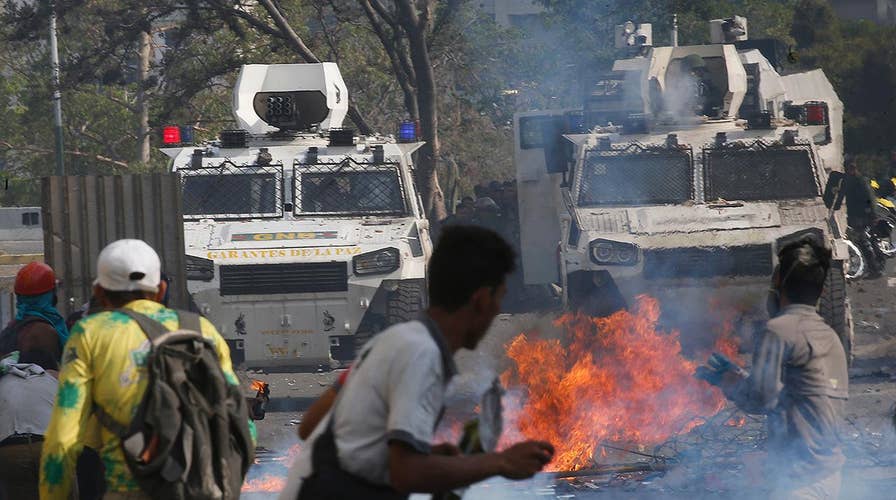
The White House insists 'all options' remain on the table as Venezuelan opposition leader Juan Guaido looks to oust Nicolas Maduro; reaction and analysis from the 'Special Report' All-Stars.
This is a rush transcript from "Special Report," April 30, 2019. This copy may not be in its final form and may be updated.
(BEGIN VIDEO CLIP)
MIKE POMPEO, SECRETARY OF STATE: It's understanding that he was ready to go. He made a decision that we have been urging him to make for quite some time. And then he was diverted from that action by the Russians. We hope he'll reconsider and get back on that plane.
BRET BAIER, HOST: Would he have safe passage to Havana if he got on that plane?
POMPEO: Bret, we've made very clear what are the expectations for Maduro's departure, for the departures of others, too, and what our expectations, what assurances we are willing to provide them. I'm not going to discuss those here.
BAIER: But living is one of them?
POMPEO: Bret, I'm just not going to start down that path.
(END VIDEO CLIP)
BAIER: Earlier in this show.
Let's bring in our panel now, Matthew Continetti, editor in chief of the "Washington Free Beacon," Susan Ferrechio, Chief Congressional Correspondent for the "Washington Examiner," and here with me, Jeff Mason, White House correspondent for "Reuters." Jeff, let's start with you. The assessment of what is happening and the diplomatic dance behind the scenes, pressuring these other countries that are not recognizing Guaido and still propping up Maduro.
JEFF MASON, WHITE HOUSE CORRESPONDENT, REUTERS: Yes. I think that is the key issue that the White House is looking at closely. The fact that Secretary Pompeo was willing to say that it's Russia who talked Maduro out of getting on that plane really escalates pressure from this White House on Moscow. And that is a relationship that has been fraught over the last couple years, obviously, because of the investigation into President Trump's campaign and potential ties between it, and President Trump's reluctance to be very critical of Putin. His secretary of state is not being reluctant right now, and that shows how much they are invested in the prospect of Guaido taking over.
BAIER: And just before the show, Matthew, the president did tweet about Cuba, saying if they don't get out of the militia business inside Venezuela, that they are going to step up, the administration will, the sanctions on Cuba exponentially.
MATTHEW CONTINETTI, EDITOR IN CHIEF, "WASHINGTON FREE BEACON": Cuba is providing assistance, Bret. China is providing assistance, and the way that the Venezuelan regime has been able to control the flow of information into that country. But I think that Russia is the key player here. If you look at the Russian actions from military flights to Venezuela to inserting the so-called little green man, these kind of nonuniformed paramilitary officers, to sending formal military advisers and assistance to Maduro, Russia is clearly trying to overthrow the Monroe doctrine, which for centuries has said no outside interference from outside powers in the western hemisphere. In order to really elevate this situation, I think the administration needs to train its criticism on Russia.
BAIER: Susan?
SUSAN FERRECHIO, "WASHINGTON EXAMINER": It's really interesting, one of the most important comments we've heard today is everything is still on the table in terms of how far the U.S. will get involved. At this point, it is so precarious there, we don't know which side will prevail. There has been efforts to overturn the Chavez government years ago. That failed. The circumstances are a lot more dire right now.
And if the U.S. does get involved, what does that mean? Is that going to mean a full-scale invasion? Will it mean some kind of precision strikes on the military there? And how far are we willing to get involved? Is there support for that in the U.S., is there support for that in Congress? All of that now is really hanging out there, given the fact that we are not really sure whether Guaido is going to be able to pull this off.
BAIER: There is some talk about a coalition forming led primarily by the Colombians and the Brazilians, but we'll see how that all comes together. Speaking of the military option and the U.S. military option, here's Senator Lindsey Graham at the national security adviser.
(BEGIN VIDEO CLIP)
SEN. LINDSEY GRAHAM, R-S.C.: I keep all options on the table.
UNIDENTIFIED MALE: Including military?
GRAHAM: Absolutely. I keep it on the table. So if I were Trump, I would let the Russians and the Cubans know this needs to stop. Any harm to the Guaido and any of his leadership, we'd hold them accountable, and stand behind the Venezuelan military.
JOHN BOLTON, NATIONAL SECURITY ADVISER: We want as our principal objective the peaceful transfer of power. But I will say again, as the president has said from the outset, and that Nicolas Maduro and those supporting him, particularly those who are not Venezuelan should know is all options are on the table.
(END VIDEO CLIP)
BAIER: It's tough, Jeff, when the national security advisor says they are not in that mode yet, and remember that pad that was seen at a White House press briefing that said "5,000 troops to Columbia." They push back that notion, but it would be a big step back for this administration to take.
MASON: It would be a huge step for this administration. I think it's worth noting this president has been very critical of previous wars that White Houses and administrations, both Republican and Democrat, have supported. He is not someone who would be eager to throw U.S. troops into another conflict. But his national security adviser and others, as you said, have made very clear that that option remains on the table, and they need to leave it on the table to have some leverage.
BAIER: And the humanitarian situation, Matthew, by the day getting really more dire inside Caracas and throughout Venezuela.
CONTINETTI: Malnutrition among children especially. And it's hard to have a people's revolution when most of the people have decamped to Colombia or Brazil, or even the United States.
But it's important to keep the military option on the table, Bret, because you have to have some fear instilled in Maduro and his cronies. What worries me about the latest developments is that they are fearing Russia more than they're fearing United States. And if we are to be successful, that equation needs to change.
BAIER: Susan, what about the secretary of state with the safe passage question to Havana?
FERRECHIO: That was really interesting how he wouldn't even guarantee his survival. But my suspicion is that he is assured of safe passage to Havana if he's willing to just get on that plane and leave. I think right now it's a maximum pressure campaign from the U.S. right now to just try to get him to get out of the country. But I will say, it is going to require some international help, either with the U.S. or other countries, if he does leave to just try to stabilize things there, because it is in such dire straits economically and the military falling apart, it's going to require some help. Whether the U.S. invades or has military strikes, someone is going to have to get in there and help them.
BAIER: Panel, standby.
Next up, Congressional Democrats push hard on infrastructure, Medicare for all, and the Mueller report. Stay with us.
(COMMERCIAL BREAK)
(BEGIN VIDEO CLIP)
REP. NANCY PELOSI, D-CALIF., HOUSE SPEAKER: We just had a very productive meeting. We are very excited about the conversation that we had with the president to advance an agenda.
CHUCK SCHUMER, D-N.Y., SENATE MINORITY LEADER: There was goodwill in this meeting, and that was difference different than some of the other meetings then we've had. We agreed on a number, which was very, very good -- $2 trillion for infrastructure. We said he would meet in three weeks and he would present to us some of his ideas on funding. So this was a very, very good start.
(END VIDEO CLIP)
BAIER: Big meeting today with Democratic leaders here at the White House. The president talking about infrastructure, had a couple of really interesting quotes about infrastructure according to a source in the room. Quote, "I would like to do something. It may not be typically Republican. I like the number you have been using, Nancy, $2 trillion, $2 trillion. That number you can talk about. I'll lead on this." Also getting some color of the interaction, you heard Peter Doocy talking about it. In the middle of the meeting, the president took out a box of Tic Tacs, white, fresh mint flavor, we're told, and had one for himself, then offered his box to the speaker who took a couple for herself. So there you go, a summit of sorts over Tic Tacs.
We are back with the panel. Susan, your thoughts on this? Obviously we are not getting how this is all going to be paid for, but they have got a number and they've got intent.
FERRECHIO: They have a number. And what is interesting about this is they are leaving the entire thing up to the president in terms of how to pay for it, a brilliant political move by the Democrats, but one that has many pitfalls for the president.
This is really in his wheelhouse. He loves to build. He's a developer by nature, and he want to try to get a deal done on infrastructure. He talked about it all through his campaign, on election night he talked about it. The problem is, it costs a lot of money. And to get anything done, Democrats want a tax increase. But they are leaving it up to the president to make that declaration.
So they said, well, in three weeks, he is going to come forward with his plan. That way his fingerprints are all over the tax increase proposal during an election year. I can't envision the president coming out with a plan like that, and so I don't have a lot of hope that this is ever going to materialize into anything serious.
BAIER: We are told, Matthew, that other talks included prescription drugs, and also on immigration, at least around the edges of immigration.
CONTINETTI: Right. In the ancient world you exchanged olive branches, I guess, as a sign of peace, and in today's Washington we have Tic Tacs. And what a difference this meeting was from the meetings during the government shutdown and the meeting last December leading up to it.
I do share Susan's skepticism, though, about how one might pay for it. Even though both parties want to have an infrastructure bill going into the 2020 election to show that they are doing something since 2018, the only way I think it gets done as if it goes once again on the national credit card.
BAIER: Is there, Jeff, consensus, do you think, in the Democratic Party that giving Trump a win, even if it is something that they want to do, is something not to do ahead of the 2020 election? Or do you think they are really trying to get to some solution on infrastructure?
MASON: I think they want something on infrastructure. I think in both cases, for both parties, they can say, if it really gets to the other side of the finish line, which I think is doubtful given the issue of whether or not they can pay for it, I think both sides can say, look, this is something that we achieved and this is something that the American people want. It has economic benefits, it has jobs benefits. But the political reality is, it is going to be hard to get it that far without some sort of agreement on how to fund it.
BAIER: We're told not a lot of talk about the Mueller report today. However, the testimony for the attorney general still in question on Thursday in the House. Here is Jerry Nadler and Senator Graham.
(BEGIN VIDEO CLIP)
REP. JERROLD NADLER, D-N.Y., HOUSE JUDICIARY COMMITTEE CHAIRMAN: We have to get to the bottom of these issues, that is why we have called him in. And it's not up to the attorney general to tell the committee how to conduct its business. We will decide what the most effective way of asking questions are, and that is what our decision is. If he doesn't show up on Thursday, we will have to go to subpoenas.
GRAHAM: I see no reason for outside counsel to interview him. He's not on trial. He's reporting to Congress his findings.
(END VIDEO CLIP)
BAIER: And Susan, you heard Secretary Pompeo say he's never had that experience in Congress, as a congressman. Your thoughts as we get ready for the Barr hearing tomorrow on the Senate side?
FERRECHIO: We'll hear from Barr in the Senate. It will be the traditional way with lawmakers interviewing him. And on Wednesday, I also anticipate that the House will to subpoena Attorney General Barr to compel him to come and testify before the House on their terms, which will include counsel, not just lawmakers. I expect Barr won't show up and that it may end up that they hold him in contempt of Congress. It wouldn't be a first. Both parties have done this to each other over the years. It never amounts to much. It ends in some kind of negotiated settlement later on. But it will create a good headline.
BAIER: Much ado about nothing, Matthew?
CONTINETTI: It's a debate over optics, but I have to say that Nadler's reasoning makes no sense. He said they need Barr to be questioned by the lawyer in order to have follow-up questions. Are the Democrats incapable of following up over their colleagues? It's the staff attorneys who write the questions for the lawmakers anyway. So the idea that they can't follow up one after another is absurd.
BAIER: Jeff, I owe you a follow up. We'll get that next time. Thanks, panel. When we come back, a little boy's dream comes true.
(COMMERCIAL BREAK)
BAIER: Finally tonight, a gorgeous night on the north lawn, one boy's dream comes true. Nine-year-old Matthew Martinez who has cystic fibrosis became a member of the SWAT team thanks to the Make-A-Wish Foundation. After being sworn in at the Richmond Police Department Training Academy, Officer Martinez helped out with a canine drug detection demonstration. He also dressed in full SWAT gear and helped rescue two teddy bears posing as hostages. The Richmond Police Department says it was happy to have Martinez on their team.
We have great news about our team, news to share. Our Jenny Buchholz gave birth to a baby girl yesterday. This is Summer (ph) Claire (ph) Buchholz. Congratulations to Jenny and Andrew, adding to the edition, one viewer at a time. It helps the demo. Thanks for inviting us into your home tonight. That's it for the “Special Report,” fair, balanced and unafraid from the White House. Here is "The Story" with Martha.
Content and Programming Copyright 2019 Fox News Network, LLC. ALL RIGHTS RESERVED. Copyright 2019 ASC Services II Media, LLC. All materials herein are protected by United States copyright law and may not be reproduced, distributed, transmitted, displayed, published or broadcast without the prior written permission of ASC Services II Media, LLC. You may not alter or remove any trademark, copyright or other notice from copies of the content.
