






The politics of Joe Biden's third presidential bid
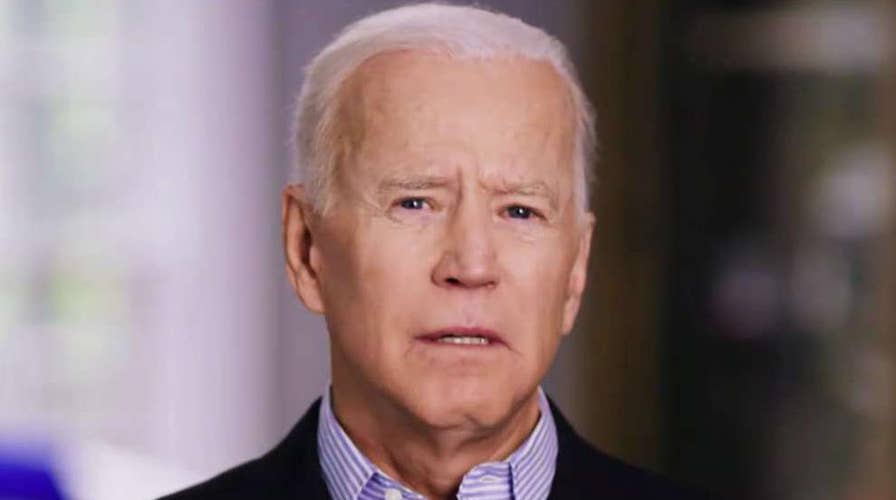
Former Vice President Joe Biden launches his 2020 bid as a battle for 'soul' of America; reaction and analysis from the 'Special Report' All-Stars.
This is a rush transcript from "The Story," April 25, 2019. This copy may not be in its final form and may be updated.
(BEGIN VIDEO CLIP)
JOE BIDEN, FORMER VICE PRESIDENT: I believe history will look back on for years of this president and all he embraces as an aberrant moment in time. But if we give Donald Trump eight years in the White House, he will forever and fundamentally alter the character of this nation. That's why today I am announcing my candidacy for president of the United States.
(END VIDEO CLIP)
CHRIS WALLACE, HOST: Well, former Vice President Joe Biden making it official today, running for president for the third time, and, as you can see, casting his candidacy as fighting against Donald Trump for the soul of America.
Let's bring in our panel to chew this over, Ben Domenech, of "The Federalist," Jonathan Swan, from "Axios," Anna Palmer of "Politico," coauthor of the new book, "The Hill to Die On, The Battle for Congress and the Future of Trump's America," and Tom Bevan, president of Real Clear Politics.
Anna, as a bestselling author, let's start with you. Rank has its privilege, gentlemen. Your thoughts about Trump's rollout today, the fact that his very first event is a big ticket fundraiser tonight in Philadelphia, $2,800 a pop, and that some more left-leaning progressive groups are already saying he's old guard.
ANNA PALMER, "POLITICO": Yes. I think two things. One, he is playing by the old playbook here, where he knows he needs to raise money. That's the big weakness, the big knock on his candidacy is can he get the money. I think the question really is going to be is can he ignite the liberal base. Right now you've already groups come out saying this is, you're too old, you don't represent where we are right now. And so far Joe Biden has not made the case I think to sell that he is the candidate for the 2020 election.
WALLACE: That's really going to be one of his first challenges is that first 24-hour fundraising number, isn't it?
JONATHAN SWAN, NATIONAL POLITICS REPORTER, "AXIOS": And the strange thing is, we're going to report this tomorrow morning, but I may as well just say it now, is he's told lobbyists they're not welcome. He doesn't want their money. And they're quite shocked, because it's nothing for Bernie to say that. He's got this army of young people who are excited about him. Joe Biden doesn't have that. This is a guy who needs to --
WALLACE: People pay him $2,800 tonight.
SWAN: They're not federal lobbyists, I'll tell you that, because they're not accepting money from them. But I think the real interesting thing about Biden is the gap between people like us, elite opinion who basically, most elite opinion makers that I see on TV think this guy has no chance, and the public opinion. He's at the moment, anyway, at the top of the polls. And you can say that's name I.D., but it's still an interesting clash.
WALLACE: Ben, President Trump greeted Biden today with I think some form of a mean tweet, as they call it. Let's put it up on the screen. "Welcome to the race, Sleepy Joe." I don't know. He may have to work on that. "I only hope that you have intelligence long in doubt, to wage a successful primary campaign. It will be nasty -- you will be dealing with people who truly have some very sick and demented ideas. But if you make it, I will see you at the starting gate."
Do you have a sense, Ben, how worried the Trump camp really is about Joe Biden?
BEN DOMENECH, "THE FEDERALIST": I actually think that they are pretty concerned about him. I think they are more concerned than, to Jonathan's point, the elite opinion might make up here. And I think that part of that has to do with the fact that Joe Biden has clearly proven in the past his appeal to the same states that were key for President Trump in deciding the 2016 election.
Personally, I think that elite opinion is wrong about Joe Biden, that he actually is a much stronger candidate that they are giving him credit for. And I think a large part of that is he has an enormous wellspring of support among African-American voters that you do not see for a lot of the other candidates in this race. Where they might be appealing to the more woke white progressive vote that I think is the loudest and shouting about a lot of different issues right now --
(LAUGHTER)
DOMENECH: Obviously. But I think that that's a little bit less of a general election appeal. The problem here for him is how does he deal with all of the hits that are going to come against him from his past? Those are going to be already we've seen them used in a lot of different ways, and I think they will be deployed against him. He is going to have to come out with different ways to respond to the different aspects of that.
WALLACE: Tom, I want to ask about one of those, because one issue is the way he handled the Anita Hill, Clarence Thomas hearing. And apparently Anita Hill's family, whenever the doorbell would -- not whenever, but oftentimes when the doorbell would ring, they would say, it must be Joe Biden calling to apologize. Apparently, that was, what, 91, I think. He apparently called some point this month to finally apologize, and she didn't regard it as sufficient. Why on earth you wait this long to clear that up?
(LAUGHTER)
TOM BEVAN, REAL CLEAR POLITICS CO-FOUNDER: I don't know. But Joe Biden, this was the easy part, announcing. Now he's going to have to face this gamut that he's going to have to run. But his base asset is electability. Even people who don't like him think he has the best chance of beating Trump, and that is a huge asset.
The other thing for Biden that is going to work in his favor, to the extent that this continues to be a scrum and it lasts a long time and you have that progressive vote divided up amongst a number of candidates, he's able to stay in his lane and that will be to his benefit in the end.
WALLACE: Anna, there, and Bret talked about it and really laid it out I thought very well in his piece, there were a lot of subject that were perfectly acceptable for a Democrat back in the 70s and the 80s and the 90s that are anathema now, whether it's the crime bill and talk about predators, his votes on abortion, other things. How big a problem is that, or are people going to kind of say, we understand, you've been around a long time. Views change.
PALMER: I think it's tough, not only because of what the policy positions he's taken, but because he is a D.C. guy. He was in the Senate for a long time. He was obviously in the White House. When you look at where a lot of the enthusiasm is among primary voters, it's with Mayor Peter Buttigieg in Indiana. It's people that are not from Washington, from the swamp. They want to have that drain. They want things to change. They want a disrupter. And I'm not sure that Joe Biden is that guy.
WALLACE: Jonathan, I want to turn to another subject, this continuing toggling back and forth by President Trump in terms of the Mueller report and dealing with Congress. Sometimes he says it's complete exoneration, sometimes he calls it a political hit job. Is there a strategy there?
SWAN: With the Mueller report, less so. Trump, the extent to which you see his frustration, what I'm told is the thing he's most frustrated about are the people around him who were taking notes. At Mar-a-Lago he was complaining about that, and obviously Don McGahn, his lawyer, was chief among that.
But there is strategy with regard to the Hill, absolutely, and the strategy is to say no to everything. And they've studied precedent, they've looked at what happened under George W. Bush, when Congress held Harriet Miers and Josh Bolton in contempt. They played out the clock, it ended up being settled under Obama. Eric Holder held in contempt, run out the clock. They've looked at it and said, you know what, for all the hoopla around Democrats on the Hill, actually we have quite a lot of power and the power to say now and gum this up in the courts is a pretty substantial one.
WALLACE: I want to pick up on that, because the president says he can assert executive privilege. Now the Congress may disagree when it comes to either current and former officials, former including people like White House Counsel Don McGahn, keep them from testifying before Congress. Members of congresses say he waived that privilege when he allowed Don McGahn and others to testify before the Special Counsel. Which side of that argument do you like better?
DOMENECH: I think this is going to be back and forth all the way down, and it's not going to be something that is going to be resolved prior to the presidential election. I think that the president actually has a good side of that argument in a lot of ways.
But we need to view this for what it is at this point, which is entirely a political football that works both within the Democratic coalition and as something pinging back and forth between Capitol Hill and the White House. This is not going to be something where we are actually going to have maybe the kind of revelations that we actually deserve as a country about how this investigation was started, where it came from, and the kind of process things that he was complaining about as Jonathan made note of. These are not things that I think what we're going to have the kind of happy resolution where we have a clear thing at the end of the day about what happened when, and who made what choice, which is what the president has been demanding for a long time.
WALLACE: Tom, I've got about 30 seconds left. As we saw with Republicans in 2015 and 2016 with Hillary Clinton, even if it's not going to go to criminal charges or something like that, just continuing to hold somebody in hearings and keep putting out information does exact a political price.
BEVAN: It does, and that certainly is the Democrats plan. The problem, the risk they run with that is by the time we get to election time, they have nothing to show but just total investigations, and there was no governing done. They have nothing to take to the American people, and they overplay their hand in that regard. But it certainly will be a daily drip and a problem for President Trump in terms of coverage.
WALLACE: All right, thank you. That's it for the panel. When we come back, a boy gets a very special treat on Easter Sunday.
(COMMERCIAL BREAK)
WALLACE: Finally tonight, 10-year-old Danny Agee was scheduled to have brain surgery the day after Easter, and he wanted to have Chick-fil-A the night before his operation. Well, his family reminded him the chain is closed on Sunday's. But one of Danny's nurses wouldn't take no for an answer.
(BEGIN VIDEO CLIP)
UNIDENTIFIED MALE: Who is that?
UNIDENTIFIED FEMALE: Chick-fil-A, on a Sunday?
(END VIDEO CLIP)
WALLACE: Danny got a special treat. Chick-fil-A on a Sunday. And his surgery went well the next day.
And that's the “Special Report” for tonight. I'm Chris Wallace in Washington. "The Story" hosted by my friend, Martha MacCallum, starts right now.
Hey, Martha.
Content and Programming Copyright 2019 Fox News Network, LLC. ALL RIGHTS RESERVED. Copyright 2019 ASC Services II Media, LLC. All materials herein are protected by United States copyright law and may not be reproduced, distributed, transmitted, displayed, published or broadcast without the prior written permission of ASC Services II Media, LLC. You may not alter or remove any trademark, copyright or other notice from copies of the content.
