





'The Five' react to President Trump's CDC tour amid coronavirus outbreak
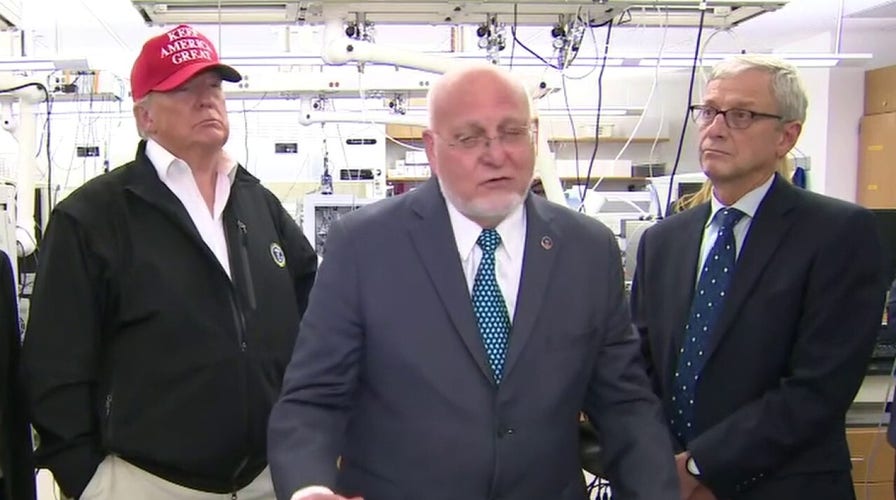
President Trump visits the Centers for Disease Control and Prevention in Atlanta having signed an $8.3 billion measure to help tackle the coronavirus outbreak.
This is a rush transcript from "The Five," March 6, 2020. This copy may not be in its final form and may be updated.
JUAN WILLIAMS, CO-HOST: That was President Trump speaking at the Centers for Disease Control and Prevention in Atlanta, Georgia. And we're still awaiting a news conference from Vice President Pence and the Coronavirus Task Force on the outbreak.
Let's bring it around the table. Dana, I was struck by the president. He had some harsh things to say about some of the governors.
DANA PERINO, CO-HOST: Well, I think -- right, OK, so that's -- you cannot say that the White House and the administration hasn't been trying to communicate very effectively, and transparently, and regularly, frequently. That was a very long press conference that the President just held with people from his senior team within the task force. These are the experts in our country. And we should feel pretty good about what's going on.
And I can understand the frustration from the president when you have governors who are pointing their fingers back at D.C. especially if they're coming from Washington State. Because Washington State is the one where you have the biggest problem, especially at that one facility. When you have people that are dying, they have a public health emergency, pointing fingers at each other does not help anybody in this situation.
And Governor Inslee immediately wanted to be political. When Vice President Pence called him the day after he was appointed to the head of the task force, just to call to say, I want to make sure we're coordinated everything. Inslee, the first thing he did was put out a tweet, like I got a call from the Vice President, and I gave him the what for, and I told him, good if there were scientists involved. And here's the president surrounded every single day by Dr. Anthony Fauci, by Ambassador Birx, by all the people that you would want in a crisis, and you have governors that are pointing the finger back.
Meantime, the President was able to sign a bill of $8.3 billion today that is going to -- which he didn't even say they needed. He wanted $2.5 billion. Now the governors and the legislators in Washington gets all that extra money. And where do you think that's going to go? Right straight to the states. And I don't think that the administration will at all hold back any of that money for politics, because they realize that they have a problem.
Now the President's always going to get the blame for anything. Every president always does. But I think that nobody can fault them for doing what they've done so far. They're trying, they're trying to be on top of it. And there's a lot of things that we have to do ourselves to take care of ourselves. You cannot expect the government to do everything for you. They can give you a lot of tips. You can avoid misinformation. You can do all the washing of the hands, stay away from people, don't shake hands, all of those things. You have to take care of yourself.
There's a lot of things that are happening outside of this country that we can't control that are having the economic impact and the consequences of that. So I think that the governor's if they point their fingers back at the president, they should just be very careful because if you're not managing your state and your cities appropriately, that finger will come back at you and it will be much worse for you.
WILLIAMS: So I always think that what we want here is transparency, as you were saying, and we want to know that we can trust the government at any level. But what you hear is people saying oh, but the president, not so much Fauci or Dr. Birx, but they say oh, the President said people can go to work or they'll get better. That the mortality rate --
PERINO: Well, we're at work. We have not been told not to go to work.
WILLIAMS: Not -- no, no, no, but I'm saying if you're infected, and we're - - none of us is infected, thank goodness.
PERINO: I didn't -- when I heard him say that, I didn't hear him say you should go to work if you have symptoms. He said that everybody should feel like they should -- can go to work unless you're otherwise notified.
GREG GUTFELD, CO-HOST: Can I say something?
WILLIAMS: Yes, yes, I was going to come to you.
GUTFELD: We're pretty sure this show is going to be over anyway. There's something really optimistic going on that people are overlooking. The job numbers were amazing. Granted, it's from last month, but it was 100,000 over the expectations, which offers you a lesson about America itself.
One way that you fight a threat, something like a virus, or a battle, or a natural disaster, is that you have to be in your strongest state, right? You have to be at your most powerful, healthy body. You know, you want to make sure you're eating the right stuff. You want to go to the gym.
Right now, you have never seen an economy this strong. And because in the last, let's say three to four years, this economy has been become stronger. So if you imagine America as a person, our immune system has never been stronger, which is why this economy and this is the positive part, is able to withstand the stock slides, the up and down of the stocks. We are not freaking out about this. And we know a year from now it'll be fine, right?
So the American economy is in its -- is in its strongest. It's in its best state for fighting a war like this one, even a war against something as microscopic as a virus.
WILLIAMS: So Jesse --
DAGEN MCDOWELL, GUEST CO-HOST: Can I add to that, because I love it when you talk numbers? The stock market actually despite all the swings was up for the week, number one. Number two, the most important thing is you have a U.S. consumer, because you have a 50-year low and the unemployment rate.
GUTFELD: Right.
MCDOWELL: Jobs are so plentiful. You have a U.S. consumer that is the best shape in terms of their cash flow, like after they pay all their bills and energy prices, they have the best cash flow on record. And what's happening, because investors, these pros are freaking out, longer-term interest rates are plunging, people are refinancing their mortgages. You have record low mortgage rates on a 30-year fixed-rate mortgage. And businesses are being calm and they're not laying people off. The airlines after 9/11 laid off 100,000 workers in 10 days.
GUTFELD: Wow.
MCDOWELL: And you have not seen that happen. Watch the weekly jobless claims. They actually fell in the most recent week. There is no freakout happening. The markets are freaking out, but that's what they do. The American people steady as she goes.
GUTFELD: Yes, it's like dating Lindsay Lohan. It goes up, it goes down. And goes up and goes down.
JESSE WATTERS, CO-HOST: Did you guys have a thing?
GUTFELD: Well, it's a long time ago.
WILLIAMS: Well, at this point -- at this point, you'd have to get --
WATTERS: I thought I knew everything about you, Greg.
WILLIAMS: You'd have to just do a fist bump with Lindsay at this point. So what we heard today was that the President's economic advisors are talking about potential subsidies for the airline industry, the cruise ship industry, even the convention industry because people are more and more canceling.
WATTERS: Well, it's going to be a tough quarter. And you know, the quarter after that is going to be even worse. So if they can give some sort of tax relief, if they can inject some sort of liquidity into these industries into the market somehow, maybe that's what they can do to survive the next month or two. Because every time I wake up in the morning, I look at the Dow futures.
GUTFELD: No, the mirror.
WATTERS: Yes, I look at the mirror. And then I look at the futures, and then I look at the mirror and my face goes like this, because it's not a good look. I don't know how people can handle being in that business, because I'm not in that business, and I'm not scared of anything except when I look at the Dow futures. Once the Dow starts to stop with the volatility, then people will start calming down.
GUTFELD: Here's how you know.
WATTERS: Yes.
GUTFELD: You look at it like an organism. All the stock market is you thinking one way and then --
WATTERS: It's not me, Greg. It's the rest of the country. Or it's the rest of the country that has any skin in the game. Because when I see people out on the streets, they're cautiously optimistic. They're not terrified. Most people that are terrified look like they're on Wall Street. Because the people that see walking around Manhattan -- what do we have eight million people, nine million people in this city, they're riding the subway. I don't see a lot of masks. We're not looking at a lot of stockpiling.
This country is recently -- the city at least seems to be weathering the storm. I wish the rest of the investors could weather the storm with a little bit more optimism and sensibility.
PERINO: I think -- but isn't that, Dagen, coming mostly from those supply chain issues rather than -- it's about the fact that for example, the trade war gets finished right. And now you have American products and farmers and ranchers being able to send their goods to China, but there is such a backlog in the traffic, you can't unload the cargo into China because of that problem. So it's like a cascading --
WILLIAMS: And the cargo coming from China.
MCDOWELL: The biggest issue to get deep into the wage briefly is that normally with recession do you have a demand shock where people aren't traveling for example, or people are not going out to eat. But this is a supply problem because of all the production, even parts that are made in China that has been shut down.
But the fact that the virus is improving in China, these factories should start reopening and there will be a backlog. The best thing the government can do, it's not the Federal Reserve cutting interest rates. It's not stimulus like a temporary payroll tax cut or anything like that. It's just to get your arms around this disease and make sure that people don't freak out.
But the people are not freaking out. Like I was on the subway the other day. I saw one mask in the literally hundreds upon hundreds --
PERINO: I had a guy today. I was -- I was wearing a coat, I got on the subway, and instead of holding the pole, I just put my elbow around it with my coat and I was holding it like this. And this gentleman sitting, he taps me. I'm like, yes? And he said, I don't think that's a good idea. Because I don't think you should be hugging the pole. And I'm like, I'm just like -- I'm holding it with my elbow so that I don't fall. Because I thought that was safe.
GUTFELD: So you're so -- you're so not a New Yorker. The moment he said that, you had about three F-bombs right in his face. Get the F away from me. Don't talk to me. And then he will never do it again.
PERINO: But he was so nice.
WATTERS: I can't believe that it takes the subway. I didn't think that was her thing.
PERINO: I always take the subway or I walk.
WILLIAMS: All right, wait a minute. Hold on, hold on --
MCDOWELL: Always need to be -- always need to be ready with a hug in the pole joke.
GUTFELD: Yes.
WILLIAMS: We should. We could have been. That would be offensive. That would be offensive.
WATTERS: Dana?
WILLIAMS: Wait a second. That's why I told you not to go down that road. But the investor class clearly, you know, they're well informed. They're got money on the line, skin in the game, as you said.
WATTERS: I know.
WILLIAMS: And there doesn't seem to be the confidence.
WATTERS: Right. There's no confidence now, and I agree. It is about the numbers to a certain extent, and they do trade off the numbers. I think the supply chain deal that's pricing at this point. The numbers the President was talking about when he's saying that there's this cruise ship or you know, there's this ship that's been infected, he doesn't want to bring it back onshore, because what's that going to do? It puts 1,000 people possibly infected back into the number of Americans infected.
And that's going to make the mortality rate pop. And he doesn't want that shock to the country because the country looks at a newspaper and sees this big number and freaks out. The investors see this big number and they freak out. If they understand that they just grounded a cruise ship and that -- this is the reason the numbers are going up, people don't look at that.
And that's why he wanted to keep it offshore. But I think he gave this task force the authority to do what was ever best for the health and wellbeing of the people on the ship.
WILLIAMS: But you saw the Fed earlier this week try to help a little bit. And you saw the market respond also apparently to former Vice President Biden's success on Tuesday. Now it goes back in the other direction.
MCDOWELL: It's up for the week. It's up for the week.
GUTFELD: Off of the percentage -- off of the percentages, we keep forgetting how large the stock market has become that we were talking about two percent, and then goes up three percent, then it comes down to two percent. It's going to be like this for -- it might look like this for months.
WILLIAMS: Well, I agree.
GUTFELD: You just have to take the long view.
WILLIAMS: Yes, I agree. I said to Jesse, don't look in the morning, just forget about it.
WATTERS: The mirror or the market.
WILLIAMS: You can look at the mirror.
GUTFELD: But wait, can I point out that we did -- we did a spot today on the -- on Fox about Spring Break. Why would you cancel Spring Break if you're in the sun It's warmer and more humid where you're seeing much, much smaller rates of infected.
WILLIAMS: No, because they have a large gathering of people.
Content and Programming Copyright 2020 Fox News Network, LLC. ALL RIGHTS RESERVED. All materials herein are protected by United States copyright law and may not be reproduced, distributed, transmitted, displayed, published or broadcast without the prior written permission of Fox News Network, LLC. You may not alter or remove any trademark, copyright or other notice from copies of the content.
