





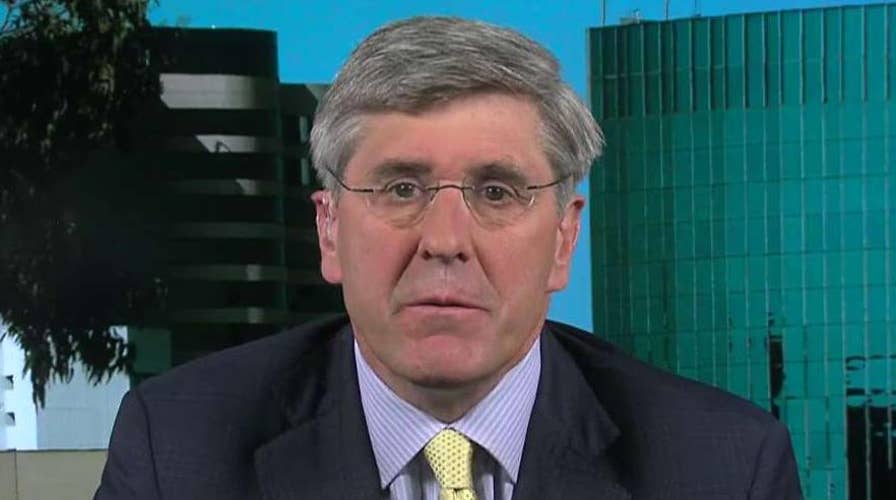
Steve Moore says his critics are pulling a 'Kavanaugh' on him
esident Trump's pick for the Federal Reserve Steve Moore says the unfair scrutiny he is facing is comparable to the criticism Brett Kavanaugh dealt with during his Supreme Court nomination.
This is a rush transcript from "Your World," April 26, 2019. This copy may not be in its final form and may be updated.
NEIL CAVUTO, HOST: All right, they are not reacting to getting FOX Business. These superheroes are separating the weekend's opening of "The Avengers," and they are not alone.
What they are really celebrating is an economy that is back with a vengeance.
Welcome, everybody. I'm Neil Cavuto, and this is "Your World."
You are going to have to work with me, America.
Anyway, the former Vice President Joe Biden is making the 2020 presidential campaign all about, well, dumping President Trump. It could be a tough sell at the corner of Wall and Broad now with an economy that's anything but in the dumps, at least right now.
So, get to it right now with Deirdre Bolton on what has the economy cooking, Kevin Corke at the White House and how it is responding and a look at whether all the 2020 Democrats, including Joe Biden, should be worrying.
We begin now with Deirdre.
What's going on here?
DEIRDRE BOLTON, FOX BUSINESS CORRESPONDENT: Neil, the U.S. economy growing, as we know, at a solid 3.2 percent annual rate for the first three months of this year, so, far outpacing estimates for 2 to 2.5 percent growth, whichever economist forecast you were following.
But an increase in exports drove the increase. So GDP surpassing even the 3 percent bar set by President Trump, which should help Republicans in the campaign for 2020. Nearer term, let's take a look at the markets. They closed higher across the board.
S&P 500 and the NASDAQ, we're waiting until it all settles, very close to record highs. I'm going to wait five minutes before I call it, but nine out of 11 S&P 500 sectors closed higher, all consumer strength, consumer discretionary, consumer staples, health care, the strongest parts of the market.
Moving ahead for the week, if you look at the Dow, you did have it on pace for the second week lower in three, but if you look at the standouts, the S&P 500 and the Nasdaq, both four weeks higher out of five, so a pretty good start, Neil.
And a lot of people saying, listen, we have been in a bull market for nine- and-a-half years. It could continue -- back to you.
CAVUTO: All right. And I think they would hope that continues certainly at the White House.
President Trump was talking up the economy today. He's planning to keep talking it up over the weekend.
Kevin Corke now at the White House with the very latest on that.
Hey, Kevin.
KEVIN CORKE, WHITE HOUSE CORRESPONDENT: Hey, my friend -- 3.2 percent, let's face it, that's a real blockbuster.
And I don't have to remind you that some previously said that 2 percent growth was the new normal. Well, the president when he heard that said that that's just not true. And even his critics would have to admit today, Neil, at least on this, he's right again.
(BEGIN VIDEO CLIP)
DONALD TRUMP, PRESIDENT: GDP is an incredible number. Remember this. Not only that. We have a great growth, which is growth. We have great growth and also very, very low inflation.
Our economy is doing great, number one in the world. We're number one economy right now in the world, and it's not even close.
(END VIDEO CLIP)
CORKE: Not even close.
Look at the Q1 numbers, 3.2 percent. That is just stunning, better than the 2.2, the 1.8, and the 1.5 in Q1 going back to 2016. So here at the White House, we're hearing a lot about future confidence in the economy and the market.
And there's just a bit of I told you so.
(BEGIN VIDEO CLIP)
LARRY KUDLOW, DIRECTOR, NATIONAL ECONOMIC COUNCIL: So I think the GDP report will continue. We will stay with our 3 percent growth rate estimate. That's been our view all along.
(END VIDEO CLIP)
CORKE: Boy, Larry was excited today. OK.
So the president spending time in the Midwest, not just today, but over the weekend in Wisconsin, in Green Bay for a big rally. Got that big number to talk about and talk about manufacturing. I think it'll resonate -- Neil, back to you.
CAVUTO: All right, thank you, my friend, Kevin Corke at the White House.
Well, the president certainly wants to win in Wisconsin again. The state's Republican Governor Scott Walker says that there are three things he needs to start doing right now to make that happen. Exactly what are they?
Well, Governor Walker will be joining me tomorrow 10:00 a.m. on "Cavuto Live," our live weekend show that is an unequivocal hit. You're welcome, America.
Meanwhile, back to me and America. Why wait for 2020? I think President Trump just laid out his campaign strategy quite deftly today.
(BEGIN VIDEO CLIP)
TRUMP: The Boston bomber vote. He should be voting, right? I don't think so. Let terrorists that are in prison vote. I don't think so.
The Democrats are also working hard to block the wall. But we are building the wall. They are not happy. Democrats want to disarm law-abiding Americans while allowing criminal aliens to operate with impunity. That will never happen as long as I'm your president. Not even close.
(END VIDEO CLIP)
CAVUTO: All right.
The read on how all of this is playing out, because I don't think this is by accident that the president chose this speech before this group and this backdrop with the markets and economy to say what he said today. It might be sort of a tee-up for 2020.
We have got New York City Republican councilman, very close friend of the president, very closely tied to the White House, Joe Borelli. We have Democratic strategist Cathy Areu. We also have The Wall Street Journal's James Freeman.
Cathy, he is pounding that theme, I think, to differentiate the Joe Biden announcement, to point out, this is what the Democrats are for. Take a look at what happened in the first quarter. That's what I'm for.
You say?
CATHY AREU, PUBLISHER, CATALINA: Yes. It's a smart thing to do, because the economy is doing well now. And we are getting the opposite from sleepy Biden, which is...
(CROSSTALK)
CAVUTO: Why do you call him sleepy? He doesn't seem that sleepy.
AREU: I know, right? He seems wide awake to me.
But it's actually a great plan, because he's trying to be the candidate for the Democratic Party. It's all about anti-Trump, anti-Trump, anti-Trump. And then it will be about the economy and other issues.
(CROSSTALK)
CAVUTO: But you say the economy is good. You just said for the first quarter it's good.
AREU: Well, yes, but Biden is not going to discuss that. It's a winning combination.
(CROSSTALK)
CAVUTO: But you feel that way.
AREU: Well, I'm not running.
(CROSSTALK)
(LAUGHTER)
CAVUTO: All right, Joseph, what do you think?
JOE BORELLI, R-N.Y., NEW YORK CITY COUNCIL: You know, look, just juxtapose the two people today. You have Joe Biden. You have Donald Trump.
What you got there was peak Donald Trump. He was on campaign message. He was hitting his points. He was hitting home the fact that Democrats are doing everything they can to not talk about the economy.
Compare that with Joe Biden. He's stepping on a rake. He's doing his campaign announcements. And today in Pennsylvania, a state where the Obama administration lost 5,000 manufacturing jobs -- rather, Trump gained 5,000 manufacturing jobs, to the Obama administration's loss of 50,000 jobs.
I mean, this is what...
(CROSSTALK)
CAVUTO: Do you think the president could win Pennsylvania again?
BORELLI: I think the president certainly has a great chance to win Pennsylvania.
Perhaps more than most other states, this is a state that will have been positively impacted by the manufacturing job increase and the tax cuts.
CAVUTO: All right.
You know, James, what I thought was interesting -- we were covering in a FOX Business at the time he was speaking out there -- that he chose that backdrop, the NRA, to speak very little about guns, even though he did. I'm not minimizing it.
JAMES FREEMAN, CONTRIBUTOR: Yes.
CAVUTO: But to say, all right, they're the party that wants to give voting rights to prison convicts and terrorists. They're the party that is looking out after illegals who shouldn't be here, rather than, you, the taxpayers, who are legally footing the bill here.
There was a strategy to that. And I'm wondering if that was a preview.
FREEMAN: Well, I think it makes sense.
So the premise of the Biden candidacy is that he's going to go into swing districts in the Industrial Midwest and take blue-collar voters back from President Trump. I think he's got to have an agenda. We didn't see it in the video announcement that...
CAVUTO: That Biden didn't have it in that?
FREEMAN: No, he didn't.
But it's got to be an agenda that looks very different from his rivals, who are the Democratic senators running. And that is, he's got to -- for those blue-collar workers, often pro-gun, generally not extreme on social issues like abortion, also climate change, OK?
If Biden is going to define himself similarly to the other candidates who have backed the Green New Deal, I don't know what he's saying to people in the Midwest who make their living building things, making things, moving things.
CAVUTO: Do you think -- and it's funny, guys, when you step back from this and you look at the numbers and all, that maybe if you're right and the economy -- what you're discovering and that Democrats who bemoan it beyond even this -- that's been a generational concern for God knows how long.
Republicans and Democrats have pounced on it, depending on the election, but that Biden wants to make this about personalities, I'm a more likable, decent guy, and ignore this other stuff on the improving economy, because technically the president's right, but I'm going to look at these other issues?
AREU: Yes, yes.
It's going to be right now, who's more anti-Trump? And the candidate who's more anti-Trump...
CAVUTO: Because you have to keep your base happy, and at the same time spread it out.
AREU: You got to keep your base happy.
This is all about getting to be candidate. This is what they're doing right now. They're not going to give all their issues out. They're not going to discuss those things. It's going to be exactly just, I don't like Trump, and I'm so much better.
(CROSSTALK)
CAVUTO: To your point, maybe it's working, right, Joe.
I mean, he raised, what $6.5 million in a little more than 24 hours?
(CROSSTALK)
BORELLI: Right. He raised $6.6 dollars, but the CEO of Comcast did a major fund-raiser for him. It wasn't like, say, Pete Buttigieg, who got some grassroots support.
But I think...
CAVUTO: You might be right. But money is money. And that shows that there are a lot of big money types who are banking on him to get the deal done.
BORELLI: But there was no chance that he would ever enter the race and not be a serious contender. I mean, this is someone who was always going to be front of the pack as soon as he announced.
I just don't see the Democratic Party of 2020 going with the guy that raked Anita Hill over the coals, or the guy that had sort of almost derogatory things to say about Barack Obama when he tried to be nice back in 2008.
This is a party that has left Joe Biden. This is a party that has gone far beyond anything Joe Biden ever was.
(CROSSTALK)
CAVUTO: But I do still think -- I could be wrong. But I do think their biggest worry at the White House is Joe Biden. I could be wrong, but it seems to me disproportionate amount of ammunition was targeted at him.
FREEMAN: I think he's the -- potentially the toughest matchup if he runs.
CAVUTO: Yes. Well, he leads eight points nationally, right?
FREEMAN: Yes.
CAVUTO: Bernie Sanders lead three points nationally, not that those things are worth the paper they're printed on, but what do you make of that?
FREEMAN: Well, I think he's a tough matchup if he runs in a different way from a lot of the other Democrats.
If he's really competing on these issues we have talked about -- he's got to have an economic growth plan. It's not working to say to union workers in the Midwest....
CAVUTO: But to Cathy's point, you do it in stages, right?
AREU: Yes, it's baby steps.
So he's doing the little baby steps. So maybe it's baby Biden, not sleepy Biden. But the party, if they didn't support him before -- he wanted to run instead of Hillary. They didn't let Biden run before. There was a time there. You mentioned it.
CAVUTO: Well, the party honchos did.
(CROSSTALK)
AREU: The party honchos said, no, no, no. But now they think he has a chance.
CAVUTO: Yes. We shall see.
AREU: They would have stopped him. They would have stopped already.
CAVUTO: Guys, I want to thank you very, very much.
In the meantime, Steve Moore says his critics are pulling sort of a Kavanaugh on him. Now President Trump's pick for the Federal Reserve isn't pulling any punches. And in his first interview since this back and forth, he's here, he says, to set the record straight.
(COMMERCIAL BREAK)
CAVUTO: All right, to hear some defense folks tell it, be afraid, be very afraid.
A defense official confirming to Fox News the Pentagon plans to expand the military's role at the U.S.-Mexico border amid this migrant crisis.
What does local law enforcement in communities along the border have to say about a little this?
Cochise County, Arizona, Sheriff Mark Dannels joins us right now.
Sheriff, thank you for taking the time.
MARK DANNELS, COCHISE COUNTY, ARIZONA, SHERIFF: Thanks for having me, Neil.
CAVUTO: It's interesting. When I look at where you are, right against the border there, you're on the front lines, so to speak, and it is getting out of control, to the point now, the administration, indeed others are arguing, we're going to have to send in the troops.
Are you worried that could compound the nerves? What do you think?
DANNELS: No.
And, in fact, we embrace it. We embrace having the military come down to our southwest border. One of the frustrations we have had, Neil, is the fact that you got Border Patrol, you got Customs, you got DHS, you got sheriffs throughout the southwest border saying, we need help. We have a crisis throughout the southwest border.
For some reason, nobody's listening to us. So to have the military now coming down, they have been down there, it's been very beneficial to relieve Border Patrol to go do the job, which is -- the cartels love it, because the cartels are taking advantage of our Border Patrol working with the migrants and the families.
Cartels are leaving open spaces on the southwest border for them to run their drugs into our country.
CAVUTO: All right, but we're showing a lot of these armed coyotes that bring in illegals and help shepherd them over the border. And they even have conflicts maybe with some of your guys, but that it's gotten to be more routine.
DANNELS: Right.
CAVUTO: What I'm curious, Sheriff, is, who has jurisdiction here? And who do you defer to at the border? These troops that are coming, are they working with Homeland Security? How's that all breaking down?
DANNELS: The military is in a non-enforcement role. Their job is to support the mission to secure the border, support Border Patrol, CBP, on nonessential jobs like the enforcement aspect of it, which relieves the Border Patrol agents to get back on the line, to get back working with us as sheriffs on the drug smuggling and also some of the violent acts we're seeing on the southern border.
CAVUTO: So, you always worry. And I know you have mentioned this before. You want to keep the calm, don't let it get out of control. That's very hard to do with detention centers when they're overflowing by thousands in some cases.
How do you keep the control here? Would the added element of a military presence unintentionally aggravate things?
DANNELS: Well, number one is -- and I go back to this all the time when I speak -- is the message. The message that we're securing our border is the most important thing we're doing on this border.
Having the military down there to support that mission, that message is so important, because we do. We need order on this border. I represent a community, a county, along with my other 30 sheriffs on the southern border.
That is our job, is to keep that calm, keep that peace, keep that order. And that's what we're asking for, is support from Congress to make sure that's happening, because our communities are being impacted by this lack of border, a lack of -- having a porous border, lack of security on the border.
CAVUTO: When you hear a growing number of Democrats -- it began with Jeh Johnson, Barack Obama's former homeland security secretary and then it extended to Cory Booker, of course, the New Jersey senator running for president right now -- saying that they agree with you that there's certainly an emergency going on to the border, are you any more hopeful that the tide is turning where both parties can work this out?
DANNELS: I am, Neil, and I will tell you why.
For 35 years I have been in law enforcement, one thing I don't police is politics. We police for people. And this is not a political issue. This is a people, humanitarian issue. This is a public safety issue. This is a national security issue, that there is no business for politics here.
What the business is, to secure those three elements. And it's refreshing to hear that, because we need to get the will back on the table to secure our southern borders.
CAVUTO: Well, you must be doing something right, Sheriff, because Democrats and Republicans praise your efforts. So touché to that and to you.
DANNELS: That's good.
CAVUTO: Thank you, sir. Be well.
DANNELS: Thank you, Neil. You too.
All right, pulling a Kavanaugh, that is how Donald Trump's pick for the Federal Reserve Stephen Moore has been sort of analyzing the criticisms that he has gotten. And he says he hasn't gotten a fair shake. We thought we'd give him one. He's next.
(COMMERCIAL BREAK)
CAVUTO: All right, President Trump's pick for the Federal Reserve Board, Steve Moore, saying he's feeling these days, like, well, Brett Kavanaugh. And maybe he hopes, in the end, it will work out the way it did for Brett Kavanaugh, that, of course, the judge made it to the Supreme Court.
Now, will Stephen Moore ever make it to the Federal Reserve?
He joins us right now.
Steve, good to have you.
STEPHEN MOORE, FORMER DONALD TRUMP CAMPAIGN ADVISER: Hi, Neil.
CAVUTO: The Kavanaugh reference, you just think a lot of these attack lines are unfair, or what were you saying?
MOORE: By the way, I'm not the only one saying that.
In fact, it's other people who have been saying that who have observed what's happened in the last month since Donald Trump, you know, asked me to serve on the Federal Reserve Board.
I talked to a reporter the other day who's been covering the Federal Reserve for 30 years. He said he's never seen anything like this in terms of the character assassination.
Look, I'm no angel. If you go back, you know, 15, 18, 20 years, as reporters are doing, and look at things I have written in terms of the thousands of articles and, you know, hundreds and hundreds of media appearances I have done and speeches, you will maybe be able to find things that I said that were impolitic.
Some of the statements I made about women in a column 18 years ago, I have been very apologetic about. I wish I hadn't written it. It was supposed to be a humor piece.
(CROSSTALK)
CAVUTO: Well, they have called you a misogynist for those comments and more.
MOORE: Yes. Yes.
CAVUTO: I'm not going to go round by round with each and every woman in the reference. And it might have been a different time, to your point.
(CROSSTALK)
MOORE: No, but here's my point, Neil.
CAVUTO: But you lost senators who might otherwise vote for you.
MOORE: Well, I don't know about that.
We haven't -- we haven't seen that yet. And, in fact, I don't think any Republican senator yet has said they would vote against me.
Look, here's my point, Neil. If this is about -- what does the Federal Reserve Board member do? They have oversight over the economy, the monetary system. If this is a debate about my economic credentials and economic record, I'm going to win 55 to 60 votes.
I mean, even The Washington Post the week after I was nominated said, he's in, he's got the support of all these senators. That's when they started with the character assassination.
And, look, I will put my record on the economy. I have been on your show many times over the last 20 years. I have been, I think, pretty good. This number that came out today that you were talking about, about the economy, 3.2 percent, I mean, this is a blockbuster number.
All of my critics -- it was people like Art Laffer and Larry Kudlow and I and, of course, Donald Trump who said we can get to 3 to 4 percent growth. We're here now. I'm very proud of that.
(CROSSTALK)
CAVUTO: And I guess the reason the Kavanaugh thing came up is that no one disputed his legal smarts. It was all this other stuff that came up and allegations that darn near torpedoed it for him.
You don't think that a lot of senators, Republican or Democrat, even though particularly female senators, would worry that a vote for you would be giving a nod to this type of language or behavior, albeit decades ago?
MOORE: So what I have told the White House and I have told several of the senators is, look, I don't want to be a liability to the Republicans in the Senate. This shouldn't be a tough vote.
I mean, if the -- and, in other words, if it becomes a -- if I do become a liability to the Republicans, I would withdraw from the race.
(CROSSTALK)
CAVUTO: So, no has asked you to withdraw, Steve? They have just said, no, keep fighting?
MOORE: No, not at all, no.
But, look, my record is pretty crystal-clear on the economy.
(CROSSTALK)
CAVUTO: Have you said that you would -- you said, if I'm too much of a detriment to you now, I will step down now?
MOORE: Oh, sure, of course. It's not worth Republicans losing two or three seats to walk the plank for me.
This should be -- my only point is, this should be a...
CAVUTO: So, you have offered that, and the president has refused that?
MOORE: Well, the president -- pardon -- well, the president has been fully supportive of me, 100 percent behind me. And so has Larry Kudlow, the chief economist.
(CROSSTALK)
CAVUTO: No, I'm sorry I wasn't clear, but you have offered that, even now, in light of this latest stuff, but they have not said you should step down?
MOORE: No, not at all.
In fact, they have said they want me to carry out. I mean, look, Donald Trump is a fighter. He doesn't back down and he doesn't want me to back down. And, again, I just want to restate this point, because I think it's really important.
This is about -- my belief, Neil, is that we can get to 4 percent economic growth with zero inflation, high employment, rising living standards. I believe that economic growth and jobs are a women's issue.
I mean, the most important thing to women is they're the ones who do the finances for a lot of the families. They're the people who care about the jobs for the members of their family. If we can grow this economy like that, we're going to see huge increases in incomes for people, reductions in poverty.
I'm a big advocate of that. And let's make the debate about and how we grow the economy, not something -- my Christmas card from 20 years ago that was a spoof that maybe said some things that were impolitic.
CAVUTO: Then let me ask you about that.
The president echoed again today, speaking to the NRA, that we had this strong GDP growth, it would have been stronger in the past if not for the Federal Reserve hiking interest rates and all this quantitative easing, where, as you know, the Federal Reserve buys Treasury notes and bonds and tries to forcibly bring down interest rates.
Do you think he is right about that?
MOORE: Yes.
Look, one of the reasons I think the president tapped me for this position -- and, by the way, I was exactly right about this and Donald Trump was exactly right. Back in December, the Fed made a catastrophically bad decision.
I was one of the first people to call them out on this, saying there is no reason to be raising rates. If anything, prices are falling. We have very strong growth. Growth does not cause inflation. This is one of my themes that I want to bring to the Fed, the Phillips curve Keynesians are wrong.
CAVUTO: So, if you were sitting on the Federal Reserve and you have -- let's say this first quarter GDP, you are quite right, Steve, was a lot stronger than people thought.
MOORE: Yes.
CAVUTO: And indicates something about the strength of the underlying recovery still.
And you would be under enormous pressure, normally, in the past, when an economy is picking up, that kind of strength, to be more on the side of raising interest rates than not. Or do you disagree with that?
MOORE: Yes, totally.
Look, growth does not cause inflation. I have said this 100 times. The Keynesians are completely wrong about this.
When you have a burgeoning economy, when you got cut taxes, reduce regulation, have pro-America trade deals, pro-America energy policies, it shifts out the supply of goods and services. That doesn't raise prices. That reduces prices.
CAVUTO: So, you see no inflation, you see no worries, and to pounce on that now would be a mistake?
(CROSSTALK)
MOORE: That what?
CAVUTO: You see no inflation, no need to worry?
MOORE: Well, I certainly didn't see inflation three months ago.
And, by the way, I just want to finish the story because it's important, Neil.
CAVUTO: Sure.
MOORE: I was right. When did the economy turn around? Because remember, December -- you reported on this every day -- the stock market fell, what, 2,500 points after the Fed raised interest rates.
(CROSSTALK)
MOORE: And then what happened? I think it was early January, the Fed had to put its tail between its legs, admit that people like, you know, myself and Donald Trump were right that they had made a mistake.
And ever since then, the economy has just been on a tear. The stock market has been on a tear. You know, why disrupt that? If you got a beautiful picture for the economy, why start raising interest rates?
CAVUTO: So, you wouldn't make a move based on the market? If the market was running ahead a lot, you wouldn't base any move...
MOORE: No, no, no.
CAVUTO: ... on rates based on, for example, that?
MOORE: No, what I want is stable prices.
CAVUTO: OK. Right.
MOORE: I don't want inflation. I don't want deflation. I like to look at the commodity prices, because they're a lead indicator of where prices are heading.
(CROSSTALK)
CAVUTO: I understand.
But, Steve, a lot of people look at you...
MOORE: Yes, as a dove.
CAVUTO: You have an impressive economic background. And there's no doubt. I have talked to you over the decades. And I would -- I would definitely agree with that.
But here's the worry with you, that you would be doing the president's bidding, and that you would be very loathe, afraid maybe, to rattle him or get him upset. If Steve Moore was among those arguing for a hike in interest rates, would the president do to you what he did with the guy he chose to head the Federal Reserve, Jerome Powell, and call you sorts of nasty names and all of that and regret hiring you?
MOORE: Well, I got to tell you, Neil, I have worked with Donald Trump now for almost four years.
And there's a lot of times he calls me up, he gets angry at me. So, a lot of times, I don't agree with him on stuff.
CAVUTO: About what? What does he angry about?
MOORE: I mean, he does. So I don't always agree with him on his trade policies and other things.
I think the guy's done a phenomenal job growing this economy. I don't think it would have happened under any other president.
CAVUTO: But you would risk -- you would raise rates, if it called for it, even though you might -- it might piss him off?
MOORE: Of course, if I saw inflation coming, if I saw inflation coming.
Look, inflation wouldn't help the president. That's what -- inflation doesn't help any president. Remember, in the '70s, Neil, inflation was what did in Jimmy Carter. So inflation hurts an economy. But I would also make the case to you, Neil, deflation hurts the economy.
That's the reason the economy was so poor in the -- late 2018. Again, I think we can get back to this 4 percent growth phenomenon, no inflation, with high low unemployment.
CAVUTO: All right.
MOORE: I mean, it'd be a beautiful picture.
And I'm going to continue to fight for that. And if that's what this is about, I would love to -- I will debate, Neil, anybody, any time, anywhere about the economy. I don't want to talk about things I wrote 20 years ago that don't have anything to do with that, period.
CAVUTO: Well, to your credit, you have appeared anywhere and everywhere. You're not afraid of anyone's questions, nor do you have any litmus test for ours. So there's something to be said of that. We will see how this goes.
Steve, thank you very much, Steve Moore.
MOORE: Thanks.
CAVUTO: Meantime, the prime minister of Japan arriving at the North Portico of the White House right now. Apparently, he is going to have a busy weekend with the president of the United States.
They have become very tight, very, very close, probably one of the few world leaders who has met as often with this president than the Prime Minister Abe, of course, who's been leading a sort of resurgence in the Japanese economy, will be an important sort of a linchpin, if you will, to eventually helping the president maybe get a trade deal with China.
There are reports that they will be golfing tomorrow in Washington. We shall see.
Actually, we will be live on the air tomorrow. So we will see for ourselves whether they do.
More after this.
(COMMERCIAL BREAK)
CAVUTO: All right, we're finding out a little bit more about this guy who apparently threw a cell phone near the president today at this NRA powwow.
He's identified as William Rose, no date of birth. It might not have been anything intentional, that he might have simply been intoxicated.
(COMMERCIAL BREAK)
(BEGIN VIDEO CLIP)
TRUMP: I just feel like a young man. I'm so young. I can't believe it. I'm the youngest person. I'm a young, vibrant man. I look at Joe, I don't know about him. I don't know.
JOSEPH BIDEN, D-PRESIDENTIAL CANDIDATE: If he looks young and vibrant compared to me, I should probably go home.
(LAUGHTER)
BIDEN: Look, everybody knows who Donald Trump is. And the best way to judge me is to watch, see if I have the energy and the capacity.
(END VIDEO CLIP)
CAVUTO: Then everyone in the country hearing these two just fell asleep.
(LAUGHTER)
CAVUTO: No. If that were the case -- like two old guys going at each other, but it's going to be entertaining, right?
These two are battling over their age. And so I'm thinking of what younger people would think, besides myself -- younger -- but I'm thinking much, much younger, like young enough to be my child. What do they think?
We have entrepreneur Michael Parrish DuDell with us. We have FOX News Headlines 24/7's Carley Shimkus, and "Blood in the Streets" bestselling author, "Your World" audio technician Dion Baia, and last, but not least, InsideEdition.com's Leigh Scheps.
So, Leigh, end it with you.
This idea of the back and forth on age, do you think either of these guys Magoo or what?
(LAUGHTER)
LEIGH SCHEPS, INSIDEEDITION.COM: Well, President Trump, he is the oldest president in history.
You have got Joe Biden, who's 76. So, really...
CAVUTO: Who would be older.
SCHEPS: Yes, he's older.
And then next year, in the election, he's going to -- they're both going to be even older. So who really cares what age they are?
People like...
CAVUTO: You don't think it should be an issue that either...
(CROSSTALK)
SCHEPS: Bernie Sanders, he's even older. I don't like him as well.
CARLEY SHIMKUS, CORRESPONDENT: I think a candidate's health matters, but that doesn't necessarily correlate with age.
And because President Trump is the oldest president to ever assume office, it almost felt like this was a concern he had with his own 2020 campaign. And he may have tried to deflect a little bit of that criticism.
(CROSSTALK)
MICHAEL PARRISH DUDELL, ENTREPRENEUR: I think it also depends too.
It's not just about how old you are. It's about the way that you think and if you're open to new ideas. If you're somebody who's old and grizzled and not interested in hearing the people around you advise you, especially people who you have brought on...
(CROSSTALK)
DUDELL: Exactly. Point taken right there.
(CROSSTALK)
DION BAIA, CORRESPONDENT: Biden would be 80, right, if he was in office.
Look at Clint Eastwood. Clint Eastwood is 90 now, literally, and he's still doing...
(CROSSTALK)
SHIMKUS: Yes, he's a good example of...
BAIA: But they did make a big issue of McCain in '08. They were saying, he'd be too old. And he was only going to be in his 70s at the time.
(CROSSTALK)
SHIMKUS: I don't think anybody's ever voted for a candidate or not voted for a candidate because they're too old. You vote based on politics.
(CROSSTALK)
BAIA: But JFK, they were saying he was too young.
CAVUTO: Well, but you raise a good example. JFK was in his early 40s. We learned in retrospect that he was dealing with Addison's disease, a host of other ailments. And he put up a good front, but he was going through a lot of things.
DUDELL: I feel like a lot of the McCain stuff comes down to who he picked for his vice president.
People were not confident in Sarah Palin. The same thing will happen here. We will see.
CAVUTO: But you wouldn't hold their age against them, just their age?
(CROSSTALK)
SCHEPS: Cher is in her 70s. Barbra Streisand is in her 70s. So, 70s is the way to go.
BAIA: Jack Nicholson just turned 80 last week or this past week.
(CROSSTALK)
SHIMKUS: I am sure that some people in the Democratic Party would hold their -- the candidate's age against them, obviously, because it's so progressive.
Pete Buttigieg is gaining so much steam. He's 37 years old. So that actually might affect Joe Biden in a primary.
(CROSSTALK)
CAVUTO: But sometimes you can be too young, right, or you're deemed...
SHIMKUS: Sure. I mean, there's a lack of experience, but that may also help Pete Buttigieg, because he has no record that can reflect negatively on him as well.
BAIA: And also but more identifiable to people who are younger, who are like, oh, that could be me.
CAVUTO: Yes. But you want to be ready for the office too, right?
BAIA: Yes, of course. But people may think they're going to want to rebel and say, oh, they're too old just because of the stigma of being -- ageism.
DUDELL: We have to think about the fact that young people are not voting at the records that they shouldn't be voting.
I think that the last election, it was about 48 percent.
CAVUTO: Well, that's because you're all high as a kite.
(CROSSTALK)
DUDELL: We're all high as a kite.
(CROSSTALK)
DUDELL: Excuse me.
(CROSSTALK)
CAVUTO: Well, let me ask you this, young people.
There's a new study that shows too much phone use is actually bad for your health. Does it make you think twice, then, about using your phone too much?
DUDELL: Let me check my phone real quick.
CAVUTO: Yes, right.
(CROSSTALK)
SCHEPS: Phone home.
DUDELL: I think there's no way. Even if it's bad for your health, there's no way that phone usage is going down. If anything, we see numbers going up.
Last year, MIT released a study, said the average American spends 24 hours a week on the Internet.
SHIMKUS: Oh, my gosh.
(CROSSTALK)
BAIA: I remember when I was growing up, they had PSAs about being too close to the TV with the headphones on. And now all those PSAs have gone out of the window, and I don't think young people young people even realize.
(CROSSTALK)
CAVUTO: But it's not unique to young people, right? Everyone uses devices.
SCHEPS: I say the same thing about sunscreen, as you say with being too close to the screen, because we all know that there are health warnings with being outside in the sun for a long period of time.
Yet we still go out in the sun. We still don't put sunscreen on and we still know it's bad for you, just like being on your phone for a long period of time. Phone home. E.T. has been talking about the phone.
(CROSSTALK)
SHIMKUS: The study was interesting, though, because it talked about how your phone -- when you're on your phone, it could raise the level of cortisol that you have in your body, which is the stress hormone.
And so if you see a bad e-mail that you don't like, or an Instagram post that you don't like, you're constantly stressed.
(CROSSTALK)
CAVUTO: You know what is wrong with your whole generation? You're like, how many likes do I have?
(CROSSTALK)
SHIMKUS: That is true. That's a problem.
(CROSSTALK)
CAVUTO: I'm just glad, when I was your age, they didn't have this technology, because it would have confirmed the fact, Neil, you have no friends.
(CROSSTALK)
DUDELL: Neil, I'm sure you have lots of friends in...
(CROSSTALK)
CAVUTO: I'm over it. They're all in my head.
Third thing guys, apparently, this "Avengers: Endgame" is out. It might make 10 or 20 bucks this weekend. Anyway, it's supposed to break all records. It might make $300 million this weekend. It might make upwards of a billion this week worldwide.
Those are off-the-chart numbers. But what is the deal with this? Why is it such a big deal?
SCHEPS: The movie theaters are contributing to this because they're open for longer periods of hours. And they're having more showings.
CAVUTO: Some are playing it 24 hours, right?
SCHEPS: Twenty-four hours. And so people are then -- they're getting as many people in the seats as possible.
I know my husband bought his ticket a month ago. People are just talking about this, and they want to be part of the conversation, and they have to go this weekend because they have to know what's happening in the in the movie, because they don't want to...
(CROSSTALK)
CAVUTO: And they don't want to go on social media in case the ending gets out.
SCHEPS: Yes. Yes. Right.
BAIA: From a business standpoint, this is opening, I think, for the first time on the most screens in the United States. And there's not really anything opening up against it.
CAVUTO: It's over three hours, right?
(CROSSTALK)
CAVUTO: Would you go in with a large drink?
BAIA: You got to take a nap.
Well, that's my problem. As I'm getting older...
(CROSSTALK)
DUDELL: The ticket prices continue to go up. So if you look at audience participation, how many people are going to the movies, it's actually going down, but the money that the theaters are making going up.
(CROSSTALK)
SHIMKUS: I think you might be looking into it a little bit too much. I think it's just the culmination of all these movies. And they want to make it...
(CROSSTALK)
CAVUTO: But you guys it's not real, right? Are you aware of...
(CROSSTALK)
BAIA: These are franchises that people waited close to 50 years to see play out in the theater. Now you're being condescending to me.
(LAUGHTER)
CAVUTO: But it was Jerry Seinfeld who famously said that these are options for us. We don't look at it as fake. We look at...
BAIA: Well, it's escapism. And these times, and these -- people like to get away, go and sit in a darkened theater, sit on your couch. You can probably watch...
(CROSSTALK)
CAVUTO: Who do you think will be the first to see this movie, Joe Biden or Donald Trump?
DUDELL: Joe Biden.
SCHEPS: Joe Biden.
(CROSSTALK)
BAIA: Yes, probably, he'd...
(CROSSTALK)
SHIMKUS: Yes, I agree, if I had to choose.
DUDELL: I don't think Donald Trump is seeing the movie.
BAIA: He may see it. He may identify with like Captain America.
(CROSSTALK)
DUDELL: He has to be in the movie to see the movie. That's the thing.
CAVUTO: How do you know he's not? We don't want to give it away.
(CROSSTALK)
SHIMKUS: Could you imagine?
CAVUTO: I can't believe I paid all that money for the Civil War series.
(LAUGHTER)
CAVUTO: All right, guys, thank you all very, very much.
We have a lot more coming up after this, including why the markets seem to be ignoring all these pressure-cooker developments -- after this.
(COMMERCIAL BREAK)
CAVUTO: All right, Rod Rosenstein, you know him, the deputy attorney general, well, he was praised by Democrats, praised by those who were critical of this president and a report that would in the end be critical of this president.
Wasn't quite the report that many thought it would be. And now Rod Rosenstein is getting a heap of criticism for essentially saying the report is fine with him.
Jim Trusty joins us right now, the former DOJ prosecutor.
JAMES TRUSTY, FORMER FEDERAL PROSECUTOR: Hey, Neil.
CAVUTO: Jim, what do you make of the heat that he's getting now for essentially saying what he did about the report, more specifically defending Bill Barr, the attorney general? What did you think of that?
TRUSTY: I guess it's kind of sadly predictable.
I mean, it goes back to the old saying, if you want a friend in Washington, get a dog. I hope by now Rod has two or three dogs around the house, because, again, people just draw lines around him to defend them. But then when they don't like the way the report comes out, or don't think it's a blueprint for impeachment, they suddenly decided that he's a conservative hack.
And I think it's probably not a giant surprise to him. And, thankfully, I don't think Rod, who's a person I'm good friends with, I don't think that he draws his energy off of the political world. He's not really letting it bother him either way, if he's got a criticism or not.
CAVUTO: Well, you obviously read the report thoroughly. I went through it. I'm no lawyer, but it seemed to jibe with the initial bullet point findings that Bill Barr had.
Now, we can differ over whether an obstruction of justice was warranted there or charges to that effect. But I believe Barr characterized it the way I guess the Mueller folks meant it, that they couldn't prove it one way or the other.
So I don't know what Barr would have somehow misrepresented. Or am I missing something?
TRUSTY: No, I'm totally with you on that.
I mean, look, Barr -- I mean, just think about the implausibility that this guy with all of his experience and knowledge would decide he's going to try to pull this trick for three weeks, that he's going to unfairly summarize a 483-page document in four pages and then get caught several weeks later.
I mean, it just doesn't make sense on its face. And the reality is it's really gratuitous. You can attack the president, you can say that there's things in there that bother you, because there certainly is dirt that's put into this report, but you don't have to go after Barr as a person.
And that's just kind of the latest version of the blood sport in Washington of going after actual public servants who are doing their job right on the most kind of personal and aggressive ways.
So I think it's really kind of gratuitous and unfounded to go after Barr. You might have disagreement with the results of this report, but it has nothing to do with the way Barr reported it.
CAVUTO: And Rod Rosenstein kind of agrees with that, issuing a statement a short time ago, Jim, that: "The only commitment I made to the president about the Russia investigation is the same commitment I made to Congress. So long as I was in charge, it would be conducted appropriately and as expeditiously as possible. Everyone who actually participated in it knows that. My relationship with the president is not one-dimensional."
He goes on that he thinks he has done right by the priorities, the enforcement priorities and protecting American citizens. Would you agree with that?
TRUSTY: Yes, I would.
I mean, look, Rod also made the comment that he can land the plane. And I think that's what he did. He took a very difficult flight and ran with it and took ownership of it and came through in terms of a very voluminous and detailed report, but with legal conclusions that I think look right.
The collusion part, obviously, no facts at all to support a case there. But on the obstruction, what they end up pointing out is it's very hard to think of obstruction, proof beyond a reasonable doubt of criminal intent, when the president is taking to the Twitterverse or yelling things at subordinates who quickly blow him off about no underlying crime, yes, an underlying investigation, but no actual underlying collusion.
So the whole idea of this obstruction becomes a very academic tough law school question of whether you could even potentially dream up a prosecution for it. And I think Rod shepherded that and those conclusions to the right result.
CAVUTO: As did you here explaining it all.
Of course, the political winds can change, Jim. So while I'm saying that I think you did a good job in this segment, that might change if I get e- mails to the contrary.
(LAUGHTER)
CAVUTO: But, seriously, Jim, thank you very, very much.
TRUSTY: Sure. Good seeing you.
(CROSSTALK)
CAVUTO: You always are.
Jim Trusty, the former DOJ prosecutor.
We will have more after this, including the investigations vs. the strong economy. Which do you think is going to get emphasized?
(COMMERCIAL BREAK)
CAVUTO: All right, the hearings to come or what you're already seeing in the economy right now, what wins out with average Americans, maybe like yourselves, on the heels of a report that shows in the first quarter the economy surged an eye-popping 3.2 percent rate?
Let's get the read from The Hill's Bob Cusack.
Bob, I guess it depends on what comes of those hearings, who says what, and disputes or agrees with the president, but the economy looks pretty good right now. It's always in the eye of the beholder and how long it lasts. But what do you think wins out?
BOB CUSACK, THE HILL: Well, I think the Democrats are in a bit of a bind, because, of course, it was Bill Clinton's message, it's the economy, stupid.
And the Trump campaign -- reelection campaign can just say, are you better off than you were four years ago? Most people would say yes to that question.
So what should Democrats talk about? Well, last year, they talked about health care in the midterms, but now with Medicare for all that actually divides them. So I think it's going to be an interesting strategy of what Democrats talk about, because I do think the investigation -- there is investigation fatigue in this country, especially after the long Mueller probe.
And that's a risk for the Democrats, especially in Congress.
CAVUTO: Now, some of the Democratic candidates have been talking about the unevenness of that recovery. That isn't new. If you have respectable economic numbers, someone will say, yes, but are you feeling it? You got a tax cut, yes, but are you getting it? So I understand that.
But it's generally uphill battle in the aggregate when you're dealing with an economy of this strength, and demographic groups of all types that are seeing record high employment levels. So is the strategy to question the president's character, as clearly Joe Biden was trying in his opening announcement here...
CUSACK: Yes.
CAVUTO: ... a good one?
CUSACK: I think it was just because if you're going to be asked, well, why is economy so strong, and if Democrats say Obama, I think that's a kind of a rough answer.
And I do think they have to go after Trump's character. But at the same time, you want to talk about issues. You want to talk about an agenda. And that's what Democrats have been talking about in the last election and they want to go forward this year.
But I do think that Democrats have been predicting, well, the economy may sour. We have not seen that. The talk of a recession wasn't that long ago, Neil, where people were predicting some type of recession in the coming months. That's not happening.
CAVUTO: I'm wondering, as you have reminded me, we elect our presidents via the electoral vote, not the popular vote. And it was in five crucial Midwestern states that this president turned red from blue, based on saying, look, you're not experiencing this tepid recovery. I can make it more meaningful.
CAVUTO: Yes.
If he were making that argument right now in those states, is it winning for him?
CUSACK: I think it is.
I think it's very close, though. As you mentioned, those states are key, when you're talking about Michigan, Wisconsin, Pennsylvania. Trump won them all. He won them narrowly. If Democrats are able to win those three states, they're likely going to win. But they have to win all three, in all likelihood.
So I do think that it is basically Trump's argument to make, I have made the economy better.
CAVUTO: All right. We shall see. Thank you, Bob.
CUSACK: Thanks, Neil.
CAVUTO: Have a great weekend.
We will have more after this, including why Wisconsin is most crucial of all.
(COMMERCIAL BREAK)
CAVUTO: All right, a good day to be live tomorrow. Of course, we're live every Saturday on "Cavuto Live."
We have got a jam-packed show for you, the Wisconsin governor, the former one, Scott Walker, on why his state is so crucial ahead of the big powwow with the president tomorrow night.
Then, of course, we have got our ambassador to Germany, Ric Grenell. He's taking on some critics of the administration, including a couple running for president, all of that tomorrow.
Content and Programming Copyright 2019 Fox News Network, LLC. ALL RIGHTS RESERVED. Copyright 2019 ASC Services II Media, LLC. All materials herein are protected by United States copyright law and may not be reproduced, distributed, transmitted, displayed, published or broadcast without the prior written permission of ASC Services II Media, LLC. You may not alter or remove any trademark, copyright or other notice from copies of the content.
